
Alginic Acid
Alginic Acid is a food-grade hydrocolloid and alginate-family ingredient used by food manufacturers for viscosity control, suspension, gel texture, water binding, stabilization, film-forming support and mouthfeel design. This page is prepared for purchasing, R&D, quality assurance and regulatory teams that need an industrially useful starting point for grade selection, supplier comparison, specification review, document collection and quotation requests.
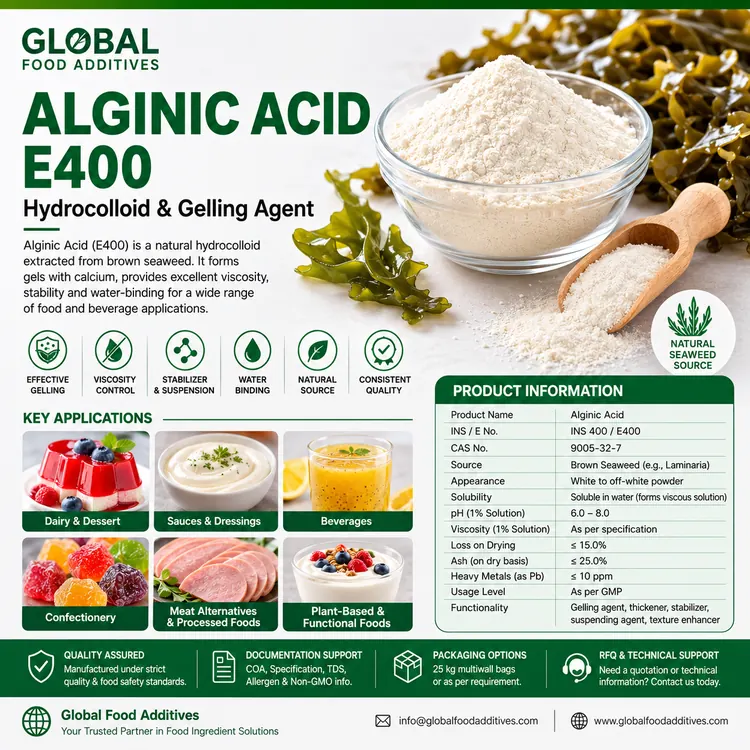
Product identity
| Product | Alginic Acid |
|---|---|
| Also known as | Algin, alginic acid polymer, acid form of alginate |
| Category | Hydrocolloids, Gums & Gelling Agents |
| Function | Thickener, stabilizer, suspension aid, water-binding agent and gelling-system component |
| E / INS number | E400 / INS 400 |
| CAS / identity | 9005-32-7 |
| Chemical nature | Anionic polysaccharide based on mannuronic acid and guluronic acid blocks |
| Typical form | Fine powder, granule, fibrous powder or instantized grade |
| Industrial selection basis | Particle size, hydration profile, viscosity, gel response, pH behaviour, ion sensitivity, purity, microbiology and regulatory documents |
Application fit
Potential use areas may include:
- Dairy systems and dairy-style desserts
- Fruit preparations, dessert gels and fillings
- Sauces, dressings, toppings and emulsified systems
- Beverages, suspensions and acidified drink systems
- Meat alternatives, seafood analogues and structured food systems
- Bakery creams, glazes, fillings and process-stable preparations
- Encapsulation, coating, film-forming and controlled-release systems
Technical purchasing notes
Alginic Acid should be evaluated by grade, not only by product name. Industrial performance depends on molecular structure, molecular-weight range, particle size, hydration speed, viscosity contribution, guluronic-to-mannuronic acid ratio, calcium response, pH environment, mixing energy, thermal history and the full food matrix. For purchasing teams, the most useful inquiry normally includes target grade, application, process conditions, viscosity target, physical form, packaging size, quantity, destination country, delivery term and document requirements.
How Alginic Acid works in food systems
Alginic Acid belongs to the alginate family of hydrocolloids extracted from brown seaweed. It is built from uronic-acid blocks that influence hydration, viscosity, ion response and gel texture. In many industrial systems, the functional behaviour of alginic acid and related alginate salts is strongly affected by calcium and other multivalent ions. This makes alginate chemistry valuable for products that need controlled thickening, suspension, gel formation, water immobilization or structured texture.
In practice, food technologists compare Alginic Acid with sodium alginate, potassium alginate, calcium alginate, pectin, carrageenan, xanthan gum, guar gum, locust bean gum, cellulose derivatives and modified starches. The correct choice depends on the required texture, processing route, pH, heat treatment, ionic environment, cost target and label expectations.
Functional performance areas
- Viscosity control: supports thickness, body and flow control in liquid or semi-solid systems.
- Suspension: helps reduce settling of particles, pulps, cocoa, minerals, fibres or insoluble ingredients.
- Gel texture: supports structured gels when used with appropriate ion systems and processing conditions.
- Water binding: helps immobilize water and reduce syneresis, purge or phase separation.
- Mouthfeel design: contributes smoothness, body and controlled texture release.
- Film and coating support: can support edible coating, encapsulation and surface-barrier concepts.
Critical formulation variables
- Target pH and acidification sequence
- Available calcium or other multivalent ions
- Hydration temperature, mixing speed and powder addition method
- Viscosity target at processing, filling, cooling and storage stages
- Heat treatment, pasteurization, sterilization or retort conditions
- Salt, sugar, protein, fat, fibre and mineral content of the formulation
- Final texture: pourable, spoonable, elastic, brittle, cohesive or firm gel
- Expected shelf life, distribution temperature and freeze-thaw exposure
Application guidance by food category
| Food system | Potential technical role | Review points before approval |
|---|---|---|
| Dairy and dairy-style desserts | Texture, body, water binding, suspension and gel-structure support | Milk protein interaction, calcium level, pH, heat treatment, cooling curve, spoonability and syneresis control |
| Fruit preparations and dessert gels | Gel formation, fruit suspension, viscosity and controlled texture | Fruit acidity, soluble solids, calcium availability, gel speed, filling temperature and storage stability |
| Sauces, dressings and toppings | Viscosity, cling, emulsion stability, suspension and mouthfeel | Oil phase, salt level, shear, pH, particle load, pumpability and pourability |
| Beverages and acidified drinks | Suspension aid, body builder and texture modifier | Hydration method, pH, mineral content, pulp or protein load, sedimentation risk and heat process |
| Meat alternatives and seafood analogues | Binding, gel network support, moisture retention and bite structure | Protein source, calcium system, thermal process, forming method, cooking loss and final bite profile |
| Bakery fillings and creams | Water control, body, filling stability and texture support | Bake stability, sugar level, acidity, pumpability, cooling behaviour and shelf-life target |
| Encapsulation and coating systems | Film formation, bead formation, barrier support and controlled release | Ion bath composition, droplet size, polymer concentration, drying process and release target |
Industrial specification checklist
A strong Alginic Acid purchasing specification should define measurable criteria. This helps R&D, QA and purchasing teams avoid substitutions that look similar on paper but perform differently in production.
Physical and chemical criteria
- Assay or identity confirmation according to supplier method
- Moisture content and loss on drying
- pH value under stated test conditions
- Particle size distribution and powder dispersibility
- Viscosity or molecular-weight range where applicable
- Ash, insoluble matter and acid-insoluble matter
- Colour, odour, taste neutrality and appearance
- Calcium response or gel-strength information where relevant
- Bulk density, flowability and dusting tendency
Food safety and compliance criteria
- Total plate count, yeast and mould, coliforms and pathogen limits
- Heavy metals, including lead, arsenic, cadmium and mercury where required
- Residual solvents or processing-aid statements where applicable
- Allergen statement and cross-contamination declaration
- GMO status and identity-preserved options where required
- Halal, kosher, vegan or other certification statements
- Country of origin, manufacturing site and traceability information
- Compliance with destination-market purity criteria and food additive regulation
Processing and handling notes
Alginic Acid and related alginate systems require careful handling because hydration, dispersion and ion exposure have a major impact on final texture. Poor powder addition may create fisheyes, agglomerates, incomplete hydration or inconsistent viscosity. For plant trials, record the water temperature, powder addition rate, mixer type, shear level, hydration time, pH adjustment stage, calcium addition point, heat process and filling temperature.
- Pre-blend with sugar, starch or other dry ingredients when suitable to improve dispersion.
- Avoid direct dumping into low-shear liquid systems unless the grade is designed for easy dispersion.
- Control calcium exposure when gel timing, viscosity or texture consistency is important.
- Validate performance under the same pH, mineral, sugar, protein and heat conditions expected in production.
- Measure viscosity at practical stages: after hydration, after heat treatment, after cooling and after storage.
- Check compatibility with preservatives, acids, proteins, salts, flavours and colour systems.
- Store closed bags in a dry, clean, cool and odour-free warehouse to prevent moisture pickup and quality loss.
Comparison with related hydrocolloids
| Ingredient | Why it may be compared | Selection note |
|---|---|---|
| Alginic Acid | Acid form of alginate used for specific hydrocolloid and ion-responsive systems | Grade selection should consider solubility, dispersion, particle size, pH and calcium response. |
| Sodium Alginate | Common water-soluble alginate salt for viscosity and calcium-set gel systems | Often preferred where fast hydration, solution viscosity and controlled calcium gelation are required. |
| Calcium Alginate | Less soluble alginate salt associated with firm gel networks and structured systems | Useful as a comparison when water-insoluble or calcium-bound alginate functionality is desired. |
| Pectin | Fruit-based gelling and stabilizing hydrocolloid | Often selected for jams, fruit preparations, acid dairy drinks and sugar/acid gel systems. |
| Carrageenan | Seaweed hydrocolloid used for dairy stabilization and gel texture | Common comparison for milk systems, desserts, processed meats and elastic gels. |
| Xanthan Gum | Cold-water viscosity, suspension and shear-thinning flow | Often compared where pourable viscosity, suspension and acid/salt tolerance are priorities. |
| Modified Starch | Cost-effective body, viscosity and water management | May be selected when opacity, body, heat stability or cost efficiency is more important than alginate gelation. |
Quality assurance and incoming inspection
For recurring industrial supply, incoming quality control should confirm that each lot matches the approved supplier specification and the customer’s trial-approved reference. Even small changes in particle size, viscosity, microbial profile or mineral content can affect hydration, gel response, pumpability and finished-product texture.
- Check product name, lot number, production date, expiry date and country of origin against the COA.
- Confirm E / INS number, CAS identity and declaration language against the approved regulatory file.
- Inspect packaging integrity, pallet condition, odour, colour, moisture exposure and foreign-material risk.
- Run a standard hydration or viscosity test using the same internal method for every incoming batch.
- Compare gel response or application performance against the approved reference sample where relevant.
- Keep retained samples for traceability, complaint handling and supplier performance review.
Documents to request
- Product specification or technical data sheet with test methods
- Certificate of analysis for the available batch or lot
- Safety data sheet where applicable
- Food-grade statement and intended-use declaration
- Origin, manufacturer, production site and traceability information
- Shelf-life, storage condition and retest-date information
- Allergen, GMO, gluten, halal, kosher and vegan statements where required
- Microbiological limits and contaminant statements
- Heavy-metal declaration according to destination-market requirements
- Label declaration guidance and E / INS number confirmation
- Packaging details, net weight, pallet configuration and container loading estimate
- Market-specific declarations required by the destination country
Packaging, logistics and storage
Alginic Acid is commonly supplied in multiwall paper bags, PE-lined bags, fibre drums, cartons or export pallet configurations depending on supplier and grade. Industrial buyers should confirm bag size, pallet type, moisture barrier, inner liner, batch coding, shelf life at dispatch, container loading quantity and whether the packaging format is suitable for food-ingredient handling in the receiving factory.
Regulatory and label review
Alginic Acid is associated with the E400 / INS 400 food additive reference, but the exact permitted use, food categories, maximum levels, purity criteria and label declaration depend on the destination market. Finished-product manufacturers should verify whether the ingredient is allowed in the intended food category and whether the correct local declaration is “Alginic Acid,” “E400,” “INS 400,” “algin,” “hydrocolloid,” “stabilizer,” “thickener” or another market-specific wording.
For export projects, buyers should align the regulatory review with the country where the final product will be sold, not only the country where the ingredient is purchased. This is especially important for multi-market products, private-label projects, infant-food restrictions, organic programs, clean-label positioning and retailer-specific additive policies.
Supplier qualification workflow
- Define the application: food category, process, target texture, pH, ion system, viscosity target and destination market.
- Share the benchmark: existing specification, COA, sample, formula note, label declaration or approved supplier reference.
- Screen documents: review TDS, COA, SDS, origin, allergen, GMO, certification, microbiology and regulatory declarations.
- Run bench trials: evaluate dispersion, hydration, viscosity, gel response, flavour neutrality, colour and stability.
- Validate plant performance: test under real mixing, heating, pumping, filling, cooling, storage and distribution conditions.
- Approve commercially: confirm final specification, packaging, lead time, minimum order quantity, incoterm and recurring documentation.
How to request this product
Send the product name, target grade or reference specification, intended application, quantity, destination country, packaging preference, expected shipment date, delivery term and required documents. If you already purchase Alginic Acid, attach or describe your existing specification, label, certificate of analysis, trial result or benchmark sample so supplier options can be compared more accurately.
Useful answers
What is Alginic Acid used for in food manufacturing?
Alginic Acid is typically discussed for viscosity, suspension, gel texture, water binding, freeze-thaw stability, stabilization and mouthfeel. Exact suitability depends on grade, particle size, application, process conditions, pH, ion system, regulations and supplier documents.
Is Alginic Acid water soluble?
Alginic Acid behaves differently from more soluble alginate salts such as sodium alginate. Solubility, hydration and dispersion must be checked against the specific grade and process. If rapid solution viscosity is required, related alginate salts may need to be evaluated alongside Alginic Acid.
Can Alginic Acid form gels?
Alginate-family ingredients can form gels through interaction with multivalent ions, especially calcium. The final gel strength, speed and texture depend on grade, ion concentration, pH, solids, mixing, temperature and the full food matrix.
Can Global Food Additives source Alginic Acid?
Global Food Additives can review sourcing options for Alginic Acid according to target specification, application, quantity, destination, packaging, delivery term and required documentation.
Which documents should be requested?
Buyers commonly request a technical data sheet or specification, certificate of analysis, safety data sheet where applicable, origin statement, shelf-life information, allergen and GMO declarations, microbiological limits, heavy-metal information, label guidance and packing details.
Is this product permitted in every country?
No. Food additive use depends on destination-market rules, food category, use level, label requirements, purity criteria and buyer responsibility. Always verify local regulation before commercial use.
Tell us which food additive or ingredient you need.
Send product names, target specifications, quantity, destination country, packaging preference, delivery term, and document requirements. Our team will review your inquiry and respond from orders@foodgradeadditives.com.
Your message has been received. You will be redirected to the home page.