
Ammonia Caramel
Ammonia Caramel, also known as Class III caramel colour or E150c, is a food-grade brown colour used by industrial food and beverage manufacturers for shade development, colour standardisation, visual identity, batch-to-batch correction and finished-product appearance consistency. It is especially relevant where brown, reddish-brown or dark amber tones are required in products such as beer, malt beverages, sauces, gravies, confectionery, dairy desserts, savoury snacks and cooked-flavour systems.
This page is prepared as a practical sourcing and technical review guide for purchasing teams, R&D technologists, QA departments, regulatory teams and import managers who need to compare colour strength, shade, physical form, stability, documentation and supplier suitability before requesting a quotation or approving a new source.
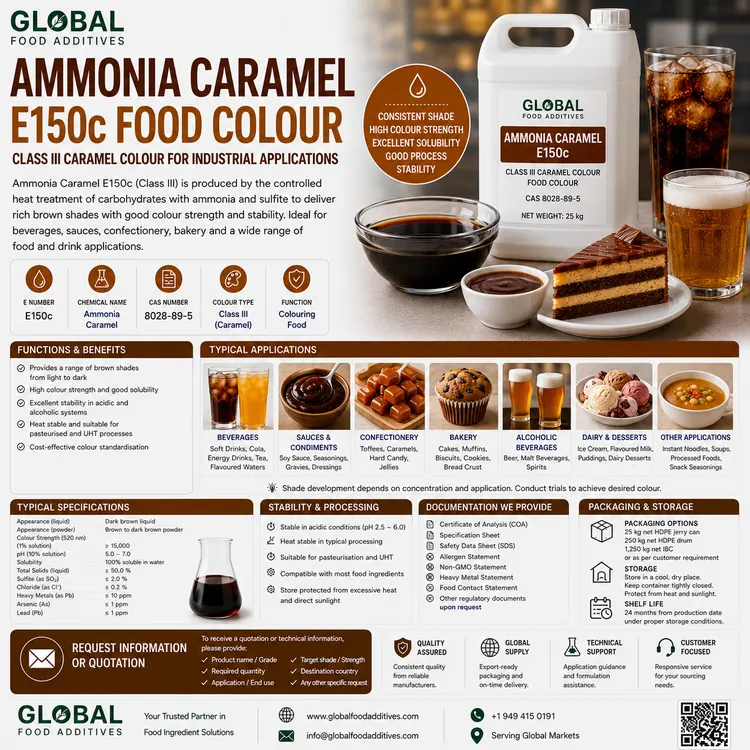
Product identity
| Product | Ammonia Caramel |
|---|---|
| Common names | Class III caramel colour, Caramel III, ammonia caramel colour, beer caramel, confectionery caramel |
| Category | Colours & Colouring Foods |
| Function | Food colour / colour standardisation ingredient / shade correction system |
| E / INS number | E150c / INS 150c |
| CAS / identity | 8028-89-5 |
| Caramel class | Class III ammonia caramel |
| Typical form | Liquid, powder, granule, dispersion or application-specific colour grade |
| Typical colour range | Amber, red-brown, dark brown or brown-black depending on grade and dosage |
| Typical grade focus | Food grade, beverage grade, sauce grade, confectionery grade or customer-specific colour-strength grade |
Application fit
Ammonia Caramel is evaluated where a stable brown tone, consistent shade and controlled colour intensity are required. Actual suitability depends on pH, alcohol content, salt level, protein content, processing temperature, packaging, storage exposure and regulatory requirements.
- Beer, malt beverages and selected alcoholic beverage systems
- Carbonated or non-carbonated beverages after stability validation
- Confectionery, toffees, fillings, coatings and syrups
- Dairy desserts, puddings, creams and flavoured milk systems
- Sauces, gravies, marinades, dressings and condiments
- Snack seasonings, savoury coatings and dry seasoning blends
- Bakery fillings, glazes, toppings and cooked-colour systems
- Plant-based, meat alternative and culinary products needing roasted or brown visual identity
Technical function in food and beverage systems
Ammonia Caramel is produced through controlled heat treatment of food carbohydrates in the presence of ammonium compounds. The result is a complex mixture of caramelized colour bodies designed to provide brown colour in food applications. Unlike simple caramel flavour or confectionery caramel, industrial caramel colour is primarily selected for colour performance, standardization capability, process compatibility and regulatory compliance.
In finished products, E150c can help correct natural raw-material colour variation, replace colour lost during processing, support brand-standard shade targets, improve consumer-recognized appearance and provide consistent visual identity across production batches. The selected grade should be matched to the food matrix because caramel colour performance depends on colloidal behavior, pH, ionic strength, protein interaction, alcohol level and thermal process conditions.
Key functional properties
- Colour standardisation: Helps manufacturers keep target shade consistent across raw-material, seasonal and process variations.
- Shade development: Provides amber, red-brown, dark brown or roasted-brown tones depending on grade and dosage.
- Visual identity: Supports product recognition in beer, sauces, gravies, snacks, confectionery and dessert systems.
- Process compatibility: Can be selected for stability in heat-treated, pasteurized, retorted, dry-blended or hot-filled systems after validation.
- Cost-in-use optimization: High colour-strength grades may reduce dosage while maintaining target appearance.
- Batch correction: Useful for small colour adjustments when production shade is outside specification.
Process variables to control
- Target shade standard and acceptable colour tolerance
- pH, acidity, alcohol level and salt concentration of the food matrix
- Heat process, pasteurization, retort exposure or hot-fill temperature
- Protein, tannin, starch, gum and mineral interaction
- Order of addition and dilution water quality
- Filtration, homogenization, carbonation or high-shear processing
- Packaging format, oxygen exposure and light exposure
- Shelf-life conditions, storage temperature and colour drift over time
Industrial formulation guidance
In industrial production, the best Ammonia Caramel grade is the one that meets both visual and processing requirements. A beverage manufacturer may prioritize clarity, shade and pH stability, while a sauce producer may prioritize heat stability, salt tolerance and deep brown colour strength. A dry seasoning blender may need powder flowability, low dusting and uniform dispersion. For this reason, purchasing teams should request application-specific guidance and evaluate samples in the real product matrix before approving a shipment.
Recommended use evaluation
- Define the required colour target using a physical standard, digital colour value or retained product sample.
- Confirm whether the required shade is amber, red-brown, roasted brown, dark brown or black-brown.
- Test the material in the actual formula, not only in water dilution.
- Measure colour before and after heat treatment, filling, cooling and storage.
- Check clarity, haze, sediment, ring formation or flocculation in beverage systems.
- Evaluate flavour impact, especially at higher dosage levels or in mild-flavour products.
- Confirm label declaration and permitted use for the destination market.
Common processing risks
- Shade mismatch: Two E150c grades can have different hue and colour strength even when both are food grade.
- Flocculation: Incompatible charge or matrix conditions may create haze, precipitation or sediment.
- Colour drift: Heat, pH, oxygen, light or long storage may shift final shade in sensitive products.
- Overdosing: Excess colour can darken the product, increase bitterness or affect flavour balance.
- Powder dispersion issues: Poor dry blending or hydration can create specks, streaks or uneven colour.
- Regulatory mismatch: E150c permission, use level and labeling may vary by country and food category.
Application-specific value
Ammonia Caramel is used across multiple food categories where product appearance is directly connected to perceived flavour, quality and brand identity. It may be compared with other caramel colour classes, cocoa powder, malt extract, roasted sugar systems, natural extracts or certified colours depending on label strategy, colour shade, regulatory status and cost-in-use.
Beverages and beer
- Supports amber to dark brown shade development in beer, malt beverages and selected beverage systems.
- Helps correct natural colour variation caused by raw materials, brewing conditions or processing.
- Requires validation for haze, ring formation, precipitation, carbonation, alcohol compatibility and pH stability.
- Colour should be checked after pasteurization, filtration, storage and exposure to light.
Sauces, gravies and condiments
- Provides roasted, cooked, savoury or dark brown appearance in sauces, gravies, marinades and condiments.
- Can help maintain consistent appearance despite variation in tomato paste, spices, hydrolyzed proteins or seasoning bases.
- Should be tested for salt stability, acid stability, heat treatment, viscosity interaction and packaging shelf life.
- Useful for visual standardization in private-label and export products requiring repeatable colour.
Confectionery and desserts
- Supports brown colour in candies, toffees, fillings, coatings, syrups, puddings and dairy desserts.
- Can reinforce caramel, cocoa, coffee, malt or cooked-sugar visual profiles.
- Dosage should be balanced with flavour intensity, sweetness, dairy proteins and fat phase behavior.
- Finished products should be checked for shade uniformity, heat stability and storage colour drift.
Snacks and dry seasoning systems
- Powder grades can support uniform colour in snack coatings, dry blends, spice mixes and savoury powders.
- Can improve the visual impact of barbecue, roasted meat, soy, gravy, malt or brown sauce profiles.
- Requires testing for dusting, particle distribution, carrier compatibility and colour release during application.
- Moisture control is important for powder flow, caking prevention and shelf-life stability.
Typical specification points to review
For industrial purchasing, the most useful comparison is not simply price per kilogram. Ammonia Caramel grades may differ in colour intensity, hue, pH, specific gravity, dry solids, viscosity, particle size, stability profile and regulatory documentation. Buyers should request the supplier’s actual specification and COA before approval.
Technical parameters
| Colour intensity | Key value for comparing cost-in-use; confirm test method, dilution, wavelength and absorbance basis. |
|---|---|
| Hue index / shade | Important for matching amber, red-brown, dark brown or black-brown target colours. |
| Appearance | Liquid, powder, granule or dispersion; should be visually consistent and free from foreign matter. |
| pH | Relevant for compatibility with acidic beverages, sauces, dairy desserts and savoury systems. |
| Specific gravity | Important for liquid grades, dosing systems, pump calibration and inventory control. |
| Viscosity | Affects pumping, metering, mixing, dilution and handling in industrial plants. |
| Dry solids / Brix | Useful for comparing concentration, water contribution and storage behavior. |
| Particle size | Important for powder grades used in dry blends, seasonings and instant systems. |
| Total nitrogen | Relevant identity and specification parameter for ammonia-process caramel colour. |
| 4-MEI / process markers | Request limits and test results where required by regulation, customer policy or destination market. |
| Heavy metals | Should comply with food-grade and destination-market limits. |
| Microbiology | Review according to product form, water activity, packaging and buyer requirements. |
Commercial parameters
| Packaging | Liquid grades may be supplied in drums, IBCs or bulk; powder grades may be supplied in bags, cartons or drums. |
|---|---|
| Net weight | Confirm available pack sizes according to supplier, form, origin and destination logistics. |
| Palletization | Confirm pallet type, container loading, wrapping, stacking limitations and moisture protection. |
| Shelf life | Confirm from supplier documents; depends on form, dry solids, packaging and storage conditions. |
| Storage | Store tightly closed in a clean, dry, cool and well-ventilated area away from excessive heat, light and contamination. |
| Handling | Liquid grades may require mixing before use; powder grades require dust and moisture control. |
| MOQ | Depends on grade, supplier stock, production schedule, packaging format and shipment route. |
| Lead time | Depends on sample approval, production, documentation, inspection, booking and freight availability. |
| Cost-in-use | Compare delivered colour strength and dosage efficiency, not only kilogram price. |
Quality, food safety and compliance notes
Ammonia Caramel for food manufacturing should be purchased only with clear food-grade documentation, traceability and regulatory support. The buyer should verify that the material is suitable for the intended food category, destination market, customer standard and finished-product label. Where the product will be used in export, retail, private-label or customer-branded production, regulatory confirmation should be completed before commercial use.
QA team checklist
- Confirm product name, caramel class, E/INS number, CAS identity and food-grade status.
- Compare supplier specification with internal purchasing and application requirements.
- Review actual batch COA before shipment or release.
- Check colour intensity, hue, pH, solids, viscosity and other agreed release parameters.
- Confirm microbiological limits, heavy metals and process-related markers where required.
- Verify allergen, GMO, halal, kosher, vegan or other buyer-required statements where applicable.
- Check production date, expiry date, batch number, label information and packaging integrity.
- Run application trials before changing supplier, grade, form or dosage.
Regulatory review points
- Destination-market permission for E150c / INS 150c in the relevant food category
- Maximum use level, GMP principle or customer-specific limit where applicable
- Finished-product labeling name, additive class and E-number declaration
- Requirements for 4-MEI, process contaminants or other marker compounds where applicable
- Import documentation, customs description and local registration requirements
- Customer standards, retailer restricted lists and clean-label or natural-positioning policy
- Finished-product colour stability, consumer acceptance and compliance responsibility
Documents to request
A complete Ammonia Caramel inquiry should include both technical and commercial document requirements. This helps reduce delays during supplier qualification, sample approval, customer audits, customs clearance and first production trials.
Core documents
- Product specification or technical data sheet
- Certificate of analysis for available batch or representative lot
- Safety data sheet
- Food-grade statement or regulatory compliance declaration
- Statement confirming caramel class and E/INS identity
- Origin statement and manufacturer information where available
- Shelf-life and recommended storage conditions
- Product label, packaging details and pallet configuration
Optional buyer-specific documents
- Halal certificate, kosher certificate or other market-specific certification
- Allergen statement and cross-contamination declaration
- GMO status declaration
- Vegan or vegetarian suitability statement where required
- Heavy metal statement or contaminant declaration
- 4-MEI declaration or test result where required
- Microbiological specification and pathogen statement
- Residual solvent, carrier or processing-aid statement where applicable
- Country-specific import, customs or registration documents
How to request this product
Send the product name, target caramel class, required form, colour strength, shade target, application, quantity, destination country, packaging preference, delivery term, expected shipment date and required documents. If you already purchase Ammonia Caramel, attach or describe your existing specification, label, certificate of analysis, colour standard or finished-product target so supplier options can be compared more accurately.
Information that improves quotation accuracy
- Target application and finished-product type
- Required E number or caramel class, such as E150c / Class III
- Liquid or powder requirement
- Colour intensity, hue index or reference colour standard
- Target dosage range or current use level
- Required annual volume and first-order quantity
- Preferred packaging size and pallet requirement
- Destination port, warehouse or delivery city
- Required Incoterms such as EXW, FOB, CFR, CIF or DAP
- Required certificates and destination-market declarations
- Sample quantity and expected approval timeline
Supplier comparison criteria
- Food-grade documentation completeness
- Consistency of colour intensity and hue between batches
- Application stability in the buyer’s real food matrix
- Compliance with process-marker and contaminant requirements
- Packaging strength, leakage protection and moisture control
- Batch traceability and shelf-life remaining at shipment
- Export experience and document responsiveness
- Total landed cost and performance cost-in-use
Useful answers
What is Ammonia Caramel used for in food manufacturing?
Ammonia Caramel E150c is used as a food colour for brown shade development, colour standardisation, visual identity and batch correction in selected beverages, beer, sauces, confectionery, dairy desserts, snacks and savoury products.
What does E150c mean?
E150c refers to Class III ammonia caramel colour. It is different from E150a plain caramel, E150b sulfite caramel and E150d sulfite ammonia caramel. The correct caramel class should be selected according to application, stability needs, regulatory requirements and finished-product label expectations.
Is Ammonia Caramel the same as caramel flavour?
No. Ammonia Caramel is primarily a colour additive used for visual appearance and standardisation. Caramel flavour is selected mainly for taste and aroma. Some caramel colours may have mild flavour impact at higher use levels, so sensory testing is still recommended.
Which technical parameters should be checked before purchasing?
Buyers should compare colour intensity, hue, pH, specific gravity or bulk density, viscosity, dry solids, total nitrogen, process-marker declarations where required, microbiological limits, heavy metals, packaging type, shelf life and destination-market compliance.
Can Global Food Additives source Ammonia Caramel?
Global Food Additives can review sourcing options for Ammonia Caramel according to target specification, colour strength, shade, form, application, quantity, destination, packaging preference, delivery term and required documentation.
Which documents should be requested?
Buyers commonly request a technical data sheet, product specification, certificate of analysis, safety data sheet, food-grade statement, origin statement, allergen or GMO declaration where required, shelf-life information, label details and packing configuration.
Is this product permitted in every country?
No. Food colour use depends on destination-market rules, food category, use level, label requirements and buyer responsibility. The buyer should confirm local regulations and customer standards before commercial use.
What should be tested during factory trials?
Factory trials should evaluate shade match, colour intensity, dispersion, heat stability, pH stability, salt stability, alcohol stability, haze, sedimentation, flavour impact, storage colour drift, packaging compatibility and finished-product label compliance.
Tell us which food additive or ingredient you need.
Send product names, target specifications, quantity, destination country, packaging preference, delivery term, and document requirements. Our team will review your inquiry and respond from orders@foodgradeadditives.com.
Your message has been received. You will be redirected to the home page.