
Ammonium Alginate
Ammonium Alginate is a food-grade alginate hydrocolloid used by industrial food manufacturers for viscosity control, suspension, stabilization, water binding, gel-system design, texture improvement and mouthfeel optimization. It is especially relevant where formulators need a seaweed-derived polysaccharide system that can support body, flow control and stability across selected aqueous food matrices.
This page is prepared as a technical sourcing reference for purchasing teams, R&D technologists, QA departments, import managers and production teams who need to compare grades, documentation, functionality, application fit and quotation requirements before supplier approval.
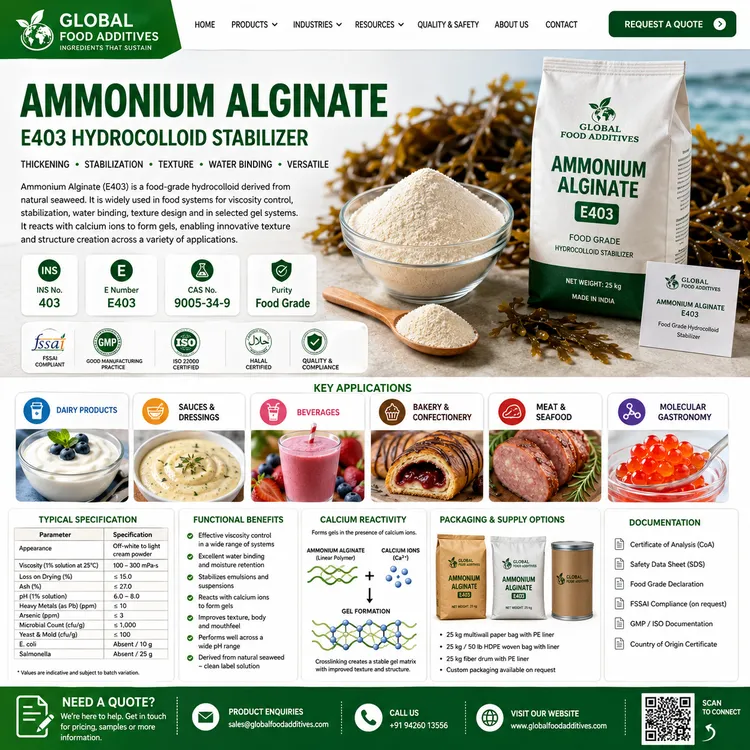
Product identity
| Product | Ammonium Alginate |
|---|---|
| Alternative names | Alginate ammonium salt, alginic acid ammonium salt |
| Category | Hydrocolloids, Gums & Gelling Agents |
| Function | Thickener / stabilizer / water-binding hydrocolloid / texture modifier / gelling-system ingredient |
| E / INS number | E403 |
| CAS / identity | 9005-34-9 |
| Material type | Ammonium salt of alginic acid, a polysaccharide hydrocolloid derived from brown seaweed |
| Typical form | Fine powder, granule or instantized dispersible grade |
| Typical grade focus | Food grade, viscosity-controlled grade or application-specific hydrocolloid grade |
Application fit
Ammonium Alginate is evaluated where controlled hydration, viscosity build, suspension, texture design and water management are important. Actual suitability depends on pH, calcium level, shear, temperature, solids, order of addition and target processing conditions.
- Dairy systems, cultured products and dessert bases
- Puddings, creams, fillings, gels and spoonable desserts
- Sauces, dressings, condiments and culinary preparations
- Beverage systems requiring body, suspension or cloud stability
- Fruit preparations, toppings, bakery fillings and glaze systems
- Meat alternatives and plant-based texture systems
- Low-fat or reduced-sugar formulations requiring mouthfeel correction
- Restructured or formed food systems where alginate functionality may support shape retention
Technical function in food systems
Ammonium Alginate belongs to the alginate family of hydrocolloids. In water-based formulations, it can hydrate and contribute viscosity, body, suspension and texture. In systems containing available calcium ions, alginate chains may participate in calcium-mediated network formation, which can be useful for gel texture, particle entrapment, shape retention or controlled structural development. The final behavior depends strongly on grade selection and process design.
Key functional properties
- Viscosity control: Helps build body and flow resistance in aqueous food systems.
- Suspension: Supports distribution of pulp, cocoa, protein particles, spices, fibers or insoluble ingredients.
- Water binding: Can help reduce free water, improve texture and support product stability.
- Texture modification: Contributes to smoothness, thickness, spoonability and mouthfeel.
- Gel-system support: May participate in calcium-reactive systems where controlled gelation is required.
- Film and coating potential: Can be considered in selected edible coating, encapsulation or surface-treatment concepts after validation.
- Stabilization: Helps improve physical stability in sauces, dressings, desserts and selected beverages.
Process variables to control
- Powder dispersion before hydration to prevent lumping or fish-eyes
- Hydration temperature, mixing speed and mixing time
- pH and acid addition sequence
- Calcium salts, dairy minerals or other divalent ions in the formula
- Sugar, salt and soluble-solids concentration
- Thermal treatment, pasteurization, cooling and post-process shear
- Compatibility with proteins, starches, pectins, gums, emulsifiers and preservatives
- Final viscosity after processing, filling, storage and distribution
Industrial formulation guidance
In industrial production, Ammonium Alginate should be selected by functional grade rather than product name alone. Two suppliers may offer the same additive name, but the materials can behave differently because of viscosity grade, particle size, alginate composition, hydration rate, moisture, ash profile and microbial specification. For this reason, application trials and specification comparison are important before commercial approval.
Recommended use evaluation
- Define the target function: thickening, stabilization, water binding, suspension, gel formation or texture correction.
- Confirm the food matrix: dairy, fruit, beverage, sauce, filling, plant-based, meat alternative or dry blend.
- Check whether the formula contains calcium, acids, phosphates, proteins, salts or high sugar levels.
- Test dispersion method in pilot scale before factory introduction.
- Measure viscosity at defined temperature, spindle, shear rate and time after hydration.
- Evaluate stability after heat treatment, cooling, storage, transport and freeze-thaw exposure where relevant.
Common processing risks
- Lumping: Poor dry dispersion can create partially hydrated particles and inconsistent viscosity.
- Over-gelation: Excess available calcium may cause premature structure formation or process instability.
- Under-hydration: Short mixing time or poor water availability can reduce performance.
- Viscosity drift: Final texture may change after holding, heat treatment, cooling or storage.
- pH sensitivity: Acidic conditions can change hydration behavior and stability, depending on the system.
- Batch variation: Hydrocolloid performance must be controlled through supplier specification and incoming QC.
Application-specific value
Ammonium Alginate can provide value in multiple food categories when the correct grade and process are selected. It is typically reviewed against other hydrocolloids such as sodium alginate, calcium alginate, pectin, carrageenan, xanthan gum, guar gum, locust bean gum, cellulose derivatives or starch systems. The best choice depends on required texture, label expectations, regulatory status, cost-in-use and manufacturing conditions.
Dairy and dessert systems
- Improves body, creaminess and spoonable texture in selected dairy-style systems.
- Supports water management and helps reduce syneresis in suitable formulations.
- Can assist suspension of cocoa, fruit, protein, minerals or insoluble ingredients.
- Requires compatibility testing with milk minerals, calcium, proteins, acids and heat treatment.
Sauces, dressings and fillings
- Helps build viscosity and cling in pourable or spoonable systems.
- Supports uniform distribution of herbs, spices, pulp, particulates or oil droplets.
- May improve freeze-thaw or storage stability depending on formula design.
- Requires evaluation under pasteurization, hot-fill, cold-fill and shear conditions.
Beverages and suspensions
- Can improve mouthfeel, body and suspension in selected beverage systems.
- Useful where pulp, cocoa, minerals, fiber or protein particles require stabilization.
- Hydration and filtration behavior should be checked in industrial processing.
- Compatibility with acidity, preservatives, minerals and thermal treatment must be validated.
Meat alternatives and structured foods
- May support binding, moisture retention and texture development in plant-based systems.
- Can be considered in formed, restructured or gel-assisted product concepts.
- Performance depends on protein type, fiber, oil, salts, calcium source and cooking process.
- Factory trials should evaluate bite, juiciness, cooking yield and shape retention.
Typical specification points to review
For industrial purchasing, the most valuable inquiry compares technical performance and quality documentation, not only price per kilogram. Ammonium Alginate is often bought according to viscosity grade, particle size, hydration behavior and application suitability. Buyers should request the supplier’s actual specification and compare it with their internal standard before approval.
Technical parameters
| Viscosity grade | One of the most important selection criteria; confirm test method, concentration, temperature and instrument conditions. |
|---|---|
| Appearance | Typically light-colored powder or granules; confirm color and absence of visible foreign matter. |
| Particle size | Affects dispersion, hydration speed, dusting, dry blending and process consistency. |
| Moisture / loss on drying | Important for shelf life, flowability and active solids comparison. |
| pH | Relevant for compatibility with acidic, dairy, beverage and gel systems. |
| Ash / mineral content | Useful for comparing alginate source and ionic profile. |
| Insoluble matter | Important for beverage, sauce, smooth texture and filtration-sensitive systems. |
| Heavy metals | Should comply with food-grade and destination-market limits. |
| Microbiology | Review total plate count, yeast and mold, coliforms and pathogens according to buyer requirement. |
| Gel or calcium reactivity | Relevant where gelation, structure formation or calcium interaction is part of the application. |
Commercial parameters
| Packaging | Commonly supplied in multi-layer bags, cartons, drums or PE-lined packaging depending on supplier and grade. |
|---|---|
| Net weight | Often requested in industrial pack sizes such as 20 kg or 25 kg; confirm exact supplier format. |
| Palletization | Confirm bag count, pallet type, stretch wrapping, container load and moisture protection. |
| Shelf life | Confirm from supplier documents; depends on grade, packaging and storage conditions. |
| Storage | Store tightly closed in a clean, dry, cool and well-ventilated area away from moisture and strong odors. |
| MOQ | Depends on supplier, stock position, origin, packaging and destination logistics. |
| Lead time | Depends on production schedule, documentation, sample approval, inspection and freight route. |
| Cost-in-use | Compare performance dosage, viscosity yield and process stability rather than kilogram price alone. |
Quality, food safety and compliance notes
Ammonium Alginate for food manufacturing should be purchased only with clear food-grade documentation and supplier traceability. The buyer should verify that the material is suitable for the target food category, process, labeling requirement and destination market. Where the product will be used for export, private label or customer-specific production, regulatory confirmation should be completed before commercial use.
QA team checklist
- Confirm product name, CAS number, E/INS reference and food-grade status.
- Compare supplier specification with the internal purchasing specification.
- Check actual batch certificate of analysis before shipment or release.
- Verify viscosity method and acceptance range used by the supplier.
- Review microbiological limits and contaminant declarations.
- Confirm allergen, GMO, halal, kosher, vegan or other buyer-required statements where applicable.
- Check production date, expiry date, batch number, label and packaging integrity.
- Conduct incoming QC and application trials before changing source or grade.
Regulatory review points
- Destination-market additive permission and food-category restrictions
- Maximum use level, quantum satis rule or customer-specific limit where applicable
- Finished-product labeling name, additive class and E/INS declaration
- Local import requirements and customs classification support
- Customer standards, retailer policies and clean-label expectations
- Finished-product stability, safety and compliance responsibility
Documents to request
A complete Ammonium Alginate inquiry should include both technical and commercial document requirements. This helps avoid delays during supplier qualification, sample approval, customs clearance, customer audits and first production trials.
Core documents
- Product specification or technical data sheet
- Certificate of analysis for available batch or representative lot
- Safety data sheet
- Food-grade statement or regulatory compliance declaration
- Origin statement and manufacturer information where available
- Shelf-life and recommended storage conditions
- Product label, packaging details and pallet configuration
Optional buyer-specific documents
- Halal certificate, kosher certificate or other market-specific certification
- Allergen statement and cross-contamination declaration
- GMO status declaration
- Vegan or vegetarian suitability statement where required
- Heavy metal statement or contaminant declaration
- Microbiological specification and pathogen statement
- Residual solvent or processing-aid statement where required
- Country-specific import, customs or registration documents
How to request this product
Send the product name, target grade or reference specification, required viscosity range, application, quantity, destination country, packaging preference, delivery term, expected shipment date and required documents. If you already purchase Ammonium Alginate, attach or describe your existing specification, label, certificate of analysis or trial result so supplier options can be compared more accurately.
Information that improves quotation accuracy
- Target application and final product type
- Required viscosity grade and test method, if available
- Required annual volume and first-order quantity
- Preferred packaging size and pallet requirement
- Destination port, warehouse or delivery city
- Required Incoterms such as EXW, FOB, CFR, CIF or DAP
- Target specification, customer standard or reference COA
- Required certificates and destination-market declarations
- Sample quantity and expected approval timeline
Supplier comparison criteria
- Food-grade documentation completeness
- Consistency of viscosity and hydration behavior
- Particle size suitability for dry blending or direct hydration
- Microbiological and contaminant control
- Packaging strength and moisture protection
- Batch traceability and shelf-life remaining at shipment
- Export experience and document responsiveness
- Total landed cost and performance cost-in-use
Useful answers
What is Ammonium Alginate used for in food manufacturing?
Ammonium Alginate is used as a hydrocolloid for viscosity control, stabilization, suspension, water binding, texture improvement and selected gel-system development. It may be evaluated in dairy systems, desserts, sauces, beverages, fillings, dressings and meat alternative applications.
How does Ammonium Alginate work?
Ammonium Alginate hydrates in water and can increase viscosity, improve body and help stabilize dispersed ingredients. In systems containing available calcium, alginate chains may contribute to gel or network formation. The final effect depends on grade, calcium level, pH, solids, shear, temperature and processing sequence.
Is Ammonium Alginate the same as Sodium Alginate?
No. Both belong to the alginate family, but they are different salts and can behave differently in formulation. Buyers should not replace one with the other without checking regulatory status, viscosity, hydration, pH behavior, mineral interaction and finished-product performance.
Which technical parameters should be checked before purchasing?
Buyers should compare viscosity grade, particle size, moisture, pH, ash, insoluble matter, heavy metals, microbiological limits, appearance, solubility, calcium reactivity where relevant, packaging type, shelf life and food-grade compliance.
Can Global Food Additives source Ammonium Alginate?
Global Food Additives can review sourcing options for Ammonium Alginate according to target specification, viscosity grade, application, quantity, destination, packaging preference, delivery term and required documentation.
Which documents should be requested?
Buyers commonly request a technical data sheet, product specification, certificate of analysis, safety data sheet, food-grade statement, origin statement, allergen or GMO declaration where required, shelf-life information, label details and packing configuration.
Is this product permitted in every country?
No. Food additive use depends on destination-market rules, food category, use level, label requirements and buyer responsibility. The buyer should confirm local regulations and customer standards before commercial use.
What should be tested during factory trials?
Factory trials should evaluate dispersion, hydration time, viscosity, lump formation, heat stability, pH stability, calcium interaction, suspension, syneresis, texture, mouthfeel, filling behavior, shelf-life stability and compatibility with other hydrocolloids or functional ingredients.
Tell us which food additive or ingredient you need.
Send product names, target specifications, quantity, destination country, packaging preference, delivery term, and document requirements. Our team will review your inquiry and respond from orders@foodgradeadditives.com.
Your message has been received. You will be redirected to the home page.