
Beta-Amylase
Beta-Amylase is a food-grade maltose-forming enzyme preparation used by industrial food, brewing, bakery, cereal and starch-processing manufacturers for controlled starch hydrolysis, fermentable sugar development, process efficiency and carbohydrate profile adjustment. It is especially relevant where formulators need maltose generation from gelatinized starch, improved wort fermentability, controlled dough fermentation, cereal sweetness development or specific starch-conversion performance.
This page is prepared as a technical sourcing reference for purchasing teams, R&D technologists, production managers, QA departments, regulatory teams and import managers who need to compare enzyme activity, activity unit, source, process range, stability, carrier system, documentation, packaging and supplier suitability before quotation or approval.
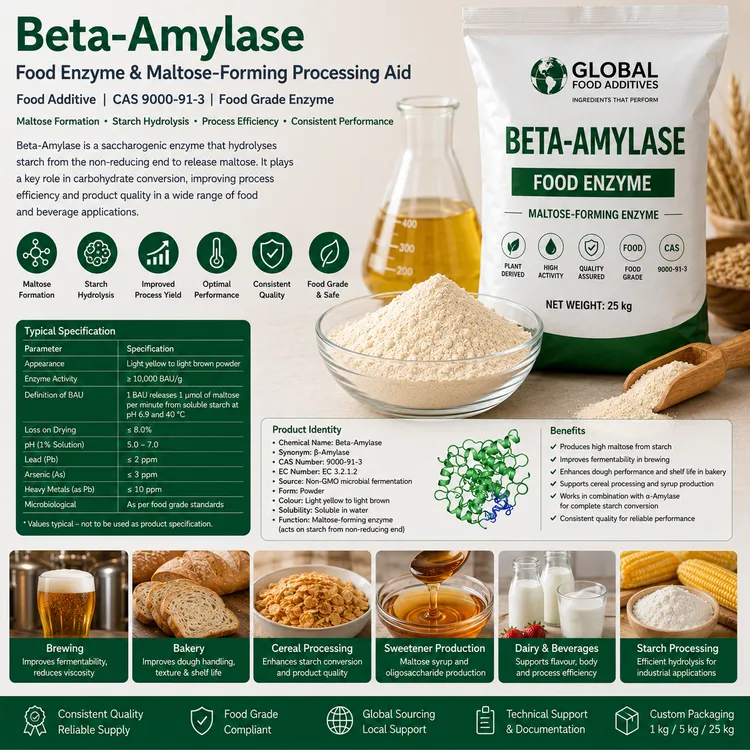
Product identity
| Product | Beta-Amylase |
|---|---|
| Common names | β-amylase, beta amylase, saccharogenic amylase, maltose-forming amylase, starch hydrolysis enzyme |
| Category | Enzymes & Processing Aids |
| Function | Food enzyme / processing aid / maltose-forming starch hydrolysis enzyme / carbohydrate conversion ingredient |
| E / INS number | Confirm by destination market and supplier documentation |
| CAS / identity | 9000-91-3 |
| Enzyme action | Exo-acting amylase that releases maltose from non-reducing ends of suitable starch-type substrates under controlled process conditions |
| Possible source | Cereal, plant, microbial or supplier-defined enzyme source depending on grade, production method and market rules |
| Typical form | Liquid enzyme preparation, powder, granulate, stabilized dry blend, tablet or custom enzyme preparation |
| Typical grade focus | Food grade, brewing grade, bakery grade, cereal processing grade, starch-processing grade, maltose syrup grade or customer-specific enzyme blend |
Application fit
Beta-Amylase is evaluated where controlled starch conversion and maltose formation are required. Suitability depends on starch gelatinization, substrate accessibility, enzyme source, activity level, pH, temperature, holding time, moisture, process shear, enzyme inactivation and local food-enzyme rules.
- Bakery, dough systems, malted flour systems and controlled fermentation support
- Brewing, distilling, malt processing, mashing and wort fermentability adjustment
- Starch processing, maltose syrup production and carbohydrate conversion systems
- Cereal processing, breakfast cereals, extruded grains and cereal-based beverages
- Plant-based drinks, cereal-based dairy alternatives and grain-based nutritional bases
- Sweetener, syrup and ingredient-manufacturing processes where permitted
- Fermented food and beverage systems where maltose generation supports process goals
- Enzyme blends with alpha-amylase, pullulanase, glucoamylase or protease where compatible and permitted
Technical function in food systems
Beta-Amylase hydrolyses suitable starch-type chains from the non-reducing ends and releases maltose units under appropriate process conditions. In practical manufacturing, this makes it useful for controlled maltose formation rather than random internal starch breakdown. It is often considered when the target is fermentable sugar generation, sweetness profile adjustment, improved starch conversion or specific carbohydrate distribution.
Beta-Amylase performance depends strongly on substrate preparation. Native ungelatinized starch may be less accessible than gelatinized, cooked or mechanically opened starch. In many industrial processes, beta-amylase is evaluated together with other enzymes because alpha-amylase can open starch chains, pullulanase can details branch points and glucoamylase can generate glucose. The right enzyme system depends on whether the target is maltose, glucose, dextrin reduction, fermentability, viscosity control or flavour development.
Key functional properties
- Maltose formation: Supports controlled generation of maltose from suitable starch and dextrin substrates.
- Fermentability support: Useful where maltose contributes to yeast fermentation, brewing performance or cereal fermentation design.
- Sweetness profile control: Can help develop mild sweetness from starch-derived carbohydrates in selected systems.
- Starch conversion: Supports carbohydrate conversion in mashing, cereal processing, syrup production and grain-based systems.
- Process efficiency: May improve conversion yield, reduce process variability and support consistent batch performance.
- Blend flexibility: Can be evaluated with alpha-amylase, pullulanase, glucoamylase or other enzymes where permitted.
- Processing-aid role: In many applications it is used for manufacturing performance, with final labelling dependent on local rules and enzyme carry-over.
Process variables to control
- Starch source, starch damage, gelatinization and substrate accessibility
- Enzyme activity unit, dosage basis and supplier assay method
- pH range, buffer capacity and acid or alkaline processing conditions
- Temperature profile, holding time and enzyme thermal stability
- Moisture content, water activity and mixing uniformity
- Calcium, salts, sugars, minerals, preservatives and enzyme inhibitors
- Compatibility with other enzymes in the same process
- Enzyme deactivation step, residual activity and finished-product requirements
Enzyme selection and formulation guidance
For industrial purchasing and R&D work, Beta-Amylase should be selected by activity, source, process fit and application result rather than product name alone. Two enzyme preparations may both be sold as Beta-Amylase but differ in activity units, pH profile, temperature tolerance, side activities, carrier system, liquid or dry form, allergen status, GMO status, fermentation-derived components, storage stability and regulatory documentation.
Recommended use evaluation
- Define the target function: maltose generation, fermentability, starch conversion, sweetness profile, viscosity reduction or process yield.
- Confirm enzyme source, activity unit, assay method and activity level before comparing suppliers.
- Test the enzyme in the real substrate and process, not only in a laboratory starch solution.
- Evaluate pH, temperature, holding time, moisture and enzyme deactivation conditions.
- Measure maltose, glucose, dextrin profile, viscosity, fermentability, sensory impact or process yield as relevant.
- Check interaction with alpha-amylase, glucoamylase, pullulanase, protease or other processing enzymes.
- Confirm food-enzyme regulatory status, processing-aid classification and label impact before commercial use.
Common processing risks
- Poor substrate access: Insufficient gelatinization or starch damage can limit enzyme performance.
- Wrong enzyme profile: Beta-Amylase is not a direct substitute for alpha-amylase, glucoamylase or maltogenic amylase.
- Temperature mismatch: Enzyme activity and stability may drop quickly outside the supplier-defined process range.
- Incomplete inactivation: Residual enzyme activity can change texture, sweetness or carbohydrate profile during storage.
- Side activity impact: Some enzyme preparations may contain side activities that affect viscosity, flavour or clarity.
- Regulatory mismatch: Food-enzyme rules, source restrictions and labelling requirements vary by market.
- Supplier switching: Activity units are not always directly interchangeable between suppliers without application trials.
Application-specific value
Beta-Amylase is used across food and beverage categories where controlled starch hydrolysis or maltose generation is commercially important. It may be compared with alpha-amylase, glucoamylase, maltogenic amylase, pullulanase, isoamylase, fungal amylase or cereal malt enzyme systems. The best choice depends on substrate, process temperature, desired sugar profile, enzyme inactivation strategy, label expectation, legal status and cost-in-use.
Bakery and dough systems
- Can support maltose generation for yeast fermentation and crust colour development in selected bakery systems.
- May be used in enzyme blends or malted flour systems to improve fermentation consistency and dough performance.
- Requires control because excessive starch conversion can change stickiness, sweetness, browning or crumb properties.
- Finished products should be evaluated for dough handling, proofing, loaf volume, crust colour, crumb softness and shelf life.
Brewing and mashing
- Supports maltose formation and fermentable sugar development during mashing or cereal adjunct processing.
- Useful when wort fermentability, attenuation, residual dextrin level or sugar profile requires adjustment.
- Requires review of mash pH, temperature rests, malt quality, adjunct type and enzyme inactivation conditions.
- Finished processes should monitor extract yield, fermentability, maltose profile, viscosity, filtration and sensory results.
Starch processing and syrup production
- Can be evaluated for maltose-rich syrup production and controlled carbohydrate conversion.
- Often requires prior liquefaction or starch gelatinization to make the substrate accessible.
- May be combined with debranching enzymes or other amylases depending on the target sugar profile.
- Process validation should measure DE, maltose content, glucose, dextrins, viscosity, filtration and yield.
Cereal, beverage and dairy-alternative systems
- Can support mild cereal sweetness, starch breakdown and carbohydrate profile adjustment in grain-based beverages.
- Useful in oat, rice, barley or cereal-based dairy alternatives where controlled starch conversion is required.
- Requires testing for viscosity, sediment, mouthfeel, sweetness, enzymatic overconversion and heat inactivation.
- Finished products should be evaluated for stability, flavour, texture drift, microbial safety and label compliance.
Typical specification points to review
For industrial purchasing, the most useful comparison is performance in the intended process, not only price per kilogram. Beta-Amylase grades may differ in enzyme activity, activity unit, source, side activities, carrier, stabilizers, pH range, temperature range, microbiological quality, allergen status, GMO status and documentation package. Buyers should request the supplier’s actual specification and certificate of analysis before approval.
Technical parameters
| Enzyme activity | Key purchasing parameter; confirm activity value, unit definition, assay substrate and test method. |
|---|---|
| Activity unit basis | Compare units carefully because supplier methods may not be directly equivalent. |
| Source | Confirm plant, cereal, microbial or supplier-defined source and production method. |
| CAS identity | 9000-91-3 as an enzyme identity reference for Beta-Amylase. |
| Form | Liquid enzyme preparation, powder, granulate, tablet, stabilized blend or application-specific formulation. |
| pH profile | Important for bakery, brewing, cereal and starch-processing process fit; confirm supplier range. |
| Temperature profile | Important for mash rests, starch conversion, syrup processing and enzyme deactivation design. |
| Side activities | Review alpha-amylase, protease, cellulase or other side activities where they may affect product quality. |
| Carrier system | May affect label, allergen status, solubility, dusting, dosing and compatibility. |
| Solubility / dispersibility | Critical for uniform dosing in liquid mashes, dough systems, syrups, dry blends and premixes. |
| Moisture | Important for dry enzyme stability, flowability and caking risk. |
| Heavy metals | Should comply with food-grade and destination-market limits. |
| Microbiology | Review total plate count, yeast and mold, coliforms, Salmonella and other organisms according to buyer requirement. |
| Enzyme stability | Confirm shelf life, storage temperature and remaining activity over storage. |
Commercial parameters
| Packaging | Liquid enzymes may be supplied in bottles, jerrycans, drums or IBCs; dry enzymes may be supplied in sachets, bags, cartons, pails or drums. |
|---|---|
| Net weight | Confirm available pack sizes according to enzyme activity, grade, storage condition and destination logistics. |
| Palletization | Confirm pallet type, wrapping, stack height, carton count and protection from heat, moisture and physical damage. |
| Shelf life | Confirm from supplier documents; depends on enzyme source, formulation, moisture, stabilizers, packaging and storage temperature. |
| Storage | Store tightly closed according to supplier instructions, typically protected from heat, moisture, direct light and contamination. |
| Handling | Use dust control and avoid inhalation of enzyme dust or aerosols; follow the supplier safety data sheet and plant safety procedures. |
| MOQ | Depends on supplier, activity level, form, stock position, packaging format and destination logistics. |
| Lead time | Depends on production schedule, quality release, activity testing, documentation, inspection and freight route. |
| Cost-in-use | Compare delivered activity, conversion result, dosage efficiency, process yield and stability rather than kilogram price alone. |
Quality, food safety and compliance notes
Beta-Amylase for food manufacturing should be purchased only with clear food-enzyme documentation, source identity, traceability and regulatory support. The buyer should verify that the enzyme preparation is suitable for the intended product category, process conditions, destination market, customer standard and finished-product label. Where the enzyme is used for export, brewing, sweetener production, cereal-based beverages, infant or special nutrition products, regulatory confirmation should be completed before commercial use.
QA team checklist
- Confirm product name, enzyme identity, CAS number, source and food-grade status.
- Check whether the grade is liquid, powder, granulate, tablet, stabilized blend or custom enzyme preparation.
- Compare supplier specification with internal purchasing and application requirements.
- Review actual batch COA before shipment or release.
- Confirm enzyme activity, activity method, pH profile, temperature profile, carrier system and microbiological limits.
- Verify allergen, cereal source, GMO, halal, kosher, vegan or other buyer-required statements where applicable.
- Review production organism, fermentation-derived material, residual antibiotic statement or enzyme safety documentation where required.
- Check production date, expiry date, batch number, label information and packaging integrity.
- Conduct incoming QC and application trials before changing supplier, activity level, dosage or form.
Regulatory review points
- Destination-market permission for Beta-Amylase as a food enzyme or processing aid
- Enzyme source, production organism and manufacturing method acceptability
- Food category, processing-aid status, carry-over rules and label declaration requirements
- Use in brewing, starch processing, bakery, cereal beverages or special nutrition categories
- Carrier, stabilizer, preservative, diluent or processing-aid declaration rules
- Allergen and cereal-source declaration requirements where applicable
- Import documentation, customs description and local registration requirements
- Finished-product safety, enzyme inactivation, label accuracy and compliance responsibility
Documents to request
A complete Beta-Amylase inquiry should include both technical and commercial document requirements. This helps reduce delays during supplier qualification, sample approval, customer audits, customs clearance, plant safety review and first production trials.
Core documents
- Product specification or technical data sheet
- Certificate of analysis for available batch or representative lot
- Safety data sheet
- Food-enzyme compliance statement or food-grade declaration
- Enzyme activity method, unit definition and activity declaration
- Source statement and production method statement where available
- pH range, temperature range and recommended process conditions
- Storage, shelf-life and handling instructions
- Product label, packaging details and pallet configuration
Optional buyer-specific documents
- Halal certificate, kosher certificate or other market-specific certification
- Allergen statement and cross-contamination declaration
- GMO status declaration and production-organism statement where required
- Vegan or vegetarian suitability statement where required
- Residual fermentation material or antibiotic statement where applicable
- Heavy metal statement or contaminant declaration
- Microbiological specification and pathogen statement
- Enzyme safety assessment, regulatory dossier or destination-market declaration where requested
- Country-specific import, customs or registration documents
How to request this product
Send the product name, target enzyme activity, application, process conditions, required form, quantity, destination country, packaging preference, delivery term, expected shipment date and required documents. If you already purchase Beta-Amylase, attach or describe your existing specification, label, certificate of analysis, enzyme unit, dosage, substrate, pH, temperature profile and process target so supplier options can be compared more accurately.
Information that improves quotation accuracy
- Target application and finished-product or process type
- Required function: maltose generation, brewing fermentability, bakery fermentation, starch conversion or syrup profile
- Required enzyme activity, unit definition or reference specification
- Required source: cereal, plant, microbial or customer-approved source
- Required form: liquid, powder, granulate, tablet, blend or application-specific preparation
- Process pH, temperature, hold time, substrate type, moisture and enzyme inactivation step
- Current Beta-Amylase grade, dosage, activity or reference COA
- Required annual volume and first-order quantity
- Preferred packaging size and storage condition
- Destination port, warehouse or delivery city
- Required Incoterms such as EXW, FOB, CFR, CIF or DAP
- Required certificates and destination-market declarations
- Sample quantity and expected approval timeline
Supplier comparison criteria
- Food-enzyme documentation completeness
- Activity consistency and assay method clarity
- Source identity and production-method transparency
- Application performance in the buyer’s real substrate and process
- Clear regulatory classification and label support for the destination market
- Compatibility with other enzymes and processing aids
- Microbiological and contaminant control
- Packaging protection against heat, moisture and activity loss
- Batch traceability and shelf-life remaining at shipment
- Total landed cost and performance cost-in-use per delivered enzyme activity
Useful answers
What is Beta-Amylase used for in food manufacturing?
Beta-Amylase is used as a food enzyme or processing aid for maltose generation, controlled starch hydrolysis, brewing performance, bakery process support, cereal processing, starch conversion, fermentable sugar development and selected texture or sweetness profile adjustments.
How does Beta-Amylase work?
Beta-Amylase works from non-reducing ends of starch-type chains and releases maltose units under suitable pH, temperature, moisture and substrate conditions. The result depends on starch accessibility, process design and enzyme activity.
Is Beta-Amylase the same as Alpha-Amylase?
No. Beta-Amylase is commonly selected for maltose formation from chain ends, while Alpha-Amylase cuts internal starch linkages and rapidly reduces viscosity. They may be used together in some processes, but they are not direct substitutes.
Which technical parameters should be checked before purchasing?
Buyers should compare enzyme activity, activity unit definition, source organism or botanical source, pH profile, temperature profile, thermal stability, side activities, carrier system, form, solubility or dispersibility, moisture, microbiological limits, heavy metals, allergen status, GMO status, packaging type, shelf life and destination-market compliance.
Can Beta-Amylase be used in brewing?
Yes, Beta-Amylase may be evaluated in brewing and mashing systems where maltose formation and fermentable sugar profile are important. Performance depends on malt quality, adjunct type, mash temperature, pH, enzyme stability and overall brewhouse process.
Can Global Food Additives source Beta-Amylase?
Global Food Additives can review sourcing options for Beta-Amylase according to target specification, enzyme activity, source, application, form, quantity, destination, packaging preference, delivery term and required documentation.
Which documents should be requested?
Buyers commonly request a technical data sheet, product specification, certificate of analysis, safety data sheet, food-enzyme compliance statement, activity method, source statement, allergen or GMO declaration where required, shelf-life information, storage instructions, label details and packing configuration.
Is this product permitted in every country?
No. Food enzyme and processing-aid use depends on destination-market rules, enzyme source, production organism, application, carry-over status, label requirements and buyer responsibility. The buyer should confirm local regulations and customer standards before commercial use.
What should be tested during factory trials?
Factory trials should evaluate enzyme dispersion, starch conversion, maltose formation, viscosity change, fermentability, process yield, sensory impact, enzyme inactivation, residual activity, compatibility with other enzymes, shelf-life impact and finished-product regulatory compliance.
Tell us which food additive or ingredient you need.
Send product names, target specifications, quantity, destination country, packaging preference, delivery term and document requirements. Our team will review your inquiry and respond from orders@foodgradeadditives.com.
Your message has been received. You will be redirected to the home page.