
Bifidobacterium Cultures
Bifidobacterium Cultures are food-grade, strain-defined microbial preparations used by industrial food, beverage, dairy, plant-based and nutrition-product manufacturers for probiotic positioning, live-cell delivery, fermentation support, culture blending and selected bio-protective or microbiological performance targets where permitted. They are especially relevant in products where viable count, strain identity, oxygen sensitivity, storage temperature and end-of-shelf-life stability are critical commercial and regulatory parameters.
This page is prepared as a technical sourcing reference for purchasing teams, R&D technologists, QA departments, regulatory teams and import managers who need to compare strain identity, CFU potency, culture form, viability, cold-chain requirements, documentation, packaging and supplier suitability before quotation or approval.
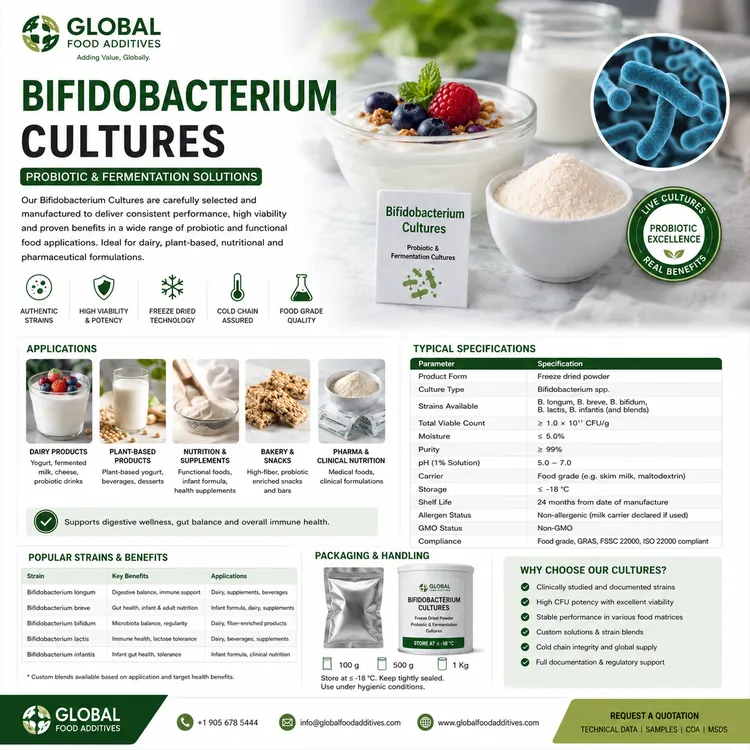
Product identity
| Product | Bifidobacterium Cultures |
|---|---|
| Common names | Bifidobacteria cultures, probiotic Bifidobacterium, freeze-dried Bifidobacterium, microbial culture preparation |
| Category | Fermentation, Cultures & Bio-Protective Ingredients |
| Function | Probiotic culture / fermentation culture / microbial preparation / live-cell ingredient / culture blend component |
| E / INS number | Confirm by destination market and supplier documentation |
| CAS / identity | Microbial preparation; identity depends on genus, species and strain |
| Typical species focus | Bifidobacterium animalis subsp. lactis, Bifidobacterium longum, Bifidobacterium breve, Bifidobacterium bifidum or other supplier-defined strains |
| Typical form | Freeze-dried culture, frozen pellet, powder, granule, sachet blend, capsule-ready powder or premix-compatible culture preparation |
| Typical grade focus | Food grade, probiotic grade, dairy culture grade, supplement grade, infant/medical nutrition grade where permitted, or customer-specific strain blend |
Application fit
Bifidobacterium Cultures are evaluated where live-cell delivery, probiotic positioning, culture compatibility and finished-product viability are required. Suitability depends on strain, dose, oxygen exposure, acidity, water activity, storage temperature, packaging, process stress and label requirements.
- Fermented dairy, yogurt-style products, cultured milk and spoonable dairy systems
- Drinking yogurts, cultured beverages and chilled probiotic drink formats
- Plant-based fermented products, oat, soy, almond or coconut-based cultured systems
- Nutrition powders, meal replacements and dry probiotic blends
- Dietary supplements, capsules, tablets, sachets, gummies and stick packs
- Infant foods, medical foods and special nutrition products where permitted
- Synbiotic products combined with fibres, inulin, FOS, GOS or other prebiotic substrates
- Culture blends with Lactobacillus, Streptococcus thermophilus or other approved food cultures where compatible
Technical function in food systems
Bifidobacterium Cultures are living microbial preparations. Their industrial value depends on the ability of the selected strain to remain viable during manufacturing, distribution and storage until the declared point of consumption. Unlike conventional dry ingredients, culture performance is affected by heat, oxygen, water activity, acidity, osmotic pressure, mechanical stress, packaging atmosphere and temperature history.
In dairy and plant-based fermented foods, Bifidobacterium may be used alone in selected systems or combined with other cultures that provide stronger acidification, texture or flavour development. In supplements and dry blends, the focus is usually on high CFU potency, stability, low moisture, oxygen protection and accurate serving-level delivery. In all cases, strain identity and viable count should be controlled by supplier documentation and finished-product testing.
Key functional properties
- Live-cell delivery: Provides defined viable microorganisms for probiotic or culture-positioned food products where permitted.
- Strain-specific performance: Technological behaviour, stability and permitted claims depend on the exact strain, not only the genus.
- Fermentation support: Can contribute to selected cultured food systems when process conditions support survival and activity.
- Blend compatibility: May be combined with lactic cultures, prebiotic fibres or nutrient systems after compatibility testing.
- Label differentiation: Supports strain-defined culture declarations, viable-count declarations or probiotic positioning where permitted.
- Dry-format flexibility: Freeze-dried powders can be used in capsules, sachets, tablets, powders and dry mixes when moisture is controlled.
- Chilled application fit: Some grades are designed for refrigerated dairy or drink products requiring controlled viable count over shelf life.
Process variables to control
- Genus, species, strain code and strain deposit or identity documentation
- CFU potency at manufacture and target CFU at end of shelf life
- Oxygen exposure during blending, filling, packaging and storage
- Moisture, water activity and humidity exposure in powder systems
- Heat exposure during processing, drying, compression, coating or filling
- pH, acidity, osmotic pressure, sugars, salts and organic acids in the food matrix
- Compatibility with starter cultures, flavours, colours, minerals and preservatives
- Cold-chain, frozen-chain or ambient stability requirements
Culture selection and formulation guidance
For industrial purchasing and R&D work, Bifidobacterium Cultures should be selected by strain identity, CFU potency, stability profile and application target. Two products may both be described as Bifidobacterium cultures but differ in species, strain, carrier system, cryoprotectants, oxygen tolerance, acid tolerance, dosage recommendation, viable count, shelf life and regulatory support. Application trials and stability studies are therefore essential before changing supplier or strain.
Recommended use evaluation
- Define whether the culture is needed for fermentation activity, probiotic positioning, culture blend development or dry supplement delivery.
- Confirm genus, species and strain code before technical or regulatory approval.
- Compare CFU per gram, recommended dosage, viable count at manufacture and end-of-shelf-life target.
- Test culture survival in the real product matrix, not only under supplier laboratory conditions.
- Validate oxygen, moisture, pH, temperature and packaging impacts during shelf life.
- Check strain compatibility with starter cultures, prebiotics, minerals, acids, flavours and preservatives.
- Confirm legal claim language, culture naming and viable-count declaration in the destination market.
Common processing risks
- Viability loss: Heat, moisture, oxygen and acid exposure can reduce viable count before end of shelf life.
- Poor strain fit: A strain suitable for capsules may not survive in acidic dairy or beverage products.
- Blend incompatibility: Other cultures, acids, preservatives, minerals or flavours may reduce culture viability.
- Cold-chain failure: Temperature abuse during transport or storage can damage sensitive culture preparations.
- Label mismatch: Declared CFU and strain names must align with actual testing and local rules.
- Compression stress: Tablet pressing, coating or gummy processing can reduce viability unless the grade is designed for that format.
- Regulatory mismatch: The term probiotic, health claims and strain claims are controlled differently across markets.
Application-specific value
Bifidobacterium Cultures are used across multiple product categories where viable culture delivery and strain identity are part of the product concept. They may be compared with Lactobacillus, Lactiplantibacillus, Lacticaseibacillus, Streptococcus thermophilus, Bacillus spore-formers, yeast cultures, postbiotic preparations or synbiotic systems. The best choice depends on processing route, target claim, storage conditions, consumer format and regulatory framework.
Dairy and yogurt-style systems
- Can be used in fermented milk, yogurt-style products, drinking yogurts and chilled dairy applications.
- Often requires co-culture design because some Bifidobacterium strains are not strong primary acidifiers.
- Compatibility with starter cultures, milk solids, stabilizers, fruit preparations and pH decline should be evaluated.
- Finished products should be tested for viable count, acidity, texture, flavour, gas production and shelf-life stability.
Plant-based fermented products
- Can be evaluated in oat, soy, almond, coconut or other plant-based cultured systems.
- Survival depends on available nutrients, pH, oxygen exposure, minerals, sugars and plant matrix composition.
- May require nutrient supplementation or culture blending for reliable fermentation and viability.
- Trials should evaluate flavour, acidification, texture, separation, viable count and refrigerated shelf life.
Nutrition powders and dry blends
- Useful in powdered supplements, meal replacements, infant or medical nutrition where permitted, and sachet blends.
- Requires low water activity, oxygen barrier packaging and controlled blending conditions.
- Powder systems should be tested for blend uniformity, segregation, humidity exposure and CFU retention.
- Finished products should be evaluated after transport simulation and full shelf-life storage.
Capsules, tablets, gummies and sachets
- Can be used in supplement-style formats when the strain and carrier system are designed for the process.
- Capsules and sachets generally expose cultures to less heat than gummies or compressed tablets.
- Compression, heat, water activity, coating solvents and gummy cooking can reduce viability.
- Finished-product release should include strain identity and viable-count testing according to the buyer’s quality system.
Typical specification points to review
For industrial purchasing, the most useful comparison is not only price per kilogram. Bifidobacterium Culture grades may differ in species, strain, CFU potency, carrier, cryoprotectant, moisture, water activity, oxygen tolerance, acid tolerance, shelf life, cold-chain requirements and regulatory documentation. Buyers should request the supplier’s actual specification and certificate of analysis before approval.
Technical parameters
| Genus, species and strain | Critical for identity, claim support, regulatory review and performance comparison. |
|---|---|
| CFU potency | Confirm CFU/g, CFU/dose, method, test conditions and overage strategy. |
| Viability guarantee | Clarify whether CFU is guaranteed at manufacture, shipment, delivery or end of shelf life. |
| Carrier system | May include maltodextrin, starch, milk-derived components, fibres or other carriers; confirm label and allergen impact. |
| Moisture / water activity | Critical for culture stability in powder, capsule, sachet and dry blend applications. |
| Oxygen tolerance | Important because many Bifidobacterium strains are oxygen-sensitive and require protective handling. |
| Acid and bile tolerance | May be relevant for probiotic positioning and product-specific technical review where permitted. |
| Particle size | Affects blending, dusting, segregation and uniformity in dry applications. |
| Pathogen testing | Review absence of Salmonella, Listeria where relevant, E. coli, Staphylococcus aureus or other buyer-required organisms. |
| Contaminant organisms | Review yeast, mold, coliforms, Enterobacteriaceae and non-target microbes according to product category. |
| Antibiotic resistance profile | Request where required by regulation, customer policy or probiotic safety assessment. |
| Stability data | Important for shelf-life modelling under refrigerated, frozen or ambient conditions. |
Commercial parameters
| Packaging | Commonly supplied in aluminium foil pouches, vacuum packs, nitrogen-flushed packs, cryogenic containers, drums or frozen culture containers depending on grade. |
|---|---|
| Net weight | Confirm available pack sizes because high-potency cultures may be supplied in small sealed units rather than bulk bags. |
| Temperature control | Confirm frozen, refrigerated or ambient-stable handling conditions and maximum transport exposure. |
| Shelf life | Confirm from supplier documents; depends on strain, form, moisture, packaging and storage temperature. |
| Storage | Store according to supplier instruction, typically protected from heat, oxygen, moisture and repeated temperature cycling. |
| Handling | Minimize open-pack time; use clean dry tools, avoid warm rooms and reseal or use full packs where possible. |
| MOQ | Depends on strain, potency, stock position, packaging, cold-chain route and documentation requirements. |
| Lead time | Depends on fermentation batch, freeze-drying schedule, quality release, viability testing and controlled-temperature freight. |
| Cost-in-use | Compare delivered CFU, survival over shelf life, overage need and regulatory support, not only kilogram price. |
Quality, food safety and compliance notes
Bifidobacterium Cultures for food manufacturing should be purchased only with clear food-grade documentation, strain identity, microbiological quality data and traceability. The buyer should verify that the strain is suitable for the intended product category, dose, storage condition, destination market and label claim. Where the product is used in infant nutrition, medical nutrition, supplements, probiotic foods or export products, category-specific regulatory confirmation should be completed before commercial use.
QA team checklist
- Confirm genus, species, strain code, supplier strain name and food-grade status.
- Check whether the material is single strain, multi-strain blend, co-culture or custom premix.
- Compare supplier specification with internal purchasing and application requirements.
- Review actual batch COA before shipment or release.
- Confirm CFU potency, viability guarantee point, moisture, water activity and pathogen testing.
- Verify allergen, dairy status, GMO, halal, kosher, vegan or other buyer-required statements where applicable.
- Check production date, expiry date, batch number, label information and packaging integrity.
- Confirm required storage temperature and temperature-monitoring records for shipment.
- Conduct incoming QC, application trials and end-of-shelf-life viability testing before changing supplier or strain.
Regulatory review points
- Destination-market permission for the strain, product category and intended use
- Allowed use of the term probiotic and related claim language
- Strain naming, genus/species declaration and CFU declaration requirements
- Minimum viable count requirements at manufacture or end of shelf life where applicable
- Infant, medical, supplement or special nutrition rules where relevant
- Carrier, cryoprotectant, diluent or processing-aid declaration rules
- Safety assessment, antibiotic resistance review or QPS/GRAS-related documentation where requested
- Finished-product safety, viability, label accuracy and compliance responsibility
Documents to request
A complete Bifidobacterium Cultures inquiry should include both technical and commercial document requirements. This helps reduce delays during supplier qualification, sample approval, customer audits, customs clearance, cold-chain planning and first production trials.
Core documents
- Product specification or technical data sheet
- Certificate of analysis for available batch or representative lot
- Strain identity statement with genus, species and strain code
- Viable count method and CFU potency declaration
- Safety data sheet where applicable
- Food-grade statement or regulatory compliance declaration
- Storage, shelf-life and temperature-control instructions
- Carrier, cryoprotectant and diluent composition statement where applicable
- Product label, packaging details and pallet or cold-chain configuration
Optional buyer-specific documents
- Halal certificate, kosher certificate or other market-specific certification
- Allergen statement and cross-contamination declaration
- Dairy-free, vegan or vegetarian suitability statement where required
- GMO status declaration
- Antibiotic resistance profile or safety assessment where required
- Pathogen and contaminant organism testing summary
- Clinical, technical or strain dossier where permitted and requested
- Temperature logger or cold-chain shipment record where required
- Country-specific import, customs or registration documents
How to request this product
Send the product name, required species or strain, target CFU per gram or per serving, application, dosage format, quantity, destination country, storage condition, packaging preference, delivery term, expected shipment date and required documents. If you already purchase Bifidobacterium Cultures, attach or describe your existing specification, label, certificate of analysis, strain name, viable-count target, storage conditions and finished-product application so supplier options can be compared more accurately.
Information that improves quotation accuracy
- Target application and finished-product type
- Required strain, species or supplier reference strain
- Required CFU/g, CFU/dose or end-of-shelf-life viable count
- Single strain, multi-strain blend, co-culture or synbiotic blend requirement
- Product pH, water activity, oxygen exposure, storage temperature and shelf-life target
- Process conditions: fermentation, blending, freeze drying, spray drying, tableting, encapsulation or chilled filling
- Current culture grade, dosage or reference COA
- Required annual volume and first-order quantity
- Preferred packaging size and cold-chain requirement
- Destination port, warehouse or delivery city
- Required Incoterms such as EXW, FOB, CFR, CIF or DAP
- Required certificates and destination-market declarations
- Sample quantity and expected approval timeline
Supplier comparison criteria
- Food-grade documentation completeness
- Clear genus, species and strain identity
- CFU potency consistency and viable-count guarantee
- Application performance in the buyer’s real product matrix
- Stability data under intended storage and packaging conditions
- Microbiological safety, contaminant control and strain safety documentation
- Carrier suitability and finished-label impact
- Cold-chain capability, packaging integrity and temperature monitoring
- Batch traceability and shelf-life remaining at shipment
- Total landed cost and performance cost-in-use per delivered CFU
Useful answers
What are Bifidobacterium Cultures used for in food manufacturing?
Bifidobacterium Cultures are used as strain-defined microbial preparations for probiotic foods, fermented dairy products, cultured beverages, plant-based ferments, nutrition powders, supplements, synbiotic products and selected culture blends where permitted by local regulations.
Are Bifidobacterium Cultures live cultures?
Most Bifidobacterium Culture products are designed as live microbial preparations, but viability depends on strain, production method, storage, handling and shelf life. Buyers should confirm CFU potency and whether the viable count is guaranteed at manufacture, shipment or end of shelf life.
Are Bifidobacterium Cultures the same as starter cultures?
Not always. Starter cultures are typically selected for acidification, flavour, texture or fermentation performance. Bifidobacterium Cultures are often selected for probiotic positioning or live-cell delivery. Some products combine Bifidobacterium with starter cultures, but the purpose should be defined clearly.
Which technical parameters should be checked before purchasing?
Buyers should compare genus, species, strain code, CFU potency, viable-count guarantee, carrier system, moisture, water activity, oxygen sensitivity, acid tolerance, storage temperature, shelf life, pathogen testing, contaminant organism limits, allergen status, GMO status and destination-market compliance.
Can Bifidobacterium Cultures be used in plant-based products?
Yes, selected strains may be evaluated in plant-based fermented products or nutrition systems. However, performance depends on matrix composition, available nutrients, pH, oxygen exposure, minerals, sugar profile, stabilizers, packaging and storage temperature.
Can Global Food Additives source Bifidobacterium Cultures?
Global Food Additives can review sourcing options for Bifidobacterium Cultures according to strain requirement, CFU potency, application, form, storage conditions, quantity, destination, packaging preference, delivery term and required documentation.
Which documents should be requested?
Buyers commonly request a technical data sheet, strain identity statement, certificate of analysis, viable-count method, safety data sheet where applicable, food-grade statement, origin statement, allergen or GMO declaration where required, shelf-life information, storage instructions, label details and packing configuration.
Are probiotic claims permitted in every country?
No. The term probiotic, health claims, viable-count declarations and strain claims are regulated differently by country. The buyer should confirm local regulations, label wording and required substantiation before commercial use.
What should be tested during factory trials?
Factory trials should evaluate culture survival, CFU recovery, strain identity, pH tolerance, oxygen exposure, moisture sensitivity, storage temperature, matrix compatibility, flavour impact, acidification, texture, package performance and viable count at end of shelf life.
Tell us which food additive or ingredient you need.
Send product names, target specifications, quantity, destination country, packaging preference, delivery term, and document requirements. Our team will review your inquiry and respond from orders@foodgradeadditives.com.
Your message has been received. You will be redirected to the home page.