
Calcium Carbonate Colour E170
Calcium Carbonate Colour is a food-grade mineral ingredient used in suitable formulations as a white colour, opacity builder, surface colourant, anticaking aid, stabilising mineral or calcium source. For industrial buyers, the commercial value of E170 is not only its white shade; it is the combination of controlled purity, particle size, brightness, dispersibility, low odour, regulatory documentation and reliable supply.
This page is designed for purchasing teams, R&D formulators, QA managers and food manufacturers who need to compare calcium carbonate grades for confectionery, bakery systems, dry blends, dairy-type products, plant-based products, sauces, seasonings, nutritional applications and other permitted food categories.
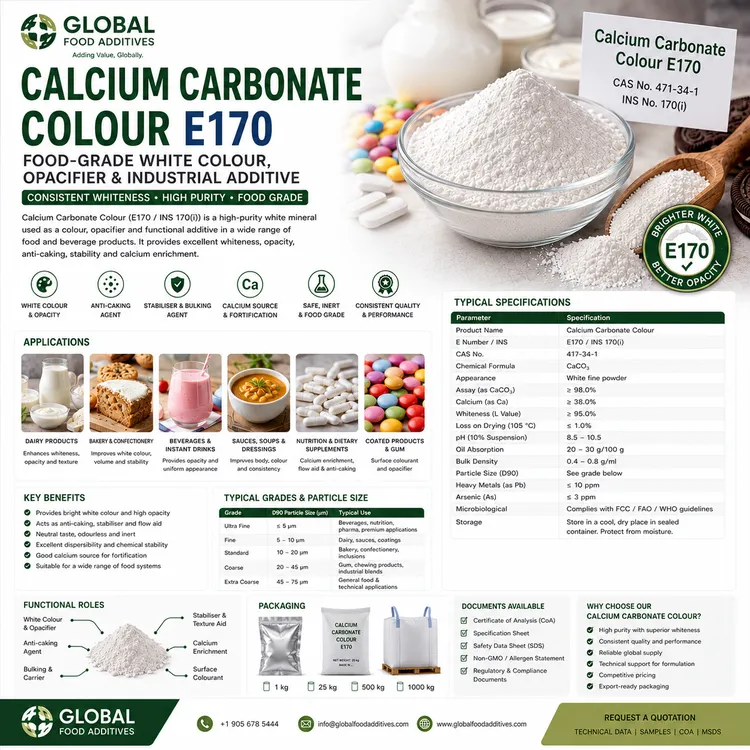
Product identity
| Product | Calcium Carbonate Colour |
|---|---|
| Common regulatory name | Calcium carbonate |
| Category | Colours & Colouring Foods |
| Function | White colour, surface colourant, opacifier, anticaking agent, stabiliser, acidity regulator or calcium mineral ingredient depending on grade and regulation |
| E / INS number | E170 / INS 170(i) |
| CAS number | 471-34-1 |
| EINECS | 207-439-9 for calcium carbonate; 215-279-6 for limestone |
| Colour Index | CI Pigment White 18 / 77220 |
| Chemical formula | CaCO3 |
| Molecular weight | 100.1 g/mol |
| Typical form | Fine powder, micronized powder, granulated grade, ground calcium carbonate, precipitated calcium carbonate, premix or water-based dispersion |
Application fit
Potential use areas may include the following, subject to local additive rules, customer specification and end-product testing:
- Confectionery panning, compressed sweets, chewing gum coatings and decorative surface systems
- Bakery mixes, dry premixes, toppings, fillings and powdered preparations
- Dairy-type desserts, plant-based drinks, nutritional beverages and calcium-fortified systems
- Sauces, dressings, creams and opaque water-based food systems requiring controlled suspension
- Seasonings, savoury snacks, instant powders and dry blends where flow and whiteness matter
- Food supplement tablets, mineral blends and nutrition products where a suitable grade is required
Technical overview
Food-grade calcium carbonate is a white, odourless, tasteless mineral powder obtained from selected limestone sources or by controlled precipitation of calcium and carbonate ions. In food production it normally performs as a dispersed solid rather than a dissolved ingredient. Its performance depends heavily on particle size distribution, whiteness, surface area, wetting behaviour, bulk density and the stability of the finished matrix.
Calcium carbonate is practically insoluble in water and alcohol, but it dissolves with effervescence in diluted food acids. This makes it useful in neutral or mildly alkaline systems where whiteness, opacity or mineral content is desired, but it also means acidic products require careful pilot testing because carbon dioxide release, pH shift, texture changes or loss of opacity may occur.
Industrial functions
- White colour and opacity: improves visual whiteness and masks background colour in coatings, fillings, tablets and selected liquid systems.
- Surface colourant: can support bright white surface appearance in confectionery and decorative applications where permitted.
- Anticaking and flow support: helps improve powder flow and reduce clumping in dry blends when particle size and dosage are selected correctly.
- Stabilising mineral: contributes mineral solids that can affect body, opacity and suspension behaviour in processed systems.
- Calcium source: provides calcium contribution in fortified foods or supplements when nutritional, legal and analytical requirements are met.
Performance characteristics
- High heat and light stability compared with many organic colours
- Neutral white appearance with grade-dependent brightness and undertone
- Low odour and low flavour impact when food-grade purity is controlled
- Practically insoluble mineral particle requiring proper dispersion or suspension
- Acid reactivity that must be checked in fruit, vinegar, fermented and low-pH products
- Grade-dependent mouthfeel, sedimentation and opacity based on particle size
Grade selection: GCC, PCC and formulated grades
Buyers should avoid treating all calcium carbonate as identical. The correct grade depends on whether the application needs low cost mineral filler performance, high brightness, tight particle size, improved dispersion, direct compression behaviour, low abrasion, low sedimentation or specific regulatory documentation.
| Grade type | Industrial meaning | Typical purchasing focus |
|---|---|---|
| Ground Calcium Carbonate (GCC) | Produced from selected limestone through grinding, classification and purification steps. It is often selected for standard opacity, mineral content and cost-effective food-grade applications. | Source quality, whiteness, mesh size, heavy metals, acid-insoluble matter, moisture, particle distribution and batch consistency. |
| Precipitated Calcium Carbonate (PCC) | Produced by controlled precipitation, generally allowing tighter control of particle morphology and particle size. It may be preferred where brightness, fine texture or controlled dispersion is important. | Particle shape, D50/D90, surface area, whiteness, purity, dispersibility, bulk density and food-contact documentation. |
| Micronized or ultrafine powder | Fine grades used when smoother mouthfeel, stronger opacity or better suspension is required. | Mouthfeel, dusting, wetting behaviour, sedimentation rate, process safety and packaging integrity. |
| Granulated or compacted grade | Dust-reduced form designed for improved handling, weighing and dry blending. | Flowability, dissolution or dispersion behaviour, dust level, particle integrity and compatibility with automated dosing systems. |
| Premix or dispersion | Calcium carbonate incorporated into a carrier, stabiliser system or liquid dispersion for faster incorporation into a defined food process. | Carrier declaration, viscosity, solids content, preservative system, microbiology, shelf life and label impact. |
Specification points buyers should review
A strong calcium carbonate inquiry should include performance targets, not only the product name. For industrial comparison, the most useful supplier specifications normally include the following parameters.
Chemical and regulatory parameters
- Assay as CaCO3, typically expressed on an anhydrous or dried basis
- Compliance target such as EU food additive specification, Codex/JECFA specification, FCC specification or customer standard where applicable
- Heavy metals and contaminants, including lead, arsenic, cadmium and other market-specific limits
- Acid-insoluble substances and magnesium/alkali salts where required by the specification
- Fluoride and other naturally occurring mineral impurities when relevant to destination rules
- Allergen, GMO, vegan, halal, kosher and irradiation declarations when required by the buyer
Physical and processing parameters
- Particle size distribution, including D10, D50, D90, mesh or residue on sieve
- Whiteness, brightness or CIE L*a*b* colour values
- Bulk density, tapped density and flow behaviour for dry dosing systems
- Moisture or loss on drying
- pH of slurry and conductivity where relevant
- Oil absorption, wetting time, dispersibility and sedimentation behaviour
- Microbiological profile for products handled in food-grade environments
Formulation and process guidance
Calcium Carbonate Colour is usually handled as a fine mineral solid. Its incorporation method should be designed around dust control, dispersion quality, particle wetting and the stability of the finished food system.
| Processing topic | Industrial guidance |
|---|---|
| Dispersion | Pre-wetting, high-shear mixing or premixing with compatible dry ingredients can reduce agglomeration. Liquid systems may require stabilisers or viscosity control to limit sedimentation. |
| pH and acid contact | Low-pH systems should be tested carefully because calcium carbonate reacts with acids and can generate gas, change pH, reduce opacity or affect flavour balance. |
| Mouthfeel | Coarser grades may create grittiness in fillings, beverages or creams. Fine or precipitated grades may be preferred when smooth texture is critical. |
| Opacity | Opacity is influenced by particle size, dosage, background colour, water activity, fat content, air incorporation and the refractive index relationship of the food matrix. |
| Powder handling | Fine powders may generate dust. Industrial handling should include closed transfer, local extraction, appropriate PPE and dust-minimising packaging where required. |
| Dry blends | For instant powders, premixes and seasonings, confirm flowability, segregation risk, density match with other powders and performance after transport vibration. |
| Thermal processing | Calcium carbonate itself is heat stable under normal food processing conditions, but the surrounding formulation may change viscosity, suspension and colour perception during heating or cooling. |
| Packaging interaction | Use packaging that protects against moisture ingress, contamination, bag rupture and excessive compaction during pallet storage and export transport. |
Application-specific purchasing notes
Confectionery and coatings
In panned confectionery, compressed sweets and decorative systems, calcium carbonate may be considered for white surface appearance, opacity and mineral contribution. Buyers should confirm particle size, brightness, coating smoothness, regulatory status, carry-through appearance and compatibility with binders, syrups, waxes or polishing systems.
Bakery, dry mixes and powders
In bakery premixes, toppings, seasonings and instant powders, the key concerns are flowability, low dusting, colour uniformity, segregation control and label compliance. Bulk density and particle size should be aligned with flour, starches, sugars, salts and other powdered ingredients.
Dairy-type and plant-based products
Calcium carbonate can support opacity and calcium fortification in selected products, but suspension stability is critical. R&D teams should test stabiliser systems, homogenisation conditions, sedimentation, pH drift, heat treatment and mineral bioavailability claims.
Sauces, creams and dressings
For opaque sauces and creams, calcium carbonate can contribute whiteness and body, but acidic recipes require caution. Formulators should evaluate gas release, viscosity change, sedimentation, flavour impact and end-of-shelf-life appearance.
Nutritional and supplement applications
When used as a calcium source, buyers should request a grade suitable for nutritional products, with controlled heavy metals, particle size, assay, microbiology and the documentation needed for supplement or fortified food regulations in the target market.
Snacks and seasonings
In savoury powder blends and snack seasonings, calcium carbonate may support flow, opacity or mineral positioning. Confirm interaction with acids, salt, flavours, oils, anti-caking agents and seasoning adhesion systems.
Quality assurance and documentation checklist
Before purchase, request documents that allow QA, regulatory and procurement teams to verify identity, compliance and commercial suitability. Document names and availability may vary by manufacturer, origin and grade.
- Technical data sheet with identity, grade, intended use and typical physical properties
- Full product specification with chemical, physical, contaminant and microbiological limits
- Certificate of analysis for an available batch or representative lot
- Safety data sheet where applicable for handling and occupational safety review
- EU, Codex/JECFA, FCC or other market-specific compliance statement where applicable
- Heavy metals declaration, including lead, arsenic, cadmium and mercury where requested
- Allergen statement, GMO statement, vegan statement and irradiation statement
- Halal and kosher certificates if required by the destination market or customer
- Country of origin, manufacturing site or approved manufacturer information where releasable
- Shelf-life, storage conditions and recommended retest date
- Packaging specification, net weight, pallet pattern, container loading and batch coding format
- Sample availability and retained-sample policy for pre-shipment evaluation
Regulatory and labelling considerations
E170 / INS 170(i) status does not automatically mean that the additive can be used in every product, country or dosage. Food additive permissions depend on the destination regulation, food category, functional class, maximum permitted level, carry-over rules, nutritional claims, label language and customer policy.
Buyers should confirm whether the product will be declared as a colour, additive, anticaking agent, calcium source, mineral ingredient or other category according to the local legislation and the function performed in the finished food. For export projects, the same formulation may require different declarations in the EU, United Kingdom, United States, Gulf countries, Türkiye, Asia-Pacific markets or private-label customer standards.
Packaging, logistics and storage
Calcium carbonate is commonly supplied in multiwall paper bags, PE-lined bags, woven PP bags, big bags or palletised export packaging. Packaging should be selected according to powder fineness, dust sensitivity, warehouse humidity, transport route and factory handling method.
| Commercial point | What to clarify |
|---|---|
| Standard pack sizes | Common options may include 20 kg, 25 kg, 500 kg or 1,000 kg units depending on grade and manufacturer. |
| Palletisation | Confirm pallet type, stretch wrap, export fumigation requirements, pallet height, container loading and mixed-pallet restrictions. |
| Storage | Store closed, dry, clean and away from moisture, odorous materials and acids. Avoid torn bags and uncontrolled warehouse humidity. |
| Shelf life | Typical shelf life depends on supplier, packaging and storage conditions. Request exact shelf life and retest policy from the manufacturer. |
| Transport | For export shipments, confirm HS code guidance, non-dangerous goods status where applicable, document set, country of origin and certificate requirements. |
How to request this product
For a fast and accurate quotation, send the product name, intended food application, destination country, target specification, quantity, annual forecast, preferred grade type, packaging preference, delivery term, required documents and expected shipment date. If you already use Calcium Carbonate Colour, please share the current specification, COA, label declaration or sample reference so alternatives can be compared against your existing standard.
Minimum inquiry details
- Product name: Calcium Carbonate Colour / E170
- Food application and target function
- Required standard: EU, FCC, JECFA, local regulation or customer specification
- Particle size, whiteness, assay or reference COA if available
- Quantity per order and annual volume estimate
- Destination country and delivery term
- Packaging size and pallet requirements
- Required certificates and declarations
Useful R&D questions
- Is the finished product acidic, neutral or alkaline?
- Is the calcium carbonate expected to dissolve, disperse, suspend or remain on the surface?
- Is the target appearance bright white, opaque, matte or neutral?
- Is mouthfeel or sedimentation a critical quality attribute?
- Will the product be heat treated, homogenised, spray dried, panned or compressed?
- Are there customer restrictions on additives, processing aids, carriers or anti-caking agents?
Useful answers
What is Calcium Carbonate Colour used for in food manufacturing?
Calcium Carbonate Colour is used in suitable applications as a white colour, surface colourant, opacity builder, anticaking agent, stabiliser or calcium source. The exact function depends on the grade, dosage, matrix, regulation and label declaration.
Is Calcium Carbonate Colour the same as food-grade calcium carbonate?
Calcium Carbonate Colour refers to food-grade calcium carbonate positioned for colour, opacity or surface appearance. Food-grade calcium carbonate may also be purchased for mineral fortification, anticaking or formulation support. The same chemical identity can have different commercial grades and intended functions.
What is the difference between GCC and PCC?
Ground calcium carbonate is produced from selected limestone through grinding and classification. Precipitated calcium carbonate is produced by controlled precipitation, often allowing tighter control of particle size and morphology. The best choice depends on brightness, texture, dispersibility, cost and specification requirements.
Can it be used in beverages?
It may be considered in selected beverage or plant-based systems as an opacity or calcium source, but it is practically insoluble and can settle. Acidic beverages require special testing because calcium carbonate reacts with acid. Stabilisation, homogenisation and regulatory review are essential.
Can Global Food Additives source Calcium Carbonate Colour?
Global Food Additives can review sourcing options for Calcium Carbonate Colour according to target specification, grade, particle size, packaging, destination, documentation and volume requirements.
Which documents should be requested?
Buyers commonly request a technical data sheet, specification, certificate of analysis, safety data sheet where applicable, origin statement, allergen declaration, GMO statement, halal or kosher certificate when required, shelf-life information, storage guidance and packing details.
Is this product permitted in every country?
No. Food additive use depends on destination-market rules, food category, function, maximum level, label declaration and buyer responsibility. Regulatory approval must be verified for each market and application.
What samples should be tested before buying commercial quantities?
Test the exact proposed grade in the real application. Check appearance, opacity, mouthfeel, sedimentation, pH, acid reaction, process stability, shelf-life stability, packaging compatibility and final label requirements.
Tell us which Calcium Carbonate Colour grade you need.
Send product name, intended application, target specification, particle size, quantity, destination country, packaging preference, delivery term and required documents. Our team will review your inquiry and respond from orders@foodgradeadditives.com.
Your message has been received. You will be redirected to the home page.