
Calcium Lactate Fortification Grade
Calcium Lactate Fortification Grade is a food-grade calcium salt selected by manufacturers for calcium enrichment, mineral premix formulation, nutrition positioning and controlled calcium delivery. It is especially useful where a mild-tasting calcium source is needed for beverages, cereals, dairy systems, nutrition powders, flour enrichment, fortified snacks and special-nutrition applications where permitted.
For industrial sourcing, Calcium Lactate Fortification Grade should be reviewed by elemental calcium contribution, assay, hydrate form, solubility, sensory impact, particle size, powder flow, blend uniformity, pH behaviour, mineral interaction, packaging protection and destination-market compliance. Global Food Additives supports manufacturers with supplier screening, specification review, sample coordination, document collection and export-ready quotation communication.
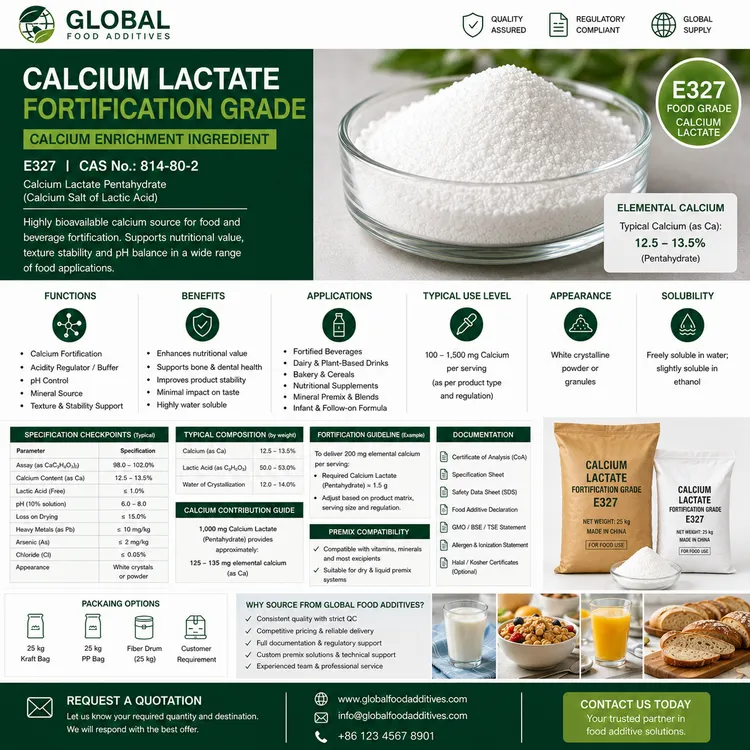
Product identity
| Product | Calcium Lactate Fortification Grade |
|---|---|
| Common names | Calcium Lactate E327, Food Grade Calcium Lactate, Calcium Salt of Lactic Acid, Calcium Lactate Pentahydrate |
| Category | Fortification Nutrients |
| Function | Calcium fortification / mineral enrichment / nutrient premix ingredient / buffering and firming support |
| E / INS number | E327 |
| CAS / identity | 814-80-2 |
| Chemical identity | Calcium salt of lactic acid; supplied as anhydrous or hydrated grades depending on supplier specification |
| Typical form | Fine powder, granule, beadlet, premix-ready grade, direct-blend grade, crystal grade or solution grade |
| Typical appearance | White to off-white crystalline powder or granule depending on particle size and hydrate form |
| Solubility profile | Water-soluble calcium salt; dissolution depends on grade, temperature, agitation, particle size and mineral system |
| Key performance role | Elemental calcium delivery, calcium claim support, premix uniformity, pH buffering, mild mineral profile and process stability |
Application fit
Calcium Lactate Fortification Grade is evaluated when a food manufacturer needs calcium addition with acceptable taste, manageable solubility and strong documentation. Potential use areas may include:
- Flour, bakery premixes, bread improvers and cereal-based enrichment systems
- Breakfast cereals, extruded cereals, granola, cereal bars and fortified snacks
- Dairy beverages, dairy powders, fermented dairy concepts and calcium-enriched desserts
- Powdered beverages, instant drinks, sports drinks and nutrition beverage systems
- Nutrition powders, meal replacements, protein blends and vitamin-mineral premixes
- Infant and medical foods where the exact grade and use are permitted by regulation
- Gummies, tablets, sachets, food supplements and supplement-adjacent food formats
- Fruit preparations, gels and alginate systems requiring controlled calcium addition
Technical performance overview
Calcium Lactate Fortification Grade is used primarily to deliver calcium in a food-compatible form. Compared with highly reactive calcium salts such as calcium chloride, it can offer a milder sensory profile in many applications. Compared with poorly soluble calcium sources, it can be easier to use in liquid, gel and premix systems, although real performance depends on pH, competing salts, proteins, stabilisers, processing conditions and packaging.
In calcium-fortified foods, the practical target is not the amount of Calcium Lactate added, but the verified elemental calcium delivered per serving at the intended point of label compliance. This requires clear understanding of assay, hydrate form, elemental calcium content, serving size, overage, process retention, storage retention, label rounding rules and any nutrient-claim threshold in the destination market.
Key formulation variables
| Elemental calcium content | Determines fortification efficiency and cost-in-use. Confirm the calcium contribution from the exact supplier grade and COA. |
|---|---|
| Hydrate form | Anhydrous and hydrated grades differ in molecular weight, calcium delivery, moisture, flowability and dosage calculation. |
| Assay basis | Assay may be reported on an as-is, dry, anhydrous or hydrated basis. This must be clarified before formulation approval. |
| Solubility | Critical for beverages, gels, syrups and liquid premixes; temperature, agitation and other minerals can affect clarity and precipitation. |
| Sensory profile | High calcium addition can create mineral, chalky or bitter notes. Sweetness, acidity and flavour masking should be evaluated. |
| Particle size | Influences dissolution speed, dusting, segregation risk, flowability and dosage uniformity in dry blends. |
| pH interaction | Calcium Lactate can contribute buffering behaviour; the final pH depends on the complete acid, salt and protein system. |
| Mineral compatibility | Calcium may interact with phosphate, citrate, carbonate, alginate, pectin, proteins and other mineral salts. |
Industrial advantages
- Practical calcium source for fortified foods and mineral premixes
- Milder taste profile than some highly bitter calcium salts
- Useful in powder, liquid, gel and dairy-style systems when validated
- Can support calcium-content and calcium-enrichment projects where permitted
- Provides calcium ions for alginate gelling and selected texture systems
- Can contribute buffering support in acidic food systems
- Available in fine powder, crystal, granule or premix-ready grades
- Can be supplied with food-grade, compendial and market-specific documentation where available
Fortification calculation and calcium target planning
Calcium fortification projects should begin with the finished-product target. The formulation team should define the required milligrams of calcium per serving, the intended claim, the serving size, the analytical tolerance, the expected process loss and the expected storage loss. Only after that should the raw material dosage be calculated from the supplier's assay and elemental calcium content.
| Planning area | Why it matters | What to request or confirm |
|---|---|---|
| Elemental calcium value | Required for nutrition-label and claim calculations | Calcium content from supplier specification and batch COA |
| Hydrate form | Changes calcium contribution per kilogram and price comparison | Anhydrous, pentahydrate or other hydrated grade; calculation basis |
| Assay range | Determines raw material potency and formulation tolerance | Assay method, result, specification range and as-is or dry-basis statement |
| Finished serving target | Links dosage to nutrition panel and calcium claim | mg calcium per serving, local reference value, claim threshold and rounding rule |
| Processing loss | Some matrices may show precipitation, separation or analytical recovery issues | Retention data after heating, extrusion, drying, fermentation or pasteurisation |
| Storage stability | Ensures calcium remains analytically and visually acceptable through shelf life | Real-time or accelerated shelf-life data for clarity, sediment, pH and calcium assay |
Premix and dry-blend functionality
In vitamin-mineral premixes, Calcium Lactate Fortification Grade must be compatible with carriers, vitamins, minerals, flavours, fibres, proteins and sweeteners. Low inclusion rates can create uniformity challenges, while high mineral inclusion rates can increase density differences and segregation risk. Powder flow, bulk density, particle size distribution, electrostatic behaviour and moisture sensitivity should be reviewed before industrial scale-up.
Recommended evaluation steps
- 1. Define the nutrition target: elemental calcium per serving, claim threshold, label value and destination market.
- 2. Confirm the grade: assay, hydrate form, calcium content, particle size, solubility and compendial alignment where required.
- 3. Check matrix compatibility: review pH, proteins, phosphates, citrate, carbonate, gums, pectin, alginate, flavours and sweeteners.
- 4. Run bench trials: test taste, clarity, sediment, dissolution, viscosity, pH shift, gel behaviour and calcium assay recovery.
- 5. Validate production handling: confirm powder flow, dusting, feeder accuracy, blend uniformity, filtration and cleaning behaviour.
- 6. Confirm compliance: verify nutrient-source approval, use level, label name, calcium claim, special-food rules and customer restrictions.
Where extra caution is needed
- Clear beverages where haze, sediment or mineral precipitation is visible
- High-protein dairy or plant-protein drinks where calcium can affect stability
- High-phosphate, carbonate or citrate systems with precipitation risk
- High-dosage calcium claims where mineral taste may become unacceptable
- Infant formula, infant foods, medical foods and regulated nutrition products
- Dry premixes where density difference can create segregation during transport
- Gels and alginate systems where calcium addition point controls texture outcome
Typical industrial application areas
| Application | Technical objective | Purchasing notes |
|---|---|---|
| Flour and bakery enrichment | Calcium addition in flour systems, bakery premixes and cereal-based products | Check particle-size match, dry-blend uniformity, dusting, baking retention, flavour impact and local enrichment rules. |
| Breakfast cereals and extruded products | Calcium fortification, nutrition positioning and claim support | Review extrusion heat, coating addition point, mineral taste, assay recovery and end-of-shelf-life calcium value. |
| Beverages and powdered drinks | Calcium delivery in liquid or reconstituted systems | Evaluate solubility, clarity, pH, sediment, flavour masking, chelators, heat treatment and packaging. |
| Dairy and dairy-style systems | Calcium enrichment with acceptable taste and product stability | Check protein stability, phosphate balance, fermentation effect, viscosity, heat treatment and cold-chain shelf life. |
| Nutrition powders and meal replacements | Mineral premix standardisation and calcium claim design | Review bulk density, powder flow, vitamin-mineral compatibility, serving-size accuracy and moisture protection. |
| Infant and medical foods where permitted | Controlled calcium source within strict nutrient ranges | Require market-specific approval, tight assay control, premium microbiology and validated finished-product analytics. |
| Gummies, tablets and sachets | Calcium delivery in portioned nutrition formats | Check taste, grittiness, compression behaviour, gel compatibility, dosage uniformity and claim compliance. |
| Alginate gels and fruit systems | Calcium-triggered texture, gel formation or firmness support | Review calcium release, pH, alginate or pectin type, contact time, flavour impact and gel strength. |
Specification checklist for buyers
For industrial purchasing, Calcium Lactate Fortification Grade should be compared by usable calcium delivery, regulatory support and processing performance, not only by price per kilogram. A low-cost grade may be less economical if it has lower calcium contribution, poor flow, weak solubility, unsuitable hydrate form or incomplete documentation.
Technical specification points
- Assay and identification method
- Hydrate form and water of crystallisation
- Elemental calcium content and conversion basis
- pH of solution and buffering behaviour
- Solubility, dissolution time and insoluble matter
- Particle size distribution, bulk density and tapped density
- Flowability, dusting tendency and segregation risk
- Colour, odour, taste and sensory neutrality
- Moisture, loss on drying and water activity where relevant
- Heavy metals including lead, arsenic, mercury and cadmium according to market requirements
- Microbiological specification and pathogen absence statement where relevant
- Residual solvents, processing aids and contaminant declarations where required
- Shelf life, storage temperature and opened-pack handling
Commercial comparison points
- Minimum order quantity and sample availability
- Standard grade: fine powder, crystal, granule, beadlet, solution or premix-ready grade
- Standard packaging size, liner type, drum, carton, bag or big-bag configuration
- Batch size, lead time and annual supply continuity
- Food-grade, FCC, USP, EP or other compendial alignment where required
- Halal, Kosher, allergen, GMO, vegan and gluten statements where required
- Suitability for calcium claims and nutrition fortification in the destination market
- Support for premix manufacturers, beverage plants, cereal plants and special-nutrition producers
Quality, safety and compliance control
Calcium Lactate Fortification Grade should be purchased with a complete technical, quality and regulatory file. Quality teams should review assay, identity, calcium content, hydrate form, purity profile, heavy metals, microbiological limits, sensory profile, solubility and packaging integrity. For nutrition applications, finished-product testing should confirm that the declared calcium level is achieved and remains compliant through the intended shelf life.
Because the same ingredient can be used as a nutrient source, acidity regulator, firming agent or stabilising ingredient, the document package should match the intended use. A calcium-claim project may require nutrient-source approval and nutrition-label support. A beverage project may require solubility and clarity validation. A special-nutrition project may require higher microbiological standards, compendial alignment and tighter contaminant limits.
Processing and handling notes
Calcium Lactate Fortification Grade should be stored in a cool, dry and clean warehouse away from moisture, strong odours and incompatible chemicals. Keep packaging tightly closed after opening to protect flowability and prevent moisture pick-up. In dry premixes, pre-blending with a carrier can improve uniformity and reduce segregation risk. In liquid systems, add under controlled agitation and allow full dissolution before filtration, pH adjustment, heat treatment or filling.
| Processing factor | Industrial importance | What to confirm |
|---|---|---|
| Dissolution method | Controls clarity, sediment, mineral distribution and process efficiency | Water temperature, stock concentration, addition rate, agitation and filtration requirement |
| Addition order | Prevents unwanted precipitation, viscosity change or premature gelation | Sequence relative to acids, phosphates, citrate, alginate, pectin, proteins and preservatives |
| Dry blending | Controls dosage uniformity and serving-to-serving calcium consistency | Carrier, preblend ratio, blend time, sample plan, bulk density and segregation testing |
| Heat treatment | Can affect solubility, haze, precipitation and matrix stability | Pasteurisation, UHT, extrusion, baking, drying, hot-fill or retort conditions |
| Packaging barrier | Protects powder flow, sensory quality and finished-product stability | Moisture barrier, liner quality, desiccant need, warehouse humidity and opened-pack handling |
Regulatory and label review notes
Calcium Lactate is identified as E327 in many markets, but its status and declaration can depend on whether it is used as a nutrient source, acidity regulator, firming agent, stabiliser, leavening-support ingredient or other technological ingredient. Calcium-fortified foods must also comply with local nutrient-source approval rules, calcium-content claim thresholds, nutrition-label rounding rules, minimum and maximum fortification levels and customer-specific standards.
For U.S.-oriented review, calcium lactate is listed in 21 CFR 184.1207 as a direct human food ingredient with uses including firming agent, flavor enhancer, flavoring agent or adjuvant, leavening agent, nutrient supplement, and stabilizer and thickener, under current good manufacturing practice conditions except in infant foods and infant formulas. For other destinations, buyers should verify the applicable local additive list, nutrient-source list, special-nutrition rules and finished-product label requirements before commercial use.
Industrial troubleshooting guide
| Observed issue | Possible cause | Corrective action to test |
|---|---|---|
| Finished calcium level is below target | Incorrect hydrate conversion, low assay, process loss, sampling error or analytical recovery issue | Confirm elemental calcium basis, review COA, improve weighing, validate sampling and test finished-product recovery. |
| Cloudiness or sediment in beverage | Calcium precipitation with phosphate, citrate, carbonate, proteins or incomplete dissolution | Change addition order, reduce concentration, adjust pH, use chelation strategy or evaluate alternative calcium system. |
| Mineral or bitter taste | High calcium dosage, insufficient flavour masking, low sweetness or unsuitable pH | Reduce dose if permitted, split calcium sources, adjust flavour, increase masking and validate sensory shelf life. |
| Premix segregation | Particle-size or density mismatch between calcium salt and carrier system | Use premix dilution, adjust particle size, improve blend order and validate samples from multiple locations. |
| Powder caking or poor flow | Moisture exposure, damaged packaging, fine particle size or humid warehouse | Improve moisture-barrier packaging, use granular grade, control humidity and reseal opened packs quickly. |
| Gel texture is inconsistent | Calcium release rate, pH, alginate or pectin variation, mixing sequence or chelators | Adjust addition point, calcium dose, gelling system, pH and contact time in pilot trials. |
Documents to request
A complete Calcium Lactate Fortification Grade purchasing file should support procurement, R&D, quality assurance, regulatory, production and customer-audit teams. Depending on application and destination market, buyers commonly request:
- Product specification or technical data sheet
- Certificate of analysis for available batch or lot
- Safety data sheet where applicable
- Food-grade declaration and intended-use statement
- Assay, identification, hydrate form and elemental calcium content
- Solubility, pH, particle size, moisture, bulk density and flowability data
- Compendial compliance statement where required, such as FCC, USP, EP or customer-specific standard
- Heavy metals, residual impurities and contaminant declarations
- Microbiological specification and pathogen absence statement where relevant
- Allergen statement, GMO statement, gluten statement and vegan suitability statement
- Halal and Kosher certificates where required
- Origin, manufacturer, shelf-life and storage information
- Label declaration guidance and market-specific nutrient-source statement
- Packaging details, pallet configuration and transport recommendations
Packaging and logistics
Calcium Lactate Fortification Grade is commonly supplied in multi-layer paper bags, PE-lined bags, cartons, fibre drums, plastic drums, big bags or sealed containers depending on grade and order size. Packaging should protect against moisture, contamination and powder leakage. Fine powder grades may require dust-control precautions during unloading and weighing, while granular or premix-ready grades may support improved flow and reduced dusting.
For export shipments, buyers should confirm net weight, gross weight, pallet dimensions, container loading, shelf life remaining at dispatch, storage temperature, humidity protection, customs classification and whether any destination-market import document is required. Warehouse teams should store the ingredient in sealed original packaging until use and avoid exposure to water, steam, strong odours and incompatible chemicals.
How to request this product
Send the product name, target grade or reference specification, required assay, elemental calcium target, physical form, quantity, destination country, packaging preference, expected shipment date and required documents. If you already purchase Calcium Lactate Fortification Grade, attach or describe your existing specification, label, certificate of analysis, application, calcium target, use level and finished-product market so supplier options can be compared more accurately.
Useful answers
What is Calcium Lactate Fortification Grade used for in food manufacturing?
Calcium Lactate Fortification Grade is typically discussed for calcium fortification, mineral enrichment, nutrition positioning, premix-ready formulation, pH buffering and process stability. Exact suitability depends on grade, application, process, regulations and supplier documents.
Is Calcium Lactate Fortification Grade the same as regular Calcium Lactate?
It is based on calcium lactate, but “fortification grade” usually means the buyer is focusing on calcium delivery, nutrition documentation, assay control, elemental calcium calculation, premix suitability and label-support requirements. The exact difference must be confirmed from the supplier specification.
Is Calcium Lactate the same as lactose?
No. Calcium Lactate is a calcium salt of lactic acid and is not the same as lactose. Buyers should still request origin, allergen and dairy-related declarations from the supplier for the exact grade.
Why does hydrate form matter?
Hydrate form affects molecular weight, assay basis, moisture level, powder handling and elemental calcium delivered per kilogram. Buyers should confirm whether the grade is anhydrous, pentahydrate or another hydrated form before calculating dosage.
Can this product be used for calcium claims?
It may support calcium claims where permitted, but the finished product must meet local nutrition-label and claim requirements. Elemental calcium content, serving size, overage, analytical tolerance and shelf-life results should be reviewed by the buyer's regulatory team.
Which specification parameters matter most?
Important parameters include assay, hydrate form, elemental calcium content, solubility, pH, moisture, particle size, bulk density, flowability, sensory profile, heavy metals, microbiological limits, shelf life and storage requirements.
Can Global Food Additives source Calcium Lactate Fortification Grade?
Global Food Additives can review sourcing options for Calcium Lactate Fortification Grade according to target specification, assay, physical form, quantity, destination, packaging preference, delivery term and required documentation.
Is this product permitted in every country?
No. Nutrient-source status, food additive use, food category permissions, maximum levels, label declaration and calcium claims depend on destination-market rules, supplier documentation and buyer responsibility.
Tell us which food additive or ingredient you need.
Send product names, target specifications, quantity, destination country, packaging preference, delivery term, and document requirements. For Calcium Lactate Fortification Grade, please also include application, elemental calcium target, required form, hydrate preference, use level, pH target, label claim target and any special nutrition-product requirements. Our team will review your inquiry and respond from orders@foodgradeadditives.com.
Your message has been received. You will be redirected to the home page.