
Carnauba Wax
Carnauba Wax, commonly referenced as E903 / INS 903, is a hard plant-derived wax used for surface shine, protective coatings, anti-sticking, moisture-barrier support, polishing performance and release control in selected food and nutraceutical manufacturing applications. For industrial buyers, the real purchasing value depends on food-grade identity, colour grade, melting point, hardness, particle form, emulsion quality, gloss performance, coating compatibility, botanical origin, regulatory fit, documentation quality and batch-to-batch consistency.
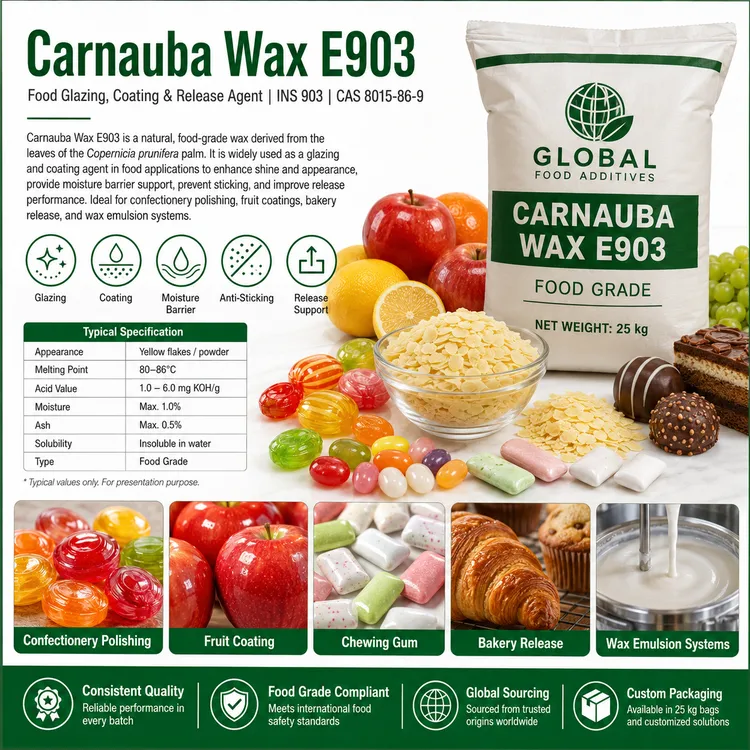
Wax performance depends on grade, melting point, particle size, emulsion system, application temperature, polishing time, humidity, surface composition and destination-market rules.
Product identity
| Product | Carnauba Wax |
|---|---|
| Alternative names | Carnauba Wax E903; INS 903; Brazil wax; palm wax; Copernicia prunifera wax; Copernicia cerifera wax; food glazing wax |
| Category | Glazing, Coating & Release Agents |
| Function | Glazing, coating, release, carrier or antifoam ingredient |
| E / INS number | E903 / INS 903 |
| CAS / identity | 8015-86-9; confirm botanical source, food-grade status and grade identity on supplier COA/SDS |
| Botanical source | Wax from the leaves of the carnauba palm; botanical naming and origin should be verified on supplier documentation |
| Typical form | Flake, bead, pastille, powder, micronized powder, liquid emulsion, aqueous dispersion or application-specific coating preparation |
| Typical appearance | Light yellow, yellow, brownish-yellow or tan solid flakes/pastilles, depending on grade, refining and colour specification |
| Main technical value | Provides high gloss, hardness, surface protection, anti-sticking, moisture-barrier support and release performance |
| Key buying point | Compare by coating performance, colour grade, melting point, application behaviour, compliance documents and cost-in-use, not only by price per kilogram |
Industrial buying value
Carnauba Wax is normally evaluated when a manufacturer needs a durable, glossy and relatively hard wax layer on the product surface. It can be used as a polishing aid, glazing agent, coating component, moisture-barrier layer, anti-sticking aid or release ingredient. The correct grade depends on whether the process uses dry wax, molten wax, aqueous emulsion, solvent-free dispersion, pan coating, tumble polishing, spray coating, fruit waxing, gum base or tablet coating.
- Supports bright gloss and premium visual finish on selected coated products
- Can reduce sticking and improve surface separation in confectionery, gum and coating processes
- Can contribute moisture-barrier performance and surface protection when used in suitable coating systems
- Can be supplied as raw wax, refined flakes, micronized powder, emulsion or custom coating blend
- Requires review of grade, origin, melting range, emulsion system, use level and destination-market approval
Technical overview
Carnauba Wax is a high-melting natural plant wax composed mainly of long-chain wax esters, fatty alcohols, acids and related wax constituents. In food and nutraceutical manufacturing, it is valued for hardness, gloss, polishability and resistance to tackiness. Because it is hard and brittle in pure form, it is often used at low dosage or blended with other waxes, resins, oils, emulsifiers or coating ingredients to control film flexibility, gloss, adhesion and processing behaviour.
For procurement and R&D teams, Carnauba Wax should be evaluated as a surface-function ingredient. A wax that is excellent for confectionery polishing may not be suitable for fruit coating, tablet glazing, bakery release or chewing gum. The final result depends on wax form, melting point, particle size, emulsification, solvent or water system, surface moisture, temperature, polishing equipment and shelf-life conditions.
Functional coating logic
Carnauba Wax works primarily at the product surface. It can help produce gloss, reduce surface tack, support moisture resistance and improve handling. In many systems, it performs best as part of a coating blend rather than as the only coating component.
- Gloss: improves shine after polishing, tumbling or controlled drying
- Hardness: contributes a firm surface film and helps reduce tackiness
- Moisture barrier: can reduce moisture transfer when applied in a continuous coating layer
- Release: can reduce sticking to pans, belts, moulds or product-contact surfaces where suitable
- Carrier function: can act as a waxy matrix or surface carrier in selected coating formulations
Performance variables
The same Carnauba Wax grade can perform differently across factories. Industrial trials should evaluate the grade under actual coating temperature, product moisture, pan speed, spray rate, drying airflow, polishing time, storage humidity and packaging conditions.
- Wax grade, colour, melting point and hardness
- Particle size, flake thickness, powder fineness or emulsion droplet size
- Application temperature, spray pressure, pan load, tumble speed and polishing time
- Product surface moisture, sugar shell, oil content, acid coating or chocolate/fat surface
- Packaging barrier, humidity, heat exposure and abrasion during distribution
Application fit
Potential use areas may include the applications below, subject to destination-market rules, approved food categories, use level, final label declaration and customer policy. These examples are technical formulation contexts, not a universal approval list.
| Application area | Technical reason to evaluate | Buyer / R&D checks |
|---|---|---|
| Confectionery polishing | Surface shine, reduced tack, improved product separation and premium visual finish on coated candies or sugar shells | Pan coating process, wax dosage, shell dryness, polishing time, tumble speed, gloss retention, bloom risk and label requirements |
| Fruit coatings | Gloss, moisture-barrier support and protective coating in approved fruit-wax systems | Fruit type, coating emulsion, respiration, drying tunnel, residue level, label rules, storage humidity and appearance after shelf life |
| Chewing gum and gum coatings | Surface polish, anti-sticking, gum-base compatibility and coating protection | Gum base, sugar-free coating, polyol system, humidity, dusting, polishing wax blend and packaging barrier |
| Tablet and supplement coatings | Final gloss, swallowability, anti-tack and coating protection in suitable tablet or nutraceutical coating systems | Regulatory category, tablet core, film coating, wax dosage, pan speed, dusting, abrasion and declaration requirements |
| Bakery release systems | Release support and anti-sticking in selected baking, moulding or contact-surface systems | Application temperature, release-oil system, pan material, bake temperature, residue, smoke point and food-contact compliance |
| Chocolate and compound coatings | Surface polish or coating performance where wax compatibility is technically and legally suitable | Fat compatibility, bloom, mouthfeel, melting profile, gloss, wax dosage and customer chocolate-standard restrictions |
| Snack and cereal coatings | Anti-sticking, gloss or surface barrier in selected coated snack, cereal or inclusion systems | Oil load, sugar syrup, drying, abrasion, pack humidity, sensory impact and coating uniformity |
| Capsules and small food units | Polishing and surface protection for selected food, nutraceutical or confectionery units | Regulatory category, coating solvent/emulsion, static charge, abrasion, gloss and packaging friction |
| Custom coating blends | Combination of gloss, hardness, flexibility, release and barrier properties | Blend compatibility with beeswax, candelilla wax, shellac, oils, emulsifiers, resins and permitted carriers |
Quality and specification parameters
For industrial purchasing, Carnauba Wax should be compared by measurable wax properties, food-grade compliance and coating performance. A technically suitable grade should deliver the required gloss, hardness, film quality and release effect without unacceptable colour, odour, contamination risk, emulsion instability, off-flavour, poor polishing or regulatory gaps.
| Specification area | What to request | Why it matters |
|---|---|---|
| Identity and grade | Product name, E903 confirmation, CAS number, botanical source, supplier grade code and intended use | Confirms correct food-grade wax identity and avoids technical or non-food wax substitution |
| Colour grade | Colour classification, visual grade, Lovibond or supplier colour method where available | Important for white coatings, light confectionery, tablets and transparent or pale systems |
| Melting range | Melting point or melting range with test method | Controls processing temperature, film hardness, polishing behaviour and heat resistance |
| Acid value | Acid value and acceptance range | Supports wax identity, refining control and batch consistency |
| Saponification value | Saponification value and analytical method | Helps characterize wax ester content and compare supplier grades |
| Ester value | Ester value or calculated ester-related data where available | Relevant for identity, functionality and quality consistency |
| Moisture and volatile matter | Moisture, volatile matter and loss on drying where relevant | Affects storage stability, emulsion preparation, caking and coating performance |
| Ash and impurities | Ash, insoluble matter, foreign matter and filtration residue limits | Important for coating smoothness, mouthfeel, equipment protection and food-grade purity |
| Particle size or physical form | Flake size, bead size, micronized powder size, sieve data or emulsion droplet guidance | Affects melting speed, dispersion, dusting, dosing accuracy and coating uniformity |
| Emulsion properties | Solids content, viscosity, pH, emulsifier system, preservative system and stability data for emulsion grades | Critical for spray coating, fruit coating, aqueous glazing and automated dosing |
| Odour and sensory impact | Odour profile, taste neutrality and sensory guidance at intended dosage | Important for confectionery, gum, fruit coatings and tablets |
| Contaminants | Heavy metals, lead, arsenic, cadmium, mercury, pesticide residues and foreign matter | Important for plant-derived waxes, export compliance and customer audits |
| Microbiology | Microbiological specification where relevant, especially for emulsion or dispersion grades | Important for water-based preparations, fruit coatings and high-care applications |
| Compliance | Food-grade declaration, allergen statement, GMO statement, gluten statement, vegan/vegetarian statement, halal/kosher if required | Reduces regulatory, customer and label-approval delays |
| Traceability | Manufacturer, processor, country of origin, batch number, production date, retest date and shelf life | Enables supplier qualification, recall readiness and audit-trail control |
Formulation and plant-trial checklist
- Target function: define whether Carnauba Wax is needed for gloss, anti-sticking, release, moisture barrier, abrasion resistance, coating hardness or final polish.
- Wax form: select flake, bead, micronized powder, molten wax, emulsion or dispersion according to the equipment and process.
- Dosage screening: test several wax levels because too little wax may give weak gloss, while too much can cause waxy feel, flaking or dullness.
- Surface condition: verify product surface dryness, temperature, oil level, sugar shell condition, dust level and humidity before wax application.
- Coating process: validate pan speed, spray rate, airflow, temperature, polishing time, drying time and load size.
- Blend compatibility: test compatibility with beeswax, candelilla wax, shellac, oils, emulsifiers, resins, colours, flavours and anti-sticking agents.
- Sensory review: check waxy mouthfeel, odour, flavour masking, texture, swallowability and surface feel.
- Shelf-life validation: monitor gloss retention, whitening, bloom, cracking, stickiness, moisture uptake, abrasion and package scuffing.
- Regulatory review: confirm E903 permission, food category, use level, label declaration and customer-specific restrictions.
- Cost-in-use: compare suppliers by wax dosage, processing speed, rejected units, coating defects, packaging performance and landed cost.
Comparison with related coating and glazing options
Carnauba Wax is part of a wider glazing and coating toolbox. The right choice depends on gloss target, hardness, flexibility, barrier need, origin, label rules, process equipment and destination-market approval.
| Coating option | Typical reason to compare | Industrial note |
|---|---|---|
| Carnauba Wax / E903 | High gloss, hard surface film, anti-sticking and moisture-barrier support | Hard and high-melting; often used at low dosage or in blends |
| Beeswax / E901 | Gloss, flexibility and coating softness in selected applications | Animal-derived; may not fit vegan or certain customer policies |
| Candelilla Wax / E902 | Plant-based wax alternative with hardness and glazing function | Different melting profile, hardness and origin; validate substitution carefully |
| Shellac / E904 | Strong gloss, film formation and coating protection in selected systems | Not plant-derived; alcohol-based or aqueous systems and label policy must be reviewed |
| Microcrystalline wax | Flexible wax film, barrier support and texture modification where permitted | Petroleum-derived; regulatory and customer acceptance vary by market and application |
| Vegetable oils and release oils | Release, anti-sticking and surface lubrication | Usually softer and less glossy; may oxidize or migrate more than wax systems |
| Hydrocolloid or film-forming coatings | Edible film structure, barrier or carrier function | Can complement waxes but may not provide the same gloss or water resistance |
Process integration guidance
Carnauba Wax should be added through a controlled coating or polishing procedure. The best addition point depends on whether the wax is used as solid wax, molten wax, powder, emulsion or dispersion. A successful process normally requires controlled surface dryness, uniform dosage, sufficient distribution, proper drying or cooling and verification of final gloss or release performance.
Solid wax and polishing systems
- Use small, controlled wax additions to avoid over-waxing, surface bloom or waxy mouthfeel
- Confirm product shell or surface is dry enough before wax addition
- Control pan speed, tumble time, airflow and temperature for uniform polish
- Validate gloss after cooling and after storage, not only immediately after production
- Record wax lot, dosage, pan load, polishing time and reject rate for traceability
Emulsion and spray coating systems
- Check emulsion solids, viscosity, pH, droplet stability and preservative system before use
- Use suitable spray nozzles, pressure and agitation to prevent separation or clogging
- Validate drying tunnel temperature, airflow, dwell time and final moisture
- Monitor coating uniformity, tack, gloss, whitening and surface defects
- Confirm microbial and preservative controls for water-based coating preparations
Coating performance and validation workflow
Industrial buyers should evaluate Carnauba Wax through application trials rather than only laboratory wax properties. The wax must perform on the actual product surface under real equipment and packaging conditions.
| Validation step | Recommended buyer action |
|---|---|
| 1. Define surface target | Set measurable expectations for gloss, tack, release, abrasion, moisture barrier and surface feel |
| 2. Select wax format | Choose flakes, beads, powder, molten wax, emulsion or dispersion based on the plant process |
| 3. Run dosage ladder | Test several wax levels and compare gloss, defects, sensory impact and cost-in-use |
| 4. Stress test storage | Evaluate heat, humidity, transport vibration, package scuffing and long-term gloss retention |
| 5. Review compliance | Confirm E903 status, use level, food category, label declaration and customer policy |
| 6. Lock specification | Approve colour grade, melting range, acid value, physical form, packaging and document package |
Handling, storage and warehouse control
Carnauba Wax should be handled according to the supplier safety data sheet, food-safety plan and local workplace rules. Solid waxes are generally stable but can cake, pick up odours, become dusty or melt/soften if stored improperly. Emulsion grades require stronger microbial, temperature and separation controls.
| Control point | Recommended buyer action |
|---|---|
| Storage environment | Store in a clean, cool, dry and well-ventilated area according to supplier recommendations |
| Temperature control | Protect from overheating, direct sunlight, hot warehouse zones and repeated temperature cycling |
| Moisture protection | Keep bags, cartons or drums sealed and protect powder or micronized grades from humidity |
| Emulsion storage | Follow supplier temperature range, mixing guidance, preservative controls and freeze-protection requirements |
| Odour control | Store away from strong-smelling ingredients, solvents, cleaning chemicals, spices and volatile flavours |
| Cross-contact | Manage allergen, GMO, halal, kosher, vegan and customer-specific segregation requirements |
| Lot traceability | Record lot number, supplier COA, internal release status and expiry/retest date before use |
| Opened packaging | Define resealing, relabelling, retest and maximum-open-time procedures for each grade |
Packaging and logistics options
Packaging depends on supplier standard, physical form and order volume. Common industrial requests include sample packs, laboratory trial packs, 5-10 kg trial cartons, 20-25 kg bags, lined cartons, fibre drums, flake cartons, pastille bags, powder drums, HDPE drums or jerrycans for emulsions, IBCs for large liquid preparations, palletised export packaging and full-container supply. For export projects, buyers should request pallet dimensions, net and gross weight, container type, liner type, batch coding system, shelf life, storage temperature, HS code guidance, document language and shipping marks before confirming the order.
Regulatory, sustainability and label diligence
Carnauba Wax should be managed as a regulated food glazing or coating ingredient according to the destination market. The buyer is responsible for verifying whether E903 / INS 903 is permitted in the destination market, whether the intended food category is covered, the maximum use level, purity criteria, label declaration, carrier system, emulsion ingredients and customer-specific restrictions.
Because Carnauba Wax is plant-derived and linked to specific agricultural supply chains, buyers may also request origin, traceability and responsible-sourcing documentation where customer standards require it. Sustainability, labour, biodiversity or responsible-sourcing claims should not be made unless supported by supplier documentation and accepted by the destination market and customer.
Documents to request
- Product specification or technical data sheet with grade, E903 / INS 903 confirmation and intended applications
- Certificate of analysis for available batch or representative lot
- Safety data sheet where applicable
- Food-grade declaration and market-specific additive-use statement
- Botanical origin statement, including carnauba palm source terminology where available
- CAS, E-number, manufacturing-process and refining-level statement where required
- Melting point or melting range, acid value, saponification value, ester value, ash and moisture data
- Colour grade, appearance, odour and sensory information where relevant
- Particle size, flake size, bead size, powder fineness or emulsion-solids data depending on product form
- Carrier, emulsifier, preservative and processing-aid declaration for emulsion or dispersion grades
- Pesticide-residue statement or test results aligned with buyer and destination-market requirements
- Heavy metals, lead, arsenic, cadmium, mercury and impurity statements aligned with buyer requirements
- Microbiological specification for emulsion, dispersion or water-containing grades where required
- Allergen statement, gluten statement, GMO statement and cross-contact information
- Vegan/vegetarian, BSE/TSE, irradiation and nanomaterial statements where required
- Halal and kosher certificates when required by customer or destination market
- Origin, traceability or responsible-sourcing declaration where required by customer policy
- Shelf-life, retest date and recommended storage conditions
- Label draft, packaging details, pallet configuration and net/gross weight
- Market-specific declarations required by the importing country
How to request this product
Send the product name, target grade, required form, intended application, quantity, destination country, packaging preference, expected shipment date, delivery term and required documents. If you already purchase Carnauba Wax, attach or describe your current specification, label, certificate of analysis, colour grade, melting range, physical form, dosage and supplier grade so alternatives can be compared accurately.
For faster technical review, include the finished-product category, target function, application process, coating equipment, use level, temperature, product surface condition, humidity exposure, packaging type, allergen/GMO requirements, destination-market rules, customer compliance requirements and whether trial samples are needed before bulk quotation.
Useful answers
What is Carnauba Wax used for in food manufacturing?
Carnauba Wax is typically reviewed for surface shine, glazing, anti-sticking, release performance, moisture-barrier support and protective coatings. Exact suitability depends on grade, application, process, regulations and supplier documents.
Is Carnauba Wax the same as beeswax or candelilla wax?
No. Carnauba Wax, beeswax and candelilla wax differ in botanical or animal origin, melting profile, hardness, gloss, flexibility, flavour impact, label status and permitted use. Substitution should be validated in the actual coating system.
Which applications commonly evaluate this wax?
Potential applications include confectionery polishing, fruit coatings, chewing gum, tablet and supplement coatings, bakery release systems, chocolate or compound coatings, snack coatings, cereal coatings and custom glazing blends.
Which technical parameters should be compared between suppliers?
Buyers should compare E903 identity, botanical origin, colour grade, melting point, acid value, saponification value, ester value, moisture, ash, particle size, emulsion solids, viscosity, gloss performance, release performance, heavy metals, pesticide residues, origin, shelf life, packaging and compliance documents.
Can Carnauba Wax be supplied as an emulsion?
Yes. Depending on supplier, Carnauba Wax may be offered as solid flakes, pastilles, powder, micronized powder, aqueous emulsion, dispersion or custom coating blend. Emulsion grades require additional checks for solids, viscosity, pH, preservative system, microbial status and freeze-thaw stability.
Can Global Food Additives source Carnauba Wax?
Global Food Additives can review sourcing options for Carnauba Wax according to target specification, grade, physical form, application, quantity, destination, packaging, shipment timing and required documentation.
Which documents should be requested?
Buyers commonly request a technical data sheet or specification, certificate of analysis, safety data sheet where applicable, food-grade declaration, E903 confirmation, origin statement, allergen/GMO/gluten statements, pesticide-residue information, heavy-metal information, shelf-life information, label details and packing details.
Is this product permitted in every country?
No. Food additive use depends on destination-market rules, food category, approved use, use level, purity criteria, label requirements and buyer responsibility. Always verify regulatory status before commercial use.
Tell us which food additive or ingredient you need.
Send product names, target specifications, quantity, destination country, packaging preference, delivery term, and document requirements. Our team will review your inquiry and respond from orders@foodgradeadditives.com.
Your message has been received. You will be redirected to the home page.