
Cassia Gum
Cassia Gum, commonly referenced as E427 / INS 427, is a seed-derived galactomannan hydrocolloid used for viscosity control, water binding, stabilisation, gel texture, suspension, freeze-thaw support and mouthfeel in selected food systems. For industrial manufacturers, the real purchasing value depends on viscosity profile, hydration behaviour, particle size, gum synergy, microbiological quality, botanical source, impurity limits, regulatory fit, documentation quality and batch-to-batch consistency.
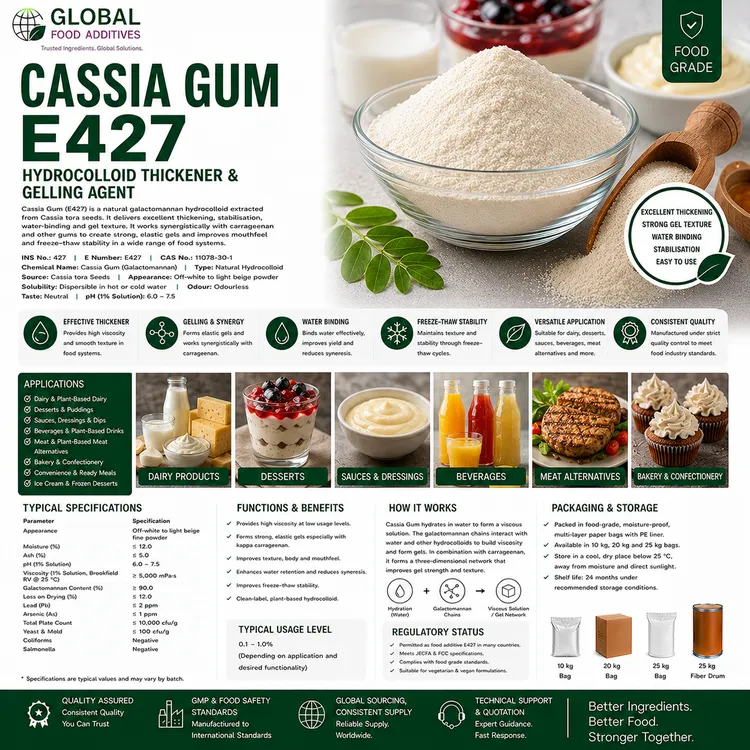
Hydrocolloid performance depends on hydration, shear, pH, temperature, sugar, salt, protein, gum blend, processing order and destination-market rules.
Product identity
| Product | Cassia Gum |
|---|---|
| Alternative names | Cassia gum E427; INS 427; cassia galactomannan; Cassia tora gum; Senna tora gum; Senna obtusifolia gum |
| Category | Hydrocolloids, Gums & Gelling Agents |
| Function | Thickener / stabilizer / gelling ingredient |
| E / INS number | E427 / INS 427 |
| CAS / identity | 11078-30-1; confirm botanical source, purification level and grade identity on supplier COA/SDS |
| Hydrocolloid family | Seed galactomannan polysaccharide |
| Typical botanical source | Endosperm of Cassia / Senna seed species; source terminology should be verified by supplier documentation |
| Typical form | Fine powder, granule, low-dust powder, instantized grade, dry blend or application-specific hydrocolloid preparation |
| Typical appearance | Off-white to pale yellow powder, depending on seed source, purification, milling and particle-size grade |
| Main technical value | Provides thickening, water binding, suspension, stabilisation and gel-building support, especially in combination with other hydrocolloids |
| Key buying point | Compare by viscosity, hydration, gel performance, regulatory status, impurity limits and cost-in-use, not only by price per kilogram |
Industrial buying value
Cassia Gum is normally evaluated when a manufacturer needs a cost-effective galactomannan hydrocolloid for texture, body, stabilisation or gel-support functions. It can be used alone for viscosity and water binding or in blends with carrageenan, xanthan, guar, locust bean gum, starches or other stabilizers to tune gel strength, suspension, mouthfeel and freeze-thaw stability.
- Supports viscosity, body and suspension in selected water-based and dairy-style systems
- Can provide gel-texture support when paired with suitable hydrocolloids
- Useful for water binding, syneresis control and freeze-thaw performance in selected applications
- Can be supplied as fine powder, granule, low-dust or instantized grade depending on supplier
- Requires careful validation of hydration temperature, impurity limits, microbial quality and destination-market approval
Technical overview
Cassia Gum is a high-molecular-weight galactomannan hydrocolloid. Like guar gum, tara gum and locust bean gum, it contains a mannose backbone with galactose side groups; however, its branching pattern and hydration behaviour give it a distinct functional profile. In food formulation, it is often valued for thickening, water binding and synergistic gel formation with other gums rather than for strong gel formation by itself.
For procurement and R&D teams, Cassia Gum should be evaluated as a functional hydrocolloid system component. The same supplier grade can perform differently in milk, water, sauce, dessert gel, meat alternative, beverage, frozen product or dry mix. Hydration method, powder dispersion, pH, heat process, sugar, salt, calcium, proteins and shear all influence final performance.
Hydration and viscosity behaviour
Cassia Gum performance depends strongly on hydration. Insufficient dispersion or low hydration temperature can cause lumps, delayed viscosity, inconsistent texture or poor stabilisation. Industrial trials should define a controlled powder-addition and hydration procedure before commercial scale-up.
- Pre-blend with sugar, salt, starch or other dry ingredients to improve dispersion
- Use adequate agitation to prevent fish-eyes and surface gelation
- Validate hydration temperature and time for each product matrix
- Check viscosity after thermal processing, cooling and storage
- Measure final texture after complete hydration, not only immediately after mixing
Synergy with other hydrocolloids
Cassia Gum is frequently evaluated in blends because galactomannans can interact with selected gelling agents. The right blend can improve gel texture, reduce syneresis, support freeze-thaw performance, stabilise emulsions or reduce total gum dosage.
- Carrageenan blends for dairy-style gels, desserts and protein-containing systems
- Xanthan blends for viscosity, suspension and shear-thinning behaviour
- Guar or locust bean gum blends for body, texture and cost optimisation
- Starch blends for heat-processed sauces, fillings and viscosity control
- Protein and fibre systems for plant-based texture and water management
Application fit
Potential use areas may include the applications below, subject to destination-market rules, food-category permission, use level, final label declaration and customer policy. These examples are technical formulation contexts, not a universal approval list.
| Application area | Technical reason to evaluate | Buyer / R&D checks |
|---|---|---|
| Dairy desserts and gelled dairy systems | Body, gel texture, water binding, protein stabilisation and syneresis control in selected formulations | Milk protein level, carrageenan synergy, calcium, pH, heat treatment, cooling curve, gel strength and spoon texture |
| Frozen desserts and ice cream-style products | Water binding, ice-crystal control, meltdown resistance and freeze-thaw texture support | Overrun, fat content, sugar solids, freezing profile, stabilizer blend, heat treatment and storage abuse testing |
| Sauces, dressings and condiments | Viscosity, suspension, emulsion support, cling and mouthfeel in hot- or cold-processed sauces | pH, salt, sugar, oil phase, emulsifiers, starch, heat process, shear, pourability and phase separation |
| Beverages and drinkable systems | Suspension, body and texture in selected beverage systems where approved and technically suitable | Hydration, sediment, turbidity, viscosity, pH, protein interaction, heat stability and drinking mouthfeel |
| Plant-based dairy alternatives | Texture, body, emulsion support and water management in plant-based milk, yogurt and dessert systems | Plant protein type, calcium salts, pH, heat process, homogenisation, flavour masking and shelf-life stability |
| Meat alternatives and savoury gels | Water binding, bite, juiciness, structure support and cook-yield improvement in selected systems | Protein source, salt level, fat phase, heating profile, methylcellulose or carrageenan interaction, cooking loss and texture |
| Bakery fillings and fruit preparations | Viscosity, water retention, bake stability and fruit suspension in fillings, toppings and preparations | Brix, pH, fruit solids, starch blend, bake exposure, freeze-thaw stability and syneresis |
| Confectionery and dessert gels | Gel-texture tuning, water binding and chew or spoonable texture development | Sugar solids, acid system, gel partner, cooking temperature, set time, texture and shelf-life moisture migration |
| Dry mixes and premixes | Hydrocolloid functionality in instant desserts, sauce powders, drink powders and stabilizer blends | Particle size, dusting, dry-blend uniformity, reconstitution, lumping, hydration time and packaging barrier |
Quality and specification parameters
For industrial purchasing, Cassia Gum should be compared by measurable hydrocolloid performance, purity, microbiology and regulatory documentation. A technically suitable grade should deliver the target viscosity or gel performance without unacceptable lumping, grittiness, microbial load, off-odour, impurity concerns, caking or regulatory gaps.
| Specification area | What to request | Why it matters |
|---|---|---|
| Identity and grade | Product name, E427 confirmation, CAS number, botanical source, supplier grade code and intended use | Confirms correct hydrocolloid identity and avoids substitution with non-food or feed-grade material |
| Galactomannan content | Polysaccharide or galactomannan content and analytical method where available | Supports performance consistency and supplier comparison |
| Viscosity | Viscosity method, concentration, hydration temperature, spindle/speed, pH and measurement temperature | Critical because viscosity values are not comparable unless test conditions are the same |
| Particle size | Mesh size, D10/D50/D90 where available, dust level and sieve residue | Affects dispersion, lumping, hydration rate, mouthfeel, dry blending and dosing accuracy |
| Hydration profile | Cold-water or hot-water hydration behaviour, time to viscosity and recommended processing conditions | Important for plant trials, instant products and process-line design |
| Gel performance | Gel strength, syneresis data and blend performance with carrageenan, xanthan or starch where available | Supports dessert, dairy, meat alternative and gel-texture applications |
| Moisture and water activity | Moisture, loss on drying and water activity where relevant | Influences caking, microbial stability, shelf life and warehouse performance |
| Ash and insoluble matter | Total ash, acid-insoluble matter and foreign matter limits | Important for purity, mouthfeel, compliance and filtration-sensitive applications |
| Botanical impurity limits | Anthraquinone-related limits, seed husk residues or market-specific impurity criteria where required | Supports regulatory compliance and customer approval for Cassia-derived materials |
| Colour and odour | Appearance, colour range, odour standard and sensory guidance | Important for dairy, beverages, light-coloured desserts and neutral-flavour products |
| Contaminants | Heavy metals, lead, arsenic, cadmium, mercury, pesticide residues, mycotoxins and foreign matter | Important for seed-derived ingredients, export compliance and customer audits |
| Microbiology | Total plate count, yeast and mould, coliforms, E. coli, Salmonella, Bacillus cereus and other limits where required | Critical for dairy, beverages, desserts, dry mixes and high-care factories |
| Compliance | Food-grade declaration, allergen statement, GMO statement, gluten statement, vegan/vegetarian statement, halal/kosher if required | Reduces regulatory, customer and label-approval delays |
| Traceability | Manufacturer, processor, country of origin, batch number, production date, retest date and shelf life | Enables supplier qualification, recall readiness and audit-trail control |
Formulation and plant-trial checklist
- Target function: define whether Cassia Gum is needed for viscosity, suspension, gel texture, water binding, freeze-thaw stability, emulsion support or mouthfeel.
- Hydration method: test water temperature, shear level, hydration time, pre-blending and order of addition.
- Dosage screening: run trials at several use levels because small hydrocolloid changes can strongly affect viscosity and texture.
- Gum synergy: evaluate blends with carrageenan, xanthan, guar, locust bean gum, starch or proteins if gel strength or syneresis control is required.
- pH and salt: validate performance at the actual finished-product pH, salt level, sugar solids and mineral balance.
- Heat process: test pasteurisation, UHT, hot-fill, retort, cooking, baking or freezing where applicable.
- Texture target: define measurable targets such as viscosity, gel strength, spoonability, pourability, cling, bite, spreadability or suspension.
- Sensory review: check mouthcoating, gumminess, sliminess, grittiness, off-odour and flavour release.
- Shelf-life validation: monitor syneresis, sediment, phase separation, viscosity drift, caking, freeze-thaw change and microbial stability.
- Cost-in-use: compare suppliers by functional dosage, processing ease, rejects, texture consistency, documentation and landed cost.
Comparison with related hydrocolloids
Cassia Gum is part of a wider hydrocolloid toolbox. The right choice depends on target texture, process conditions, label rules, cost, gum synergy and destination-market approval.
| Hydrocolloid option | Typical reason to compare | Industrial note |
|---|---|---|
| Cassia Gum / E427 | Galactomannan thickening, water binding and gel support with other gums | Check market approval, impurity limits, hydration needs and blend performance |
| Guar Gum / E412 | High cold-water viscosity and broad thickening use | Often hydrates faster; can create higher viscosity but different texture and mouthfeel |
| Locust Bean Gum / E410 | Gel synergy, dairy texture and freeze-thaw support | Often requires heat for full hydration; supply and cost can vary |
| Tara Gum / E417 | Intermediate galactomannan performance between guar and locust bean gum | Useful for texture and stabilisation where approved; compare hydration and cost-in-use |
| Xanthan Gum / E415 | Suspension, shear-thinning viscosity and acid/salt tolerance | Strong for sauces and beverages; blends with galactomannans can modify texture |
| Carrageenan / E407 | Dairy gelation, protein interaction and gel texture | Common partner for galactomannans; verify type, potassium/calcium response and label strategy |
| Starches | Bulk viscosity, body and cooked texture | Can reduce gum cost but may affect flavour, opacity, freeze-thaw stability and processing |
Process integration guidance
Cassia Gum should be added through a controlled hydrocolloid-dispersion process. The best addition point depends on the product matrix, powder grade, hydration temperature and other stabilizers. Poor dispersion can cause lumps, delayed hydration and inconsistent texture even when the correct grade is used.
Dry addition and pre-blending
- Pre-blend Cassia Gum with sugar, salt, starch or other dry ingredients to improve powder separation
- Add slowly into a vortex or high-shear zone to avoid fish-eyes
- Control dusting and operator exposure during weighing and mixing
- Validate the mixing sequence with other gums and proteins
- Record lot number, dosage, mixing speed, hydration time and final viscosity
Thermal and high-moisture processing
- Define the temperature needed for full hydration in the target matrix
- Check viscosity before and after pasteurisation, cooking, cooling and holding
- Monitor gel setting during cooling if the gum is used with carrageenan or other gelling agents
- Evaluate shear sensitivity through pumps, homogenisers and fillers
- Confirm texture after 24 hours and after expected shelf-life storage
Hydrocolloid blend design
Most industrial Cassia Gum projects should include blend trials. The goal is not simply to increase viscosity but to achieve the correct texture with stable processing, acceptable sensory profile and compliant labelling. Blend performance should be tested in the real product rather than in water alone.
| Blend objective | Recommended buyer action |
|---|---|
| Increase viscosity | Compare Cassia Gum alone and in blends with xanthan, guar, starch or cellulose derivatives |
| Improve gel texture | Evaluate carrageenan, locust bean gum or starch blends for gel strength, elasticity and syneresis |
| Stabilise proteins | Test dairy or plant protein systems under final pH, heat treatment and storage conditions |
| Reduce syneresis | Measure water release after cooling, freezing, thawing, centrifugation or shelf-life storage |
| Improve mouthfeel | Run sensory panels for gumminess, sliminess, thickness, creaminess and flavour release |
| Optimise cost | Compare cost per tonne of finished product at equal texture, not equal gum dosage |
Handling, storage and warehouse control
Cassia Gum should be handled according to the supplier safety data sheet, food-safety plan and local workplace rules. Hydrocolloid powders can absorb moisture, cake, create dust and lose flowability if stored poorly. Storage conditions should protect functionality, microbiological quality and powder handling performance.
| Control point | Recommended buyer action |
|---|---|
| Storage environment | Store in a clean, cool, dry and well-ventilated area according to supplier recommendations |
| Moisture protection | Keep bags or containers sealed until use and protect opened packs from humidity and condensation |
| Dust management | Use suitable handling controls and PPE according to SDS and site policy |
| Odour control | Store away from strong-smelling ingredients, cleaning chemicals, spices and volatile flavours |
| Cross-contact | Manage allergen, gluten, soy, dairy, sesame, nut and other cross-contact risks according to site requirements |
| Lot traceability | Record lot number, supplier COA, internal release status and expiry/retest date before use |
| Opened packaging | Define resealing, relabelling, retest and maximum-open-time procedures for each grade |
Packaging and logistics options
Packaging depends on supplier standard, particle size, grade and order volume. Common industrial requests include sample packs, laboratory trial packs, 5-10 kg trial bags, 20-25 kg multiwall bags, PE-lined bags, cartons, fibre drums, big bags, palletised export packaging and full-container supply. For export projects, buyers should request pallet dimensions, net and gross weight, liner type, batch coding system, shelf life, storage temperature, HS code guidance, document language and shipping marks before confirming the order.
Regulatory and label diligence
Cassia Gum should be managed as a regulated hydrocolloid food additive or ingredient according to the destination market. The buyer is responsible for verifying whether E427 / INS 427 is permitted in the destination market, whether the intended food category is covered, the maximum use level, purity criteria, impurity limits, botanical-source wording, label declaration and customer-specific restrictions.
Regulatory status can differ by country, food category and product positioning. A grade that is acceptable in one dairy dessert, sauce or frozen product may not be automatically acceptable in infant foods, medical foods, beverages, export-only products or organic programs. Regulatory and customer approval should be completed before bulk purchase and before full-scale production.
Documents to request
- Product specification or technical data sheet with grade, E427 / INS 427 confirmation and intended applications
- Certificate of analysis for available batch or representative lot
- Safety data sheet where applicable
- Food-grade declaration and market-specific additive-use statement
- Botanical origin statement, including Cassia / Senna source terminology where available
- CAS, E-number, manufacturing-process and purification-level statement where required
- Viscosity method, concentration, hydration conditions, pH, temperature and acceptance range
- Particle size, bulk density, moisture, ash, acid-insoluble matter and flowability data
- Anthraquinone-related impurity statement or test results where required by destination market or customer specification
- Pesticide-residue statement or test results aligned with buyer and destination-market requirements
- Heavy metals, lead, arsenic, cadmium, mercury, mycotoxins and impurity statements aligned with buyer requirements
- Microbiological specification for dairy, beverage, dessert, dry mix or high-care applications
- Allergen statement, gluten statement, GMO statement and cross-contact information
- Vegan/vegetarian, BSE/TSE, irradiation and nanomaterial statements where required
- Halal and kosher certificates when required by customer or destination market
- Shelf-life, retest date and recommended storage conditions
- Label draft, packaging details, pallet configuration and net/gross weight
- Market-specific declarations required by the importing country
How to request this product
Send the product name, target grade, required viscosity, intended application, quantity, destination country, packaging preference, expected shipment date, delivery term and required documents. If you already purchase Cassia Gum, attach or describe your current specification, label, certificate of analysis, viscosity method, particle size, dosage and supplier grade so alternatives can be compared accurately.
For faster technical review, include the finished-product category, target texture, pH, heat process, hydration method, gum blend, protein system, sugar and salt level, freeze-thaw requirement, allergen/GMO requirements, destination-market rules, customer compliance requirements and whether trial samples are needed before bulk quotation.
Useful answers
What is Cassia Gum used for in food manufacturing?
Cassia Gum is typically reviewed for viscosity, suspension, water binding, gel texture, freeze-thaw stability, syneresis control and mouthfeel. Exact suitability depends on grade, application, process, regulations and supplier documents.
Is Cassia Gum the same as guar gum?
No. Cassia Gum and guar gum are both galactomannan hydrocolloids, but they differ in botanical source, molecular structure, hydration, viscosity, gum synergy, texture and regulatory status. Substitution should be validated in the actual finished product.
Does Cassia Gum gel by itself?
Cassia Gum is mainly used for thickening and stabilisation, but it can contribute to gel texture when used with suitable hydrocolloids such as carrageenan or other gelling systems. Gel performance depends on the full formulation.
Which applications commonly evaluate this hydrocolloid?
Potential applications include dairy desserts, frozen desserts, sauces, dressings, beverages, plant-based dairy alternatives, meat alternatives, bakery fillings, confectionery, dessert gels, dry mixes and stabilizer blends.
Which technical parameters should be compared between suppliers?
Buyers should compare E427 identity, viscosity method, particle size, hydration profile, gel performance, galactomannan content, moisture, ash, acid-insoluble matter, botanical impurity limits, microbiology, heavy metals, pesticide residues, origin, shelf life, packaging and compliance documents.
Can Global Food Additives source Cassia Gum?
Global Food Additives can review sourcing options for Cassia Gum according to target specification, viscosity, application, quantity, destination, packaging, shipment timing and required documentation.
Which documents should be requested?
Buyers commonly request a technical data sheet or specification, certificate of analysis, safety data sheet where applicable, food-grade declaration, E427 confirmation, origin statement, allergen/GMO/gluten statements, pesticide-residue information, heavy-metal information, microbiology data, shelf-life information, label details and packing details.
Is this product permitted in every country?
No. Food additive use depends on destination-market rules, food category, approved use, use level, purity criteria, label requirements and buyer responsibility. Always verify regulatory status before commercial use.
Tell us which food additive or ingredient you need.
Send product names, target specifications, quantity, destination country, packaging preference, delivery term, and document requirements. Our team will review your inquiry and respond from orders@foodgradeadditives.com.
Your message has been received. You will be redirected to the home page.