
Catalase
Catalase is a food enzyme preparation used to decompose hydrogen peroxide into water and oxygen in selected food manufacturing processes. It is typically evaluated for residual peroxide removal, dairy and cheese processing, peroxide-treated ingredient streams, liquid-food systems, aseptic-process support, oxidation management and process validation. For industrial buyers, the real purchasing value depends on declared activity, activity unit method, source organism, peroxide decomposition rate, pH and temperature profile, dosage efficiency, regulatory status, storage stability and documentation quality.
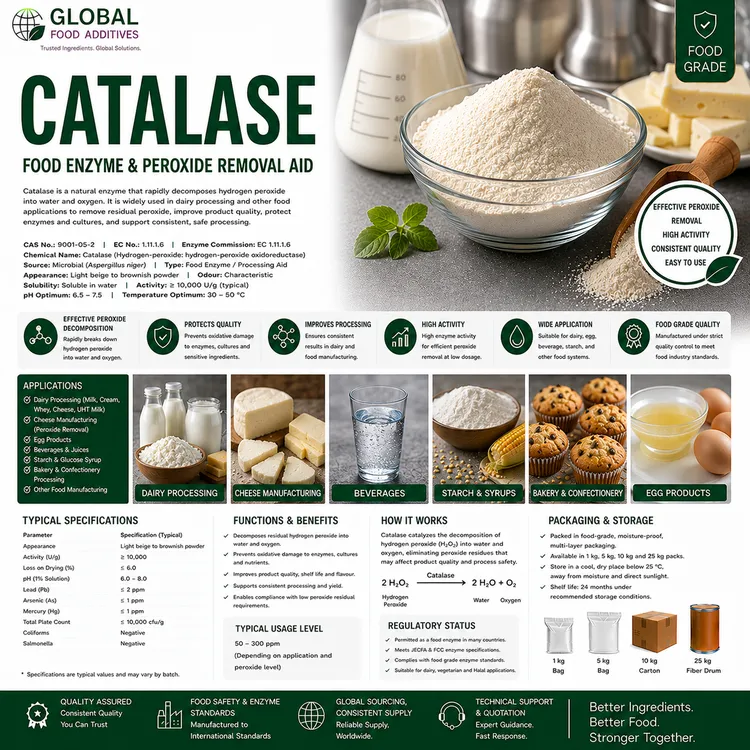
Catalase performance depends on peroxide level, pH, temperature, contact time, dosage, mixing, substrate matrix, thermal inactivation and destination-market food enzyme rules.
Product identity
| Product | Catalase |
|---|---|
| Alternative names | Catalase enzyme; food-grade catalase; hydrogen peroxide decomposing enzyme; peroxide removal enzyme |
| Category | Enzymes & Processing Aids |
| Function | Food enzyme / processing aid for manufacturing performance |
| E / INS number | Confirm by destination market and supplier documentation; food enzymes are often regulated by source organism, function and intended use rather than an E number |
| CAS / identity | 9001-05-2 |
| EC reference | EC 1.11.1.6; confirm activity units and test method on supplier specification |
| Primary reaction | 2 H2O2 → 2 H2O + O2 |
| Typical form | Liquid enzyme concentrate, stabilised liquid, powder, granulate, coated granule, tablet or custom enzyme preparation |
| Typical source | Microbial fermentation or biological extraction depending on supplier; confirm source organism, production strain and GMO status on documentation |
| Main technical value | Rapid peroxide decomposition, residual peroxide control, oxidation-management support and process efficiency in suitable food systems |
| Key buying point | Compare by peroxide removal performance under your process conditions, not only by kilogram price or nominal enzyme activity |
Industrial buying value
Catalase is normally evaluated when a factory uses hydrogen peroxide as part of a process and must reduce residual peroxide before the next manufacturing step. It can be used to protect cultures, enzymes, proteins, flavours, colours and sensitive product systems from unwanted oxidative effects. The best grade depends on peroxide concentration, target residual level, process pH, temperature, contact time, mixing efficiency and whether the enzyme must be inactivated or removed after use.
- Supports hydrogen peroxide decomposition into water and oxygen
- Can help protect starter cultures, enzymes and sensitive ingredients from residual peroxide
- Useful in selected dairy, cheese, liquid-food and peroxide-treated ingredient processes where permitted
- Can improve process control where peroxide removal must be validated before fermentation, filling or packaging
- Requires careful review of activity units, source organism, dosage, contact time, inactivation and regulatory classification
Technical overview
Catalase is an oxidoreductase enzyme that decomposes hydrogen peroxide. In food processing, this function is valuable when hydrogen peroxide has been used for antimicrobial treatment, ingredient treatment, processing-equipment steps or packaging-related operations and must be reduced before the product moves forward. Catalase does not replace hygienic design, pasteurisation, validated sanitation or regulatory approval; it is a process tool that must be integrated into a controlled manufacturing system.
Commercial catalase preparations may differ by source organism, activity method, purity, carrier, stabiliser, pH profile, temperature profile and physical form. Some products are designed for liquid dairy systems, some for general peroxide removal, and others for specialised industrial use that may not be suitable for food. Buyers should confirm food-grade status and market-specific suitability before approving any grade.
How Catalase works
Catalase accelerates the conversion of hydrogen peroxide into water and oxygen. In practical food processing, this can reduce peroxide residue, lower oxidative stress in the product matrix and make the system more compatible with starter cultures, rennet, enzymes, flavours, colours or other peroxide-sensitive components.
- Substrate: hydrogen peroxide in an aqueous or food-process matrix
- Output: water and oxygen released during peroxide decomposition
- Key control: sufficient enzyme activity, contact time and mixing to meet residual peroxide target
- Process risk: oxygen release can create foam, pressure or headspace changes if poorly controlled
- Validation need: residual peroxide should be measured with a suitable analytical method after treatment
Performance variables
The same Catalase dose can perform differently across factories and product matrices. Industrial trials should evaluate the enzyme under actual peroxide concentration, pH, temperature, solids, fat, protein, salt, mixing and hold-time conditions.
- Initial hydrogen peroxide concentration and target residual level
- pH, temperature, ionic strength and buffer capacity
- Milk solids, proteins, fats, sugars, salts, minerals and stabilisers
- Mixing efficiency, tank geometry, foam control and oxygen release
- Thermal inactivation, downstream fermentation, filling and shelf-life requirements
Application fit
Potential use areas may include the applications below, subject to destination-market rules, enzyme approval, processing-aid interpretation, process design, final label requirements and customer policy. These examples are technical production contexts, not a universal approval list.
| Application area | Technical reason to evaluate | Buyer / R&D checks |
|---|---|---|
| Dairy and cheese milk treatment | Removal of residual hydrogen peroxide before starter culture addition, renneting or cheese processing where permitted | Peroxide dose, residual peroxide target, milk pH, temperature, contact time, culture compatibility, rennet performance and local dairy rules |
| Fermented dairy systems | Protects fermentation cultures from peroxide residues that could delay acidification or reduce culture activity | Starter culture sensitivity, pH curve, incubation temperature, dissolved oxygen, flavour development and residual enzyme control |
| Liquid egg and egg-based systems | Can be reviewed where peroxide treatment or oxidative processing steps require controlled peroxide reduction | Protein functionality, foaming, colour, flavour, heat treatment, microbial validation and legal use |
| Beverage and liquid-food systems | Residual peroxide reduction in selected liquid systems or ingredient streams where hydrogen peroxide has been used and permitted | pH, sugar, acids, flavours, colour stability, oxygen release, filtration, haze and residual peroxide method |
| Cheese brines and process liquids | Potential peroxide control in selected process streams where peroxide residues must be reduced before reuse or product contact | Salt level, pH, microbial control plan, enzyme stability, validation method and plant hygiene requirements |
| Aseptic and packaging-related operations | Support for peroxide-residue control in validated operations where food contact or product transfer requires peroxide management | Packaging system, legal limits, residue testing, contact surface, inactivation/removal plan and process validation |
| Bakery and dough systems | May be evaluated where peroxide or oxidant residues affect dough handling, yeast activity or ingredient quality | Flour system, oxidant source, yeast performance, dough rheology, proofing, sensory impact and regulatory status |
| Brewing and fermentation processes | Can be reviewed where peroxide residues could affect yeast or fermentation performance in permitted process steps | Yeast viability, wort pH, dissolved oxygen, peroxide test method, foam, flavour and process validation |
| Ingredient preparation and enzyme blends | Can protect peroxide-sensitive ingredients or companion enzymes in controlled process sequences | Compatibility with other enzymes, preservatives, temperature, pH, inactivation conditions and final-product declaration |
Quality and specification parameters
For industrial purchasing, Catalase should be compared by enzyme activity, peroxide-removal performance, source-organism documentation and application fit. A technically suitable enzyme should achieve the target peroxide reduction without unacceptable side effects, activity loss, contamination risk, allergen uncertainty, weak stability or regulatory gaps.
| Specification area | What to request | Why it matters |
|---|---|---|
| Enzyme identity | Product name, enzyme class, CAS number, EC reference, source organism and production method | Confirms the food enzyme identity and supports regulatory/customer approval |
| Declared activity | Catalase activity units, assay method, hydrogen peroxide substrate concentration, pH, temperature and acceptance range | Activity units are method-dependent and must be understood before comparing suppliers |
| Peroxide decomposition rate | Application data showing hydrogen peroxide reduction over time under defined conditions | Supports dosage calculation and process validation |
| pH profile | Optimum pH, working pH range and stability at process pH | Critical for milk, brines, beverages, egg systems and fermentation processes |
| Temperature profile | Optimum temperature, working temperature range, thermal stability and inactivation conditions | Required for process design and residual enzyme control |
| Dosage guidance | Recommended dosage per kg, litre, tonne, ppm peroxide or application-specific basis | Supports cost-in-use calculation and trial design |
| Physical form | Liquid concentrate, stabilised liquid, powder, granulate, coated granule, tablet or custom blend | Determines handling, dosing accuracy, dusting, dissolution, storage and operator exposure |
| Carrier and stabilisers | Carrier declaration, preservatives, salts, glycerol, sugars, buffers or other formulation components | Affects label review, allergen status, dosage, viscosity, shelf life and customer approval |
| Foam and oxygen release | Guidance on oxygen generation, foam control and tank venting under expected peroxide levels | Important for process safety, tank design, product loss and filling consistency |
| Microbiological quality | Total plate count, yeast and mould, coliforms, E. coli, Salmonella and production-strain absence where required | Important for food enzyme safety, high-care processing and import compliance |
| Contaminants | Heavy metals, lead, arsenic, cadmium, mercury, mycotoxins and unwanted metabolites where relevant | Supports food-grade approval, export compliance and customer audit requirements |
| Allergen and GMO status | Allergen statement, GMO statement, fermentation substrate information and processing aid declarations | Important for customer approval, clean-label policies and destination-market documentation |
| Storage and shelf life | Recommended storage temperature, shelf life, opened-pack guidance and activity retention data | Enzyme activity can decline with heat, moisture, oxygen, time and poor handling |
| Traceability | Manufacturer, production site, batch number, production date, expiry/retest date and lot-specific COA | Enables supplier qualification, recall readiness and audit-trail control |
Formulation and plant-trial checklist
- Target function: define whether Catalase is needed for peroxide removal before fermentation, enzyme protection, dairy processing, packaging-related residue control or liquid-stream treatment.
- Peroxide mapping: measure starting hydrogen peroxide concentration and define the maximum acceptable residual peroxide level.
- Assay basis: confirm supplier activity units and avoid comparing enzyme products by unit number alone.
- Dosage screening: test multiple dosage levels under real process pH, temperature, peroxide level and contact time.
- Mixing validation: verify that the enzyme is distributed evenly and no untreated peroxide pockets remain in the tank or line.
- Foam management: evaluate oxygen release, venting, foam control and headspace effects before scale-up.
- Process endpoint: define when peroxide destruction is complete and how residual peroxide will be measured.
- Culture compatibility: confirm that starter cultures, yeast, rennet or companion enzymes perform normally after catalase treatment.
- Inactivation review: decide whether the enzyme needs thermal inactivation, removal or processing-aid justification.
- Cost-in-use: compare suppliers by delivered peroxide removal, dosage, process time reduction, validation support and landed cost.
Comparison with related food enzyme and peroxide-management options
Catalase is part of a wider processing-aid toolbox. The correct choice depends on whether the process goal is peroxide destruction, oxidation control, microbial reduction, colour protection, flavour protection or enzyme compatibility.
| Option | Typical reason to compare | Industrial note |
|---|---|---|
| Catalase | Hydrogen peroxide decomposition into water and oxygen | Best suited when residual peroxide must be removed before downstream processing |
| Peroxidase systems | Hydrogen peroxide-dependent oxidation reactions in selected systems | Different reaction pathway; not a direct replacement for Catalase in peroxide removal |
| Thermal peroxide reduction | Heat-assisted peroxide breakdown in some process streams | May affect flavour, protein quality, energy cost or process time |
| Chemical reducing agents | Peroxide reduction or oxidation control in limited applications where legally permitted | May affect label, taste, regulatory status and customer policy |
| Process dilution or rinsing | Physical reduction of peroxide concentration in equipment or packaging systems | May increase water use, waste load and validation complexity |
| Companion enzyme blends | Peroxide protection for other enzymes or sensitive processing steps | Requires compatibility testing because pH, preservatives and temperature can affect multiple enzymes |
Process integration guidance
Catalase should be introduced through a controlled process window. The optimal point of addition depends on hydrogen peroxide concentration, product matrix, equipment design and downstream process. In many applications, Catalase is added after peroxide treatment and before fermentation, coagulation, filling, packaging, flavour addition or enzyme-sensitive steps.
Liquid enzyme handling points
- Meter accurately into milk, brine, liquid food, process water or ingredient stream according to supplier guidance
- Mix evenly to avoid local untreated peroxide zones
- Protect the enzyme from excessive heat before use
- Confirm compatibility with preservatives, cleaning residues, acids, salts and companion enzymes
- Record enzyme lot, dosage, addition time, temperature, pH and residual peroxide result
Powder and granulate handling points
- Use dust controls and PPE according to SDS because enzyme dust can be sensitising
- Pre-dilute or dissolve where required to avoid clumping or uneven dosing
- Control humidity during weighing, dosing and storage
- Check dissolution rate in the actual process medium
- Keep opened packs sealed and minimise exposure to moisture and heat
Residual peroxide validation
Residual peroxide control is the central performance measure for most Catalase applications. A supplier dosage recommendation is only a starting point. The buyer should validate the peroxide-removal result using a suitable method, sampling plan and process hold time.
| Validation point | Recommended buyer action |
|---|---|
| Initial peroxide level | Measure peroxide concentration before Catalase addition under real process conditions |
| Dosage curve | Test multiple enzyme doses and contact times to define the most efficient treatment window |
| Sampling location | Sample from locations that represent the whole tank or line, not only the dosing point |
| Residual target | Define the acceptable residual peroxide limit based on product, downstream process, regulation and customer policy |
| Interference check | Confirm that milk solids, proteins, colours, flavours, sugars, preservatives or salts do not interfere with the peroxide test method |
| Batch documentation | Record peroxide test result, Catalase lot, dosage, hold time, temperature and release decision |
Enzyme inactivation and residual activity control
Some Catalase applications require a defined endpoint. If residual enzyme remains active, it may continue to affect peroxide challenge tests, oxidative systems or downstream process validation. The inactivation or processing-aid strategy should be validated in the real product matrix.
| Control point | Recommended buyer action |
|---|---|
| Target endpoint | Define the residual peroxide target and downstream process requirement before treatment |
| Thermal inactivation | Validate time and temperature needed to reduce enzyme activity under actual product pH and solids conditions |
| pH effect | Review whether the final product pH slows or stabilises remaining enzyme activity |
| Removal step | Check whether filtration, centrifugation or separation is needed in the specific process |
| Storage monitoring | Track product quality, oxygen release, flavour, culture performance and peroxide results during shelf life where relevant |
Handling, storage and warehouse control
Catalase should be handled according to the supplier safety data sheet, food-safety plan and local workplace rules. Enzyme preparations can lose activity if exposed to heat, moisture or unsuitable storage conditions. Powder enzymes can also create inhalation-sensitisation concerns if dust is not controlled.
| Control point | Recommended buyer action |
|---|---|
| Storage environment | Store in a cool, dry, clean and well-ventilated area according to supplier recommendations |
| Temperature control | Confirm whether refrigerated storage is required and protect from heat during transport and warehousing |
| Moisture protection | Keep containers sealed until use and protect powder or granulate grades from humidity and condensation |
| Operator exposure | Use suitable dust extraction, closed handling and PPE according to SDS and site risk assessment |
| Cross-contact | Store away from allergens, strong chemicals, oxidants, cleaning agents and incompatible materials |
| Lot traceability | Record lot number, supplier COA, internal release status and expiry/retest date before use |
| Opened packaging | Define resealing, relabelling, activity-retention and maximum-open-time procedures for each grade |
Packaging and logistics options
Packaging depends on supplier standard, enzyme form, activity and order volume. Common industrial requests include sample packs, laboratory trial bottles, 1-5 kg pouches, 10-25 kg drums or bags for powder enzymes, HDPE drums or jerrycans for liquid enzymes, coated granule packs, insulated packaging, refrigerated shipment where required, palletised export packaging and full-container supply. For export projects, buyers should request storage temperature, net and gross weight, pack count, liner type, batch coding system, shelf life, activity retention guidance, HS code guidance, document language and shipping marks before confirming the order.
Regulatory and label diligence
Catalase should be managed as a food enzyme or processing aid according to the destination market. The buyer is responsible for verifying whether the exact enzyme preparation, production organism, manufacturing process and intended use are permitted in the target country and product category. Some markets require source-organism information, enzyme nomenclature, technological function, absence of viable production organism, toxicology support or processing-aid justification.
The final label route depends on local rules and how the enzyme functions in the finished food. In some cases, a food enzyme used as a processing aid may not be labelled in the same way as an ingredient; in other cases, declaration may be required. Buyers should confirm this before commercial use, especially for export, dairy products, fermented foods, infant foods, organic products, clean-label programs and customer-specific standards.
Documents to request
- Product specification or technical data sheet with enzyme name, CAS number, EC reference and intended applications
- Certificate of analysis for available batch or representative lot
- Safety data sheet where applicable
- Food enzyme declaration and food-grade or processing-aid statement
- Source organism, production strain and fermentation-process declaration to the level available from supplier
- GMO statement, including production organism and final enzyme preparation status where required
- Activity unit method, hydrogen peroxide substrate concentration, assay pH, assay temperature and acceptance range
- pH profile, temperature profile, recommended dosage range and thermal inactivation guidance
- Carrier, stabiliser, preservative and formulation-component declaration
- Peroxide-removal performance data or application guidance where available
- Shelf-life, retest date and recommended storage conditions
- Microbiological specification and absence-of-pathogen statement
- Heavy metals, lead, arsenic, cadmium, mercury, mycotoxins and impurity statements aligned with buyer requirements
- Allergen statement, vegan/vegetarian status, BSE/TSE and irradiation statements where required
- Halal and kosher certificates when required by customer or destination market
- Label draft, packaging details, pack count, pallet configuration and net/gross weight
- Market-specific regulatory declarations required by the importing country
How to request this product
Send the product name, target application, catalase activity requirement, activity unit method if known, physical form, quantity, destination country, packaging preference, expected shipment date, delivery term and required documents. If you already purchase Catalase, attach or describe your current specification, label, certificate of analysis, enzyme activity, dosage, source organism, peroxide level, target residual peroxide and process conditions so supplier options can be compared accurately.
For faster technical review, include raw material, starting hydrogen peroxide level, target residual peroxide, pH, temperature, contact time, mixing system, process objective, inactivation step, allergen/GMO requirements, destination-market rules, customer compliance requirements and whether trial samples are needed before bulk quotation.
Useful answers
What is Catalase used for in food manufacturing?
Catalase is typically reviewed for hydrogen peroxide decomposition, residual peroxide removal, dairy processing, cheese milk treatment, fermentation protection, beverage or liquid-food systems, process validation and oxidation-management support. Exact suitability depends on enzyme grade, application, process, regulations and supplier documents.
Is Catalase an additive or a processing aid?
In many applications Catalase is evaluated as a food enzyme processing aid, but the final classification depends on destination-market rules, the intended function, residual activity, finished-product presence and customer policy.
What reaction does Catalase catalyse?
Catalase catalyses the decomposition of hydrogen peroxide into water and oxygen. In simplified form, the reaction is 2 H2O2 → 2 H2O + O2.
Why are Catalase activity units hard to compare?
Activity units may be based on different hydrogen peroxide concentrations, pH values, temperatures, reaction times and analytical methods. A higher activity number on one supplier specification does not always mean stronger performance in the buyer's process.
Which applications commonly evaluate this enzyme?
Potential applications include dairy processing, cheese milk treatment, fermented dairy systems, liquid egg or egg-based systems, beverages, liquid-food streams, brines, packaging-related peroxide residue control, bakery, brewing and companion enzyme protection.
Which technical parameters should be compared between suppliers?
Buyers should compare declared catalase activity, activity method, source organism, peroxide decomposition rate, pH and temperature profile, dosage range, thermal inactivation data, carrier system, liquid or powder form, microbiology, heavy metals, allergen/GMO status, shelf life, packaging and compliance documents.
Can Global Food Additives source Catalase?
Global Food Additives can review sourcing options for Catalase according to target specification, enzyme activity, application, quantity, destination, packaging, shipment timing and required documentation.
Which documents should be requested?
Buyers commonly request a technical data sheet or specification, certificate of analysis, safety data sheet where applicable, food enzyme declaration, source-organism statement, activity method, allergen/GMO statements, microbiological safety information, heavy-metal data, storage instructions, shelf-life information, label details and market-specific declarations.
Is this product permitted in every country?
No. Food enzyme use depends on destination-market rules, enzyme source, production organism, food category, processing-aid interpretation, use level, label requirements and buyer responsibility. Always verify regulatory status before commercial use.
Tell us which food additive or ingredient you need.
Send product names, target specifications, quantity, destination country, packaging preference, delivery term, and document requirements. Our team will review your inquiry and respond from orders@foodgradeadditives.com.
Your message has been received. You will be redirected to the home page.