
Cheese Starter Cultures
Cheese Starter Cultures are food-grade microbial culture systems used to control dairy fermentation, acidification, curd development, flavour formation, texture, ripening and selected bio-protective performance in cheese manufacturing. For industrial cheese producers, the real purchasing value depends on culture type, strain composition, activity, acidification curve, phage strategy, process temperature, cheese style, cold-chain stability, regulatory fit, documentation quality and batch-to-batch consistency.
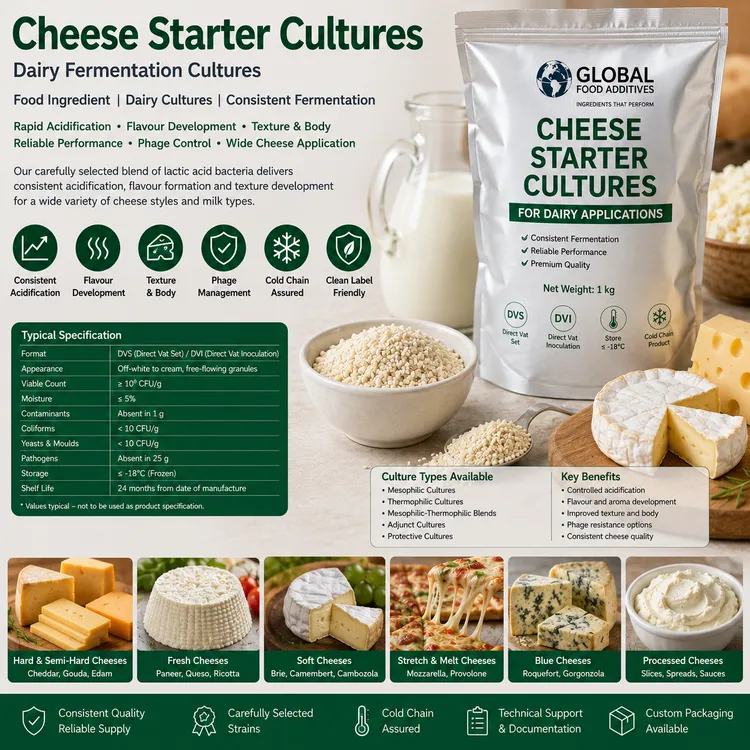
Culture performance depends on milk quality, heat treatment, inoculation rate, vat temperature, salt, moisture, phage control, ripening conditions and cold-chain handling.
Product identity
| Product | Cheese Starter Cultures |
|---|---|
| Alternative names | Dairy starter cultures; cheese cultures; DVS cultures; DVI cultures; direct-vat-set cultures; ripening cultures; adjunct cultures |
| Category | Fermentation, Cultures & Bio-Protective Ingredients |
| Function | Fermentation, starter culture or bio-protective ingredient |
| E / INS number | Confirm by destination market, cheese category, species, strain and supplier documentation |
| CAS / identity | Culture blend; exact microbial identity is supplier- and product-specific |
| Common culture groups | Mesophilic lactic acid bacteria, thermophilic lactic acid bacteria, aroma cultures, adjunct cultures, ripening cultures, protective cultures, propionic cultures and mould cultures where applicable |
| Typical form | Freeze-dried culture, frozen pellet, frozen concentrate, powder, sachet, pouch, canister or custom blend |
| Typical application route | Direct vat inoculation, bulk starter propagation, mother culture system or defined-strain rotation program |
| Main technical value | Controls acidification, pH profile, curd formation, flavour, texture, gas production, ripening behaviour and microbial consistency |
| Key buying point | Compare cultures by cheese type, activity, acidification curve, strain strategy, phage robustness, storage requirement and cost per vat or tonne of milk, not only price per pack |
Industrial buying value
Cheese Starter Cultures are normally evaluated when a dairy plant needs predictable fermentation, repeatable pH development, consistent curd handling, controlled flavour, texture stability and reliable ripening. The correct culture can reduce production variability, limit slow-vat events, improve moisture control and help standardise cheese quality between plants, seasons and milk sources.
- Supports controlled lactose fermentation and target pH development
- Helps define cheese style, flavour pathway, texture and ripening profile
- Can improve consistency across milk seasons, plant shifts and production lots
- May provide aroma, gas formation, eye development or bio-protective support depending on strain selection
- Requires cold-chain control, phage-risk review and supplier technical support for industrial success
Technical overview
Cheese Starter Cultures are selected microbial cultures used to drive controlled fermentation in cheese milk and curd. Their primary role is usually acidification through conversion of lactose into lactic acid, but industrial culture systems often do more than lower pH. Depending on the species and strain package, they can influence flavour, aroma, proteolysis, gas formation, body, texture, rind development, ripening rate and microbial competition.
Culture selection is one of the most important decisions in cheese manufacturing because it interacts with milk quality, heat treatment, coagulant choice, cutting program, cooking temperature, whey drainage, salting method, moisture target and ripening conditions. A culture that performs well in a fresh cheese process may be unsuitable for a cooked-curd, pasta filata, eye-forming or long-ripened cheese.
Culture selection logic
The correct starter culture should be selected from the cheese make procedure backwards. R&D and production teams should define target pH at key points, vat time, curd firmness, moisture target, salting method, ripening temperature and final flavour before selecting the culture package.
- Mesophilic cultures for moderate-temperature cheeses and fresh or semi-hard styles
- Thermophilic cultures for higher-temperature and cooked-curd processes
- Aroma cultures for diacetyl, buttery notes or flavour complexity
- Adjunct cultures for ripening acceleration, flavour depth or texture modification
- Protective cultures for selected microbial-competition or shelf-life support functions
Fermentation performance variables
The same culture may perform differently when milk composition, heat treatment, bacteriophage load, temperature control, salt level or residual antibiotics change. Industrial approval should be based on production-relevant trials, not only supplier dosage tables.
- Milk quality, lactose, protein, fat, mineral balance and somatic cell condition
- Heat treatment, pasteurisation profile and cooling accuracy
- Inoculation rate, culture activity, vat temperature and hold time
- Phage pressure, plant hygiene, whey handling and air movement
- Salt-in-moisture, ripening humidity, oxygen exposure and packaging format
Application fit
Potential use areas may include the applications below, subject to destination-market rules, cheese standard of identity, process design, culture approval, final label declaration and customer policy. These examples are technical production contexts, not a universal approval list.
| Cheese or dairy application | Technical reason to evaluate | Buyer / production checks |
|---|---|---|
| Fresh cheese and acid-set dairy products | Fast and controlled acidification, clean flavour, moisture control and reliable pH endpoint | Acidification curve, incubation temperature, coagulation time, whey drainage, final pH, shelf-life microbiology and sensory profile |
| Cheddar and stirred-curd cheeses | Mesophilic acid development, curd handling, flavour foundation and texture consistency | pH at drain, pH at milling, salt-in-moisture, phage rotation, bitterness risk, ripening temperature and flavour maturity |
| Gouda, Edam and semi-hard cheeses | Controlled acidification, eye openness control, sweet/nutty flavour potential and brining performance | Washed-curd process, pH after brining, salt uptake, gas formation, adjunct cultures and ripening humidity |
| Mozzarella and pasta filata cheeses | Thermophilic acidification, stretch development, melt behaviour and process timing | pH at stretching, calcium balance, stretchability, melt, browning, shredding, cook loss and frozen-storage performance |
| Swiss-style and eye-forming cheeses | Thermophilic foundation plus propionic or gas-forming systems for eye and flavour development | Propionic culture activity, lactate availability, warm-room ripening, eye size, splits, late gas and flavour intensity |
| Blue cheeses | Starter acidification plus mould culture support for blue veining, proteolysis and flavour | Starter compatibility, Penicillium culture, oxygen access, piercing, salt, moisture, rind development and ripening temperature |
| White mould and surface-ripened cheeses | Starter control plus surface culture strategy for rind growth, pH rise and texture softening | Geotrichum/Penicillium compatibility, surface pH, salting, humidity, airflow, wrapping and ammonia management |
| Washed-rind cheeses | Acidification foundation plus smear culture and surface-ripening control | Rind wash conditions, salt level, Brevibacterium or smear blend, surface pH, humidity, airflow and aroma target |
| Plant-based cheese alternatives | Fermentation flavour development and acidification in selected plant-based systems where cultures are suitable | Substrate fermentability, sugar source, protein/fat matrix, pH curve, culture compatibility and final label rules |
Culture types and practical selection
Starter cultures are not interchangeable. A supplier may offer single-strain, multi-strain, defined-strain, mixed-strain, direct-vat-set, bulk-starter, frozen or freeze-dried systems. Each format has different advantages for activity, consistency, flexibility, phage control and plant logistics.
| Culture type | Typical role | Industrial note |
|---|---|---|
| Mesophilic starter cultures | Acidification in moderate-temperature cheeses such as Cheddar, Gouda, fresh cheese and many semi-hard cheeses | Review acidification speed, flavour profile, phage rotation and compatibility with adjuncts |
| Thermophilic starter cultures | Acidification in higher-temperature cheeses such as Mozzarella, Parmesan-style, Swiss-style and cooked-curd cheeses | Review performance after cooking temperatures, stretch pH and high-temperature survival |
| Aroma cultures | Production of buttery, creamy, nutty or complex flavour notes depending on metabolism | Check citrate metabolism, gas production, flavour intensity and defects such as openness or excessive aroma |
| Adjunct cultures | Ripening acceleration, flavour depth, proteolysis, texture change or specialty cheese character | Use as part of a defined ripening strategy; excessive proteolysis can create bitterness or texture defects |
| Protective cultures | Microbial competition and shelf-life support in selected cheese systems | Not a substitute for hygiene, pasteurisation, temperature control or regulatory validation |
| Propionic cultures | Eye formation and sweet/nutty flavour in Swiss-style cheeses | Requires lactate availability, warm-room control and careful gas-defect management |
| Mould and surface-ripening cultures | Rind formation, blue veining, surface deacidification and flavour development | Control oxygen, humidity, salt, pH, airflow and cross-contamination risk |
| Custom culture blends | Plant-specific cheese performance, phage strategy, flavour profile or process optimisation | Best approved through plant trials, pH monitoring and sensory validation |
Quality and specification parameters
For industrial purchasing, Cheese Starter Cultures should be compared by performance, viability, safety, cold-chain stability and documentation rather than pack price alone. A technically suitable culture should deliver predictable acidification and cheese quality without unacceptable phage sensitivity, contamination risk, flavour defects, slow vats or cold-chain failure.
| Specification area | What to request | Why it matters |
|---|---|---|
| Culture identity | Species, strain or blend information to the level disclosed by supplier, plus intended use category | Confirms technical suitability and supports regulatory/customer approval |
| Activity units | Supplier activity units, inoculation rate, vat size guidance and milk-volume basis | Required for accurate dosage, cost-per-vat calculation and plant scale-up |
| Acidification profile | pH curve, temperature conditions, time to target pH and model milk or cheese data | Critical for vat scheduling, curd handling, moisture control and product consistency |
| Format | Freeze-dried, frozen, direct-vat-set, bulk starter, frozen pellet or custom format | Determines storage, handling, dosage, cold-chain risk and production flexibility |
| Phage strategy | Phage-rotation information, strain robustness, recommended rotation sets and plant support options | Helps reduce slow-vat risk and acidification failure in high-volume cheese plants |
| Temperature range | Growth range, optimum temperature and survival through cheese cooking conditions | Important for mesophilic, thermophilic and cooked-curd cheese processes |
| Salt and pH tolerance | Performance in brined, salted, low-pH or high-moisture conditions where relevant | Supports ripening consistency and defect prevention |
| Flavour and gas profile | Aroma potential, gas production, citrate metabolism, proteolytic activity and defect warnings | Important for eye formation, buttery notes, openness, bitterness, texture and specialty cheese character |
| Microbiological safety | Absence of pathogens, contaminant limits, yeast/mould limits where applicable and hygiene statements | Supports food-safety approval, audits and high-care dairy processing |
| Antibiotic and inhibitor sensitivity | Guidance on milk inhibitors, antibiotic residues and starter inhibition risks | Starter failure can occur when milk contains inhibitors or sanitation residues |
| Compliance | Food-grade declaration, allergen statement, GMO statement, vegan/vegetarian status where relevant, halal/kosher if required | Reduces regulatory, customer and label-approval delays |
| Storage and shelf life | Storage temperature, frozen or refrigerated shelf life, shipping conditions and opened-pack guidance | Culture viability and activity depend heavily on correct cold-chain control |
| Traceability | Manufacturer, production site, batch number, production date, expiry date and lot-specific COA | Enables supplier qualification, recall readiness and audit-trail control |
Formulation and plant-trial checklist
- Cheese type: define the target cheese style, moisture, fat-in-dry-matter, salting method, ripening time and target flavour.
- Acidification targets: set pH checkpoints such as pH at rennet addition, cutting, draining, milling, salting, stretching, brining and packaging.
- Milk quality: review milk heat treatment, standardisation, inhibitor testing, bacteriological quality and seasonal variation.
- Dosage validation: test supplier dosage under actual vat size, temperature, milk composition and plant schedule.
- Phage control: implement culture rotation, whey management, air hygiene, sanitation, equipment separation and supplier phage guidance.
- Coagulant interaction: confirm that starter activity supports the chosen rennet or coagulant system and target curd firmness.
- Salt and moisture: monitor how culture choice affects acidification, syneresis, salt uptake, water activity and final cheese texture.
- Ripening profile: track flavour, proteolysis, gas, rind development, bitterness, texture and pH migration during ripening.
- Shelf-life validation: monitor spoilage organisms, late gas, texture defects, surface growth, flavour changes and package swelling.
- Cost-in-use: compare suppliers by cost per vat, cost per tonne of cheese milk, yield, defect reduction, schedule reliability and technical support.
Phage management and culture rotation
Bacteriophage risk is one of the most important industrial concerns in cheese fermentation. Even a high-quality culture can fail if the plant environment contains phage capable of infecting the active starter strains. A strong procurement plan should include supplier guidance for rotation sets, hygiene controls and technical troubleshooting.
| Phage-control point | Recommended buyer action |
|---|---|
| Culture rotation | Use recommended rotation sets or alternate strain blends where applicable to reduce repeated phage exposure |
| Whey handling | Control whey aerosols, whey traffic and whey-storage areas because whey can carry high phage loads |
| Air and water hygiene | Review air movement, condensate, water quality and cleaning systems around vats and culture handling zones |
| Slow-vat monitoring | Record acidification curves and investigate delayed pH development quickly |
| Supplier support | Ask whether phage testing, rotation guidance or plant technical support is available |
Comparison with related fermentation ingredients
Cheese Starter Cultures are part of a wider dairy fermentation toolbox. They are often used alongside coagulants, enzymes, ripening cultures, protective cultures and process controls. The correct choice depends on cheese style, process, pH profile, flavour target, ripening conditions and legal requirements.
| Ingredient or culture option | Typical reason to compare | Industrial note |
|---|---|---|
| Primary cheese starter cultures | Main acidification, lactose fermentation and pH control | Core culture system; failure can affect the entire cheese make procedure |
| Adjunct cultures | Flavour development, ripening acceleration and specialty cheese character | Usually not a replacement for primary acidifying cultures |
| Protective cultures | Microbial competition and selected shelf-life support | Must be validated with hygiene, cold chain and regulatory requirements |
| Propionic cultures | Eye formation and sweet/nutty flavour in Swiss-style cheeses | Requires warm-room ripening and careful late-gas management |
| Mould cultures | Blue veining, white mould rind or surface-ripened character | Oxygen, humidity, salting and cross-contamination control are essential |
| Coagulants and rennet | Milk coagulation and curd formation | Works together with starter-driven pH; not a substitute for fermentation control |
| Lipase or ripening enzymes | Flavour intensity, piquant notes or ripening modification | Can create strong flavour; dosage and cheese style must be controlled |
Process integration guidance
Cheese Starter Cultures should be introduced through a controlled culture-handling procedure. The best method depends on whether the culture is freeze-dried, frozen, direct-vat-set or intended for bulk starter propagation. Poor handling can reduce viability, delay acidification and create inconsistent cheese quality.
Direct-vat culture handling
- Store frozen or refrigerated according to supplier instructions until use
- Minimise time outside controlled temperature before dosing
- Distribute culture evenly across the vat surface or into milk flow according to supplier guidance
- Record culture lot, dosage, vat number, milk volume and inoculation time
- Monitor pH curve to confirm performance against the approved make schedule
Bulk-starter system handling
- Validate propagation medium, temperature, incubation time and sanitation program
- Test activity before adding bulk starter to cheese milk
- Control contamination risk from tanks, lines, water, air and operator handling
- Maintain strict separation from whey and high-phage areas
- Document propagation lot, pH, acidity, sensory condition and release status
Cold-chain and logistics control
Cheese Starter Cultures are temperature-sensitive biological ingredients. Cold-chain management is not an administrative detail; it is part of product performance. Buyers should confirm storage temperature, shipping method, transit time, dry ice or gel pack use, temperature logger policy, shelf life and customs-clearance strategy before placing orders.
| Cold-chain control point | Recommended buyer action |
|---|---|
| Storage temperature | Confirm whether the culture requires frozen storage, deep-frozen storage or refrigerated storage |
| Transit protection | Request insulated packaging, dry ice, gel packs or validated shipper format according to culture type |
| Temperature monitoring | Use temperature loggers for critical shipments or long transit routes where feasible |
| Customs planning | Prepare import documents in advance to avoid delays that can reduce culture activity |
| Receiving inspection | Check package condition, temperature status, lot number, expiry date and COA before warehouse release |
| Opened packs | Define opened-pack policy; many culture products are intended for immediate use after opening |
Handling, storage and warehouse control
Cheese Starter Cultures should be handled according to supplier instructions, the food-safety plan and local workplace rules. Because cultures are living or viable biological systems, storage conditions, inventory rotation and operator practices directly affect performance.
| Control point | Recommended buyer action |
|---|---|
| Inventory rotation | Use first-expiry-first-out control and keep culture lots clearly separated |
| Temperature exposure | Avoid repeated thawing, warming or extended exposure during weighing and dosing |
| Contamination prevention | Handle cultures with clean, dry tools and avoid contact with whey, brine, raw milk or wet surfaces |
| Lot traceability | Record lot number, supplier COA, internal release status and expiry date before use |
| Segregation | Store away from strong odours, cleaning chemicals, allergens or materials that can damage packaging |
| Emergency handling | Define procedure for freezer failure, delayed shipment, damaged packaging or temperature excursion |
Packaging and logistics options
Packaging depends on supplier standard, culture format, activity, dosage and shipment route. Common industrial requests include small trial packs, sachets, foil pouches, canisters, sealed frozen packs, frozen pellets, dry-ice shippers, insulated cartons, temperature-controlled parcel shipments and palletised cold-chain export. For export projects, buyers should request storage temperature, shelf life, gross and net weight, pack count, lot coding system, dry-ice requirement, temperature logger availability, HS code guidance, document language and shipping marks before confirming the order.
Regulatory and label diligence
Cheese Starter Cultures should be managed as regulated microbial food ingredients. The buyer is responsible for verifying whether the exact culture species, strain or blend is permitted in the destination market, whether the intended cheese category is covered, whether the culture is used as a processing aid or ingredient, how it must be declared and whether customer-specific restrictions apply.
For international cheese projects, regulatory review should be completed before commercial purchase. A culture accepted in one country or cheese standard may require a different documentation package or label position in another. Buyers should also verify requirements for GMO status, allergens, milk-derived carriers, halal, kosher, vegan suitability, strain disclosure and import permits where applicable.
Documents to request
- Product specification or technical data sheet with culture type, format, dosage guidance and intended cheese applications
- Certificate of analysis for available batch or representative lot
- Safety data sheet where applicable
- Food-grade declaration and intended-use statement
- Species, strain or blend declaration to the level available from the supplier
- Activity units, inoculation rate, milk-volume basis and acidification curve where available
- Phage-rotation guidance, strain-rotation set information or technical support note where applicable
- Storage temperature, cold-chain shipping instructions, shelf-life and expiry date
- Absence-of-pathogen statement and microbiological safety specification
- Allergen statement, including any milk, lactose, soy or carrier-related information
- GMO statement, vegan/vegetarian status where relevant, BSE/TSE and irradiation statements where required
- Halal and kosher certificates when required by customer or destination market
- Origin statement, manufacturer information and traceability declaration
- Label draft, packaging details, pack count, net/gross weight and temperature-control packing format
- Market-specific declarations required by the importing country
How to request this product
Send the product name, cheese type, target culture function, current make procedure, milk volume per vat, desired culture format, target acidification profile, quantity, destination country, packaging preference, expected shipment date, delivery term and required documents. If you already purchase Cheese Starter Cultures, attach or describe your current specification, label, certificate of analysis, culture code, dosage, pH curve and cheese application so supplier options can be compared accurately.
For faster technical review, include milk type, pasteurisation profile, process temperature, rennet/coagulant system, target pH checkpoints, salting method, ripening conditions, phage history, flavour target, shelf-life target, destination-market rules, customer compliance requirements and whether trial cultures are needed before bulk quotation.
Useful answers
What are Cheese Starter Cultures used for in food manufacturing?
Cheese Starter Cultures are typically reviewed for fermentation control, acidification, pH reduction, flavour development, texture formation, ripening support, gas formation and selected bio-protective performance. Exact suitability depends on cheese type, grade, process, regulations and supplier documents.
Are all cheese cultures the same?
No. Mesophilic, thermophilic, adjunct, protective, propionic, mould and surface-ripening cultures have different roles. The correct culture depends on cheese style, process temperature, pH targets, ripening conditions and flavour objective.
What is a direct-vat-set culture?
A direct-vat-set culture is added directly to cheese milk or the vat without plant propagation. It can simplify handling and improve consistency, but it still requires correct storage, dosing and pH monitoring.
Why is phage control important?
Bacteriophage can attack starter strains and cause slow acidification or starter failure. Culture rotation, whey control, hygiene, air management and supplier technical support are important in industrial cheese plants.
Which technical parameters should be compared between suppliers?
Buyers should compare species and strain identity, activity units, dosage, acidification curve, culture format, phage-rotation guidance, temperature range, salt tolerance, flavour profile, contaminant limits, pathogen testing, storage temperature, shelf life, packaging and compliance documents.
Can Global Food Additives source Cheese Starter Cultures?
Global Food Additives can review sourcing options for Cheese Starter Cultures according to cheese type, target function, specification, quantity, destination, cold-chain requirements, packaging, shipment timing and required documentation.
Which documents should be requested?
Buyers commonly request a technical data sheet or specification, certificate of analysis, safety data sheet where applicable, food-grade declaration, species or strain statement where available, allergen/GMO statements, microbiological safety information, storage instructions, shelf-life information, cold-chain packing details and market-specific declarations.
Is this product permitted in every country?
No. Culture use depends on destination-market rules, cheese category, species or strain status, label requirements, processing-aid interpretation and buyer responsibility. Always verify regulatory status before commercial use.
Tell us which food additive or ingredient you need.
Send product names, target specifications, quantity, destination country, packaging preference, delivery term and document requirements. Our team will review your inquiry and respond from orders@foodgradeadditives.com.
Your message has been received. You will be redirected to the home page.