
Citric Acid for Antioxidant Synergy
Citric Acid for Antioxidant Synergy is a food-grade citric acid application grade used to support oxidation control in fats, oils, flavours, colours, vitamins and sensitive finished products. In antioxidant systems, citric acid is valued mainly as a sequestrant and synergist: it helps bind trace pro-oxidant metals, supports pH control and can improve the performance of antioxidants such as tocopherols, rosemary extract, ascorbyl palmitate, BHA, BHT, TBHQ or other permitted oxidation-control ingredients, depending on local rules and finished-product design.
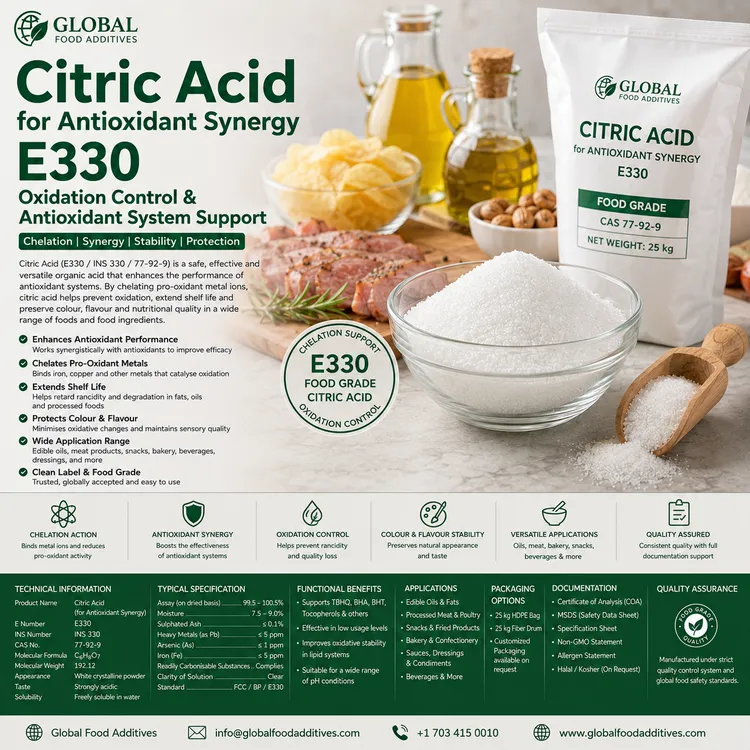
Product identity
| Product | Citric Acid for Antioxidant Synergy |
|---|---|
| Common names | Citric acid E330, INS 330, food-grade citric acid, citric acid antioxidant synergist, citric acid sequestrant |
| Category | Antioxidants & Oxidation Control |
| Function | Antioxidant synergist, oxidation-control support ingredient, acidity regulator, sequestrant and metal-chelation support ingredient |
| E / INS number | E330 / INS 330 |
| CAS / identity | 77-92-9 for anhydrous citric acid; monohydrate grades may use CAS 5949-29-1 |
| Chemical description | 2-hydroxy-1,2,3-propanetricarboxylic acid |
| Primary oxidation-control role | Trace-metal chelation and antioxidant-system synergy rather than primary radical-chain termination |
| Typical form | Fine crystal, powder, granule, aqueous solution, dry blend, premix or application-specific antioxidant-system component |
| Industrial purchasing basis | Acid form, assay, particle size, moisture, solubility, solution clarity, impurity profile, heavy metals, microbiology, origin, certification and packaging |
Application fit
Citric Acid for Antioxidant Synergy is evaluated where oxidation is driven or accelerated by trace metals, oxygen exposure, heat, light, unsaturated lipids, sensitive colours, volatile flavours or vitamins.
- Edible oils, frying oils, salad oils and oil-based blends
- Snack seasonings, coated nuts, extruded snacks and savoury powder systems
- Meat, poultry, seafood and plant-based protein systems
- Bakery fats, shortenings, fillings, creams and fat-containing bakery products
- Beverages, concentrates, syrups, vitamin drinks and flavour emulsions
- Flavour compounds, essential oils, citrus oils and beverage bases
- Dairy systems, sauces, dressings, condiments and emulsified products
- Colour-sensitive foods containing carotenoids, anthocyanins, chlorophyll derivatives or natural colour systems
- Premixes containing vitamins, minerals, flavours, fats or oxidation-sensitive nutrients
Technical overview for manufacturers
Citric acid is not normally selected as a stand-alone antioxidant in the same way as tocopherols, rosemary extract, BHA, BHT, TBHQ or ascorbyl palmitate. Its industrial value comes from antioxidant synergy: it can reduce the catalytic effect of trace metals such as iron and copper, support the target pH of the product, improve colour and flavour stability in selected matrices and complement other permitted antioxidants. This makes it useful in formulations where oxidation causes rancidity, stale flavour, colour loss, vitamin degradation, haze, metallic notes or shortened shelf life.
How citric acid supports antioxidant systems
Metal chelation
Trace iron, copper and other transition metals can accelerate lipid oxidation and colour deterioration. Citric acid can help complex these metals and reduce their pro-oxidant effect in suitable systems.
Antioxidant synergy
Citric acid may improve the practical effectiveness of permitted antioxidants by reducing metal-catalysed oxidation pathways that primary antioxidants alone may not fully control.
pH management
In aqueous and emulsified foods, pH influences oxidative stability, preservative performance, colour expression, protein behaviour and flavour balance.
Colour and flavour protection
By reducing metal-driven instability, citric acid can support the protection of sensitive flavours, citrus oils, natural colours and vitamin systems, subject to application trials.
Primary antioxidant versus synergist role
| Ingredient role | Typical examples | Main function | Citric acid relevance |
|---|---|---|---|
| Primary antioxidant | Tocopherols, rosemary extract, BHA, BHT, TBHQ, propyl gallate where permitted | Interrupts or slows radical-chain oxidation reactions in fats and oils | Citric acid is normally not used as the main chain-breaking antioxidant. |
| Oxygen or reducing-system support | Ascorbic acid, erythorbic acid, ascorbyl palmitate where permitted | Supports reducing conditions, oxygen control or antioxidant regeneration depending on system | Citric acid may complement these ingredients by controlling pH and trace-metal activity. |
| Sequestrant / chelator | Citric acid, sodium citrate, phosphates, EDTA where permitted | Binds pro-oxidant metals that accelerate rancidity, colour loss and flavour instability | This is the main industrial reason to use citric acid for antioxidant synergy. |
| Process and packaging control | Nitrogen flushing, oxygen barrier packaging, low-temperature storage, light protection | Reduces oxygen, light and heat exposure during storage and distribution | Citric acid works best as part of a complete formulation and shelf-life-control strategy. |
Grade selection guidance
| Manufacturing need | Grade point to confirm | Why it matters |
|---|---|---|
| Edible oils and oil-based systems | Acid form, particle size, dosing point, dispersion strategy, carrier system and compatibility with antioxidants | Citric acid must be introduced effectively because pure citric acid does not dissolve readily in oil. |
| Snack seasonings and dry blends | Fine crystal or powder size, dry-blend uniformity, dusting, flowability and interaction with salt or flavours | Supports uniform distribution and reduces localised sourness, caking or speckling. |
| Meat, poultry and seafood systems | pH effect, salt compatibility, metal load, protein impact, colour stability and process temperature | Controls oxidation while avoiding unwanted protein texture changes or excessive acidity. |
| Beverages and flavour bases | Solution clarity, pH target, chelation effect, flavour balance and colour stability | Helps protect sensitive flavours and colours while maintaining finished-product sensory balance. |
| Bakery fats and fillings | Premix design, fat compatibility, particle size, moisture sensitivity and antioxidant system | Protects fat-containing components where rancidity and stale notes can shorten shelf life. |
| Export production | Destination-market additive status, permitted antioxidant partners, label declaration and certificate package | Prevents regulatory delays, label problems and customer-approval issues. |
Application-specific technical notes
| Application | Oxidation risk | Citric acid contribution | Trial focus |
|---|---|---|---|
| Refined edible oils | Trace metals, heat, oxygen and unsaturated fatty acid profile | Supports metal sequestration when introduced with a suitable process or premix strategy | Measure peroxide value, anisidine value, induction time, colour and sensory rancidity. |
| Fried snacks | Oxidised frying oil, seasoning metals, oxygen exposure and light | Can complement antioxidant systems in oil or seasoning phases | Evaluate oil quality, headspace oxygen, seasoning interaction, package barrier and shelf life. |
| Meat and poultry products | Heme iron, lipid oxidation, warmed-over flavour and colour instability | May support metal control and pH adjustment when allowed and correctly dosed | Check pH, colour, purge, texture, cooked flavour, TBARS or other oxidation indicators. |
| Seafood systems | Highly unsaturated lipids, metal ions, oxygen and frozen storage | Supports oxidation-control strategy with suitable antioxidants and packaging | Track rancid notes, drip loss, colour, pH, freezer stability and sensory quality. |
| Beverage bases and flavour emulsions | Citrus oil oxidation, colour fading, vitamin loss and metallic flavour | Supports pH control and metal chelation in water phase or emulsion systems | Test pH, cloud stability, colour, flavour freshness, vitamin retention and storage temperature. |
| Vitamin and mineral premixes | Metal-catalysed degradation and interaction between nutrients | Can help manage pH and metal reactivity in compatible premix formats | Validate potency retention, moisture, caking, compatibility and label compliance. |
| Colour-sensitive foods | Metal-catalysed colour loss, pH shift, heat and light exposure | May support colour stability through chelation and pH control | Run storage trials with the actual colour system, packaging and light exposure. |
Formulation and process considerations
- Oil solubility: pure citric acid is not naturally oil-soluble; oil applications should define a dosing step, carrier, premix, dispersion method or aqueous contact stage.
- Water phase location: in emulsions, sauces, beverages and meat systems, citric acid is most effective when it is properly distributed in the phase where metals, pH and oxidation triggers are active.
- pH impact: dosage must be balanced so oxidation control does not create excessive sourness, protein destabilisation, colour shift or preservative imbalance.
- Antioxidant pairing: evaluate citric acid with the actual antioxidant system, such as tocopherols, rosemary extract, ascorbyl palmitate, BHA, BHT, TBHQ or permitted local alternatives.
- Trace metals: test iron and copper sources from ingredients, process water, salt, minerals, protein materials, colours, equipment contact and packaging.
- Particle size: fine grades dissolve faster but may dust; coarse grades may handle better but dissolve more slowly or distribute unevenly in dry systems.
- Moisture control: dry blends, effervescent systems, seasonings and premixes should be protected from humidity to avoid caking and premature reactions.
- Heat exposure: frying, baking, retort, pasteurisation and hot-fill conditions must be tested because oxidation pathways accelerate at higher temperature.
- Packaging: oxygen barrier, light barrier, headspace control, nitrogen flushing and pack size can be as important as the antioxidant formulation.
- Sensory validation: confirm that the selected dosage does not create sourness, metallic notes, bitterness, colour shift or flavour imbalance.
Oxidation-control testing plan
For industrial approval, citric acid should be tested as part of a complete oxidation-control system rather than only as an isolated ingredient. The best test design compares a control sample, the current antioxidant system, citric acid alone and citric acid combined with the intended antioxidant package.
| Test area | Useful measurements | Why it matters |
|---|---|---|
| Lipid oxidation | Peroxide value, anisidine value, TOTOX value, hexanal, Rancimat/OSI induction time and sensory rancidity | Shows whether the system delays primary and secondary oxidation in real storage conditions. |
| Colour stability | L*a*b* colour data, visual shade panel, colour retention percentage and light-exposure testing | Important for natural colours, carotenoids, anthocyanins, chlorophyll derivatives and flavour emulsions. |
| Flavour stability | Sensory panel, off-note tracking, citrus oil freshness, metallic notes and stale flavour development | Oxidation is often first noticed as flavour deterioration before analytical limits are exceeded. |
| Vitamin or nutrient retention | Assay of sensitive vitamins, active compounds or fortified nutrients during storage | Relevant for beverages, premixes, nutrition products and fortified foods. |
| Process compatibility | pH drift, viscosity, emulsion stability, sediment, haze, protein stability and package interaction | Ensures oxidation control does not create a separate formulation defect. |
| Shelf-life simulation | Real-time and accelerated storage under heat, light, oxygen and humidity stress | Confirms performance under distribution and retail conditions. |
Quality parameters to compare
Industrial purchasing should compare Citric Acid for Antioxidant Synergy by purity, form, application performance and cost-in-use. A lower-cost grade may create higher operational cost if it dissolves slowly, cakes, carries more impurities, lacks the required certificates or does not distribute correctly in the antioxidant system.
| Parameter | What to request from supplier |
|---|---|
| Acid form | Anhydrous, monohydrate, solution, blend or premix identity, including CAS reference and acid-equivalence basis. |
| Assay | Specification range, test method, COA result and whether the result is reported on anhydrous or monohydrate basis. |
| Particle size | Fine, standard, coarse or customised particle size, sieve data, dusting tendency and dry-blend performance. |
| Solubility and clarity | Water solubility, dissolution speed, solution clarity, insoluble matter and suitability for beverage or premix use. |
| Impurity profile | Sulphated ash, oxalate, sulphate, chloride, readily carbonisable substances and other specification items required by the buyer. |
| Heavy metals | Lead, arsenic, cadmium, mercury and destination-specific contaminant limits where applicable. |
| Microbiology | Total plate count, yeast and mould, coliforms, E. coli, Salmonella and buyer-specific microbiological limits when required. |
| Antioxidant system compatibility | Supplier guidance for use with tocopherols, rosemary extract, ascorbyl palmitate or permitted synthetic antioxidants where applicable. |
| Certification | Halal, kosher, ISO, FSSC 22000, BRCGS, HACCP, GMP, non-GMO, vegan, vegetarian or other customer-required certificates. |
| Packaging | Bag weight, inner liner, moisture barrier, pallet configuration, batch coding, shelf life and storage conditions. |
Regulatory and labelling review points
Citric Acid for Antioxidant Synergy is still citric acid from a regulatory and specification perspective, but its final use must be checked against the destination country, food category, dosage, function, purity standard and label wording. Buyers should confirm whether the product is declared as “citric acid,” “E330,” “acidity regulator,” “antioxidant,” “sequestrant,” “antioxidant synergist” or another locally accepted declaration.
Function declaration
Confirm the permitted functional class and label wording for the finished product. The same ingredient may be positioned as an acidity regulator, sequestrant or antioxidant-system support ingredient depending on market rules.
Use-level review
Check whether use is governed by GMP, quantum satis, category-specific limits or finished-product standards in the destination market.
Antioxidant partners
Verify the regulatory status and maximum levels of any antioxidants used together with citric acid, especially in fats, oils, snacks, meat products and export foods.
Claims and positioning
Validate “natural,” “clean label,” “no artificial preservatives,” “antioxidant protected,” “non-GMO,” “vegan,” “halal” or “kosher” claims against supplier documents and local rules.
Formulation development checklist
- Define the oxidation problem: rancidity, stale flavour, colour fading, vitamin loss, metallic notes, haze, off-odour or shortened shelf life.
- Identify the oxidation drivers: trace metals, oxygen, heat, light, unsaturated fats, process water, packaging, minerals, proteins or flavours.
- Confirm whether citric acid is being used as a sequestrant, pH regulator, antioxidant synergist or part of a broader antioxidant blend.
- Select the correct form: anhydrous, monohydrate, fine powder, granule, aqueous solution, dry blend or application-specific premix.
- Test citric acid alone and in combination with the proposed antioxidant system under real formulation and process conditions.
- Measure pH, acid taste, colour, flavour, peroxide value, anisidine value, sensory rancidity and shelf-life performance where relevant.
- Validate the dosing point, mixing time, carrier system, oil/water phase distribution and compatibility with production equipment.
- Confirm label declaration, permitted use, antioxidant partner limits and claim wording before artwork approval.
- Approve the supplier only after specification, COA, packaging, lead time, price, certification and logistics meet the project requirement.
Documents to request
- Product specification or technical data sheet with identity, assay, form and recommended use guidance
- Certificate of analysis for available batch or representative lot
- Safety data sheet for handling, storage and transport review
- Food-grade declaration and additive-status statement for the destination market
- Origin statement, manufacturer information and fermentation/process declaration when available
- Allergen statement, GMO statement, gluten statement, vegan/vegetarian statement and irradiation statement
- Halal and kosher certificates when required by customer or destination market
- Heavy metal, oxalate, sulphated ash, chloride, sulphate and other impurity data according to buyer requirements
- Microbiological specification and recent microbiology results when required
- Antioxidant-system compatibility information or application note where available
- Shelf-life, storage conditions and opened-pack handling guidance
- Packaging details, inner liner, moisture barrier, net weight, gross weight and pallet configuration
- Market-specific regulatory statements, label guidance and customs documents when available
Packaging, storage and logistics
Citric acid grades used for antioxidant synergy are normally supplied in food-grade bags, lined paper sacks, polyethylene-lined cartons, fibre drums, big bags, liquid containers or supplier-specific premix packaging. Packaging should protect against moisture pickup, caking, contamination, odour pickup and handling damage during storage and transport.
Moisture protection
Confirm inner liner, bag material, humidity resistance, pallet wrapping and warehouse guidance because citric acid can cake under poor storage conditions.
Plant handling
Review bag weight, dusting, particle size, flowability, bulk density, manual dosing, automated feeding and sieve compatibility before plant approval.
Storage control
Store tightly closed in a cool, dry, clean and odour-free area, away from moisture, strong bases, oxidising materials and incompatible chemicals.
Export readiness
Request packing list, batch list, certificate package, shelf-life remaining at shipment, origin documents and country-specific import documents before dispatch.
Commercial sourcing notes
Commercial evaluation should include both technical performance and supply reliability. Buyers should compare supplier capacity, lead time, minimum order quantity, grade availability, particle-size options, premix capability, packaging, certificate availability, price validity, Incoterms, payment terms and consistency of batch quality. For repeated production, request retained samples, batch-to-batch COA history and a change-notification commitment.
| Purchasing question | Why it matters |
|---|---|
| Is the required grade anhydrous, monohydrate, solution or premix? | Acid equivalence, moisture contribution, solubility, handling and cost-in-use can differ significantly. |
| Where will the citric acid be introduced in the process? | The dosing point controls whether citric acid reaches the phase where metal chelation and pH control are needed. |
| Which antioxidant system is used with it? | Compatibility with tocopherols, rosemary extract, ascorbyl palmitate or other permitted antioxidants should be tested. |
| Is the product oil-rich, water-rich or emulsified? | Solubility and distribution strategy depend on the dominant phase and process equipment. |
| What oxidation test will define success? | Peroxide value, anisidine value, sensory rancidity, colour retention or vitamin retention may lead to different formulation decisions. |
| Which documents are available before shipment? | Missing COA, SDS, origin, halal, kosher, non-GMO or regulatory documents can delay customer approval and customs clearance. |
How Global Food Additives supports sourcing
Global Food Additives, Inc. supports food manufacturers with practical sourcing coordination for Citric Acid for Antioxidant Synergy and other oxidation-control ingredients. Our team can help compare grade options by acid form, particle size, application fit, antioxidant-system compatibility, specification, documentation, packaging, lead time, certification and destination-market requirements. We can also coordinate sample discussions, supplier document review and quotation comparison against your current approved material or target formulation.
How to request this product
Send the product name, desired acid form, target application, current specification if available, oxidation-control objective, antioxidant partners, process conditions, quantity, destination country, packaging preference, expected shipment date and required documents. If you already use citric acid in an antioxidant system, attach your current specification, certificate of analysis, label declaration, antioxidant blend details or benchmark shelf-life target so supplier options can be compared more accurately.
| Best inquiry information | Example details to include |
|---|---|
| Application | Edible oil, snack seasoning, meat system, bakery fat, beverage, flavour emulsion, vitamin premix, sauce, dressing or colour-sensitive product. |
| Oxidation target | Rancidity control, colour retention, vitamin protection, flavour stability, peroxide-value reduction, metal chelation or shelf-life extension. |
| Technical conditions | Oil phase, water phase, pH, heat process, oxygen exposure, packaging, antioxidant partners, metals/minerals present and intended dosage. |
| Grade preference | Anhydrous, monohydrate, fine powder, granule, solution, premix, FCC grade, EU grade, halal, kosher or non-GMO grade. |
| Commercial details | Sample quantity, first order quantity, annual volume, Incoterm, delivery date, destination port or country and payment preference. |
| Documentation | Specification, COA, SDS, origin, allergen, GMO, halal, kosher, heavy metals, microbiology, shelf-life and packaging documents. |
Useful answers
What is Citric Acid for Antioxidant Synergy used for in food manufacturing?
Citric Acid for Antioxidant Synergy is used to support oxidation control by chelating trace metals, adjusting pH and improving the effectiveness of broader antioxidant systems in suitable fats, oils, beverages, flavours, colours, vitamins and finished foods.
Is citric acid a primary antioxidant?
No. Citric acid is usually used as a synergist or sequestrant rather than as a primary chain-breaking antioxidant. It helps reduce metal-catalysed oxidation and can complement other permitted antioxidants.
Can citric acid be used directly in oil?
Pure citric acid has limited direct solubility in oil. Oil-rich systems normally require a suitable dosing step, carrier, dispersion method, aqueous contact stage or supplier-designed antioxidant premix.
Which antioxidants can citric acid support?
Depending on local regulations and application design, citric acid may be evaluated with tocopherols, rosemary extract, ascorbyl palmitate, BHA, BHT, TBHQ, propyl gallate or other permitted antioxidant systems.
How should antioxidant synergy be tested?
Compare a control, citric acid alone, the primary antioxidant alone and the combined system. Track peroxide value, anisidine value, sensory rancidity, colour retention, flavour stability, vitamin retention and real-time shelf life.
Which documents should be requested?
Buyers commonly request a technical data sheet, certificate of analysis, safety data sheet, food-grade statement, origin statement, allergen and GMO declarations, halal or kosher certificate if required, heavy metal data, shelf-life, storage and packaging details.
Can Global Food Additives source Citric Acid for Antioxidant Synergy?
Global Food Additives can review sourcing options according to target grade, acid form, application, oxidation-control objective, quantity, destination country, packaging preference and required documentation.
Is this product permitted in every country?
No. Food additive use, functional-class declaration, maximum use level where applicable and product-category rules depend on destination-market regulations, supplier documentation and customer responsibility.
Tell us which Citric Acid grade or antioxidant-system support solution you need.
Send product name, acid form, application, oxidation-control target, quantity, destination country, packaging preference, delivery term and required documents. Our team will review your inquiry and respond from orders@foodgradeadditives.com.
Your message has been received. You will be redirected to the home page.