
Collagen Peptides
Collagen Peptides, also known as hydrolyzed collagen or collagen hydrolysate, are food-grade protein ingredients designed for high solubility, easy dispersion, neutral sensory performance and nutritional fortification. In industrial food manufacturing, they are commonly evaluated for protein enrichment, powdered drink systems, ready-to-drink beverages, dietary supplements, bars, dairy products, confectionery, bakery, soups, sauces and specialised nutrition formulas.
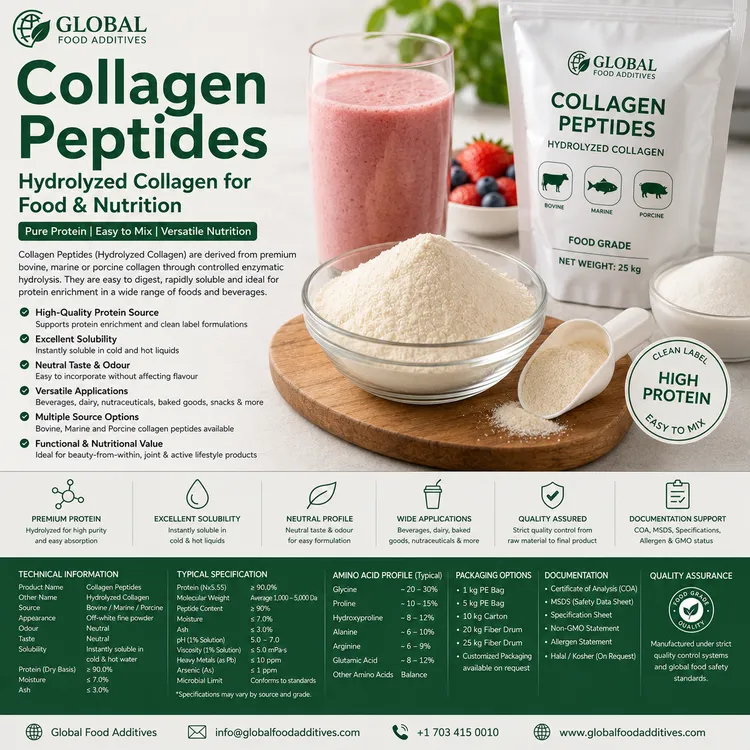
Product identity
| Product | Collagen Peptides |
|---|---|
| Common names | Hydrolyzed collagen, collagen hydrolysate, collagen peptides, collagen protein |
| Category | Proteins, Texturizers & Functional Ingredients |
| Function | Functional protein, nutritional ingredient, protein fortification ingredient and texture-support ingredient |
| E / INS number | Usually not purchased as an E-number additive; confirm classification by destination market and supplier documentation |
| CAS / identity | Hydrolyzed collagen |
| Typical source | Bovine hide, bovine bone, porcine skin, fish skin, fish scale or other approved animal collagen source |
| Typical form | Fine powder, instant powder, agglomerated powder, granule, blend or hydrated ingredient |
| Typical functionality | Protein enrichment, rapid dissolution, low viscosity contribution, neutral taste support and formulation flexibility |
Application fit
Collagen Peptides may be evaluated in applications where soluble protein contribution, clean dispersion, low flavour impact and consistent nutritional declaration are important.
- Protein powders and instant drink mixes
- Ready-to-drink beverages, shots and concentrates
- Nutrition bars, cereal bars and functional snacks
- Dairy products, yoghurts, desserts and dairy alternatives
- Bakery, biscuits, fillings and powdered premixes
- Confectionery, gummies, jellies and chewable formats
- Soups, sauces, broths and savoury nutrition systems
- Sports nutrition, beauty-from-within and healthy-aging products
- Medical nutrition and senior nutrition formulations, subject to regulatory review
Technical overview for industrial buyers
Collagen Peptides are produced by controlled hydrolysis of collagen-rich raw materials. The hydrolysis process reduces native collagen into shorter peptide chains, improving water solubility and reducing gel-forming behavior compared with gelatin. For manufacturers, the most important grade-selection criteria are source species, molecular weight distribution, protein content, hydroxyproline level, taste, odour, colour, solubility, clarity, microbiological quality, heavy-metal profile, religious certification and market-specific documentation.
Functional value in food and nutrition systems
Protein enrichment
Supports protein declaration in powders, beverages, bars and nutrition systems. Buyers should confirm protein test method, nitrogen conversion factor, amino acid profile and finished-product labelling requirements.
High solubility
Well-selected peptide grades dissolve rapidly in hot or cold water and are suitable for instant drink mixes, liquid concentrates and RTD systems where sediment control is critical.
Low viscosity impact
Compared with many intact proteins and gelatin systems, collagen peptides generally allow higher protein addition with lower viscosity development, depending on grade and dosage.
Neutral formulation profile
High-quality grades are selected for low odour, low bitterness, light colour and minimal flavour interference in vanilla, chocolate, fruit, coffee, dairy and neutral-flavour systems.
Collagen Peptides versus gelatin
| Parameter | Collagen Peptides | Gelatin |
|---|---|---|
| Typical manufacturing purpose | Protein enrichment, soluble nutrition systems and low-viscosity functional formulations | Gel formation, texture building, binding, thickening and confectionery structure |
| Hydrolysis level | More extensively hydrolyzed into shorter peptide chains | Partially hydrolyzed collagen with gel-forming properties |
| Solubility | Generally soluble in cold or warm water depending on grade | Typically requires swelling and heating for full hydration |
| Gel formation | Normally non-gelling or very low gelling behavior | Forms thermo-reversible gels with defined bloom strength |
| Best-fit applications | Beverages, powders, bars, supplements, nutrition products and protein-fortified foods | Gummies, marshmallows, desserts, capsules, gelled dairy and structured confectionery |
| Key specification focus | Molecular weight, protein, solubility, taste, source and documentation | Bloom strength, viscosity, gel clarity, setting behavior, source and documentation |
Source selection: bovine, marine, porcine and other origins
Source origin is one of the most important commercial and regulatory decisions. It affects market acceptance, religious certification, allergen expectations, flavour profile, sustainability messaging, cost, documentation and import requirements.
| Source | Typical advantages | Points to verify |
|---|---|---|
| Bovine collagen peptides | Common industrial availability, broad pricing options, neutral sensory profile and scalable supply. | BSE/TSE statement, country of origin, slaughter and hide/bone source, halal status, veterinary documentation and customer acceptance. |
| Marine collagen peptides | Useful for pescatarian positioning, beauty nutrition concepts and fish-origin product lines. | Fish allergen declaration, species origin, odour control, heavy metals, iodine concerns where relevant, sustainability documentation and marine-source traceability. |
| Porcine collagen peptides | Technically effective and often commercially competitive for markets where porcine origin is accepted. | Religious-market restrictions, label declaration, customer policy, origin statement and destination-market acceptability. |
| Specialty or blended sources | May support customised amino acid profiles, positioning claims or application-specific functionality. | Full formulation transparency, source breakdown, allergen status, regulatory classification and certificate consistency. |
Grade selection guidance
| Manufacturing need | Grade point to confirm | Why it matters |
|---|---|---|
| Instant beverage powder | Agglomeration, wettability, dispersibility, bulk density and dusting profile | Improves consumer mixing, reduces floating powder, supports sachet filling and improves dosing accuracy. |
| Ready-to-drink beverage | Solubility, clarity, heat stability, pH tolerance and sedimentation behavior | Prevents haze, precipitation, ringing, sediment and visible instability during shelf life. |
| Protein bar | Particle size, water binding, taste, browning tendency and interaction with syrups | Supports texture control, lower grittiness, stable chew and reduced hardening over shelf life. |
| Confectionery or gummies | Non-gelling behavior, compatibility with gelatin or pectin systems and flavour impact | Allows nutritional positioning without disrupting the designed gel structure. |
| Dairy or dairy alternative | Heat treatment, pH, protein interaction, mouthfeel and fermentation compatibility | Reduces risk of separation, chalkiness, bitterness, sediment and process instability. |
| Export product | Origin, certificates, regulatory statements, claims support and label declaration | Helps avoid customs, certification, customer approval and market-compliance delays. |
Key technical parameters to compare
For industrial purchasing, price per kilogram should be compared together with protein content, loss on drying, molecular weight profile, solubility, sensory quality, microbiology, heavy metals, certification and application performance. A lower-cost grade may be more expensive in use if it causes higher dosage, rework, poor solubility, off-taste, dusting or rejected documentation.
| Parameter | What to request from supplier |
|---|---|
| Protein content | Specification range, testing method, nitrogen conversion basis and typical certificate of analysis result. |
| Molecular weight profile | Average molecular weight, distribution range and method used for peptide-profile determination. |
| Amino acid profile | Typical glycine, proline, hydroxyproline and total amino acid profile, especially for nutrition-focused products. |
| Hydroxyproline level | Representative value or range to help confirm collagen identity and compare suppliers. |
| Solubility and clarity | Cold-water and hot-water solubility, recommended hydration method, turbidity or clarity data where available. |
| Sensory profile | Colour, odour, taste, bitterness, fishy notes for marine grades and suitability for neutral formulations. |
| Physical properties | Particle size, bulk density, tapped density, flowability, dusting, wettability and instantisation status. |
| Microbiology | Total plate count, yeast and mould, coliforms, E. coli, Salmonella, Staphylococcus aureus and other buyer-required limits. |
| Contaminants | Heavy metals, pesticide or veterinary-residue statements where applicable, dioxin/PCB information for marine grades if required. |
| Certification | Halal, kosher, ISO, FSSC 22000, BRCGS, HACCP, GMP, organic or other certification according to customer need. |
Processing and formulation considerations
- Hydration method: confirm whether the powder should be added to water under agitation, pre-blended with dry ingredients or dispersed into syrup or milk phase.
- Cold-water performance: test real cold-fill and consumer-mixing conditions, especially for sachets, tubs and instant beverage powders.
- pH tolerance: acidic beverages, fruit preparations and fermented systems should be tested for haze, sediment, flavour change and colour change.
- Heat treatment: pasteurisation, UHT, hot-fill, baking and confectionery cooking can affect taste, colour and interaction with sugars or other proteins.
- Maillard browning: formulas containing reducing sugars should be evaluated for browning and flavour development during heat processing or storage.
- Protein blending: check compatibility with whey, casein, soy, pea, rice, oat, egg or other proteins when creating multi-protein systems.
- Mineral systems: calcium, magnesium, iron and electrolyte blends may influence taste, clarity, stability and sedimentation.
- Flavour systems: marine grades and high-dosage formulas require sensory screening for bitterness, broth notes, fish notes or masking requirements.
- Packaging: moisture protection is critical because powders can cake, lose flowability or develop handling problems under high humidity.
- Claims review: beauty, skin, joint, bone, sports and healthy-aging claims must be validated against destination-market rules and finished-product composition.
Application development checklist
- Define the product category, serving size, protein target and final label position before requesting quotations.
- Select source origin according to customer policy, religious certification, allergen expectations and market acceptance.
- Request pilot samples from at least two grades when solubility, taste or instant performance is critical.
- Prepare lab batches at the intended dosage and process conditions, not only in water.
- Measure solubility, pH, sediment, colour, odour, viscosity and sensory impact immediately after production.
- Run accelerated and real-time shelf-life checks in the final packaging format.
- Confirm finished-product protein testing, nutrition declaration and claim wording before commercial production.
- Approve the supplier only after documentation, sample performance, pricing, lead time and packaging all match the project requirement.
Quality and food safety documentation
Collagen Peptides are animal-derived ingredients, so traceability and documentation are especially important for industrial purchasing. Buyers should verify the full supply chain from raw material source through processing, packaging, storage and export documentation.
- Product specification or technical data sheet with source, protein content, solubility, sensory and physical parameters
- Certificate of analysis for available batch or representative lot
- Food-grade declaration and intended-use statement
- Source-origin statement identifying bovine, porcine, marine or other source
- BSE/TSE statement for bovine-origin material where required
- Veterinary health certificate or sanitary certificate when needed for import clearance
- Allergen declaration, including fish allergen status for marine collagen
- GMO statement, irradiation statement and residual solvent statement where applicable
- Halal and kosher certificates when required by destination market or customer policy
- Heavy metal results and contaminant information according to buyer specification
- Microbiological limits and recent microbiology results
- Shelf-life, storage conditions and opened-pack handling guidance
- Packaging details, pallet configuration, net weight, gross weight and batch traceability information
- Regulatory statement for destination country and proposed product category when available
Packaging, storage and logistics
Collagen Peptides are typically supplied in food-grade multiwall bags, polyethylene-lined cartons, fibre drums, big bags or customised industrial packaging. The selected pack size should match plant hygiene, dosing method, warehouse humidity, production batch size and export handling requirements.
Powder protection
Use moisture-resistant inner liners and sealed packaging to reduce caking, clumping, microbial risk and loss of flowability during storage.
Handling efficiency
Confirm bag size, pallet pattern, lifting requirements, dusting profile, sieve compatibility and whether the powder is suitable for manual or automated dosing.
Warehouse control
Store in a cool, dry, clean and odour-free area. Keep away from high humidity, direct sunlight, strong odours and chemicals.
Export readiness
Request full packing list, batch list, shelf-life remaining at shipment, certificate package, origin documents and country-specific import documents before dispatch.
Commercial sourcing notes
Commercial evaluation should include both technical performance and supply reliability. Buyers should compare supplier capacity, lead time, minimum order quantity, sample availability, price validity, Incoterms, payment terms, origin restrictions, certificate availability and consistency of batch quality. For high-volume projects, request retained samples, batch-to-batch COA history and a change-notification commitment.
| Purchasing question | Why it matters |
|---|---|
| Is the source bovine, marine, porcine or blended? | Affects label declaration, certification, allergen status, consumer acceptance and import requirements. |
| Is the grade instantised? | Important for consumer-ready powders, sachets, vending systems and cold-water drink mixes. |
| What is the protein content? | Impacts nutritional declaration, dosage cost and comparison between suppliers. |
| What is the molecular weight profile? | Influences solubility, taste, digestibility positioning and functional performance. |
| Which certificates are available before shipment? | Prevents customs delays, customer rejection and relabelling risk. |
| What is the shelf-life and storage condition? | Supports inventory planning, shipment timing and customer delivery requirements. |
How Global Food Additives supports sourcing
Global Food Additives, Inc. supports food manufacturers with practical sourcing coordination for Collagen Peptides and other functional protein ingredients. Our team can help compare grades by source origin, specification, documentation, packaging, lead time, certification and destination-market requirements. We can also coordinate sample discussions, supplier document review and quotation comparison against your current approved material or target specification.
How to request this product
Send the product name, desired source origin, target grade, current specification if available, application, protein target, quantity, destination country, packaging preference, expected shipment date and required documents. If you already purchase Collagen Peptides, attach your current specification, certificate of analysis, label declaration or benchmark sample details so supplier options can be compared more accurately.
| Best inquiry information | Example details to include |
|---|---|
| Application | Powder drink, RTD beverage, bar, dairy product, supplement, gummy, bakery, soup, sauce or specialised nutrition product. |
| Source preference | Bovine, marine, porcine, halal bovine, kosher fish, non-porcine or supplier-recommended source. |
| Technical target | Protein percentage, molecular weight range, instant solubility, low odour, low bitterness, powder flow or clear solution requirement. |
| Commercial details | Sample quantity, first order quantity, annual volume, destination country, Incoterm, delivery date and payment preference. |
| Documentation | Specification, COA, SDS where applicable, halal, kosher, allergen, GMO, origin, BSE/TSE, veterinary certificate and regulatory statements. |
Useful answers
What are Collagen Peptides used for in food manufacturing?
Collagen Peptides are used for protein enrichment, nutritional positioning, instant beverage systems, bars, supplements, dairy products, confectionery, bakery and other formulations where soluble hydrolyzed collagen and a controlled sensory profile are required.
Are Collagen Peptides the same as gelatin?
No. Collagen Peptides are more extensively hydrolyzed and are normally selected for solubility and non-gelling performance. Gelatin is selected when gel strength, elasticity and thermo-reversible gel structure are required.
Which collagen source should I choose?
Source selection depends on market acceptance, price target, taste profile, religious certification, allergen status, origin documentation and label expectations. Bovine, marine and porcine grades should be compared against the final product and destination country.
Can Collagen Peptides be used in clear beverages?
Some grades may be suitable for clear or lightly cloudy beverages, but clarity, pH stability, heat treatment, sediment, flavour and shelf-life performance must be tested in the real beverage system.
Which documents should be requested?
Buyers commonly request a technical data sheet, certificate of analysis, food-grade statement, origin statement, allergen declaration, GMO statement, BSE/TSE statement for bovine material, halal or kosher certificate if required, microbiology, heavy metals, shelf-life and packaging details.
Can Global Food Additives source Collagen Peptides?
Global Food Additives can review sourcing options according to source preference, target specification, application, quantity, destination country, packaging and required documentation.
Can finished products make skin, joint or beauty claims?
Claims depend on destination-market regulation, product classification, dosage, scientific substantiation and label approval. Buyers should verify all claim wording before commercial use.
Is this product permitted in every country?
No. Food ingredient use, source declaration, import rules, claims and labelling requirements depend on destination-market rules, food category and customer responsibility.
Tell us which Collagen Peptides grade or functional protein solution you need.
Send product name, source preference, target specification, application, quantity, destination country, packaging preference, delivery term and required documents. Our team will review your inquiry and respond from orders@foodgradeadditives.com.
Your message has been received. You will be redirected to the home page.