
Copper Sulphate
Copper Sulphate, also written Copper Sulfate, is an inorganic copper source reviewed in food manufacturing for copper mineral fortification and vitamin-mineral premix systems where permitted. It is not a general-purpose ingredient: it requires strict food-grade qualification, precise dosage control, contaminant review and destination-market regulatory confirmation.
Industrial buyers should specify whether the required material is anhydrous copper sulphate, copper sulphate pentahydrate, a premix-ready dilution or a solution grade. The selected form affects copper content, dosage calculation, solubility, colour, handling, moisture behavior, safety classification and label documentation. This page is designed for purchasing teams, R&D formulators, nutrition premix manufacturers, QA managers, regulatory teams and import coordinators.
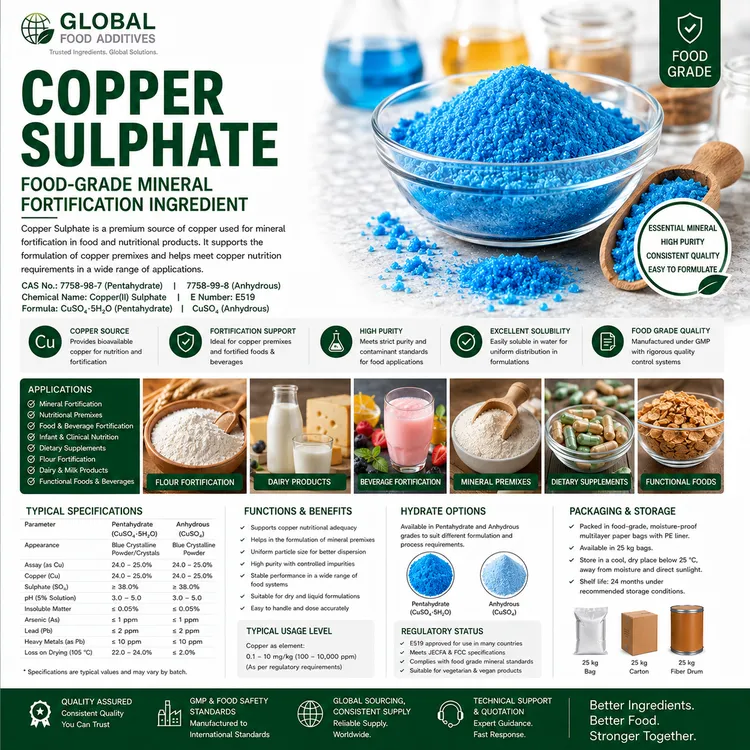
Product identity
| Product | Copper Sulphate |
|---|---|
| Alternative spelling | Copper Sulfate |
| Common names | Cupric sulphate, cupric sulfate, copper(II) sulphate, copper(II) sulfate, blue vitriol for pentahydrate grades |
| Category | Fortification Nutrients |
| Function | Copper mineral source for fortification, enrichment, nutrition positioning and premix-ready formulation where legally permitted |
| E / INS number | Confirm by destination market and supplier documentation; often handled as a nutrient source rather than a standard E-number additive |
| CAS / identity | 7758-98-7 for anhydrous copper sulphate; pentahydrate form should be confirmed separately by supplier documentation |
| Typical hydrate forms | Anhydrous copper sulphate and copper sulphate pentahydrate; other hydrates may exist but should be explicitly confirmed |
| Typical form | Blue crystalline powder or granule for pentahydrate, off-white to grey-white anhydrous powder, fine powder, premix-ready dilution or solution grade |
| Main sourcing note | Specify hydrate form, copper content, assay basis, intended food category, dosage calculation and contaminant limits before quotation. |
Application fit
Potential use areas may include the following, subject to destination-market rules, approved copper source status, maximum levels and finished-product validation:
- Flour enrichment and cereal fortification systems where permitted
- Breakfast cereals, cereal bars and dry grain-based nutritional products
- Vitamin-mineral premixes for fortified foods and beverages
- Powdered nutrition products, meal replacements and fortified drink mixes
- Dairy, plant-based dairy alternatives and nutritional beverages after compatibility testing
- Infant, medical and special-nutrition foods only where permitted and under strict regulatory control
- Tableted, capsule-style or supplement-like food formats where allowed
- Custom mineral blends requiring accurate copper delivery and traceability
Technical overview for industrial buyers
Copper Sulphate is a concentrated mineral source, so industrial use is focused on accurate copper delivery rather than bulk functionality. In most food applications, copper is required at very low nutritional levels. This means that pure or high-strength copper sulphate is usually unsuitable for direct manual dosing unless the factory has validated micro-weighing, premixing, segregation control and release testing.
The practical purchasing decision should start with the required copper level in the finished product and the legal maximum for the target market. From there, formulators calculate the required addition based on elemental copper content, hydrate form, assay and overage policy. Incorrect hydrate assumptions can cause significant dosage errors because anhydrous and pentahydrate forms contain different proportions of copper by mass.
Hydrate form and copper-content basis
Copper Sulphate may be supplied as anhydrous copper sulphate or hydrated copper sulphate, especially the pentahydrate form. The hydrate form changes molecular weight, colour, water content, copper percentage and dosage calculation. Industrial buyers should never assume that two products with the same commercial name deliver the same elemental copper.
| Form | Industrial relevance | Purchasing focus |
|---|---|---|
| Anhydrous copper sulphate | Higher copper concentration by weight; usually off-white to grey-white and strongly moisture-sensitive. | Confirm CAS, assay, elemental copper basis, moisture limits, food-grade status and safety handling requirements. |
| Copper sulphate pentahydrate | Common blue crystalline hydrate with lower copper percentage by weight than anhydrous material. | Confirm pentahydrate identity, copper assay, particle size, crystal form, impurities and storage stability. |
| Premix-ready diluted grade | Useful for safe handling, improved weighing accuracy and better distribution in vitamin-mineral premixes. | Confirm carrier, dilution strength, blend uniformity, assay tolerance, allergen/GMO status and label impact. |
| Liquid solution grade | Used where controlled metering or premade mineral solution is preferred. | Confirm concentration, pH, microbial controls, preservatives if any, packaging, shelf life and compatibility. |
Fortification and premix value
Trace-mineral delivery
Copper Sulphate can provide copper for foods requiring trace-mineral fortification. Because the required addition level is low, dosage precision and blend uniformity are more important than bulk ingredient cost.
Premix compatibility
Copper ions can interact with vitamins, fats, colours and other minerals. Premix design should consider oxidation risk, carrier selection, moisture, pH, light exposure and separation from sensitive ingredients where needed.
High solubility
Copper Sulphate is highly water soluble, which can be useful for solutions and beverages, but also increases reactivity and sensory risk in some matrices. Solubility should be balanced against taste, colour and stability concerns.
Controlled overage
Overage may be needed to meet end-of-shelf-life nutrient claims, but copper has narrow formulation tolerance compared with bulk nutrients. Overage must be justified by stability data and legal maximum limits.
Application matrix
| Food or process area | Typical technical objective | Key questions before sourcing |
|---|---|---|
| Flour and cereal enrichment | Deliver trace copper through a vitamin-mineral premix with uniform distribution. | Is copper sulphate permitted for the specific cereal or flour category, and what is the allowed copper level? |
| Breakfast cereals and cereal bars | Support declared copper nutrition levels while maintaining flavour, colour and shelf-life stability. | Will copper interact with fat, flavours, colours, vitamins or packaging oxygen exposure? |
| Powdered nutrition products | Provide accurate copper delivery in dry blends and reconstituted beverages. | What carrier, particle size, dilution strength and blend-uniformity test are required? |
| Ready-to-drink beverages | Deliver copper in solution while controlling taste, colour, pH and oxidation. | Will copper cause metallic taste, haze, sediment, colour change or vitamin degradation? |
| Dairy and plant-based alternatives | Support mineral fortification in protein and fat-containing systems. | How will copper interact with proteins, emulsifiers, fats, minerals, heat treatment and shelf-life conditions? |
| Infant, medical and special nutrition | Meet strict nutrient targets, contaminant limits, assay requirements and regulatory specifications. | Is the exact copper source approved for the regulated category and destination market? |
| Custom vitamin-mineral premixes | Provide copper in a controlled and traceable premix with appropriate carrier and segregation control. | Has the premix supplier validated uniformity, assay recovery, compatibility and storage stability? |
| Tableted or supplement-style foods | Provide copper in controlled serving units with accurate assay and acceptable sensory profile. | What is the serving size, copper target, tablet hardness, disintegration requirement and legal classification? |
Copper Sulphate versus related copper sources
| Copper source | Industrial difference | Purchasing implication |
|---|---|---|
| Copper Sulphate | Highly soluble inorganic copper salt with strong copper availability and clear assay basis when specified correctly. | Useful for premixes and solutions, but requires careful compatibility, taste and oxidation review. |
| Copper gluconate | Organic copper salt often used in nutrition and supplement-style formats. | May be preferred for specific label or nutrition positioning, but copper percentage and cost-in-use differ. |
| Copper citrate | Copper salt of citric acid with different solubility and formulation behavior. | May be considered where solubility or compatibility differs from sulphate systems. |
| Copper amino acid chelates | Chelated copper sources used in selected nutrition systems. | Often require supplier-specific documentation, chelation claims review and higher cost evaluation. |
| Copper oxide | Low-solubility copper source with different bioavailability and dispersibility considerations. | Should not be treated as interchangeable with copper sulphate without nutrition and regulatory review. |
Specification parameters to compare
Copper Sulphate specifications should be reviewed more strictly than many bulk food ingredients because copper is a trace nutrient with potential toxicity at excessive levels. Buyers should compare assay, hydrate form and impurity limits before price.
| Parameter | Why it matters |
|---|---|
| Identity and hydrate form | Confirms whether the material is anhydrous, pentahydrate or another hydrate; this controls copper-content calculations. |
| Assay as copper sulphate | Supports supplier qualification and comparison against food-grade or pharmacopeial-style standards. |
| Elemental copper content | Required for dosage calculation, nutrition labeling and finished-product copper target. |
| Moisture or water of crystallization | Important for hydrate confirmation, stability, caking, assay consistency and dosage accuracy. |
| pH of solution | Supports beverage, premix, dairy and acidified-food compatibility review. |
| Insoluble matter | Important for solution clarity, premix quality and customer acceptance. |
| Particle size distribution | Affects dry blending, segregation, dusting, dissolution speed and dosing accuracy. |
| Bulk density and flow | Important for premix manufacture, automatic dosing, sachet filling and container loading. |
| Iron, zinc, lead, arsenic, cadmium, mercury and nickel limits | Critical for food-grade compliance, contaminant control and sensitive categories such as infant nutrition. |
| Chloride, free acid or sulfate-related impurities | May be relevant for taste, corrosion, process compatibility and purity review. |
| Microbiological quality | Usually low-risk for inorganic salts but still relevant for premixes, nutrition powders and customer QA programs. |
| Food-grade and regulatory declarations | Confirms suitability for the intended food category and destination market. |
| Shelf life and storage conditions | Supports purchasing, warehouse rotation, export timing and quality assurance. |
Premix design and micro-dosing control
Copper Sulphate is normally best managed through a controlled vitamin-mineral premix rather than direct addition to large food batches. A premix reduces weighing error, improves distribution and makes it easier to verify uniformity. The premix carrier should be selected to reduce segregation, moisture pickup, oxidation and interaction with sensitive nutrients.
When designing a premix, buyers should define the finished-product copper target, serving size, regulatory maximum, expected process loss, shelf-life retention, analytical method and acceptable assay tolerance. In many cases, a diluted copper premix or triturated grade is safer and more practical than pure copper sulphate for routine factory handling.
Uniformity
Copper must be distributed evenly at low dosage. Particle-size matching, carrier choice, mixing time and segregation control are essential for consistent serving-level delivery.
Compatibility
Copper can catalyze oxidation of fats, flavours, colours and vitamins. Sensitive ingredients may need separation, encapsulation, lower moisture, oxygen control or different mineral sourcing.
Assay recovery
Finished-product testing should confirm that copper assay recovery matches the declared level. Matrix effects can influence analytical results and should be discussed with the laboratory.
Safety margin
Copper overage should be conservative and justified. Fortification targets must remain below applicable maximum levels throughout shelf life and expected consumer use.
Compatibility and stability notes
Copper is a reactive transition metal. In foods and premixes, it may accelerate oxidation, affect vitamins, promote off-flavours, interact with colours and influence protein or polyphenol systems. This does not automatically prevent use, but it means the exact formula and processing conditions must be tested.
Special attention is recommended in high-fat powders, emulsified beverages, plant-based drinks, products containing ascorbic acid, products with sensitive natural colours, transparent-packaged beverages and long-shelf-life ambient nutrition products. Packaging oxygen barrier, water activity, light exposure and storage temperature may all affect copper compatibility.
Formulation and processing notes
- Confirm the hydrate form before calculating copper dosage; anhydrous and pentahydrate grades are not equivalent by weight.
- Calculate addition based on elemental copper content, not only on copper sulphate percentage.
- Use premix dilution when direct micro-dosing would create unacceptable weighing or uniformity risk.
- Validate blend uniformity, segregation risk and assay recovery before commercial production.
- Check interaction with ascorbic acid, vitamins, oils, flavours, proteins, polyphenols, natural colours and reducing agents.
- For beverages, test clarity, haze, sediment, colour change, metallic taste, pH drift and shelf-life stability.
- For dry powders, evaluate caking, colour migration, dusting, flow and compatibility with hygroscopic ingredients.
- For infant, medical and special-nutrition products, request enhanced contaminant, microbiological and regulatory documents.
- Do not approve industrial, agricultural or technical copper sulphate for food use; require documented food-grade suitability.
Trial and validation recommendations
Laboratory screening
- Confirm identity, hydrate form, copper content, solubility, appearance and pH against the supplier specification.
- Compare impurity and heavy-metal limits against customer and destination-market requirements.
- Prepare small premixes to assess colour uniformity, segregation, dusting and carrier compatibility.
Pilot formulation
- Test the copper source in the real formula, including heat, pH, water activity, light and storage conditions.
- Measure copper recovery, taste, colour, oxidation, vitamin retention and physical stability over time.
- Compare pure copper sulphate against diluted premix formats where practical.
Factory validation
- Run the material through actual weighing, premixing, dosing, blending, filling and packaging conditions.
- Track dosage accuracy, worker exposure controls, lot traceability and cross-contamination prevention.
- Confirm that cleaning procedures prevent unintended copper carryover into non-fortified products.
Commercial approval
- Approve the exact manufacturer, hydrate form, assay, product code, origin, packaging and shelf life.
- Keep retained samples, COA records, premix calculations, regulatory confirmation and assay reports for audits.
- Define supplier change-notification requirements for raw material source, hydrate form, assay method or impurity profile.
Documents to request
- Product specification or technical data sheet clearly identifying Copper Sulphate / Copper Sulfate and hydrate form
- Certificate of analysis for available batch or representative lot
- Safety data sheet where applicable
- Food-grade declaration and compliance statement for the intended destination market
- Elemental copper content declaration and assay basis
- Hydrate form declaration, including anhydrous or pentahydrate identity
- Assay method information and analytical reference method where available
- Heavy-metal and elemental impurity declarations, including lead, arsenic, cadmium, mercury and nickel where required
- Microbiological specification or low-risk inorganic mineral statement where applicable
- Origin statement, manufacturer information, shelf-life statement and recommended storage conditions
- Allergen, GMO, vegan/vegetarian, irradiation and residual solvent statements when applicable
- Halal, kosher, ISO, HACCP, FSSC, BRCGS or other certification copies when required
- Packaging specification, bag or drum size, pallet configuration and container loading information
- Market-specific mineral source, fortification, label, import or customs declarations required by the destination country
Packaging, storage and logistics
Copper Sulphate should be stored in original, tightly closed packaging in a clean, dry, cool and well-ventilated warehouse, away from incompatible materials and strong odours. Powder grades should be protected from moisture, damaged bags, dust generation and cross-contamination. The material should be handled according to the supplier SDS and site safety procedures.
Common industrial packaging may include lined bags, drums, pails, fibre drums, PE liners or palletized export configurations depending on grade and volume. For long-distance shipments, buyers should consider humidity, container condensation, packaging integrity, lot coding, pallet wrapping and segregation from non-food chemicals. Opened packaging should be resealed immediately and used according to the supplier's instructions.
Regulatory and labeling review
Copper Sulphate should be reviewed as a mineral nutrient source, not as a general additive that can be used freely in any food. Regulations may define which copper compounds are permitted, which food categories can be fortified, the permitted minimum and maximum copper levels, and how copper must be declared on the label.
Buyers should confirm whether the final product requires copper fortification, whether voluntary fortification is allowed, whether copper claims can be made, whether the source is permitted for the target population, and whether the dosage remains within legal and nutritional limits. Infant, medical, sports nutrition and supplement-like products require especially careful review.
Technical purchasing notes
When reviewing Copper Sulphate, compare the supplier specification against the intended food application, process conditions, target copper level, premix design, label expectations and local rules. For industrial purchasing, the most useful inquiry normally includes required hydrate form, elemental copper target, assay, particle size, physical form, packaging size, quantity, destination and document requirements.
If the target is a vitamin-mineral premix, include carrier system, dilution strength, batch size, mixing process and assay tolerance. If the target is a beverage or liquid system, include pH, heat process, clarity requirement, vitamin system, packaging and shelf-life target. If the product is for infant, medical or special nutrition, include all regulatory standards, contaminant limits and analytical requirements.
How to request this product
Send the product name, required spelling or naming preference, hydrate form, target copper content, reference specification, quantity, destination country, packaging preference, expected shipment date and required documents. If you already purchase Copper Sulphate, attach or describe your current specification, certificate of analysis, label, premix formula or supplier product code so alternative sources can be compared more accurately.
Useful answers
What is Copper Sulphate used for in food manufacturing?
Copper Sulphate is reviewed as a copper mineral source for fortification, enrichment, nutrition positioning and vitamin-mineral premix formulation. It is used only where permitted and at carefully controlled nutritional levels.
Is Copper Sulphate the same as Copper Sulfate?
Yes. Copper Sulphate is the British spelling and Copper Sulfate is the American spelling. Both names refer to copper(II) sulphate / copper(II) sulfate, also known as cupric sulphate or cupric sulfate.
Which CAS number should be used?
CAS 7758-98-7 is commonly associated with anhydrous copper sulphate. Copper sulphate pentahydrate is commonly referenced separately. Buyers should confirm hydrate form, CAS number and copper content on the supplier specification and COA.
Is Copper Sulphate safe in all amounts?
No. Copper is an essential trace mineral, but excess intake can be harmful. Copper Sulphate must be used only according to validated dosage calculations, legal limits, nutrition requirements and customer specifications.
Can Copper Sulphate be added directly to food?
Direct addition is usually not recommended unless the factory has validated micro-dosing and mixing controls. Many manufacturers use a diluted premix to improve safety, uniformity and dosage accuracy.
Which Copper Sulphate grade should be requested?
Buyers should request food-grade material with confirmed hydrate form, copper assay, impurity limits, particle size, solubility, packaging, origin and required regulatory documents. Industrial, agricultural or technical grades should not be used for food.
Can Copper Sulphate affect product stability?
Yes. Copper can interact with vitamins, fats, colours, flavours, proteins and reducing agents. It may contribute to oxidation, off-flavour, colour change or nutrient degradation if the formula is not properly designed and tested.
Can Global Food Additives source Copper Sulphate?
Global Food Additives can review sourcing options for Copper Sulphate according to target specification, hydrate form, copper assay, quantity, destination, packaging and required documentation.
Which documents should be requested?
Buyers commonly request a technical data sheet, specification, certificate of analysis, safety data sheet, food-grade statement, hydrate form declaration, copper assay, heavy-metal declaration, shelf-life information, label and packing details, plus halal, kosher, allergen, GMO or vegan statements when required.
Is Copper Sulphate permitted in every country?
No. Use depends on destination-market rules, approved mineral sources, food category, fortification policy, maximum level, label requirements and buyer responsibility. Always verify current regulations and final product suitability before commercial use.
Tell us which Copper Sulphate grade or mineral premix you need.
Send product names, target specifications, hydrate form, copper assay, application, quantity, destination country, packaging preference, delivery term and document requirements. Our team will review your inquiry and respond from orders@foodgradeadditives.com.
Your message has been received. You will be redirected to the home page.