
Disodium EDTA E386
Disodium EDTA, also known as Disodium Ethylenediaminetetraacetate or Disodium Edetate, is a food-grade chelating and sequestration ingredient used in selected food and beverage systems to support oxidation control, colour stability, flavour protection and shelf-life consistency. It is considered when trace metal ions such as iron and copper may accelerate rancidity, flavour loss, discolouration, clouding or vitamin degradation.
For industrial buyers, Disodium EDTA should be reviewed not only as an additive name on a product list, but as a specification-controlled ingredient. Proper approval normally requires confirmation of food-grade status, assay, purity, solubility, heavy metals, microbiological limits, origin, regulatory permission, label declaration, packaging integrity and batch-level traceability.
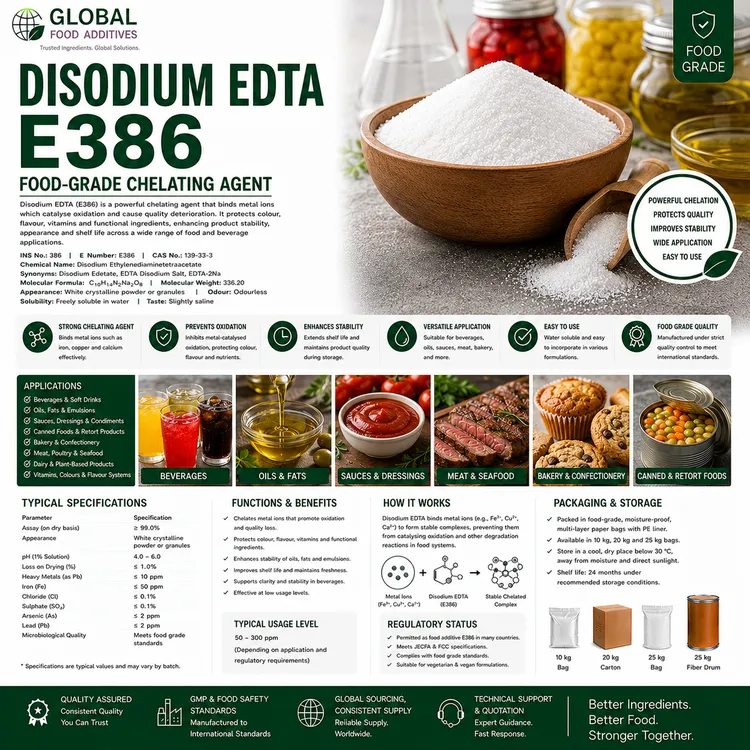
Product identity
| Product name | Disodium EDTA |
|---|---|
| Common technical name | Disodium Ethylenediaminetetraacetate |
| Other names | Disodium Edetate; EDTA Disodium Salt; Ethylenediaminetetraacetic Acid Disodium Salt |
| Category | Antioxidants & Oxidation Control |
| Functional class | Chelating agent / sequestrant / oxidation-control ingredient |
| E / INS number | E386 / INS 386 |
| CAS / identity | 139-33-3 |
| Chemical family | Disodium salt of ethylenediaminetetraacetic acid |
| Typical formula reference | C10H14N2Na2O8, usually declared according to supplier specification and hydrate status |
| Typical commercial form | White crystalline powder, granule or aqueous solution grade, supplier dependent |
| Primary technical purpose | Control of trace metal ions that can catalyse oxidation, colour loss, flavour instability or product deterioration |
Application fit
Disodium EDTA is normally considered where trace metal control is important for product stability. Potential use areas may include:
- Beverages, concentrates, syrups and acidified drink systems
- Sauces, dressings, mayonnaise-style products, condiments and emulsified systems
- Canned vegetables, legumes, mushrooms and brined food products
- Seafood systems, marinades, pickled products and ready-to-eat savoury foods
- Colour-sensitive, flavour-sensitive or vitamin-sensitive formulations
- Products where iron, copper or other metal ions may reduce shelf-life consistency
Industrial function and formulation value
Disodium EDTA is primarily used for chelation. In practical food formulation, this means it can bind small amounts of metal ions that may otherwise promote oxidative reactions, rancidity, pigment degradation, turbidity, off-flavour development or vitamin loss. This is particularly valuable in systems containing water, salts, acids, minerals, natural colours, oils, flavour compounds or ingredients that may introduce trace metals during processing.
The ingredient is often evaluated as part of a broader stability system rather than as a standalone preservative solution. In many formulations, it may be reviewed together with acidulants, antioxidants, preservatives, emulsifiers, colour systems, packaging controls and thermal-process design. The correct approach depends on the product matrix, target shelf life, pH, oxygen exposure, heat treatment, storage temperature and local legal limits.
Technical performance considerations
Metal-ion control
Trace iron, copper and other polyvalent metal ions can enter foods from water, salts, spices, vegetable ingredients, processing equipment, minerals or packaging-contact surfaces. Disodium EDTA is used to reduce the catalytic activity of these ions by forming more stable complexes.
Oxidation protection
In oxidation-sensitive foods, metal ions can accelerate rancidity, stale notes, colour fading and flavour degradation. EDTA-based chelation can support the performance of antioxidant and packaging systems, especially in emulsions, beverages, sauces and brines.
pH and system design
The performance of chelating agents depends on food-system pH and matrix composition. Acidified products, brines, emulsified sauces and beverage systems should be evaluated for solubility, clarity, flavour impact, label requirements and legal use level.
Dosing and dispersion
For powder grades, evaluate dissolution order, mixing time, lump formation, dusting, hygroscopicity and compatibility with salts, acids, sweeteners, preservatives and colour premixes. For liquid grades, confirm active content, density, microbial status and dosing accuracy.
Typical manufacturing applications
| Application area | Technical role | Purchasing and formulation notes |
|---|---|---|
| Beverages and concentrates | Supports colour, flavour and vitamin stability by controlling trace metals in water-based systems. | Check pH, clarity, haze risk, water quality, mineral content, preservative system, heat treatment and local additive permission. |
| Sauces, dressings and condiments | Helps reduce oxidation and flavour deterioration in acidic, emulsified or oil-containing products. | Evaluate interaction with emulsifiers, gums, acids, preservatives, oils, spice extracts and packaging oxygen exposure. |
| Canned and brined foods | May support colour and flavour stability in products exposed to minerals, salts, heat treatment and long storage. | Review legal use category, brine composition, retort process, can-contact materials, headspace oxygen and shelf-life target. |
| Seafood and savoury prepared foods | Can help manage metal-catalysed quality changes in high-moisture, protein-containing or brined systems. | Confirm permitted use, sensory neutrality, sodium contribution, process stability and customer label expectations. |
| Colour-sensitive formulations | Supports protection of natural or synthetic colour systems that may be affected by trace metals. | Conduct shelf-life trials under light, heat and oxygen exposure. Test with the actual colour source and packaging format. |
| Vitamin- or flavour-sensitive products | Can reduce degradation pathways linked to catalytic metal ions and improve shelf-life consistency. | Evaluate together with antioxidant package, oxygen control, processing temperature, packaging barrier and storage condition. |
Specification points to review before approval
Industrial buyers should compare supplier specifications against internal quality standards, customer requirements, the intended food process and destination-market legislation. A robust technical review normally covers:
- Assay or active content: Confirm the declared basis, hydrate status, calculation method and specification range.
- Identity testing: Confirm that the product is clearly identified as Disodium EDTA / E386 / INS 386 and that the supplier references suitable analytical methods.
- Appearance and physical form: Check colour, odour, crystal form, particle size, bulk density, flowability and suitability for the dosing system.
- Moisture or loss on drying: Important for shelf life, caking tendency, solubility behaviour and batch-to-batch consistency.
- pH and solution clarity: Relevant for beverages, sauces, brines, concentrates and clear or lightly coloured food systems.
- Chelation performance: For sensitive applications, confirm performance through finished-product trials rather than relying only on generic data.
- Purity and impurities: Review heavy metals, nitrilotriacetic acid where applicable, residual substances, insoluble matter and supplier-specific purity limits.
- Microbiology: Confirm total plate count, yeast and mould, pathogens and any category-specific microbiological expectations, especially for liquid grades.
- Origin and production route: Request manufacturer, country of origin, raw-material declaration and processing-aid information where required.
- Allergen and dietary status: Request allergen, GMO, halal, kosher, vegetarian or vegan documents where required by the final product or customer.
- Packaging and shelf life: Check bag type, liner, drum or container format, net weight, pallet configuration, storage condition and expiry or retest date format.
Regulatory and labelling review
Disodium EDTA is identified as E386 / INS 386, but permission is not automatic for every country, food category or maximum level. Before commercial use, the buyer should verify additive status in the destination market, the relevant food category, maximum permitted level, carry-over rules, import requirements and finished-product label declaration.
Depending on local rules, finished product labels may need to declare the additive class and name or number, such as "sequestrant: Disodium EDTA", "antioxidant: Disodium EDTA", "E386" or "INS 386". Where products are positioned as natural, clean-label, organic, child-oriented, low-sodium, preservative-free or export-market specific, additional regulatory and customer approval is recommended before launch.
Quality, storage and handling expectations
Storage
Store in tightly closed original packaging in a clean, dry, cool and well-ventilated area. Protect powder grades from moisture, damaged bags, odour contamination and direct sunlight. Liquid grades should be stored according to supplier instructions, including temperature limits and microbial-control guidance.
Handling
Powder handling should follow site procedures for dust control, personal hygiene and cross-contamination prevention. Use dedicated or properly cleaned dosing tools when the ingredient is used in allergen-controlled, halal, kosher, vegetarian or vegan production areas.
Incoming inspection
At goods receipt, verify product name, batch number, net weight, packaging condition, shelf life, supplier certificate of analysis and label information. Inspect for caking, moisture ingress, damaged liners, leakage or foreign odour before releasing the lot for production.
Traceability
Batch-level traceability should connect purchase order, supplier lot, certificate of analysis, warehouse receipt, internal material code, production batch and finished-product lots. This supports customer audits, export compliance and recall-readiness programs.
Compatibility and plant-trial guidance
Before full commercial approval, Disodium EDTA should be evaluated in pilot or plant-scale trials using the same water source, processing equipment, ingredient sequence, packaging format and shelf-life conditions as the commercial product. Laboratory screening can be useful, but it may not reveal all interactions that occur during pasteurisation, retorting, hot filling, cooling, storage or distribution.
- Water quality: Measure hardness, iron, copper and other relevant minerals when the product is water-based.
- Processing sequence: Confirm when Disodium EDTA should be added for best dissolution and metal-ion control.
- Sensory neutrality: Check that the selected use level does not create unwanted bitterness, metallic notes or flavour changes.
- Colour stability: Test real colours under expected light, heat and oxygen exposure.
- Packaging interaction: Evaluate oxygen barrier, metal packaging, closure system, headspace and shelf-life storage temperature.
- Regulatory margin: Confirm the approved food category and maximum level before plant trials are scaled to commercial production.
Documents to request
For a professional food-manufacturing approval process, buyers should request documentation that supports identity, safety, compliance, traceability and customer claims. Typical document requirements include:
- Product specification or technical data sheet
- Certificate of analysis for the offered batch or representative lot
- Safety data sheet where applicable
- Food-grade statement and intended-use statement
- Origin statement, manufacturer statement and production-route declaration
- Allergen statement and cross-contact information
- GMO status statement, if required by the destination market or customer
- Halal, kosher, vegetarian or vegan certificate or declaration, if applicable
- Heavy metals, microbiological and purity limits from the supplier specification
- Statement on residual impurities or relevant controlled substances where required
- Shelf-life, storage, packaging and pallet-configuration details
- Label draft, bag marking, drum label or batch-coding format
- Market-specific declarations required by the importing country, retailer or end customer
Commercial sourcing and logistics notes
Disodium EDTA is typically purchased by industrial users according to grade, documentation package, origin, batch availability, shipment destination, packaging format and cost-in-use performance. When comparing offers, buyers should not evaluate only the unit price. Assay, hydrate form, solubility, purity, caking behaviour, documentation quality, lead time, regulatory suitability and finished-product performance can all affect the real commercial value of the material.
For export projects, buyers should confirm HS code guidance with their customs broker, required import permits, country-specific additive rules, original document requirements, shelf-life remaining at dispatch, pallet treatment, container loading plan and whether the product requires special protection from humidity during transport.
How to request this product
To receive a more accurate quotation, send the product name, target specification, intended food application, annual or spot quantity, destination country, packaging preference, required delivery term, expected shipment date and requested documents. If you already purchase Disodium EDTA, attach your current specification, supplier label, certificate of analysis or benchmark sample details so alternatives can be compared more accurately.
Minimum inquiry details
- Product name: Disodium EDTA / E386 / INS 386
- Required grade and target specification
- Powder, granule or liquid preference
- Quantity per shipment and annual forecast
- Destination country and delivery term
- Preferred packaging size and pallet requirements
- Required certificates and declarations
Helpful technical details
- Application type and finished-product category
- Product pH, heat process and shelf-life target
- Water quality or known metal-ion sensitivity
- Target problem: colour loss, rancidity, flavour fading, clouding or vitamin degradation
- Need for halal, kosher, vegetarian, vegan, allergen or GMO documentation
- Any regulatory market, customer standard or retailer requirement to be matched
Useful answers
What is Disodium EDTA used for in food manufacturing?
Disodium EDTA is used as a chelating and oxidation-control ingredient in selected food and beverage systems. It helps bind trace metal ions that may accelerate rancidity, colour fading, flavour deterioration, vitamin degradation or instability in sensitive finished products. Exact suitability depends on grade, use level, process, label requirements, regulations and customer documents.
Is Disodium EDTA a direct antioxidant?
Disodium EDTA is best understood as a chelating or sequestration ingredient. It supports oxidation control indirectly by binding catalytic metal ions such as iron and copper. It is often evaluated together with antioxidants, preservatives, acidulants, packaging controls and process controls.
Which applications are most relevant?
Relevant application areas may include beverages, concentrates, sauces, dressings, condiments, canned foods, brines, seafood systems, pickled products, colour-sensitive formulations and products where trace-metal control is important. Final use depends on local additive permissions and customer requirements.
Which documents should be requested?
Buyers commonly request a technical data sheet or specification, certificate of analysis, safety data sheet where applicable, origin statement, food-grade statement, allergen statement, GMO statement, halal or kosher documents if required, shelf-life information, storage guidance, label details and packaging configuration.
Is Disodium EDTA suitable for halal, kosher, vegetarian or vegan products?
Suitability depends on the exact supplier, raw-material origin, production route, processing aids and certification status. Request supplier declarations before using the product in halal, kosher, vegetarian, vegan or claim-sensitive finished foods.
Is this product permitted in every country?
No. Food additive use depends on destination-market rules, food category, use level, labelling requirements and buyer responsibility. Regulatory approval should be checked before commercial production.
Tell us which food additive or ingredient you need.
Send product names, target specifications, quantity, destination country, packaging preference, delivery term, and document requirements. Our team will review your inquiry and respond from orders@foodgradeadditives.com.
Your message has been received. You will be redirected to the home page.