
Distilled Monoglycerides
Distilled Monoglycerides, commonly associated with E471 / INS 471, are industrial food emulsifiers used to manage the interface between fat, water, air and starch systems. They are selected by manufacturers when a formulation requires reliable emulsion stability, controlled fat crystallization, improved aeration, crumb softness, anti-staling performance, overrun, dispersion efficiency and processing tolerance.
For purchasing teams, this page provides a practical technical framework for comparing grades, requesting documents, reviewing quality parameters and preparing a clear quotation inquiry. Final suitability must always be confirmed against the exact food category, process, dosage, destination-market regulation and supplier specification.
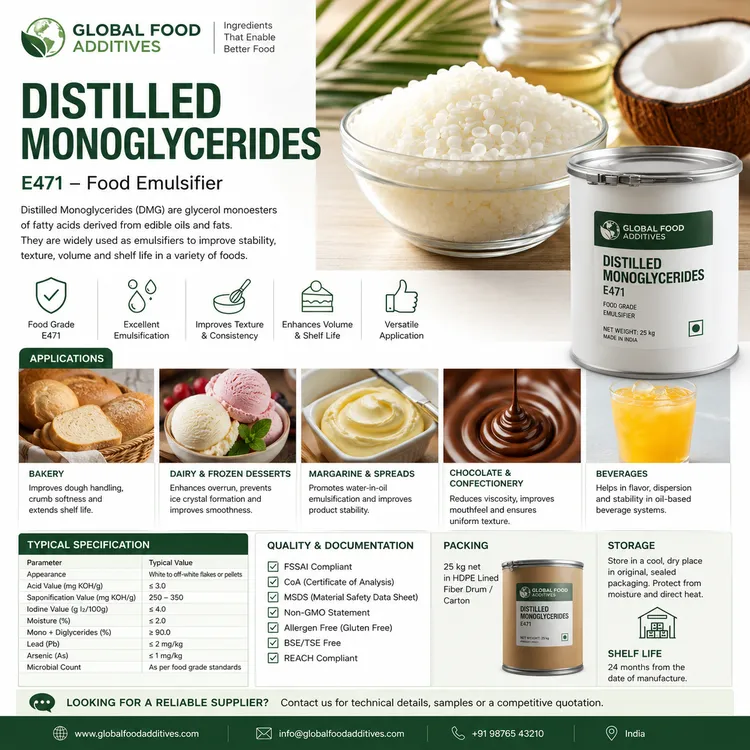
Product identity
| Product | Distilled Monoglycerides |
|---|---|
| Common abbreviation | DMG |
| Category | Emulsifiers & Surface Active Ingredients |
| Function | Food emulsifier / surface-active ingredient |
| E / INS number | E471 / INS 471 |
| Identity | Mixture of mono- and diglycerides of edible fatty acids |
| Typical source | Vegetable oil-based grades are common; origin must be verified from supplier documents |
| Typical form | Powder, bead, flake, pellet, paste or liquid grade |
| Solubility behavior | Generally dispersible in fat phase; performance depends on melting profile, particle size, hydration and process temperature |
| Use status | Food additive use depends on destination-market rules, food category and maximum permitted use level |
Application fit
Potential industrial use areas may include:
- Bakery bread, buns, rolls, cakes and sponge systems
- Margarine, shortening, spreads and fat blends
- Ice cream, frozen desserts and whipped toppings
- Beverage emulsions, dairy analogues and coffee whiteners
- Chocolate, compound coatings, fillings and confectionery fats
- Instant mixes, powders and dry premix systems where dispersibility is required
Industrial function and performance value
Distilled Monoglycerides are valued because they can influence multiple physical systems at once. In oil-in-water and water-in-oil systems, they help reduce interfacial tension and support stable dispersion. In bakery, they can form complexes with amylose, slow starch retrogradation and improve crumb softness over shelf life. In aerated systems, they can support foam structure, improve overrun and contribute to more uniform air-cell distribution. In fat-based systems, they can influence crystallization behavior, texture, plasticity and processing consistency.
Key technical mechanisms
- Emulsification: supports fine dispersion of fat and water phases during mixing, homogenization or thermal processing.
- Starch complexing: contributes to softer bakery crumb and delayed firming in bread, buns and sweet baked goods.
- Aeration support: improves air incorporation and foam stability in cakes, whipped toppings and frozen desserts.
- Fat structuring: can help manage fat crystal networks in margarine, shortening, fillings and spreads.
- Processing tolerance: improves formulation robustness during mixing, heating, cooling, shearing, pumping and storage.
Common buying objectives
- Improve texture, softness, volume or mouthfeel
- Reduce oiling-off, phase separation or creaming
- Support consistent overrun and air-cell distribution
- Enhance shelf-life performance in bakery and fat systems
- Replace or compare existing E471 grades from another supplier
- Secure export-ready documentation for customer approval
Application guidance by industry
Grade selection should be aligned with the target process and finished-product performance. A bakery grade may prioritize starch-complexing ability and fine dispersion, while a margarine or shortening grade may prioritize melting profile, fat compatibility and crystallization behavior. For dairy, frozen dessert and beverage systems, the buyer should evaluate dispersion behavior, heat stability, compatibility with proteins, salts, hydrocolloids, stabilizers and homogenization conditions.
Bakery and flour-based products
In bread, buns, rolls, cakes and sponge systems, Distilled Monoglycerides may be used to improve dough handling, batter stability, loaf volume, crumb softness and shelf-life texture. They are often evaluated alongside enzymes, DATEM, SSL, CSL, lecithin, hydrocolloids and improver blends depending on the target formulation.
- Crumb softness and delayed firming
- Improved volume and uniform cell structure
- Better batter aeration in cakes and sponge products
- More consistent industrial mixing and line performance
Margarine, spreads and shortening
In fat-continuous systems, Distilled Monoglycerides may support water dispersion, plastic texture, spreadability, emulsion stability and controlled crystallization. Compatibility with fat composition, cooling profile, crystallizer settings and storage temperature should be tested before scale-up.
- Improved water-in-oil emulsion stability
- Reduced water separation and oiling-off
- Controlled texture in spreadable fat products
- More stable performance during storage and transport
Ice cream and aerated dairy systems
In ice cream, frozen desserts and whipped toppings, E471-type emulsifiers can help manage fat destabilization, overrun, meltdown resistance and texture. Performance depends on fat type, protein system, stabilizer package, pasteurization, aging, freezing and whipping conditions.
- Support for overrun and foam stability
- Improved mouthfeel and body
- Better fat destabilization control
- More consistent freezing and whipping performance
Chocolate, coatings and confectionery fats
In chocolate, compound coatings and fat-based fillings, selected grades may support flow behavior, fat dispersion, texture uniformity and processing consistency. Buyers should confirm compatibility with cocoa butter, cocoa butter equivalents, lauric fats, non-lauric fats, lecithin, PGPR and other emulsifiers.
- Flow and viscosity support in fat systems
- Reduced processing variation
- Improved fat dispersion in coatings and fillings
- Potential support for texture and snap depending on formulation
Specification parameters to compare
Distilled Monoglycerides should not be purchased by name alone. Industrial buyers should compare measurable specification parameters, intended application, origin, regulatory suitability and batch-to-batch consistency. The most important data points may vary by application, but the following items are commonly reviewed during supplier qualification.
| Parameter | Why it matters |
|---|---|
| Monoglyceride content | Higher monoglyceride content is typically associated with stronger functional activity and more consistent emulsifying performance. |
| Free glycerol | Helps assess purity and potential impact on taste, handling and formulation balance. |
| Acid value | Indicates free fatty acid level and can affect stability, odor and quality perception. |
| Iodine value | Provides insight into fatty acid unsaturation and can influence melting behavior, oxidative stability and application fit. |
| Melting point / dropping point | Critical for dispersion, activation temperature, fat compatibility and process design. |
| Particle size / physical form | Affects mixing speed, dusting, dosing accuracy, dispersion and premix compatibility. |
| Peroxide value | Useful for evaluating oxidation status in fat-derived ingredients. |
| Heavy metals and contaminants | Required for food safety, regulatory compliance and customer approval. |
| Microbiological limits | Important for food-grade status, especially for sensitive applications and export documentation. |
| Origin and feedstock declaration | Important for halal, kosher, vegetarian, vegan, allergen, sustainability and customer-label requirements. |
Processing and formulation notes
For best industrial performance, Distilled Monoglycerides should be incorporated according to the process design and supplier recommendation. Some grades perform best when melted into the fat phase; others are designed for easier dispersion in premixes or direct addition. Incorrect activation temperature, insufficient mixing, unsuitable particle size or poor compatibility with the fat phase can reduce performance even when the ingredient meets its specification.
Practical handling points
- Confirm whether the grade should be pre-melted, dry blended or dispersed under high shear.
- Match melting profile with the process temperature and product matrix.
- Evaluate dispersion quality at pilot scale before full production.
- Check interaction with lecithin, hydrocolloids, proteins, salts, enzymes and other emulsifiers.
- Monitor finished-product texture, volume, stability and shelf-life performance over time.
Scale-up considerations
- Mixing sequence and shear conditions
- Heating and cooling profile
- Fat composition and crystallization behavior
- Water activity, pH and salt level
- Homogenization pressure where applicable
- Packaging, storage and distribution temperature
Quality, compliance and documentation review
Food manufacturers should request documents before confirming commercial orders. The technical data sheet and certificate of analysis should be reviewed against the buyer’s internal standard, regulatory requirements and finished-product application. For export business, documentation should also match destination-country expectations, customs clearance needs and customer approval procedures.
Documents to request
- Product specification or technical data sheet
- Certificate of analysis for available batch or lot
- Safety data sheet where applicable
- Food-grade declaration and regulatory status statement
- Origin declaration and manufacturing-country information
- Allergen statement and cross-contact information
- GMO / non-GMO statement where required
- Halal and kosher certificates where required
- Vegetarian, vegan or animal-origin declaration where required
- Palm, palm-kernel or RSPO-related statement where required
- Contaminant, heavy metal and microbiological limits
- Shelf-life, storage and transport information
- Label draft, packaging details and pallet configuration
- Market-specific declarations required by the destination country or end customer
Packaging, storage and logistics
Packaging format should be selected according to product form, warehouse conditions, dosing system and shipment route. Powder, bead and flake forms are commonly supplied in lined bags or cartons, while paste or liquid grades may require drums, pails, IBCs or heated handling depending on viscosity and melting profile. Buyers should confirm net weight, pallet pattern, container loading, shelf life, recommended storage temperature and moisture protection before shipment.
Storage guidance to confirm
- Recommended storage temperature and humidity
- Protection from heat, moisture and direct sunlight
- Odor control and segregation from strong-smelling materials
- First-expired, first-out inventory management
- Handling instructions for paste or liquid grades
Logistics data to request
- Net weight and gross weight per unit
- Bag, carton, drum, pallet or IBC dimensions
- Pallet configuration and container loading plan
- HS code suggestion and export document list
- Temperature sensitivity during transit
Supplier qualification questions
Before changing supplier or approving a new source, purchasing and R&D teams should compare the new grade with the existing specification, production conditions and finished-product performance. A trial batch is strongly recommended for critical applications such as bread improvers, high-volume cake production, ice cream systems, margarine lines and chocolate or coating processes.
- Is the grade optimized for bakery, dairy, margarine, beverage, confectionery or general-purpose use?
- What is the declared monoglyceride content and typical batch range?
- What is the fatty acid profile and melting point range?
- Is the product vegetable-origin, palm-based, animal-origin-free or otherwise declared?
- Which regulatory standards and destination markets can be supported?
- Can the supplier provide current COA, TDS, SDS and food-grade declarations?
- Is the same grade available consistently for repeat orders?
- What is the minimum order quantity, lead time and available packaging?
- Are halal, kosher, allergen, GMO, RSPO or sustainability documents available?
How to request this product
Send the product name, target grade or reference specification, application, quantity, destination country, packaging preference, expected shipment date, required certifications and document list. If you already purchase Distilled Monoglycerides, attach or describe your existing specification, technical data sheet, label or certificate of analysis so supplier options can be compared more accurately.
Useful answers
What are Distilled Monoglycerides used for in food manufacturing?
Distilled Monoglycerides are used to support emulsion stability, starch complexing, aeration, fat dispersion, crumb softness, anti-staling performance, overrun and processing tolerance. Exact suitability depends on grade, application, processing conditions, regulations and supplier documents.
What is the difference between standard E471 and distilled monoglycerides?
Standard E471 products may contain a broader mixture of mono- and diglycerides. Distilled Monoglycerides are typically purified to increase monoglyceride content, which can provide stronger and more consistent emulsifying performance in industrial applications.
Can Global Food Additives source Distilled Monoglycerides?
Global Food Additives can review sourcing options for Distilled Monoglycerides according to target specification, application, quantity, destination, packaging and required documentation.
Which industries commonly evaluate this product?
Common industries include industrial bakery, margarine and spreads, shortening, frozen desserts, whipped toppings, beverage emulsions, chocolate, compound coatings, confectionery fillings and dry premix manufacturing.
Which documents should be requested?
Buyers commonly request a technical data sheet, product specification, certificate of analysis, safety data sheet where applicable, origin statement, allergen statement, GMO statement, halal or kosher certificate if required, shelf-life information, label details and packaging configuration.
Is this product permitted in every country?
No. Food additive use depends on destination-market rules, food category, use level, label requirements and buyer responsibility. Always verify regulatory status before commercial use.
What information helps prepare a faster quotation?
Share the application, desired grade, monoglyceride content if known, physical form, quantity, destination country, packaging preference, target shipment date, certification requirements and any reference specification or COA currently used.
Tell us which food additive or ingredient you need.
Send product names, target specifications, quantity, destination country, packaging preference, delivery term and document requirements. Our team will review your inquiry and respond from orders@foodgradeadditives.com.
Your message has been received. You will be redirected to the home page.