
Erythrosine
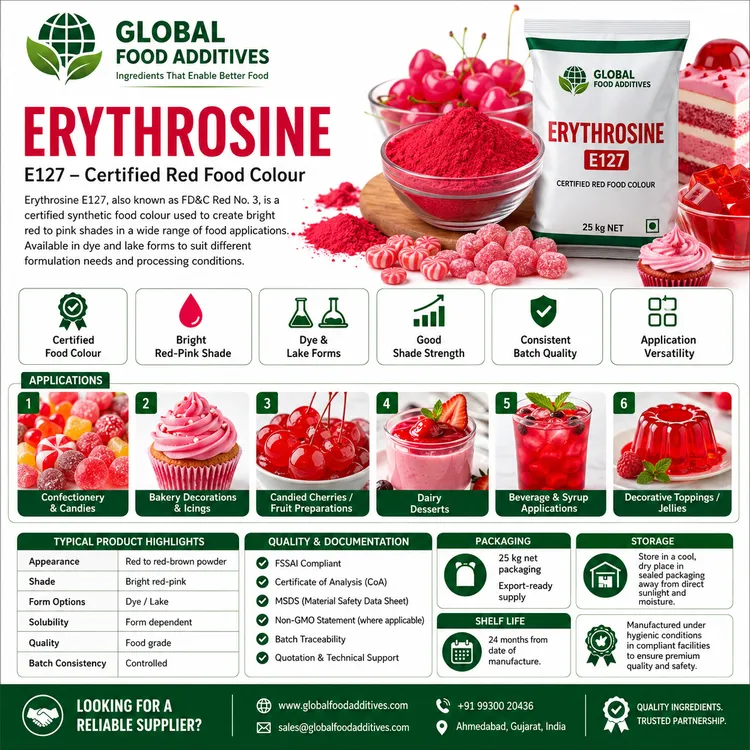
Erythrosine, also known as E127, INS 127, Food Red 14 or FD&C Red No. 3 in some markets, is a synthetic certified red-pink colour used for shade development and colour standardisation in selected applications where permitted. Industrial sourcing must focus on current regulatory status, food-category permission, certified dye or lake identity, colour strength, purity, heavy metals, subsidiary dyes, label declaration, batch certification and customer compliance requirements.
Product identity
| Product | Erythrosine |
|---|---|
| Common names | Erythrosine E127, INS 127, FD&C Red No. 3, Red 3, Food Red 14, Acid Red 51, C.I. 45430 |
| Category | Colours & Colouring Foods |
| Function | Certified synthetic food colour / red-pink shade standardisation ingredient |
| E / INS number | E127 / INS 127, subject to strict destination-market restrictions |
| CAS / identity | 16423-68-0 |
| Chemical identity | Disodium salt of tetraiodofluorescein / organoiodine xanthene colour |
| Typical shade | Bright red, cherry red, pink-red or bluish-red depending on grade, concentration, matrix and pH |
| Typical form | Water-soluble dye powder, liquid colour, aluminium lake, dispersion or application-specific colour blend |
| Industrial purchasing basis | Assay, colour strength, dye or lake form, particle size, shade, solubility, certification, impurities, heavy metals, permitted market and documentation |
Application fit
Erythrosine is evaluated only where the colour is legally permitted for the target food category and destination market. It is not a universal red colour solution.
- Selected confectionery and decorative products where permitted
- Processed cherries, fruit preparations or specialty fruit systems where permitted
- Bakery decorations, icings, glazes and toppings where permitted
- Tablets, coatings, capsules or nutraceutical formats only where permitted
- Dry mixes, powder blends and instant products subject to local rules
- Liquid colour blends for specific approved applications
- Lake colour systems for fat-based or low-moisture matrices where permitted
- Export products requiring exact market-by-market regulatory review
Technical overview for manufacturers
Erythrosine is a high-tinting-strength synthetic xanthene dye that produces bright red to pink-red shades. It is valued for strong visual impact at low dosage, but it is also one of the most regulation-sensitive synthetic colours. For industrial food manufacturers, the main purchasing question is not only “Does it create the target shade?” but also “Is this exact colour form permitted in the destination market, in this food category, at this level, under the intended label declaration?”
Functional value in colour systems
High colour strength
Provides strong red-pink visual impact at low use levels when the grade is appropriate and legally permitted for the food category.
Shade standardisation
Supports batch-to-batch colour consistency in selected systems where natural raw material variation or process variation affects appearance.
Dye and lake flexibility
Water-soluble dye forms and lake forms can be selected for different matrices, but permission and performance must be checked separately.
Blending potential
Can be blended with other permitted colours to adjust red, pink, berry, cherry or decorative shades, subject to local regulations and compatibility.
Dye form versus lake form
| Form | Typical use logic | Technical points to verify |
|---|---|---|
| Water-soluble dye | Used where colour must dissolve into water-based systems, syrups, aqueous coatings or liquid colour blends. | Solubility, pH behaviour, shade, assay, clarity, staining, heat stability, batch certification and permitted food category. |
| Aluminium lake | Used where dispersion into fat-based, low-moisture or dry systems is needed rather than full water solubility. | Lake strength, particle size, aluminium content, oil/fat dispersion, speckling, migration, application permission and label rules. |
| Liquid preparation | Used for easier dosing in industrial plants, colour kitchens or automated systems. | Active colour content, carrier, preservative system, viscosity, pH, microbial status, packaging and shelf life. |
| Dry blend or dispersion | Used for pre-standardised shade systems or application-ready colour blends. | Carrier, dilution ratio, blend uniformity, dusting, segregation, colour strength and full label declaration. |
Grade selection guidance
| Manufacturing need | Grade point to confirm | Why it matters |
|---|---|---|
| Clear water-based product | Water-soluble dye grade, solution clarity, pH range and insoluble matter | Prevents haze, sediment, poor dissolution and uneven colour distribution. |
| Confectionery coating or icing | Dye/lake selection, shade strength, migration, humidity stability and surface staining | Controls visual brightness, bleeding, colour transfer and shelf-life appearance. |
| Low-moisture or fat-based system | Lake grade, particle size, oil dispersion, carrier compatibility and permitted use | Improves dispersion and reduces speckling in dry or fat-containing products. |
| Dry premix | Particle-size match, dilution carrier, dusting, blend uniformity and segregation risk | Supports safe dosing and uniform finished-product colour after mixing or reconstitution. |
| Export formulation | Destination-market status, food-category permission, maximum level and label wording | Prevents rejected shipments, relabelling costs, reformulation and compliance failures. |
| Replacement project | Shade match, colour strength conversion and alternative colour availability | Allows reformulation toward permitted colours such as carmine, anthocyanins, beetroot red or other approved systems where suitable. |
Processing and formulation considerations
- Regulatory status first: confirm permission before technical trials because Erythrosine is restricted or changing in some important markets.
- Dye or lake selection: choose water-soluble dye for aqueous systems and lake/dispersion forms for low-moisture or fat-based systems where permitted.
- Dosage accuracy: high colour strength requires precise weighing, pre-dilution and validated dosing to prevent shade variation or hot spots.
- pH and matrix: final shade may shift depending on pH, acidity, proteins, sugars, minerals, hydrocolloids and other colours.
- Heat process: evaluate colour before and after baking, boiling, pasteurisation, hot-fill or confectionery cooking.
- Light exposure: test in final packaging because display lighting, transparent packaging and long shelf life can affect shade retention.
- Colour migration: icings, fillings, glazes, gummies and layered products should be tested for bleeding or staining during storage.
- Interaction with other colours: red shade systems often combine multiple colours; each colour must be permitted and compatible at the intended use level.
- Label declaration: confirm whether the market requires E127, erythrosine, FD&C Red No. 3, Red 3, colour, artificial colour or another exact wording.
- Reformulation planning: where Erythrosine is being phased out or restricted, run shade-matching trials with permitted alternatives early.
Application-specific technical notes
| Application | Technical value | Trial focus |
|---|---|---|
| Confectionery | Strong cherry-red or pink-red shade at low dosage where permitted | Check legal status, acid/sugar system, heat process, bleeding, surface staining and storage humidity. |
| Bakery decorations and icings | Bright decorative colour for frostings, glazes and toppings where permitted | Evaluate colour migration, fat content, pH, light exposure, freezing/thawing and consumer label requirements. |
| Fruit preparations | Red shade standardisation in selected fruit systems where permitted | Test pH, fruit acids, soluble solids, heat process, anthocyanin interaction and shelf-life colour stability. |
| Dry mixes | Standardised red shade after reconstitution or processing | Confirm blend uniformity, dusting, carrier compatibility, dissolution, segregation and final colour development. |
| Tablets and coatings | High-impact pink/red coating colour where permitted by product category | Check ingested-product colour rules, lake selection, film coating compatibility, migration and documentation. |
| Beverage systems | Potential bright red colour in water-based systems where allowed | Confirm permission, pH, clarity, light stability, preservative interaction and country-specific restrictions. |
Regulatory and market review points
Erythrosine must be handled as a high-control colour additive. Permission differs substantially by market, food category and form. Some jurisdictions allow only narrow uses, some restrict consumer exposure, some require batch-certified colour and some have announced removal or phase-out timelines. Buyers should avoid using old specifications, old labels or older customer approvals as proof of current permission.
Market status
Check the current legal position for each destination country before purchase, sampling, labelling or shipment.
Food category
Permission may depend on the exact food category, such as confectionery, processed fruit, decoration, supplement or other specific application.
Form distinction
Rules for straight dye, aluminium lake, blend and liquid preparation may differ. Confirm the exact form, not only the name “Erythrosine.”
Transition planning
For markets with phase-out or delisting timelines, build reformulation, shelf-life, inventory and label transition plans early.
Quality parameters to compare
Industrial purchasing should compare Erythrosine by regulatory suitability, colour strength, purity and documentation rather than price per kilogram alone. A low-cost colour that lacks batch certification, updated market declarations or impurity data can create major customer and import risk.
| Parameter | What to request from supplier |
|---|---|
| Colour identity | Exact identity as Erythrosine, E127, INS 127, FD&C Red No. 3, dye or lake, including Colour Index reference where available. |
| Assay / colour strength | Specification range, test method, COA result, active dye content and shade comparison data. |
| Batch certification | Certification lot number or regulatory batch release documentation where required by the destination market. |
| Subsidiary dyes | Limits and test results for subsidiary colouring matters and related dye impurities. |
| Insoluble matter | Water-insoluble matter for dye grades and particle-size/dispersion data for lake grades. |
| Heavy metals | Lead, arsenic, mercury, cadmium and destination-specific contaminant limits. |
| Iodine-related impurities | Free iodine, iodide or supplier-specific iodine-related specification items where applicable. |
| Physical properties | Appearance, moisture, particle size, dusting, flowability, bulk density and caking tendency. |
| Microbiology | Total plate count, yeast and mould, coliforms, E. coli, Salmonella and buyer-specific microbiological limits where applicable. |
| Documentation | Technical data sheet, COA, SDS, origin, allergen, GMO, regulatory declaration, label guidance, shelf life and packaging details. |
Colour replacement and reformulation planning
Where Erythrosine is restricted, being phased out or not aligned with customer policy, manufacturers should plan reformulation with permitted alternatives. A successful replacement project must compare not only colour shade but also pH behaviour, heat stability, light stability, flavour impact, cost-in-use, label declaration and consumer acceptance.
| Potential alternative direction | Technical notes | Buyer action |
|---|---|---|
| Carmine / cochineal systems | Strong red to pink shades with good stability in many systems, but animal-derived and subject to declaration and religious/vegan considerations. | Confirm customer policy, allergen-style statements, halal/kosher/vegan position and market rules. |
| Anthocyanins | Plant-derived red/purple colours that are pH-sensitive and can shift shade in neutral or high-pH systems. | Test pH, light exposure, heat, SO₂ sensitivity, metal ions and shelf-life colour retention. |
| Beetroot red | Useful pink-red shade in selected systems but can be sensitive to heat, light, oxygen and water activity. | Run process and storage trials before commercial shade approval. |
| Red radish, purple sweet potato or black carrot colours | Can support natural-colour positioning with varying pH and heat behaviour depending on source and grade. | Request application-specific samples and colour stability data. |
| Allura Red or other synthetic permitted colours | May match strong red shades in markets where permitted, but each colour has its own restrictions and label rules. | Confirm legal status, customer policy and maximum permitted levels in the destination market. |
Application development checklist
- Confirm the destination country, food category and current legal status of Erythrosine before accepting the colour as a candidate.
- Identify whether the project requires water-soluble dye, lake, dispersion, liquid colour or a pre-standardised shade blend.
- Request assay, shade, batch certification and impurity data from the supplier before sample approval.
- Test at multiple dosage levels using the real formula, process and packaging conditions.
- Record pH, heat exposure, light exposure, storage temperature, migration, bleeding and colour retention.
- Compare shade against a physical colour standard, L*a*b* target or approved customer benchmark.
- Check all other colours in the blend for destination-market permission and maximum use levels.
- Validate label declaration, colour naming, artificial colour statements and warning statements where applicable.
- For restricted markets, develop a parallel reformulation using permitted alternative colour systems.
- Approve the supplier only after performance, legality, documents, packaging, price, lead time and customer requirements are aligned.
Documents to request
- Product specification or technical data sheet with exact colour identity and form
- Certificate of analysis for available batch or representative lot
- Colour assay, shade strength and test method
- Batch certification or colour certification documentation where required
- Food-grade declaration and destination-market regulatory statement
- Statement of permitted food categories and recommended label declaration where available
- Heavy metal results and impurity profile, including subsidiary dyes and insoluble matter
- Lake composition, aluminium content and particle size for lake grades
- Safety data sheet for handling, storage and transport review
- Origin statement, manufacturer information and change-control statement
- Allergen statement, GMO statement, gluten statement, vegan/vegetarian statement and irradiation statement
- Halal and kosher certificates when required by customer or destination market
- Microbiological specification and recent microbiology results where applicable
- Shelf-life, storage conditions and opened-pack handling guidance
- Packaging details, inner liner, net weight, gross weight, pallet configuration and batch traceability information
- Market-specific regulatory statements, customs documents and reformulation guidance where available
Packaging, storage and logistics
Erythrosine may be supplied as dye powder, lake powder, liquid colour, dispersion or pre-standardised blend. Packaging should protect against moisture, contamination, light exposure, staining, dusting and accidental cross-contact with non-colour ingredients. Strong traceability and lot segregation are especially important for certified colours and export shipments.
Powder grades
Confirm dusting, particle size, moisture barrier, inner liner, staining control, weighing precautions and compatibility with colour-room dosing procedures.
Liquid grades
Confirm active dye content, carrier, preservative system, pH, viscosity, microbial status, sediment tendency and mixing-before-use guidance.
Storage control
Store tightly closed in a cool, dry, clean and clearly labelled area away from direct sunlight, moisture, strong odours and incompatible materials.
Export readiness
Request certificate package, colour certification, origin documents, packing list, batch list and country-specific import documents before dispatch.
Commercial sourcing notes
Commercial evaluation should include regulatory suitability, shade performance and supply reliability. Buyers should compare supplier approval status, certification availability, assay consistency, colour strength, impurity profile, packaging, minimum order quantity, lead time, price validity, Incoterms and market-specific documents. For recurring production, request retained samples, batch-to-batch COA history and written notification of regulatory, source, site or specification changes.
| Purchasing question | Why it matters |
|---|---|
| Is Erythrosine permitted for the destination market? | This is the first approval gate because some markets have restrictions, delisting or phase-out timelines. |
| Is the required form dye, lake or blend? | Performance, solubility, label declaration and legal permission can differ by form. |
| Is batch certification required? | Some certified colour systems require official batch certification before use in regulated products. |
| What shade and colour strength are needed? | Cost-in-use and colour matching depend on assay, shade, dye content and application performance. |
| Will the product be exported? | Export products may need different colour systems for different markets, even under the same brand. |
| What is the replacement plan? | Restricted markets may require approved alternatives, label updates, shelf-life trials and inventory transition planning. |
How Global Food Additives supports sourcing
Global Food Additives, Inc. supports food manufacturers with practical sourcing coordination for Erythrosine and alternative red colour systems. Our team can help compare dye, lake and blend options by shade, strength, application fit, regulatory status, documentation, packaging, lead time, certification and destination-market requirements. We can also coordinate sample discussions, supplier document review and quotation comparison against your current approved colour or reformulation target.
How to request this product
Send the product name, required form, target shade, intended application, destination country, current specification if available, quantity, packaging preference, expected shipment date and documentation requirements. If you already purchase Erythrosine, attach your existing specification, certificate of analysis, colour certification, label declaration or benchmark colour standard so supplier options and regulatory risks can be compared more accurately.
| Best inquiry information | Example details to include |
|---|---|
| Application | Confectionery, processed fruit, bakery decoration, tablet coating, dry mix, liquid colour blend or export reformulation project. |
| Technical target | Target shade, colour strength, dye or lake form, dosage range, pH, heat process, light exposure and packaging format. |
| Compliance need | Destination country, food category, maximum level, label declaration, batch certification and customer policy. |
| Grade preference | Water-soluble dye, aluminium lake, liquid colour, dispersion, certified colour, halal, kosher, allergen-free or supplier-recommended grade. |
| Commercial details | Sample quantity, first order quantity, annual volume, Incoterm, delivery date, destination port or country and payment preference. |
| Documentation | Specification, COA, SDS, colour certification, origin, allergen, GMO, halal, kosher, heavy metals, impurities, shelf-life and packaging documents. |
Useful answers
What is Erythrosine used for in food manufacturing?
Erythrosine is a synthetic red-pink food colour used for visual identity, shade development and colour standardisation in selected applications where it is legally permitted.
Is Erythrosine a natural colour?
No. Erythrosine is a synthetic certified colour. It should not be positioned as a natural colour or colouring food.
Is Erythrosine the same as FD&C Red No. 3?
Yes. In U.S. terminology, Erythrosine is commonly known as FD&C Red No. 3 or Red 3. Internationally, it may also be listed as E127 or INS 127.
What is the difference between dye and lake forms?
Dye forms are generally selected for water-based systems, while lake forms are dispersed pigments used in low-moisture, fat-based or dry systems. Permission and performance should be checked separately for each form.
Can Erythrosine be used in the United States?
U.S. status has changed. Buyers should verify current FDA requirements, transition dates, product category and customer obligations before importing, manufacturing or selling products containing FD&C Red No. 3.
Which documents should be requested?
Buyers commonly request a technical data sheet, certificate of analysis, batch certification where applicable, food-grade statement, colour strength or assay, impurity profile, heavy metal data, safety data sheet, origin, shelf-life, storage and packaging details.
Can Global Food Additives source Erythrosine?
Global Food Additives can review sourcing options according to target shade, grade, form, quantity, destination country, packaging preference and required documentation.
Is this product permitted in every country?
No. Erythrosine is highly market-specific. Some countries restrict or prohibit its use, while others allow only certain categories or levels. Buyers must verify current rules before commercial production.
Tell us which Erythrosine grade or red colour solution you need.
Send product name, target shade, colour form, application, quantity, destination country, packaging preference, delivery term and required documents. Our team will review your inquiry and respond from orders@foodgradeadditives.com.
Your message has been received. You will be redirected to the home page.