High iron density
With roughly one-third elemental iron by weight, Ferrous Fumarate can deliver fortification targets at lower addition rates than many lower-iron salts. Buyers should still use the supplier's actual assay for calculation.
 Global Food AdditivesFood-grade additive sourcing
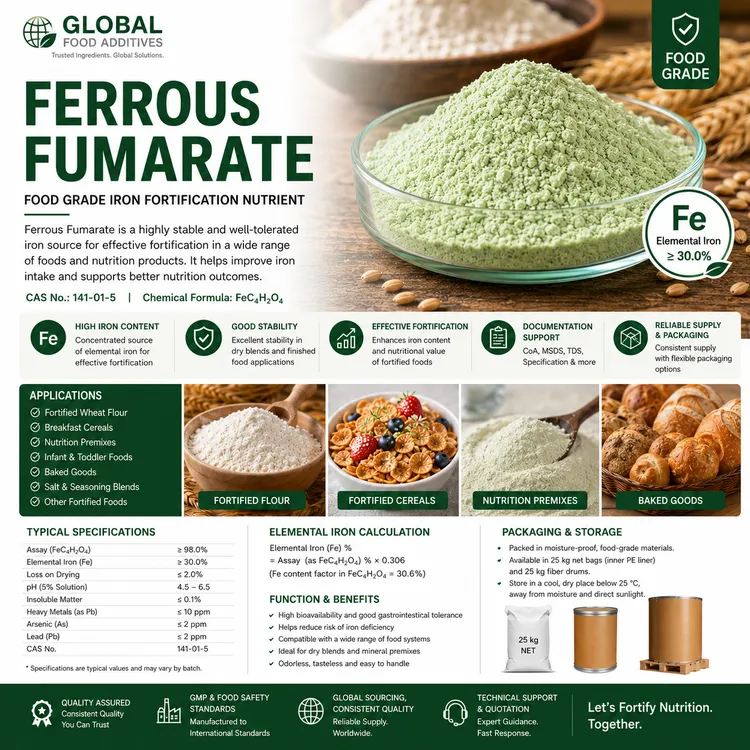
Ferrous Fumarate is a food-grade iron fortification nutrient used in mineral premixes, flour enrichment, cereal fortification, nutrition powders, food supplements and selected specialty nutrition products. It is valued as a high-iron organic salt with approximately one-third elemental iron by weight, making it useful where formulators need meaningful iron contribution with controlled dosage. For industrial buyers, the most important review points are iron assay, elemental iron calculation, particle size, colour, solubility, bioavailability objective, sensory impact, premix uniformity, regulatory acceptance and batch documentation.
| Product | Ferrous Fumarate |
|---|---|
| Chemical name | Iron(II) fumarate |
| Category | Fortification Nutrients |
| Function | Iron fortification nutrient / mineral enrichment ingredient / premix mineral |
| E / INS number | Confirm by destination market and supplier documentation |
| CAS / identity | 141-01-5 |
| Molecular formula | C4H2FeO4 |
| Approximate elemental iron | About 33% by weight, depending on supplier assay and grade |
| Typical appearance | Reddish-brown to reddish-orange powder or granule |
| Typical form | Fine powder, granular grade, beadlet, coated grade, premix-ready dilution or formulated mineral blend |
Potential use areas may include:
Ferrous Fumarate is selected when manufacturers need a concentrated iron source with a different solubility and reactivity profile from highly soluble iron salts. Its relatively high elemental iron content can reduce addition rate compared with lower-iron mineral salts, while its lower solubility can be useful in dry or semi-dry systems where metallic taste, colour shift and oxidation must be controlled. Final performance depends on particle size, matrix composition, moisture, pH, fat level, processing temperature, packaging oxygen barrier and shelf-life conditions.
With roughly one-third elemental iron by weight, Ferrous Fumarate can deliver fortification targets at lower addition rates than many lower-iron salts. Buyers should still use the supplier's actual assay for calculation.
Ferrous Fumarate is often evaluated in dry premixes, cereal systems, tablets and nutrition powders where flowability, particle-size matching and segregation control are important to uniform nutrient distribution.
Compared with highly soluble iron salts, Ferrous Fumarate may offer different taste and reactivity behaviour. Application trials should confirm colour, flavour, rancidity and vitamin compatibility through shelf life.
It can be used in selected food fortification and nutrition programmes where the compound is permitted and where the matrix supports the target bioavailability, sensory quality and regulatory label claim.
Ferrous Fumarate should be purchased by grade, not only by product name. Physical form, assay, particle size, coating system and carrier declaration can significantly change how the ingredient performs in production.
| Grade type | Typical purchasing interest | Technical points to verify |
|---|---|---|
| Fine powder | Vitamin-mineral premixes, dry nutrition blends, tablets and capsules requiring rapid distribution in controlled blending systems. | Iron assay, particle size, dusting, bulk density, colour, flowability, blend uniformity and worker handling controls. |
| Granular grade | Applications needing better flow, reduced dusting and improved handling in larger industrial blending systems. | Granule size, friability, segregation behaviour, dissolution profile, colour specking and compatibility with carrier particles. |
| Coated or encapsulated grade | Products where iron interaction with fats, flavours, vitamins or colours must be reduced. | Coating composition, release profile, heat stability, label declaration, allergen status and performance after processing. |
| Premix-ready dilution | Food factories requiring easier dosing and safer dispersion at low iron addition levels. | Carrier, dilution ratio, homogeneity, elemental iron per kilogram, anti-caking system and regulatory status of all components. |
| Custom mineral blend | Nutrition products, public-health formulations or fortified staples requiring multiple nutrients in one premix. | Nutrient interactions, overages, carrier choice, particle-size alignment, COA format and market-specific formula approval. |
Iron fortification should be calculated using elemental iron contribution, not the total weight of Ferrous Fumarate. Theoretical values are useful for early development, but purchase orders and production recipes should use the supplier's approved specification and lot-specific certificate of analysis.
| Material | Formula basis | Approximate elemental iron content | Buyer note |
|---|---|---|---|
| Ferrous Fumarate | C4H2FeO4 | About 33% Fe | Use the actual assay from the COA for final dosage and label calculation. |
| Premix dilution containing Ferrous Fumarate | Supplier-specific | Depends on dilution ratio and carrier | Request elemental iron per kilogram and blend uniformity data. |
| Coated Ferrous Fumarate | Core plus coating system | Lower than uncoated material depending on coating level | Confirm coating composition, iron release and label declaration. |
Industrial Ferrous Fumarate purchasing should be controlled by an approved specification. The following checkpoints help procurement, R&D and quality teams compare supplier offers and avoid false equivalence between grades.
Ferrous Fumarate should be validated in the final formulation because iron compounds can affect taste, colour, oxidation, vitamin retention and consumer acceptance. Trial design should include dosage, particle distribution, sensory testing, colour stability, nutrient retention, analytical recovery and shelf-life review.
Ferrous Fumarate may be evaluated for fortified wheat flour, maize meal, rice, pasta and grain-based staples. Uniform premix dispersion is critical because iron is added at low levels across large production batches.
In cereals and bars, iron source selection should consider processing heat, fat oxidation, colour, aftertaste, coating systems and nutrient declaration through shelf life.
Powdered nutrition products require particle-size matching to reduce segregation. Compatibility with milk powder, proteins, cocoa, vitamins, flavours and sweeteners should be tested.
Ferrous Fumarate is commonly evaluated in supplement-style formats where high iron density is useful. Check compressibility, capsule fill weight, excipient compatibility, disintegration and label dosage.
Because Ferrous Fumarate has limited solubility, beverage applications require careful dispersion and sediment evaluation. Finished products should be tested for taste, pH, suspension stability and colour.
These categories are highly regulated. Buyers should confirm permitted iron compound, purity, contaminant limits, dosage, bioavailability objective, label declaration and analytical method before sourcing.
| Technical factor | Why it matters | Practical buyer / R&D action |
|---|---|---|
| Blend uniformity | Low-dose mineral addition can segregate if particle size, density or flow properties differ from the carrier matrix. | Validate premix dilution, carrier selection, mixer load, sampling locations and analytical uniformity. |
| Colour specking | Ferrous Fumarate has a reddish-brown appearance that may show in light-coloured products. | Check particle size, dispersion method and visibility in the final food or tablet. |
| Metallic taste | Iron compounds can contribute metallic or mineral notes depending on use level and matrix. | Run sensory trials and consider coating, flavour masking or alternative iron forms where required. |
| Oxidation risk | Iron can promote lipid oxidation in fat-containing foods, causing off-flavours and quality loss. | Test peroxide value, rancidity, packaging oxygen barrier and shelf-life performance. |
| Vitamin compatibility | Iron may interact with sensitive vitamins and colours, especially in moist or oxygen-exposed products. | Check compatibility with folic acid, vitamin A, vitamin C, iodine, flavours and colours in the complete premix. |
| Analytical recovery | Fortification verification depends on accurate iron testing and correct unit expression. | Agree on method, sample preparation, reporting unit and acceptance range before commercial production. |
Ferrous Fumarate should be compared with alternative iron sources by elemental iron content, bioavailability objective, sensory impact, stability, regulatory acceptance and cost-in-use. Do not substitute iron compounds without R&D, QA and regulatory approval.
| Iron source | Typical industrial reason to evaluate | Key difference to check |
|---|---|---|
| Ferrous Fumarate | High iron content, lower solubility than sulphate, useful in selected dry fortification and nutrition systems. | Check particle visibility, dispersion, bioavailability objective, taste and regulatory status. |
| Ferrous Sulphate | Economical and soluble iron source widely evaluated for fortification and premixes. | Can be more reactive in sensitive foods; check oxidation, taste and vitamin compatibility. |
| Ferrous Gluconate | Used in supplements, specialty foods and some food colour or iron applications. | Lower elemental iron percentage changes dosage economics and formulation impact. |
| Ferric Pyrophosphate | Considered where lower reactivity and better sensory stability are needed. | Often lower bioavailability unless specially processed; particle size and grade are important. |
| Electrolytic or reduced iron | Used in some cereal and flour systems for low reactivity and dry stability. | Particle size, bioavailability and regulatory acceptance must be carefully checked. |
| Encapsulated iron | Designed to reduce interactions with fats, flavours, vitamins and sensitive matrices. | Coating material, release profile, heat tolerance, label declaration and cost-in-use must be reviewed. |
For repeat purchasing, Ferrous Fumarate should be approved through a formal supplier qualification process. The buyer should maintain an approved specification, COA history, supplier questionnaire, traceability records, change-control expectations and finished-product analytical plan.
Check lot number, manufacturing date, expiry or retest date, iron assay, identity, moisture, insoluble matter, particle size, heavy metals and packaging condition before releasing the material to production.
Request traceability from manufacturer to shipment. For export orders, align invoice, packing list, certificate of origin, batch documents and container or pallet references.
Ask whether the production site operates under recognised food safety or quality systems such as HACCP, ISO 22000, FSSC 22000, BRCGS, IFS, GMP or another customer-accepted programme.
For long-term projects, confirm notification expectations for changes in manufacturing site, process route, specification limits, packaging, coating system, carrier system or certifications.
Ferrous Fumarate is regulated differently across markets and product categories. Some countries define mandatory fortification levels for staple foods, while others allow voluntary fortification or restrict specific population groups. Nutrient declarations, iron claims, health claims, minimum or maximum levels and permitted compounds must be confirmed against the destination country's regulations before commercial use.
Food-grade Ferrous Fumarate should be packed to protect the product from moisture, contamination and excessive environmental exposure. Packaging selection is especially important for fine powders, coated grades and premix-ready products that must remain free-flowing during storage and transport.
Supplier options may include 20 kg or 25 kg bags, cartons, drums, foil-lined bags or smaller sealed packs depending on grade, particle size, coating system and order quantity.
Store tightly closed in a cool, dry, clean area away from moisture, direct sunlight, strong odours and incompatible materials. Reseal opened packaging promptly.
Use clean tools, dust-minimising handling and controlled dispensing. Avoid cross-contamination with allergens, colours, strong oxidisers or materials not approved for the food production area.
For international shipments, align product description, HS code guidance, origin certificate, shelf-life remaining, halal or kosher status, food-grade declaration and destination-specific import documents.
Send the product name, target iron assay, elemental iron requirement, particle size, pure powder or premix-ready preference, coating requirement if any, quantity, destination country, preferred packaging, expected shipment date, Incoterms, application area and required documents. If you already purchase Ferrous Fumarate, attach or describe your current specification, COA, target dosage, premix formula, label declaration or finished-product standard so supplier options can be compared accurately.
Example: “We need food-grade Ferrous Fumarate, CAS 141-01-5, target iron assay required, powder or granular grade, application: cereal fortification / mineral premix / nutrition powder / tablet, quantity: 500 kg trial or annual contract, destination: EU / GCC / USA / Africa, required documents: TDS, COA, SDS, food-grade statement, heavy metals declaration, allergen statement, GMO statement, halal certificate, origin certificate and shelf-life declaration. Please quote FOB / CIF / CFR with lead time.”
Ferrous Fumarate is used as an iron source for food fortification, cereal fortification, flour enrichment, mineral premixes, nutrition powders, tablets, capsules and selected specialty nutrition applications where local rules permit. Exact suitability depends on grade, dosage, matrix, process, regulation and supplier documentation.
Ferrous Fumarate typically contains about 33% elemental iron by weight. Final dosage should be calculated from the supplier's specification and lot-specific certificate of analysis.
Ferrous Fumarate is generally considered only slightly soluble. This can be useful in some dry systems but may require careful dispersion, sediment testing or alternative iron selection in beverages.
Yes. Iron compounds can affect taste, colour and oxidation. Ferrous Fumarate may create visible reddish-brown particles in light-coloured products if particle size and blending are not controlled.
Not automatically. Ferrous Fumarate and Ferrous Sulphate have different solubility, elemental iron content, sensory behaviour and formulation performance. Substitution should be confirmed through application trials, analytical testing and regulatory review.
Buyers commonly request a technical data sheet, approved specification, certificate of analysis, safety data sheet, iron assay, food-grade statement, origin statement, allergen declaration, GMO statement, halal or kosher certificate where required, contaminant declaration, shelf-life information and packaging details.
Global Food Additives can review sourcing options for Ferrous Fumarate according to target assay, particle size, physical form, quantity, destination, packaging, lead time and required documentation.
No. Iron fortification permissions, mandatory or voluntary fortification rules, permitted compounds, dosage limits, label declarations and nutrient claims depend on destination-market legislation, food category, serving size and customer responsibility.
Send product name, target iron assay, elemental iron requirement, particle size, physical form, quantity, destination country, application, packaging preference, delivery term and document requirements. Our team will review your inquiry and respond from orders@foodgradeadditives.com.