
High Acyl Gellan Gum E418
High Acyl Gellan Gum is a food-grade microbial hydrocolloid used to build soft elastic gels, stabilize suspended particles, improve mouthfeel, control water release and create structured fluid textures. It is especially valuable in beverage, dairy-alternative, dessert and gelled food systems where formulators need suspension or elasticity without a brittle agar-like gel.
For industrial purchasing, High Acyl Gellan Gum should be selected by gel texture, suspension strength, hydration requirement, ion sensitivity, pH tolerance, heat process, particle size, standardization system and destination market compliance. Global Food Additives supports specification review, supplier comparison, sample coordination, document collection and export-ready quotation communication for E418 High Acyl Gellan Gum requirements.
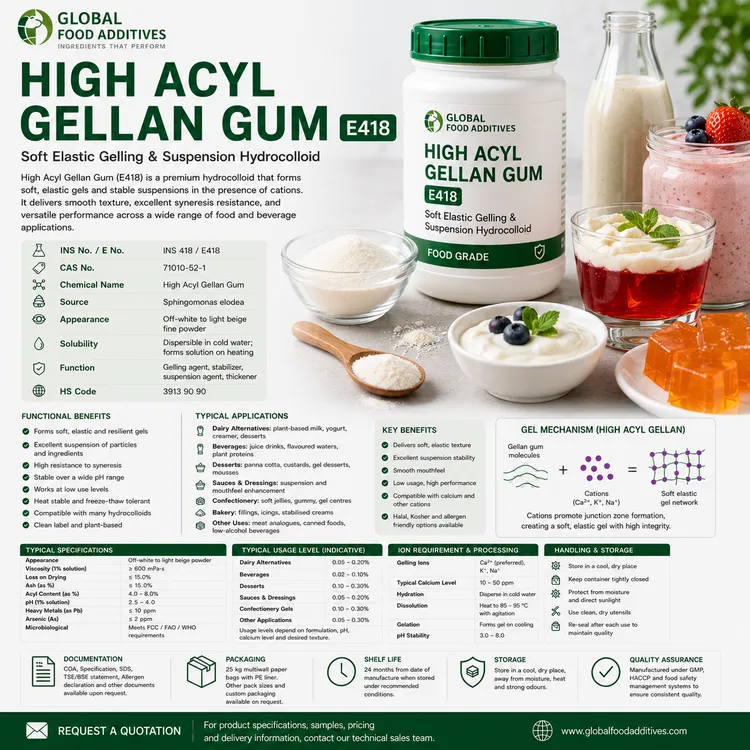
Product identity
| Product | High Acyl Gellan Gum |
|---|---|
| Common names | HA Gellan, High Acyl Gellan, Gellan Gum E418, INS 418 |
| Category | Hydrocolloids, Gums & Gelling Agents |
| Function | Gelling agent / stabilizer / suspension agent / thickener / mouthfeel and texture hydrocolloid |
| E / INS number | E418 / INS 418 |
| CAS / identity | 71010-52-1 |
| Polymer type | Anionic microbial polysaccharide produced by fermentation |
| Gellan type | High acyl grade, retaining acyl substituents that create softer and more elastic gel texture |
| Typical form | Fine powder, granule, standardized blend or application-specific hydrocolloid system |
| Key performance | Soft elastic gel, weak-gel suspension, fluid gel texture, water binding, mouthfeel improvement and syneresis control |
| Key purchasing controls | High-acyl status, gel strength, viscosity, hydration temperature, ion sensitivity, pH range, particle size, moisture, ash, microbiology and heavy metals |
Application fit
High Acyl Gellan Gum is selected when the target is a soft, elastic, flexible or weak-gel structure rather than the firm and brittle gel usually associated with low-acyl gellan gum.
- Plant-based milks, dairy alternatives and protein beverages
- RTD beverages requiring suspension of cocoa, minerals, fibres, proteins or pulp
- Neutral and acidic beverages where the selected grade is suitable
- Dairy desserts, plant-based desserts, puddings, creams and spoonable gels
- Fruit preparations, dessert sauces, fillings and structured toppings
- Fluid gels, pourable gels, culinary gels and texture-designed food systems
- Confectionery gels, vegan gels and gelatin-replacement systems when blended correctly
- Sauces, dressings and specialty systems requiring suspension or elastic mouthfeel
Technical overview for industrial buyers
Gellan gum is an anionic polysaccharide produced by fermentation. Commercial food grades are usually described as high acyl, low acyl or blends of the two. High acyl gellan retains naturally occurring acyl substituents on the polymer chain, which changes the gel texture dramatically. Instead of forming a hard, brittle gel, high-acyl grades typically create soft, elastic and flexible gels with good mouth-coating properties.
In beverages and fluid systems, high acyl gellan can help create a weak gel network at very low dosage. This network can reduce sedimentation, support suspension and improve body while still allowing the product to pour or drink smoothly. The final texture depends on gellan type, concentration, hydration, cooling rate, calcium level, sodium and potassium ions, pH, proteins, sugars, minerals, heat treatment and homogenization conditions.
Functional performance
- Forms soft, elastic and flexible gels
- Creates weak-gel networks for suspension in drinkable systems
- Helps suspend cocoa, minerals, fibres, proteins, pulp and insoluble particles
- Improves mouthfeel and body at low dosage levels
- Can reduce sedimentation and phase separation in selected beverages
- Supports fluid gel, pourable gel and spoonable texture design
- Can improve water binding and reduce syneresis in desserts and gels
- Can be blended with low acyl gellan, xanthan, guar, locust bean gum, pectin, carrageenan or starch to tailor performance
Grade selection variables
| High-acyl content | Controls softness, elasticity, flexibility and mouthfeel compared with low-acyl grades. |
|---|---|
| Gel strength | Affects dosage, suspension power, spoonability and finished product texture. |
| Hydration behavior | Determines heating requirement, mixing time, lumping risk and plant processing window. |
| Ion sensitivity | Calcium, magnesium, sodium and potassium can strongly influence gelation, texture and suspension. |
| Particle size | Affects wetting, dispersion, dusting, dry-blend uniformity and hydration speed. |
| Standardization system | Some grades are standardized with salts, sugars or carriers to deliver consistent gel or suspension performance. |
High acyl versus low acyl gellan gum
The most common sourcing error is purchasing “gellan gum” without specifying high acyl, low acyl or a blend. Low-acyl gellan forms firm, brittle and clear gels that can be useful in cuttable gels and some confectionery systems. High-acyl gellan forms softer, more elastic and more opaque gels that are useful where a resilient bite, creamy mouthfeel or weak-gel suspension is required. Blends can produce intermediate textures.
Texture comparison
| High acyl gellan | Soft, elastic, flexible, resilient and useful for weak gels, suspension and mouthfeel. |
|---|---|
| Low acyl gellan | Firm, brittle, more cuttable and often clearer, depending on grade and formulation. |
| HA/LA blend | Used to balance elasticity, firmness, brittleness, melt behaviour, particle suspension and cost-in-use. |
| Specialized beverage grade | Designed for low-dose suspension, controlled hydration and drinkable texture in beverage systems. |
| Specialized gel grade | Designed for desserts, gels, fillings or confectionery where elastic gel texture is the primary target. |
Formula factors that change performance
- Calcium and magnesium content of water, minerals and proteins
- Sodium and potassium salts from recipe or buffer systems
- pH and acid addition point
- Heat treatment and hydration temperature
- Cooling rate and filling temperature
- Protein type, fat level and homogenization conditions
- Sugar, polyol, fibre and total solids level
- Interaction with carrageenan, pectin, CMC, xanthan, starch or emulsifiers
Application-specific guidance
In plant-based milks and protein beverages, High Acyl Gellan Gum can help suspend plant protein, calcium salts, cocoa, fibres and other insoluble solids. It can create a very weak gel network that breaks during pouring and drinking but reforms enough to slow sedimentation during storage. The grade must be tested with the actual protein source, mineral system, heat treatment, homogenization, pH and package size.
In desserts and spoonable products, high acyl gellan can provide elastic gel texture, creamy mouthfeel and water control. It can be useful in plant-based desserts, dairy desserts, layered gels, fruit gels and culinary gels where a brittle texture is not desired. Blending with low acyl gellan or other hydrocolloids can adjust bite, cut, melt, spoonability and syneresis.
In sauces, fillings and specialty systems, high acyl gellan can support suspension and texture design at low dosage. It should be evaluated for hydration, pH stability, salt tolerance, freeze-thaw behaviour, shear stability and compatibility with starches, proteins, acids, sugars, emulsifiers and preservatives.
Beverage and dairy-alternative systems
- Plant-based milks: supports suspension of protein, calcium, cocoa and insoluble solids.
- RTD protein drinks: helps control sedimentation and improves body when the grade is compatible with protein and heat treatment.
- Cocoa beverages: helps suspend cocoa particles and minerals while maintaining drinkable texture.
- Fruit or pulp beverages: may improve pulp suspension where pH and processing conditions are suitable.
Desserts, gels and culinary textures
- Soft gels: creates elastic, flexible texture rather than brittle cut.
- Spoonable desserts: improves body, resilience and water control.
- Fluid gels: can create pourable or spoonable gelled textures after controlled shearing.
- Confectionery blends: can modify elasticity when used with low acyl gellan or other gelling agents.
Processing and hydration recommendations
High Acyl Gellan Gum usually requires careful dispersion and heating for full hydration. It is often dry-blended with sugar, maltodextrin, starch, protein powder or another dry ingredient before addition to water. Poor dispersion can cause fish-eyes, lumps, incomplete hydration and inconsistent suspension. Hydration temperature and hold time should follow the supplier's instructions and be validated with the real plant process.
Ion control is critical. Calcium and other cations can trigger or strengthen gellan networks, but too much ion activity too early can cause premature gelation, graininess or poor hydration. In beverage systems, minerals may come from water hardness, calcium fortification, milk salts, protein isolates, buffers or other ingredients. The order of addition and heat process should be designed to hydrate the gum before gelation begins.
Gellan systems should be tested after heat treatment, homogenization, filling, cooling and storage. A product that looks stable immediately after processing can still show sedimentation, flocculation, weak gel breakdown, excessive viscosity or phase separation later. Plant trials should include shelf-life testing at relevant temperatures and package sizes.
Typical quality parameters
- Appearance, colour, odour and visual purity
- High-acyl or low-acyl type declaration
- Gel strength, texture or supplier-specific gel test
- Viscosity under defined concentration, temperature and method
- Loss on drying or moisture content
- Ash and mineral profile where relevant
- pH of solution or dispersion
- Particle size distribution, bulk density and flowability
- Hydration behaviour and recommended processing conditions
- Residual alcohol, such as isopropyl alcohol or ethanol, where included in specification
- Nitrogen or protein residue where required by customer specification
- Microbiological limits including total plate count, yeast, mold, coliforms and pathogens where applicable
- Heavy metals such as lead, arsenic, mercury and cadmium according to market or customer requirements
Common purchasing risks
- Buying “gellan gum” without specifying high acyl, low acyl or blend ratio
- Replacing high acyl gellan with low acyl gellan and creating a brittle texture
- Ignoring water hardness, calcium fortification and mineral interactions
- Approving a sample without testing the real heat treatment and homogenization process
- Using a gum grade that hydrates poorly under the plant's mixing conditions
- Not testing shelf-life sedimentation in the final package size
- Using gellan at too high a dosage and creating unwanted gelation or poor drinkability
- Not confirming residual solvents, microbiology, heavy metals and destination-market documents
Regulatory and compliance notes
Gellan Gum is commonly identified as E418 / INS 418 in food additive systems. It may be declared as gellan gum, stabilizer, thickener or gelling agent depending on destination-market rules, technical function, food category and label format. High acyl and low acyl gellan are functional types of the same hydrocolloid family, but some customers may require the exact type, supplier grade code and application statement for approval.
Buyers should verify permitted food categories, use levels, purity criteria, organic-standard compatibility, infant-food restrictions, vegan or vegetarian positioning, allergen status, GMO position, fermentation organism statement and customer-specific requirements before commercial use. Where gellan is used in beverage suspension, finished-product validation should include label review, nutritional calculation, stability data and sensory approval.
For the European Union, United Kingdom, GCC countries, Turkey, Codex-aligned markets and other destinations, the buyer should confirm whether the offered grade and intended application are acceptable in the target market. Supplier documents can support review, but local food law, use level, claim wording and final label remain the responsibility of the manufacturer.
Documents to request
- Product specification or technical data sheet with gellan type and application guidance
- Certificate of analysis for the available batch or lot
- Food-grade statement and E418 / INS 418 declaration
- High acyl, low acyl or blend-type declaration
- Gel strength, viscosity or texture method used for standardization
- Recommended hydration temperature, processing instructions and ion-control notes
- Safety data sheet where applicable for industrial handling
- Origin, manufacturer, production site and traceability statement
- Fermentation organism or manufacturing-process statement where required
- Allergen, GMO, vegan, halal and kosher statements where required
- Residual alcohol statement where required by market or customer specification
- Microbiological specification and recent test results
- Heavy-metal and contaminant declaration
- Shelf-life, storage conditions and retest policy
- Packaging specification, net weight, pallet configuration and container loading details
- Change-control, non-irradiation, BSE/TSE, pesticide and food-contact packaging statements when required
Packaging, storage and logistics
High Acyl Gellan Gum is commonly supplied in multiwall paper bags with food-grade inner liners, cartons, fibre drums or other sealed industrial packaging depending on grade and order volume. Packaging should protect the powder from moisture, odour pickup, foreign material, infestation and warehouse damage. For export shipments, buyers should confirm net weight, gross weight, pallet dimensions, label language, batch coding, country-of-origin marking and whether heat-treated pallets or other logistics documents are required.
Store in a cool, dry, clean and well-ventilated warehouse away from moisture, strong odours and direct sunlight. Opened bags should be resealed immediately. Gellan powders can absorb moisture and form lumps, reducing dispersion quality and causing hydration defects. First-expiry-first-out rotation, humidity control and clean dry-transfer practices are important for consistent industrial performance.
Who usually buys High Acyl Gellan Gum?
- Plant-based milk and dairy-alternative manufacturers
- RTD beverage, protein drink and cocoa beverage producers
- Dairy dessert, plant-based dessert and spoonable product manufacturers
- Fruit preparation, dessert sauce and filling manufacturers
- Confectionery gel, vegan gel and specialty texture producers
- Sauce, dressing and culinary texture developers
- Hydrocolloid blend producers, premix companies and ingredient distributors
Information needed for quotation
- Target product name: High Acyl Gellan Gum, HA Gellan or E418
- Application and finished product type
- Required function: soft gel, elastic gel, suspension, mouthfeel, fluid gel or water control
- Whether high acyl only or a high-acyl/low-acyl blend is required
- Target texture, viscosity, gel strength or current supplier reference
- Process conditions: hydration temperature, heat treatment, homogenization, filling temperature and cooling profile
- Formula conditions: pH, water hardness, calcium level, protein source, mineral fortification and total solids
- Current specification, COA or approved supplier reference if available
- Destination country and regulatory documentation needs
- Trial quantity, commercial quantity and annual volume
- Preferred packaging size and pallet requirements
- Required certificates: halal, kosher, vegan, allergen, GMO, origin or other declarations
- Delivery term, destination port or warehouse address
- Expected shipment date and sample approval timeline
How Global Food Additives supports sourcing
Global Food Additives can help compare High Acyl Gellan Gum grades by gel texture, suspension strength, hydration behaviour, particle size, standardization system, documentation package, packaging format and commercial availability. For industrial customers, the fastest sourcing route is to provide an existing specification, certificate of analysis, application details, pH, heat treatment, mineral system, desired texture and approved supplier reference. This allows supplier options to be compared by real cost-in-use and process performance, not only by price per kilogram.
For new product development, our team can coordinate sample options and supplier questions around high-acyl versus low-acyl selection, beverage suspension, plant-based milk stability, protein compatibility, soft elastic gel texture, fluid gel development, ion sensitivity, export documents and packaging. Final formulation, process validation, dosage, regulatory review and finished-product label remain the responsibility of the manufacturer.
How to request this product
Send the product name, target grade or reference specification, application, required function, target texture, process conditions, formula pH, mineral or calcium level, quantity, destination country, packaging preference, expected shipment date and required documents. If you already purchase High Acyl Gellan Gum, attach or describe your current specification, certificate of analysis, label, process conditions or approved supplier reference so supplier options can be compared accurately.
Useful answers
What is High Acyl Gellan Gum used for in food manufacturing?
High Acyl Gellan Gum is used for soft elastic gels, suspension, mouthfeel, water binding, fluid gel texture, syneresis control and stabilisation. It is commonly evaluated in plant-based milks, protein beverages, desserts, sauces, fruit preparations, gels and specialty texture systems.
How is High Acyl Gellan Gum different from Low Acyl Gellan Gum?
High Acyl Gellan Gum forms soft, elastic and flexible gels. Low Acyl Gellan Gum forms firmer, more brittle and more cuttable gels. Many applications use blends to balance elasticity, firmness, suspension and mouthfeel.
Why is gellan gum used in plant-based beverages?
Gellan gum can create a weak gel network that helps suspend proteins, minerals, cocoa, fibres and other particles while maintaining a drinkable texture. The correct grade depends on pH, heat treatment, mineral system, protein source and target mouthfeel.
Does High Acyl Gellan Gum need heating?
Most grades require proper dispersion and heating for full hydration. Hydration temperature, hold time, shear, salts, sugars, pH and order of addition should be validated with the supplier's technical guidance and the actual plant process.
Can High Acyl Gellan Gum replace gelatin?
It can support vegan or gelatin-free gel systems in some applications, but the texture is not identical to gelatin. Formulators may need blends with low acyl gellan, pectin, starch, carrageenan or other hydrocolloids to reach the desired bite, elasticity and melt profile.
Can Global Food Additives source High Acyl Gellan Gum?
Global Food Additives can review sourcing options for High Acyl Gellan Gum according to grade type, texture target, suspension requirement, application, quantity, destination, packaging and required documentation.
Which documents should be requested?
Buyers commonly request a technical data sheet, certificate of analysis, food-grade statement, E418 / INS 418 declaration, high-acyl type declaration, allergen and GMO statements, microbiological data, heavy-metal statement, residual alcohol statement, shelf-life information and packing details.
Is this product permitted in every country?
No. Food additive use depends on destination-market rules, food category, use level, purity criteria, label requirements and buyer responsibility. Always verify final suitability for the intended application.
Tell us which food additive or ingredient you need.
Send product names, target specifications, quantity, destination country, packaging preference, delivery term, and document requirements. Our team will review your inquiry and respond from orders@foodgradeadditives.com.
Your message has been received. You will be redirected to the home page.