
Hydroxypropyl Methylcellulose E464
Hydroxypropyl Methylcellulose, commonly called HPMC or Hypromellose, is a food-grade non-ionic cellulose ether used for viscosity control, suspension, film formation, water binding, emulsion stabilization and heat-induced gelation. It is especially valuable in food systems where a formulation must remain workable during cold mixing but develop structure during heating or cooking.
For industrial buyers, HPMC should be selected by viscosity grade, gel temperature, substitution profile, hydration behavior, particle size, application method and destination-market compliance. Global Food Additives supports specification review, supplier comparison, sample coordination, document collection and export-ready quotation communication for E464 food-grade HPMC requirements.
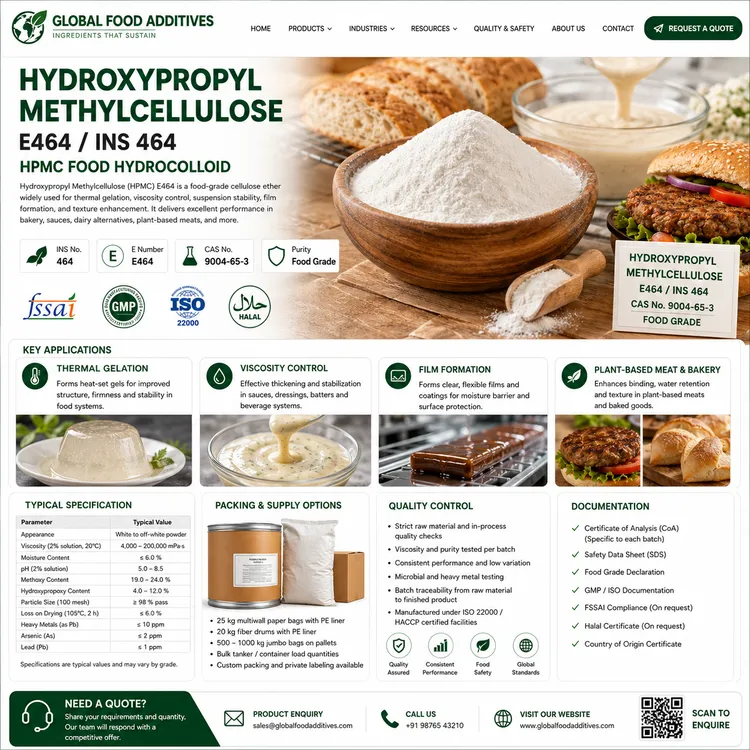
Product identity
| Product | Hydroxypropyl Methylcellulose |
|---|---|
| Common names | HPMC, Hypromellose, Hydroxypropyl Methylcellulose E464 |
| Category | Hydrocolloids, Gums & Gelling Agents |
| Function | Thickener / stabilizer / film former / protective colloid / suspending agent / thermal-gelling hydrocolloid |
| E / INS number | E464 / INS 464 |
| CAS / identity | 9004-65-3 |
| Chemical family | Non-ionic cellulose ether produced by methyl and hydroxypropyl substitution of cellulose |
| Typical form | Fine powder, granule, surface-treated powder or instantized grade |
| Key functionality | Cold-water viscosity, heat-induced gelation, film formation, water retention, suspension and foam or emulsion stabilization |
| Key purchasing controls | Viscosity, gel temperature, substitution profile, particle size, moisture, ash, pH, hydration behavior, microbiology, heavy metals, residual reagents and regulatory documents |
Application fit
HPMC is selected where formulators need water-phase viscosity, heat-setting structure, clean taste, oil and water retention, suspension or film formation.
- Plant-based burgers, sausages, nuggets, formed products and meat alternatives
- Gluten-free bread, bakery mixes, batters, dough systems and baked goods
- Sauces, dressings, dips, condiments, soups and ready-meal systems
- Frozen foods, coated products, reheat meals and thermal-processing applications
- Ice cream, frozen desserts, dairy-style desserts and plant-based desserts
- Bakery fillings, creams, toppings, icings and confectionery preparations
- Film coatings, glazes, protective coatings and tablet or supplement coating systems
- Dry mixes, instant powders and powdered stabilizer systems requiring controlled hydration
Technical overview for industrial buyers
Hydroxypropyl Methylcellulose is derived from cellulose and modified to create a water-dispersible, non-ionic hydrocolloid with strong process functionality. Its most distinctive food-manufacturing property is thermal gelation: many HPMC grades hydrate and thicken in the cold phase, then build a gel network when heated. This behavior is the reverse of many conventional hydrocolloids and is highly valuable in applications that must gain structure during cooking, frying, baking or reheating.
HPMC grade selection is highly technical. Viscosity grade controls cold-phase thickness and handling. Substitution profile influences hydration speed, gel temperature, gel strength, clarity and compatibility with salts, proteins, sugars and fats. Particle treatment influences whether the powder disperses slowly, hydrates quickly or resists lumping during mixing. Because suppliers may use different test methods and grade codes, buyers should compare application performance rather than product name alone.
Functional performance
- Builds viscosity in cold or warm water systems depending on grade and dispersion method
- Forms a thermal gel when heated, supporting structure during cooking or reheating
- Improves water retention and reduces cooking loss in selected plant-based and protein systems
- Helps bind oil, water, proteins, starches and insoluble particles into a stable matrix
- Supports film formation for coatings, glazes and protective surface layers
- Improves suspension of spices, fibers, minerals, cocoa, proteins or particulates
- Can improve volume, crumb softness and gas retention in gluten-free bakery systems
- Provides non-ionic compatibility with many salts, sugars, proteins and hydrocolloids
Grade selection variables
| Viscosity grade | Controls solution thickness, mixing behavior, pumping, batter pickup, mouthfeel and finished texture. |
|---|---|
| Gel temperature | Determines when heat-induced structure develops during baking, frying, cooking, pasteurization or reheating. |
| Substitution profile | Methoxy and hydroxypropoxy levels influence solubility, hydration, gelation, film formation and compatibility. |
| Particle size | Affects wetting, dusting, dissolution speed, lumping risk and dry-blend uniformity. |
| Surface-treated grade | Designed for delayed hydration and easier dispersion before viscosity development. |
| Instant grade | Designed for fast hydration in selected cold-water systems, dry mixes and rapid-processing applications. |
Application-specific guidance
In plant-based meat systems, HPMC is widely evaluated because it can help create a heat-set network during cooking. This supports bite, binding, water retention, juiciness, fat retention and shape stability in burgers, sausages, meatballs, nuggets and formed products. The grade should be selected according to cooking temperature, fat level, protein source, fiber system, salt level, methylcellulose or HPMC blend strategy and desired bite profile.
In gluten-free bakery, HPMC can help compensate for the absence of gluten by improving gas retention, dough viscosity, loaf volume, crumb softness and structure. It may be used with starches, rice flour, corn flour, tapioca starch, potato starch, fibers, proteins, emulsifiers and enzymes. The correct grade depends on mixing method, proofing, baking temperature, water absorption and target crumb texture.
Plant-based meat and protein systems
- Burgers and patties: supports heat-set binding, cooking yield, juiciness and shape retention.
- Sausages and formed products: helps stabilize water, oil and protein particles during heating.
- Nuggets and coated products: can improve structure, batter adhesion and reheating performance.
- Hybrid protein systems: supports texture design in combinations of soy, pea, wheat, mycoprotein or other proteins.
Bakery, sauces and coatings
- Gluten-free bread: improves dough viscosity, gas retention, loaf volume and crumb structure.
- Sauces and dressings: supports suspension, body and stable viscosity in selected recipes.
- Batters: helps control pickup, adhesion, film formation and crispness after frying or baking.
- Coatings and glazes: contributes film strength, surface coverage and moisture-barrier support.
Processing and hydration recommendations
HPMC hydration must be controlled carefully because poor addition practice can create fish-eyes, lumps or incomplete viscosity development. Many grades disperse better when dry-blended with sugar, salt, starch, flour, protein powder or another dry carrier before being added to water. Some grades are designed to disperse first and hydrate after a pH or temperature change. Others hydrate quickly and require high mixing efficiency.
A common industrial approach is to disperse HPMC in hot water or a dry blend, then complete hydration during cooling and mixing. The correct procedure depends on the supplier grade. Formulators should test plant-scale mixing, powder addition rate, water temperature, shear, hydration time, solids level and order of addition. Viscosity should be measured after full hydration, not only immediately after mixing.
For thermal-gelling applications, manufacturers should validate the gelation point under the real product conditions. Salts, sugars, fats, proteins, acids, starches and other hydrocolloids can shift apparent gelation behavior. Finished products should be tested through actual cooking, cooling, freezing, thawing, reheating and shelf-life storage where relevant.
Typical quality parameters
- Appearance, color, odor and visual purity
- Viscosity under defined concentration, temperature and method
- Methoxy and hydroxypropoxy substitution values where included in the specification
- Gel temperature or thermal gelation profile where relevant to application
- Moisture or loss on drying
- Ash, pH and insoluble matter
- Particle size distribution, bulk density and flowability
- Hydration rate, lumping behavior and surface-treatment status
- Microbiological limits including total plate count, yeast, mold, coliforms and pathogens where applicable
- Heavy metals, residual reagents and impurities according to market and customer requirements
- Allergen, GMO, vegan, halal and kosher status where required by the customer
Common purchasing risks
- Buying only by “HPMC” or “E464” without confirming viscosity grade and gel temperature
- Replacing methylcellulose with HPMC without testing heat-set texture and hydration behavior
- Using a fast-hydrating grade in a dry mix where delayed hydration is needed
- Using a high-viscosity grade that creates excessive mixing load or poor powder dispersion
- Ignoring salts, acids, sugars, proteins or fats that may change gelation and viscosity
- Approving a grade in lab trials without validating plant-scale powder addition and hydration
- Not confirming destination-market status, label declaration and customer restrictions
- Not checking microbiology, heavy metals, residual reagents and certification documents before shipment
Regulatory and compliance notes
Hydroxypropyl Methylcellulose is commonly identified as E464 / INS 464 in many food additive systems. Regulatory treatment depends on the destination country, food category, use level, purity criteria, label declaration and customer standard. Buyers should verify whether the ingredient is permitted in the intended food category and whether any maximum level or special labeling requirement applies.
In the United States, Hydroxypropyl Methylcellulose is listed in 21 CFR 172.874. The regulation identifies the additive by CAS number 9004-65-3 and permits use in food, except in standardized foods that do not provide for such use, when the additive meets the referenced definition and specifications and is used as an emulsifier, film former, protective colloid, stabilizer, suspending agent or thickener in accordance with good manufacturing practice.
For the European Union, United Kingdom, GCC countries, Turkey, Codex-aligned markets and other destinations, buyers should confirm E464 permission, food-category restrictions, purity criteria, infant-food restrictions, organic compatibility, vegetarian or vegan positioning and customer-specific requirements before commercial production.
Documents to request
- Product specification or technical data sheet with viscosity grade and test method
- Certificate of analysis for the available batch or lot
- Food-grade statement and E464 / INS 464 declaration
- Methoxy and hydroxypropoxy substitution data where included in the supplier specification
- Gel temperature or thermal gelation profile where relevant to the application
- Safety data sheet where applicable for industrial handling
- Origin, manufacturer, production site and traceability statement
- Allergen, GMO, vegan, halal and kosher statements where required
- Microbiological specification and recent test results
- Heavy-metal and elemental impurity declaration
- Residual reagent, residual solvent or contaminant statement where required by the customer or market
- Shelf-life, storage conditions and retest policy
- Packaging specification, net weight, pallet configuration and container loading details
- Change-control, non-irradiation, BSE/TSE, pesticide and food-contact packaging statements when required
Packaging, storage and logistics
HPMC is commonly supplied in multiwall paper bags with food-grade inner liners, cartons, drums, fibre drums or other sealed industrial packaging depending on grade and volume. Packaging should protect the material from moisture, odour pickup, contamination and warehouse damage. For export shipments, buyers should confirm net weight, gross weight, pallet dimensions, batch coding, label language, country-of-origin marking and whether heat-treated pallets or fumigation documentation are required.
Store in a cool, dry, clean and well-ventilated warehouse away from moisture, strong odours and direct sunlight. Opened bags should be resealed immediately. Because HPMC powders can absorb moisture and form lumps, humidity control and first-expiry-first-out stock rotation are important. Powders should be handled using good dust-control practices, especially in bulk transfer, dry blending and pneumatic conveying operations.
Who usually buys HPMC?
- Plant-based meat, vegan burger and meat-alternative manufacturers
- Gluten-free bakery, bakery mix and industrial bread producers
- Sauce, dressing, dip, soup and ready-meal manufacturers
- Frozen food, battered product and coated product manufacturers
- Ice cream, dessert and plant-based dairy alternative producers
- Supplement, tablet coating and nutraceutical manufacturers
- Hydrocolloid blend producers, premix companies and ingredient distributors
Information needed for quotation
- Target product name: Hydroxypropyl Methylcellulose, HPMC, Hypromellose or E464
- Application and finished product type
- Required function: viscosity, thermal gelation, film formation, suspension, water binding or coating
- Target viscosity grade and test method, if known
- Target gel temperature or heat-set performance requirement
- Preferred grade type: standard, surface-treated, instantized, fine powder or granule
- Current specification, COA or approved supplier reference if available
- Process conditions: mixing temperature, hydration method, cooking temperature, pH, salt and solids
- Destination country and regulatory documentation needs
- Trial quantity, commercial quantity and annual volume
- Preferred packaging size and pallet requirements
- Required certificates: halal, kosher, vegan, allergen, GMO, origin or other declarations
- Delivery term, destination port or warehouse address
- Expected shipment date and sample approval timeline
How Global Food Additives supports sourcing
Global Food Additives can help compare HPMC grades by viscosity, gel temperature, hydration behavior, particle size, substitution profile, documentation package, packaging format and commercial availability. For industrial customers, the fastest sourcing route is to provide an existing specification, certificate of analysis, approved supplier reference, application details and process conditions. This allows supplier options to be compared by real cost-in-use and process performance, not only by price per kilogram.
For new product development, our team can coordinate sample options and supplier questions around thermal gelation, plant-based meat binding, gluten-free bakery performance, film formation, coating behavior, powder handling, documentation and export logistics. Final formulation, process validation, use level, regulatory review and finished-product label remain the responsibility of the manufacturer.
How to request this product
Send the product name, target grade or reference specification, required function, viscosity target, gel temperature, application, process conditions, quantity, destination country, packaging preference, expected shipment date and required documents. If you already purchase Hydroxypropyl Methylcellulose, attach or describe your current specification, certificate of analysis, label, process conditions or approved supplier reference so supplier options can be compared accurately.
Useful answers
What is Hydroxypropyl Methylcellulose used for in food manufacturing?
Hydroxypropyl Methylcellulose is used as a thickener, stabilizer, film former, suspending agent and thermal-gelling hydrocolloid. It is commonly evaluated in plant-based meats, gluten-free bakery, sauces, dressings, batters, coatings, desserts, frozen foods and dry mixes.
Why is HPMC important in plant-based meat?
HPMC can hydrate during cold mixing and form structure during heating. This heat-set behavior helps bind water, oil and protein particles, supporting cooking yield, juiciness, bite and shape retention in plant-based burgers, sausages and formed products.
Does HPMC dissolve in hot or cold water?
Most HPMC grades are designed to hydrate in cold water after proper dispersion, while hot water may be used to disperse some grades before hydration during cooling. The correct procedure depends on viscosity grade, particle treatment and supplier instructions.
How is HPMC different from methylcellulose?
Both are cellulose ethers, but HPMC contains both methyl and hydroxypropyl substitution. This affects hydration, gel temperature, gel strength, viscosity, film formation and application behavior. Direct replacement should be validated in the finished product.
Can Global Food Additives source Hydroxypropyl Methylcellulose?
Global Food Additives can review sourcing options for Hydroxypropyl Methylcellulose according to viscosity grade, gel temperature, application, quantity, destination, packaging and required documentation.
Which documents should be requested?
Buyers commonly request a technical data sheet, certificate of analysis, viscosity method, food-grade statement, E464 / INS 464 declaration, safety data sheet where applicable, allergen and GMO statements, microbiological data, heavy-metal statement, shelf-life information and packing details.
Is this product permitted in every country?
No. Food additive use depends on destination-market rules, food category, use level, purity criteria, label requirements and buyer responsibility. Always verify final suitability for the intended application.
Tell us which food additive or ingredient you need.
Send product names, target specifications, quantity, destination country, packaging preference, delivery term, and document requirements. Our team will review your inquiry and respond from orders@foodgradeadditives.com.
Your message has been received. You will be redirected to the home page.