
Kappa Carrageenan
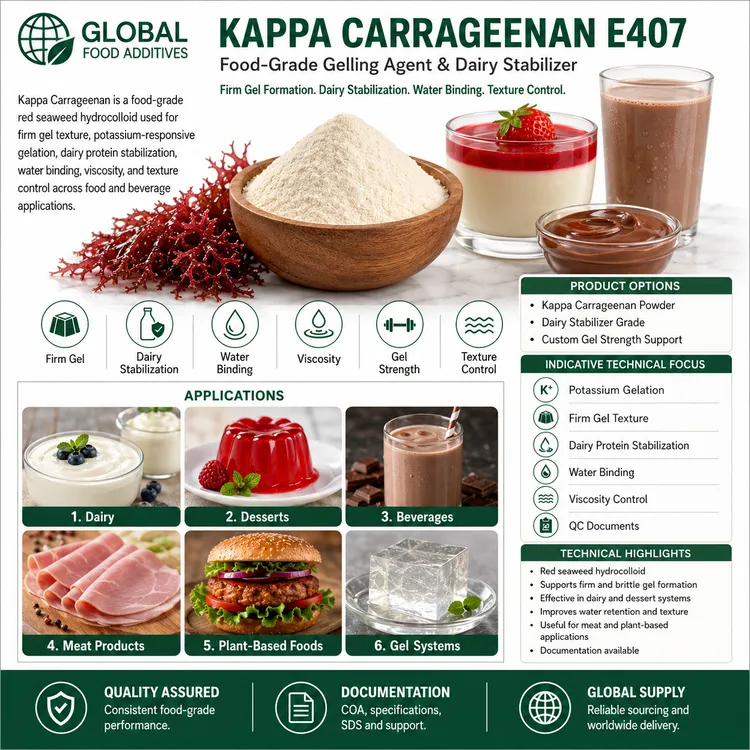
Kappa Carrageenan is a food-grade red seaweed hydrocolloid used by industrial food manufacturers for firm gel texture, dairy stabilization, suspension, water binding, meat-system yield improvement, plant-based structuring and controlled mouthfeel. It is especially valued for potassium-responsive gel formation and for its interaction with dairy proteins in milk-based products.
For industrial purchasing and formulation work, Kappa Carrageenan should be reviewed by gel strength, viscosity, seaweed source, refined or semi-refined status, particle size, standardization salts, milk reactivity, potassium sensitivity, syneresis behaviour, process tolerance and destination-market regulatory status. This page is prepared for R&D, QA, production and procurement teams that need a structured basis for technical comparison, supplier qualification and quotation requests.
Product identity
| Product | Kappa Carrageenan |
|---|---|
| Other names | κ-Carrageenan, kappa-type carrageenan, carrageenan E407, red seaweed hydrocolloid |
| Category | Hydrocolloids, Gums & Gelling Agents |
| Function | Thickener / stabilizer / gelling ingredient |
| E / INS number | E407 / INS 407 |
| CAS / identity | 9000-07-1 |
| Typical source | Red seaweed raw materials, commonly including Kappaphycus or Eucheuma-related seaweeds depending on grade and origin |
| Typical form | Fine powder, granule, instantized grade, standardized blend or application-specific carrageenan system |
| Gel profile | Firm, strong and relatively brittle gel; highly responsive to potassium ions |
| Key technical behaviour | Thermoreversible gel formation, milk protein interaction, water binding, suspension support and texture standardization |
Application fit
Potential use areas may include:
- Dairy desserts, puddings, flans, custards, cream systems and milk gels
- Chocolate milk, cocoa beverages, nutritional drinks and dairy suspensions
- Processed cheese, cheese analogues, recombined dairy and filled dairy systems
- Meat, poultry, seafood, injection brines and restructured protein products
- Plant-based meat, plant-based dairy and vegan gel systems
- Water dessert gels, jelly products, fruit gels, toppings and fillings
- Sauces, dressings, marinades, gravies and ready-meal systems
- Pet food gels, canned products and thermally processed texture systems
Technical overview
Kappa Carrageenan is a sulfated polysaccharide hydrocolloid extracted from red seaweed. In food systems, it hydrates under heat and forms a gel network during cooling. The gelation mechanism is strongly influenced by cations, especially potassium. Kappa Carrageenan is therefore widely selected where a firm, sliceable or brittle gel is needed, or where a low-dosage stabilizer is required in dairy and protein systems.
In milk, Kappa Carrageenan can interact with casein micelles and help stabilize cocoa, protein and mineral suspensions at low use levels. This makes it important in chocolate milk, sterilized milk drinks, UHT dairy beverages and certain nutritional beverages. In meat and poultry systems, carrageenan can support water binding, brine retention, sliceability and cook yield when used with salt, phosphates or other binders where permitted.
Industrial performance depends on grade. A Kappa Carrageenan intended for a water gel may not perform like a dairy-reactive grade, and a standardized meat-system blend may not be suitable for a delicate dessert. Buyers should evaluate gel strength, milk reactivity, ion sensitivity, viscosity, solubility temperature, syneresis, clarity, taste neutrality and process conditions before approval.
Functional benefits in food systems
Firm gel formation
Creates firm, strong and thermoreversible gels, especially in the presence of potassium ions. It is suitable for dessert gels, pet food, processed cheese and structured plant-based systems.
Dairy stabilization
Interacts with dairy proteins and can help stabilize cocoa, protein, minerals and other particles in chocolate milk, UHT milk drinks and dairy beverages.
Water binding and yield
Supports water retention in meat, poultry, seafood, plant-based meat and processed protein systems, helping improve texture, sliceability and cooking performance where permitted.
Texture standardization
Helps manufacturers control firmness, brittleness, cutability, mouthfeel and gel release in high-volume products where batch-to-batch texture consistency is critical.
Kappa, Iota and Lambda Carrageenan comparison
| Type | Main texture profile | Typical ion response | Industrial use focus |
|---|---|---|---|
| Kappa Carrageenan | Firm, strong and relatively brittle gels; may show syneresis if not properly balanced. | Strongly responsive to potassium ions; also interacts with dairy proteins. | Dairy gels, chocolate milk stabilization, meat systems, processed cheese, plant-based gels and firm dessert gels. |
| Iota Carrageenan | Softer, elastic and more flexible gels. | Responsive to calcium ions. | Elastic dairy desserts, creams, sauces and systems needing less brittle gel texture. |
| Lambda Carrageenan | Thickening without true gel formation under normal food conditions. | Used primarily for viscosity rather than gelation. | Cold-soluble thickening, dairy drinks, sauces and texture enhancement. |
Application engineering guidance
| Application | Typical technical objective | Key formulation review points |
|---|---|---|
| Dairy desserts and milk gels | Firm gel structure, clean cut, spoonable texture, water control and consistent set. | Review milk protein, calcium, potassium, sugar, starch, pH, heating, cooling rate, total solids and interaction with locust bean gum or starch. |
| Chocolate milk and cocoa drinks | Stabilize cocoa particles, prevent sedimentation and support creamy mouthfeel at low dosage. | Validate with cocoa type, fat level, protein, pH, homogenization, UHT or pasteurization conditions, bottle storage and shake-back performance. |
| UHT dairy and nutritional beverages | Protein and mineral suspension, mouthfeel, heat stability and storage stability. | Check heat treatment, protein source, minerals, pH, carrageenan dose, sterilization, sedimentation and age gelation risk. |
| Processed cheese and cheese analogues | Improve sliceability, firmness, melt control and water binding. | Review protein, fat, emulsifying salts, calcium, pH, shear, cook temperature, cooling rate and final melt profile. |
| Meat and poultry products | Improve water retention, brine binding, cooking yield, slicing and texture. | Validate with salt level, phosphate system, injection rate, tumbling, cook temperature, chilling, purge, regulatory limit and label declaration. |
| Plant-based meat and seafood analogues | Create firm bite, water binding, thermal stability and gel structure. | Review protein source, methylcellulose, starch, fat phase, potassium salts, calcium salts, heating, cooling and reheat stability. |
| Water dessert gels and jellies | Create firm gel texture, clean demoulding and controlled brittleness. | Balance potassium level, sugar, acids, fruit juice, pH, setting temperature, clarity, syneresis and local confectionery rules. |
| Sauces and gravies | Improve body, cling, suspension and heat-stable texture. | Review salt, acid, starch, fat phase, shear, retort or pasteurization, freeze-thaw and reheating behaviour. |
| Pet food gels | Provide can gel, loaf structure, water binding and sliceable texture. | Validate protein type, mineral content, retort process, gel set, syneresis, cutting, palatability and regulatory status. |
Hydration and processing principles
Kappa Carrageenan generally requires heating for full hydration. It is commonly dispersed into water, milk or brine with good agitation and then heated to activate hydration before gelation occurs during cooling. In dry systems, pre-blending with sugar, salt, starch or other dry ingredients can reduce lumping and improve dispersion.
Hydration is affected by particle size, water quality, ions, sugar, salts, pH and total solids. Potassium ions can promote strong gelation, but too much ionic strength can interfere with hydration if added too early. Acidic conditions combined with high heat can reduce carrageenan molecular weight and weaken gel performance, so acid addition timing and thermal exposure should be controlled.
Gelation, ions and texture control
Kappa Carrageenan gel texture is controlled by polymer concentration, potassium level, calcium level, total salts, protein content, sugar level, cooling conditions and hydrocolloid blend design. Potassium salts can strengthen kappa gels, while calcium can also influence network formation and brittleness. In dairy systems, carrageenan-protein interaction is often more important than water-gel strength alone.
Syneresis can occur when gels are too strong or poorly balanced. Blending Kappa Carrageenan with locust bean gum, konjac gum, starch, iota carrageenan or other stabilizers may improve elasticity, reduce brittleness, improve water retention or change bite. The right blend depends on whether the product target is firm, elastic, spoonable, sliceable, pourable or heat-reversible.
| System | Typical effect | Industrial review points |
|---|---|---|
| Kappa + potassium salts | Increases gel strength and firmness. | Control potassium level carefully to avoid excessive brittleness or premature gelation. |
| Kappa + dairy protein | Improves suspension and stabilization in milk systems. | Validate with real milk protein, heat process, homogenization and storage conditions. |
| Kappa + locust bean gum | Can improve elasticity and reduce brittleness in gel systems. | Optimize gum ratio, hydration temperature, cooling rate and final gel texture. |
| Kappa + konjac gum | Can create stronger and more elastic gel networks in selected systems. | Review pH, salts, heating profile, water binding, syneresis and bite. |
| Kappa + starch | Can provide body, cost efficiency and improved cooked texture. | Validate starch gelatinization, shear, acid stability, cooling and storage texture. |
| Kappa + iota carrageenan | Can tune firmness and elasticity between brittle and elastic gel profiles. | Optimize ratio for dairy desserts, plant-based gels and processed foods. |
Specification and quality-control parameters
For industrial purchasing, Kappa Carrageenan should be compared by functional performance and documentation quality, not only by E number. Supplier specifications should clearly define whether the material is refined carrageenan, semi-refined carrageenan, processed seaweed material or a standardized blend, because these categories can differ in purity, cellulose content, clarity, gel performance and regulatory acceptance.
Identity and source
- Product name and carrageenan type: kappa, kappa-rich or blended carrageenan
- E number / INS number: E407 / INS 407
- CAS number: 9000-07-1
- Seaweed species or botanical source where available
- Country of origin and processing site
- Refined, semi-refined or standardized blend status
Functional properties
- Gel strength and test method
- Viscosity and test concentration
- Milk reactivity or dairy stabilization performance where applicable
- Potassium reactivity and gel setting profile
- Particle size distribution or mesh size
- Solubility, hydration time and recommended processing temperature
Chemical limits
- Loss on drying or moisture content
- Total ash and acid-insoluble ash
- Sulfate content and related specification where provided
- pH of solution or dispersion
- Acid-insoluble matter
- Residual alcohol or potassium chloride process residues where applicable
Food safety controls
- Total plate count, yeast and mould
- Coliforms, E. coli, Salmonella and other specified pathogens where required
- Lead, arsenic, cadmium, mercury and other elemental impurities
- Heavy metal compliance for destination market
- Allergen, gluten, GMO, irradiation and nanomaterial statements
- Halal, kosher, vegan or vegetarian suitability where commercially required
Processing and handling notes
Kappa Carrageenan is normally supplied as a dry powder or granule and should be stored in a cool, dry place away from moisture and strong odours. Opened bags should be resealed quickly to prevent moisture pickup and caking. In production, dust control and proper powder handling are important for operator safety and batch consistency.
For dairy systems, carrageenan is often added before or during heat treatment, depending on process design. For water gels, the gum is usually dispersed, heated until fully hydrated, combined with salts, sugars, acids or flavours according to the process, and then cooled to set. For meat systems, carrageenan may be dispersed in brine and incorporated through injection, tumbling or mixing. Each process requires validation because hydration and gelation can be influenced by salt, protein and temperature.
Quality effects to validate
| Quality factor | Possible Kappa Carrageenan effect | Validation method |
|---|---|---|
| Gel strength | Can create firm, sliceable or brittle gel texture. | Gel strength analyzer, texture profile analysis, cut test and sensory panel. |
| Syneresis | Strong gels may release water if poorly balanced. | Storage test, centrifuge test, freeze-thaw test and visual separation measurement. |
| Suspension | Can stabilize cocoa, minerals, fibres, herbs, spices or protein particles. | Sedimentation test, accelerated shelf-life test, shake-back test and package observation. |
| Dairy stability | Can help stabilize milk proteins and cocoa in heat-treated dairy beverages. | UHT or pasteurization trial, protein stability, sediment, age gelation and sensory testing. |
| Cook yield | Can support water binding in meat and poultry products. | Cook loss, purge, sliceability, texture profile and brine retention testing. |
| Mouthfeel | Can create firmness, body, chew or brittleness depending on system. | Sensory panel, texture analysis and comparison against a reference formula. |
| Thermal reversibility | Gels can melt and reset depending on formulation and ion profile. | Heat-cool cycling, rheology, melt test and repeated storage trials. |
Regulatory and labeling review
Kappa Carrageenan is commonly declared under the broader carrageenan additive category E407 / INS 407. Regulatory treatment depends on destination market, food category, refined or semi-refined status, use level, product standard and label requirements. Buyers should verify whether the intended food permits carrageenan and whether processed seaweed material, if offered, has a different additive number or declaration requirement.
Label declarations may include “carrageenan,” “stabilizer,” “thickener,” “gelling agent,” “E407” or another locally accepted term. Some standardized foods may restrict the use of stabilizers or specify permitted hydrocolloids. Claims related to natural origin, vegan, vegetarian, clean label, seaweed-derived, dairy stabilization or texture improvement should be reviewed under destination-market rules.
Food manufacturers should also distinguish food-grade carrageenan from non-food or degraded carrageenan materials. Supplier documentation should confirm food-grade status, molecular-weight compliance where required, heavy metal limits, residual solvent limits and compliance with relevant food additive specifications.
Industrial purchasing notes
When reviewing Kappa Carrageenan, compare the supplier specification against the intended application, process conditions, gel target, dairy or meat functionality, label expectations and local rules. For industrial purchasing, the most useful inquiry normally includes application, gel strength requirement, viscosity target, refined or semi-refined preference, seaweed origin, particle size, packaging size, quantity, destination and document requirements.
| Purchasing factor | Why it matters |
|---|---|
| Carrageenan type | Kappa, iota, lambda and blended systems behave very differently in gels, dairy and beverages. |
| Gel strength | Determines firmness, cutability, yield and dosage in dessert, meat, pet food and plant-based applications. |
| Milk reactivity | Critical for chocolate milk, UHT dairy drinks and protein-containing beverages. |
| Seaweed origin | Source and season can influence gel performance, colour, supply reliability and cost. |
| Refined vs semi-refined status | Affects purity, cellulose content, clarity, regulatory classification and application fit. |
| Standardization system | Potassium salts, sugars or other carriers may be added to standardize gel strength and performance. |
| Particle size | Fine, coarse, granulated and instantized grades differ in dusting, hydration rate, dispersion and lump risk. |
| Documentation package | Complete food-grade, allergen, GMO, residual solvent, heavy metal, microbiology, halal, kosher and regulatory documents reduce approval delays. |
Documents to request
- Product specification or technical data sheet with E number, CAS number and carrageenan type
- Certificate of analysis for available batch or lot
- Gel strength method, gel strength result and test conditions
- Viscosity method, test concentration, temperature and acceptance range
- Milk reactivity, potassium reactivity or application-performance data where relevant
- Refined, semi-refined or processed seaweed classification statement
- Seaweed source, botanical origin and country of origin information where available
- Food-grade statement and destination-market regulatory declaration
- Residual solvent statement, including isopropyl alcohol where applicable
- Heavy metals, lead, arsenic, cadmium, mercury and microbiological limits
- Acid-insoluble ash, acid-insoluble matter, moisture, ash, pH and sulfate data where specified
- Allergen, gluten, GMO, irradiation and nanomaterial statements where required
- Halal, kosher, vegan or vegetarian suitability documents where commercially required
- Shelf-life, storage condition and humidity-protection guidance
- Packaging details, net weight, inner liner, pallet configuration and batch coding
- Label declaration guidance and market-specific compliance statement
- Change-control, traceability and supplier quality-system information where required
How to request this product
Send the product name, target grade or reference specification, application, gel strength requirement, viscosity requirement, refined or semi-refined preference, particle size preference, quantity, destination country, packaging preference, expected shipment date and required documents. If you already purchase Kappa Carrageenan, attach or describe your existing specification, label, certificate of analysis, gel strength method, supplier grade or dosage target so supplier options can be compared more accurately.
For faster technical review, include the final product type, target texture, pH, processing temperature, heating and cooling profile, protein level, potassium or calcium level, salt level, sugar level, other gums in the formula, required certifications, preferred origin, annual consumption estimate and whether you need a laboratory sample, pilot quantity or commercial shipment.
Useful answers
What is Kappa Carrageenan used for in food manufacturing?
Kappa Carrageenan is used for firm gel texture, dairy stabilization, suspension, water binding, meat-system yield, plant-based structuring, mouthfeel and texture control. Typical applications include dairy desserts, chocolate milk, processed cheese, meat products, plant-based foods, gels, sauces and pet food.
How does Kappa Carrageenan differ from Iota Carrageenan?
Kappa Carrageenan usually forms stronger and more brittle gels, especially with potassium ions. Iota Carrageenan generally forms softer and more elastic gels, especially with calcium ions. Many commercial systems blend both to balance firmness and elasticity.
Why is Kappa Carrageenan used in chocolate milk?
It can interact with dairy proteins and help suspend cocoa particles at low dosage. The correct grade and dosage must be validated with the actual milk protein level, cocoa type, heat treatment, homogenization and shelf-life conditions.
How should Kappa Carrageenan be hydrated?
It is normally dispersed with good agitation and heated for full hydration. Pre-blending with dry ingredients can reduce lumping. Acid, salts, sugars and ions should be added in a controlled order according to the formulation and supplier guidance.
Can Global Food Additives source Kappa Carrageenan?
Global Food Additives can review sourcing options for Kappa Carrageenan according to target specification, gel strength, viscosity, carrageenan type, application, quantity, destination, packaging and required documentation.
Which documents should be requested?
Buyers commonly request a technical data sheet, product specification, certificate of analysis, gel strength method, viscosity method, food-grade statement, residual solvent statement where applicable, origin statement, allergen declaration, GMO declaration, shelf-life information and packing details.
Is Kappa Carrageenan permitted in every country?
No. Food additive use depends on destination-market rules, food category, use level, grade type, label requirements and buyer responsibility. Final regulatory suitability should be verified before commercial use.
What should be checked before switching Kappa Carrageenan suppliers?
Check carrageenan type, gel strength, viscosity, milk reactivity, particle size, refined or semi-refined status, seaweed origin, colour, odour, microbiological limits, heavy metals, residual solvents, allergen status, regulatory documents, shelf life and finished-product performance.
Tell us which food additive or ingredient you need.
Send product names, target specifications, quantity, destination country, packaging preference, delivery term and document requirements. For Kappa Carrageenan, please also include the application, desired gel strength, viscosity target, refined or semi-refined preference, particle size, target texture, pH, process temperature, other gums in the formula and required certificates. Our team will review your inquiry and respond from orders@foodgradeadditives.com.
Your message has been received. You will be redirected to the home page.