
Konjac Glucomannan
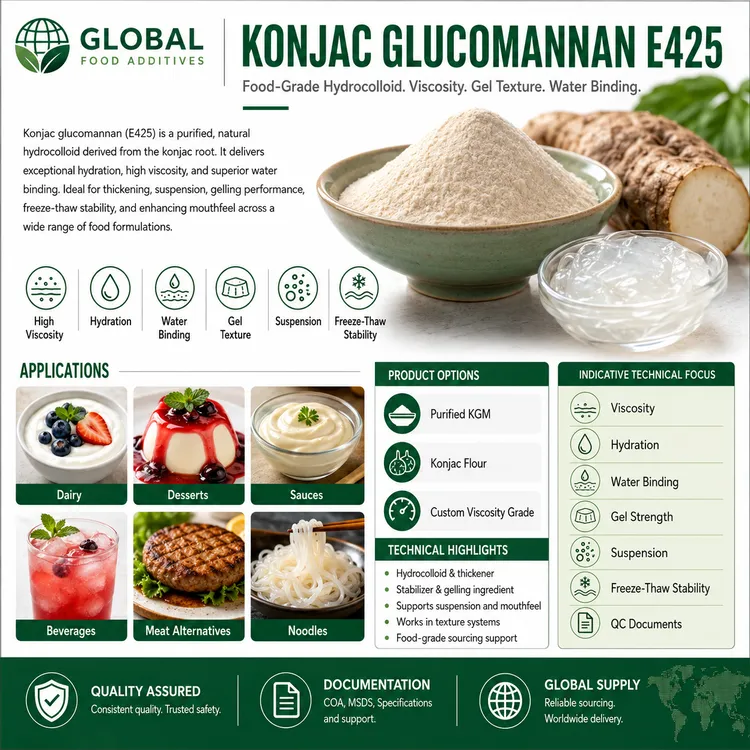
Konjac Glucomannan is a purified food-grade hydrocolloid used by food manufacturers for high viscosity, suspension, water binding, elastic gel texture, freeze-thaw stability, moisture retention and improved mouthfeel. It is commonly evaluated in dairy desserts, sauces, beverages, noodles, plant-based meat, seafood analogues, frozen foods, fillings, nutritional systems and texture-modified foods.
Konjac Glucomannan is typically selected when a formulation requires stronger water binding, cleaner gel texture, improved chew, reduced syneresis or a lower use level than many conventional hydrocolloids. For industrial purchasing, it should be reviewed by viscosity grade, glucomannan purity, particle size, hydration behavior, gel strength, regulatory status and documentation quality rather than by product name alone.
Product identity
| Product | Konjac Glucomannan |
|---|---|
| Common abbreviation | KGM |
| Other names | Konjac mannan, purified konjac glucomannan, konjac gum, konjac polysaccharide |
| Category | Hydrocolloids, Gums & Gelling Agents |
| Function | Thickener / stabilizer / gelling ingredient |
| E / INS number | E425; Konjac Glucomannan is commonly associated with E425(ii), subject to market verification |
| CAS / identity | 37220-17-0 |
| Typical source | Purified polysaccharide fraction from konjac tuber or corm material |
| Typical form | Fine powder, purified powder, granule, instantized grade or application-specific blend |
| Key technical behavior | High water binding, strong viscosity development, shear-thinning flow, elastic gel formation under selected conditions and synergy with other hydrocolloids |
Application fit
Potential use areas may include:
- Dairy desserts, puddings, yoghurts, cream systems and frozen desserts
- Fruit preparations, fillings, toppings, glazes and spoonable dessert gels
- Sauces, dressings, condiments, marinades and ready-meal systems
- Beverages, suspensions, nutritional drinks and fibre-containing formulas where permitted
- Meat alternatives, plant-based meat, seafood analogues and structured protein systems
- Noodles, shirataki-style products, pasta alternatives and low-calorie gel foods
- Bakery fillings, moisture-control systems and texture-modified foods
Technical overview
Konjac Glucomannan is a high-molecular-weight polysaccharide with strong water-binding capacity. In food systems, it hydrates to form highly viscous solutions and can support gel formation under specific processing conditions. Its functionality is driven by polymer purity, molecular weight, particle size, degree of acetylation, hydration method, solids content, pH, temperature, salts, sugars and interaction with other hydrocolloids.
Compared with broader konjac gum or konjac flour grades, Konjac Glucomannan is typically positioned as a more purified and controlled functional material. This can be important when a manufacturer needs cleaner taste, lighter colour, stronger viscosity reproducibility, lower impurity load or more predictable gel performance. However, supplier grades vary widely, so application trials and specification review are essential.
Functional benefits in food systems
High viscosity at low dosage
Konjac Glucomannan can build strong viscosity and improve body in sauces, dairy systems, fillings, beverage suspensions and plant-based products when properly dispersed and hydrated.
Water binding and syneresis control
Its strong hydration capacity can help reduce water separation in gels, frozen desserts, plant-based meat, fruit fillings, texture-modified foods and high-moisture systems.
Elastic gel texture
KGM can support elastic, cohesive and chewy textures, especially in alkaline heat-set systems or in synergy with xanthan gum, carrageenan, starches and selected proteins.
Mouthfeel and fat replacement
In selected formulas, KGM can improve creaminess, juiciness, chew, smoothness and fullness while supporting reduced-fat, reduced-calorie or plant-based texture strategies.
Application engineering guidance
| Application | Typical technical objective | Key formulation review points |
|---|---|---|
| Dairy desserts and puddings | Improve body, spoonable texture, gel strength, creaminess and syneresis resistance. | Review milk protein level, calcium, sugar, pH, heat process, starch, carrageenan, gelatin replacement target, cooling rate and final texture target. |
| Frozen desserts | Support water binding, smoothness, ice-crystal control, meltdown resistance and freeze-thaw stability. | Validate with stabilizer blend, fat level, overrun, aging time, freezing curve, storage temperature abuse and sensory texture after repeated freeze-thaw cycles. |
| Sauces and dressings | Build viscosity, suspend particulates, improve cling and reduce separation. | Check oil phase, acid type, pH, salt, sugar, shear, pasteurization, filling temperature and interaction with xanthan, starch, guar or cellulose gums. |
| Beverages and suspensions | Improve body, mouthfeel and suspension of insoluble ingredients. | Use caution with hydration and viscosity. Evaluate pH, thermal process, sedimentation, fibre positioning, mouthfeel, dosage and regulatory status. |
| Meat alternatives | Create bite, chew, juiciness, binding and thermal stability in plant-based or hybrid meat systems. | Review protein source, extrusion or mixing process, fat phase, methylcellulose, carrageenan, starch, salts, pH, cooking loss and reheat texture. |
| Seafood analogues | Support elastic bite, water retention, sliceability and gel structure in surimi-style or plant-based seafood systems. | Evaluate salt level, protein gelation, starch, calcium, pH, heating profile, freeze-thaw stability and final bite. |
| Noodles and gel foods | Create elastic gel structure, chew, low-calorie texture and high-moisture matrix stability. | Confirm alkaline treatment, heat setting, calcium or salt system, product dimensions, choking-risk review, cooking stability and local product-format rules. |
| Fruit fillings and glazes | Improve viscosity, water binding, fruit suspension and bake or freeze-thaw tolerance. | Validate with pH, soluble solids, calcium, pectin, starch, fruit solids, heating, shear and packaging process. |
| Texture-modified foods | Support controlled texture, water binding and smooth mouthfeel in special nutrition or dysphagia-oriented foods. | Verify finished texture class, swallowing safety, viscosity stability, hydration completeness, regulatory category and clinical-use requirements. |
Hydration and dispersion principles
Konjac Glucomannan hydrates strongly and can create lumps if it is added too quickly into water without adequate dispersion. Dry pre-blending with sugar, salt, starch, protein powder or another carrier is commonly used to separate particles before hydration. High shear, controlled powder addition and adequate hydration time help achieve a smooth and uniform system.
Hydration rate depends on particle size, water temperature, concentration, shear rate, pH, dissolved solids, sugar, salt and competing water-binding ingredients. Fine powders can hydrate rapidly but may dust and lump. Granulated and instantized grades may improve handling and reduce lumping, but final viscosity still depends on the full formulation and process.
Gelation systems and hydrocolloid synergy
Konjac Glucomannan can create different texture profiles depending on how it is processed. In alkaline heat-set systems, deacetylation of KGM can support firmer, elastic and thermally stable gel networks. In neutral or mildly acidic foods, KGM is often used with synergistic hydrocolloids to achieve the target texture without excessive gum dosage.
| System | Typical effect | Industrial review points |
|---|---|---|
| KGM + xanthan gum | Can form elastic, cohesive gels or highly structured viscosity systems. | Optimize gum ratio, total dosage, hydration order, salt level, pH, heat process and final texture target. |
| KGM + carrageenan | Can improve gel strength, elasticity, water binding and dairy dessert structure. | Review milk protein, calcium, potassium, sugar, pH, cooling rate, carrageenan type and syneresis control. |
| KGM + starch | Can improve body, viscosity, freeze-thaw stability and filling texture. | Validate starch gelatinization, shear tolerance, acid stability, retrogradation, water competition and storage texture. |
| KGM + protein | Can support juiciness, binding and texture in plant-based or meat systems. | Evaluate protein hydration, pH, salt, heat denaturation, fat phase, cooking loss, chew and sliceability. |
| KGM + methylcellulose | Can support thermal gel structure, bite and juiciness in meat alternatives. | Check methylcellulose grade, heating profile, cooling profile, water content, fat release and sensory chew. |
| Alkaline KGM gel | Can produce firm, elastic and heat-stable gel structures. | Confirm alkali type, pH, heat treatment, neutralization if needed, product format, texture, consumer safety and regulatory status. |
Specification and quality-control parameters
For industrial purchasing, Konjac Glucomannan should be compared by measurable functionality, purity and documentation quality. A low-cost material may create weaker viscosity, slower hydration, poor gel strength, high impurity load, off-colour, off-odour or inconsistent texture. The supplier specification should define both chemical purity and functional performance with clear test methods.
Identity and composition
- Product name and E number
- Konjac glucomannan or E425(ii) identity statement where applicable
- CAS number or identity statement
- Glucomannan content or purity indicator
- Botanical source and country of origin
- Production process and purification level where available
Functional properties
- Viscosity specification and test method
- Solution concentration used for viscosity testing
- Hydration time and hydration temperature
- Gel strength or texture data where applicable
- Particle size distribution or mesh size
- Dispersibility, instantization and lump-resistance information
Chemical limits
- Loss on drying or moisture content
- Total ash and acid-insoluble ash
- pH of aqueous dispersion
- Protein, starch or fibre impurities where specified
- Sulfur dioxide or sulfite residue where applicable
- Heavy metals and elemental impurities
Food safety controls
- Total plate count, yeast and mould
- Coliforms, E. coli, Salmonella and other specified pathogens where required
- Arsenic, lead, cadmium and mercury limits where required
- Allergen and cross-contact statement
- GMO, irradiation and nanomaterial statements where required
- Halal, kosher, vegan or vegetarian suitability where commercially required
Processing and handling notes
Konjac Glucomannan is usually supplied as a dry powder or granule and should be stored in a cool, dry place away from moisture. Because it binds water strongly, opened packaging should be resealed quickly. In production, powder handling should minimize dust, humidity exposure and cross-contamination. Pre-blending with dry ingredients is often helpful for uniform dispersion in sauces, stabilizer systems, bakery fillings, seasonings and nutritional powders.
For hot-process applications, the gum should be allowed enough time to disperse and hydrate before final acid, salt or heat adjustment. For cold-process systems, instantized or controlled-particle-size grades may be preferred, but adequate shear and hydration time remain important. For frozen foods, freeze-thaw testing should include multiple cycles because water binding and gel texture can change after storage abuse.
Quality effects to validate
| Quality factor | Possible Konjac Glucomannan effect | Validation method |
|---|---|---|
| Viscosity | Can significantly increase low-shear viscosity and improve body. | Brookfield viscosity, rheometer flow curve, process viscosity and finished product hold test. |
| Gel texture | Can create elastic, firm, chewy or cohesive textures depending on system. | Texture profile analysis, gel strength, bite test, cut test and sensory panel. |
| Syneresis | Can reduce water separation in gels, dairy systems, fillings and plant-based foods. | Centrifuge test, storage test, freeze-thaw test and visual separation measurement. |
| Mouthfeel | Can improve smoothness, creaminess, juiciness, body or chew. | Sensory panel, trained texture evaluation and comparison against a reference formula. |
| Suspension | Can help keep particles, fibres, cocoa, spices, herbs or minerals suspended. | Sedimentation test, accelerated shelf-life test and package storage observation. |
| Freeze-thaw stability | Can help reduce water separation and texture breakdown in selected frozen systems. | Repeated freeze-thaw cycles, drip loss measurement, texture analysis and sensory evaluation. |
| Colour and flavour | Lower-purity grades may affect appearance or introduce earthy notes. | Colour measurement, odour check, sensory panel and comparison of supplier grades. |
Regulatory and labeling review
Konjac Glucomannan is commonly associated with E425 and E425(ii), but use permissions, maximum levels, product categories, label requirements and product-format restrictions vary by destination market. Buyers should confirm whether the intended grade is permitted in the target food category and whether local rules distinguish between konjac gum and konjac glucomannan.
Special attention is required for jelly confectionery, mini-cup jelly, gel snacks and products that may present a choking risk. Product shape, firmness, serving size, intended consumer group and local restrictions should be reviewed before using KGM in elastic ready-to-eat gels or confectionery formats.
Label declarations may vary by jurisdiction and may require terms such as “konjac glucomannan,” “konjac gum,” “thickener,” “stabilizer,” “gelling agent,” “E425” or another locally accepted wording. Fibre, satiety, weight-management, cholesterol, digestive or health-related claims should not be used unless they are substantiated and permitted in the destination market.
Industrial purchasing notes
When reviewing Konjac Glucomannan, compare the supplier specification against the intended food application, hydration process, target viscosity, gel texture, label expectations and local rules. For industrial purchasing, the most useful inquiry normally includes target grade, viscosity requirement, particle size, glucomannan content, application, processing temperature, pH, packaging size, quantity, destination and document requirements.
| Purchasing factor | Why it matters |
|---|---|
| Glucomannan content | Higher purified KGM content can improve viscosity consistency, gel performance, colour and taste neutrality. |
| Viscosity grade | Different grades can create very different body and mouthfeel at the same dosage. |
| Particle size | Fine, coarse, granulated and instantized grades differ in dispersion, dusting, hydration rate and lump risk. |
| Gel performance | Gel strength, elasticity and bite are critical for noodles, plant-based meat, desserts and structured products. |
| Microbiological quality | Important for ready-to-eat, cold-filled, low-heat, beverage and nutrition applications. |
| Moisture protection | KGM can hydrate and clump if exposed to humidity during storage or transport. |
| Regulatory support | Some applications and product formats need careful review, especially gel confectionery and fibre-positioned products. |
| Documentation package | Complete food-grade, allergen, GMO, origin, heavy metal, microbiology, halal, kosher and regulatory documents reduce approval delays. |
Documents to request
- Product specification or technical data sheet with E number, CAS number and identity statement
- Certificate of analysis for available batch or lot
- Glucomannan content, purity statement or composition information where available
- Viscosity test method, test concentration, hydration conditions and acceptance range
- Particle size distribution, mesh size or instantization information
- Gel strength, texture data or application guidance where applicable
- Food-grade statement and destination-market regulatory declaration
- Safety data sheet where applicable
- Origin, manufacturer, production site and processing information
- Allergen, gluten, GMO, irradiation and nanomaterial statements where required
- Halal, kosher, vegan or vegetarian suitability documents where commercially required
- Heavy metals, arsenic, lead, cadmium, mercury and microbiological limits
- Sulfur dioxide or sulfite declaration where applicable
- Shelf-life, storage condition and humidity-protection guidance
- Packaging details, net weight, inner liner, pallet configuration and batch coding
- Label declaration guidance and market-specific compliance statement
- Change-control, traceability and supplier quality-system information where required
How to request this product
Send the product name, target grade or reference specification, viscosity requirement, glucomannan content requirement, particle size preference, quantity, destination country, packaging preference, expected shipment date and required documents. If you already purchase Konjac Glucomannan, attach or describe your existing specification, label, certificate of analysis, viscosity target, mesh size or supplier grade so sourcing options can be compared more accurately.
For faster technical review, include the final product type, target function, desired texture, processing temperature, pH, soluble solids, salt level, sugar level, other gums in the formula, required certifications, preferred origin, annual consumption estimate and whether you need a lab sample, pilot quantity or commercial shipment.
Useful answers
What is Konjac Glucomannan used for in food manufacturing?
Konjac Glucomannan is used for viscosity, suspension, gel texture, water binding, freeze-thaw stability, syneresis control, mouthfeel and texture development. Typical review areas include dairy, desserts, sauces, beverages, noodles, plant-based foods and meat alternatives.
What is the difference between Konjac Gum and Konjac Glucomannan?
Konjac Gum is often used as a broader commercial term, while Konjac Glucomannan refers to the purified functional polysaccharide fraction. Some markets distinguish E425(i) konjac gum and E425(ii) konjac glucomannan, so the exact identity should be confirmed on supplier documentation.
How should Konjac Glucomannan be hydrated?
It should normally be dispersed slowly under adequate shear or pre-blended with dry ingredients such as sugar, salt, starch or protein before hydration. Hydration depends on particle size, water temperature, KGM concentration, shear, pH, salts and total solids.
Can Konjac Glucomannan form heat-stable gels?
Yes, selected Konjac Glucomannan systems can form elastic and heat-stable gels, especially under alkaline heat treatment or in synergistic combinations with gums such as xanthan or carrageenan. The exact texture must be validated in the final formulation.
Can Global Food Additives source Konjac Glucomannan?
Global Food Additives can review sourcing options for Konjac Glucomannan according to target specification, viscosity grade, particle size, purity, application, quantity, destination, packaging and required documentation.
Which documents should be requested?
Buyers commonly request a technical data sheet, product specification, certificate of analysis, viscosity method, glucomannan content, particle size information, food-grade statement, safety data sheet where applicable, origin statement, allergen declaration, GMO declaration, shelf-life information and packing details.
Is Konjac Glucomannan permitted in every country?
No. Food additive use depends on destination-market rules, product category, use level, product format, label requirements and buyer responsibility. Some jelly confectionery formats may face special restrictions because of choking risk.
What should be checked before switching Konjac Glucomannan suppliers?
Check glucomannan content, viscosity grade, test method, particle size, hydration rate, purity, colour, odour, microbial limits, sulfur dioxide where applicable, heavy metals, allergen status, regulatory documents, shelf life and application performance in the finished food.
Tell us which food additive or ingredient you need.
Send product names, target specifications, quantity, destination country, packaging preference, delivery term and document requirements. For Konjac Glucomannan, please also include the application, desired viscosity, glucomannan content, particle size, gel texture target, pH, process temperature, other gums in the formula and required certificates. Our team will review your inquiry and respond from orders@foodgradeadditives.com.
Your message has been received. You will be redirected to the home page.