
Magnesium Diglutamate
Magnesium Diglutamate is a food-grade glutamate flavour enhancer used in selected savoury food systems where umami intensity, flavour continuity, salt perception, mouthfulness and taste balance are important. It is typically evaluated by R&D, procurement, QA and regulatory teams for seasoning blends, soups, sauces, snacks, meat analogue systems and sodium-reduction projects where the full formulation must be tested before commercial approval.
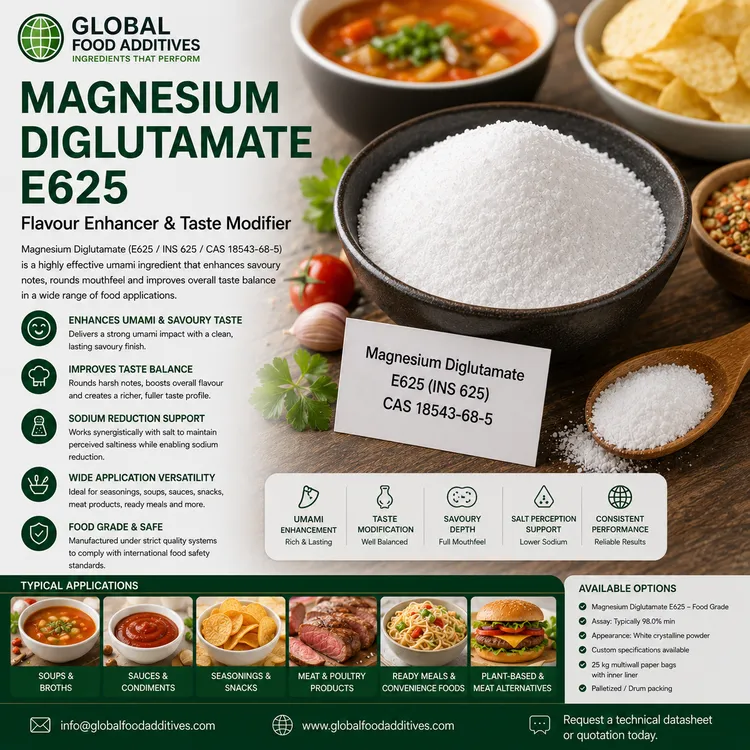
Product identity
| Product | Magnesium Diglutamate |
|---|---|
| Alternative names | Magnesium glutamate, magnesium L-glutamate, glutamic acid magnesium salt |
| Category | Flavour Enhancers & Taste Modifiers |
| Function | Flavour enhancer / taste modifier / savoury system ingredient |
| E / INS number | E625 / INS 625 where permitted |
| CAS / identity | 18543-68-5 |
| Formula note | Commonly represented as Mg(C5H8NO4)2; hydrate state and exact grade should be confirmed by supplier documents |
| Typical form | White to off-white powder, crystalline powder or granular food-grade material |
| Primary application type | Savoury flavour systems, seasoning blends, soups, sauces, snacks and meat analogue formulations |
| Key buyer check | Confirm assay, glutamate content, sensory profile, solubility, label declaration, food category permission and maximum use level |
Application fit
Potential use areas may include savoury products where a clean umami profile, rounded flavour body and controlled taste enhancement are required.
- Seasoning blends, spice mixes and dry rubs
- Instant soups, bouillons, broths and stock powders
- Sauces, gravies, marinades and culinary bases
- Snack seasonings, chips, crackers and extruded snacks
- Meat analogues, plant-based protein systems and savoury fillings
- Ready meals, noodle seasonings and prepared-food flavour bases
- Low-sodium or sodium-reduced savoury development where permitted
Technical purchasing notes
When reviewing Magnesium Diglutamate, compare the supplier specification against the intended food category, taste target, process conditions, dosage range, label expectations and local rules. Industrial buyers should not evaluate this ingredient only by additive name. The practical result depends on assay, glutamate contribution, magnesium contribution, particle size, solubility, pH behavior, hydrate form, sensory profile, blending method, packaging barrier and finished product matrix.
Functional role in savoury systems
- Umami enhancement: contributes savoury intensity and depth in formulations based on meat, vegetable, yeast, soy, mushroom, cheese or roasted notes.
- Flavour rounding: can smooth sharp edges, extend flavour duration and support a fuller taste profile in dry and wet culinary systems.
- Salt perception support: may help improve perceived savouriness in sodium-reduction work, although it should not be treated as a direct salt substitute.
- Aftertaste management: can help balance bitterness, metallic notes or thin flavour perception when used with suitable acids, sweeteners, proteins and savoury flavours.
- Synergy with nucleotides: may be evaluated with inosinate, guanylate, yeast extracts or hydrolyzed vegetable proteins where permitted and label strategy allows.
Performance depends on
- Finished product pH, salt level and water activity
- Dosage, blend uniformity and processing sequence
- Solubility and dispersion in the target matrix
- Interaction with yeast extract, HVP, MSG, IMP, GMP and natural flavours
- Heat treatment, retort exposure, drying or extrusion conditions
- Matrix composition: protein, fat, starch, fiber, acids and spices
- Regulatory permission by country and food category
- Consumer label expectations for glutamate-based flavour enhancers
Formulation guidance for R&D teams
Magnesium Diglutamate should be evaluated as part of the complete savoury system rather than as an isolated ingredient. The same grade may perform differently in a bouillon powder, tomato sauce, plant-based patty, spicy snack seasoning or ready-meal gravy because the flavour response depends on salt, acidity, fat phase, protein source, processing temperature and aroma profile.
| Formulation factor | Industrial importance |
|---|---|
| Dosage range | Should be optimized through sensory trials. Excessive dosage can create over-enhancement, lingering aftertaste or label concerns. |
| Salt level | Influences savoury perception and sodium-reduction strategy. Magnesium Diglutamate may support saltiness perception but does not replace sodium chloride one-to-one. |
| pH and acidity | Acidic sauces, tomato bases and fermented systems may show different flavour impact compared with neutral soups or dry seasonings. |
| Solubility and dispersion | Important for soups, sauces, brines, marinades and instant systems where undissolved particles or uneven distribution can affect taste quality. |
| Thermal processing | Retort, cooking, frying, extrusion and drying can change the full flavour matrix. Finished product tasting is more reliable than raw blend evaluation. |
| Synergistic enhancers | Combination with yeast extract, hydrolyzed proteins, nucleotides, mushroom powders or fermented ingredients may increase savoury depth. |
| Label positioning | Some buyers prefer clear additive declaration, while others require natural-flavour, yeast-extract or clean-label alternatives. This must be decided before formulation lock. |
| Consumer market | Glutamate acceptance varies by region, customer and product segment. Regulatory and marketing teams should review label language early. |
Specification parameters to evaluate
A professional Magnesium Diglutamate inquiry should include measurable quality and sensory parameters. Procurement teams should compare the technical data sheet, certificate of analysis and buyer specification before approving the material for commercial use.
| Parameter | Why it matters |
|---|---|
| Assay / purity | Confirms active ingredient level and supports supplier comparison, dosage calculation and batch consistency. |
| Glutamate content | Relevant for flavour-enhancement strength, label review and maximum-level calculations where expressed as glutamic acid or equivalent. |
| Magnesium content | Important for formula calculation, mineral contribution and comparison with other glutamate salts. |
| Hydrate state / loss on drying | Affects assay correction, storage behavior, caking tendency, solubility and dosage calculation. |
| Particle-size distribution | Affects blend uniformity, dusting, segregation, dissolution speed, dry-mix flow and sachet-filling accuracy. |
| Solubility and clarity | Important for soups, sauces, marinades, brines and instant systems where visible sediment or slow dissolution is undesirable. |
| pH of solution | Helps R&D assess interaction with acids, proteins, stabilizers, meat systems and finished product flavor balance. |
| Appearance and odor | Supports sensory screening and helps detect contamination, aging, packaging damage or supplier variation. |
| Heavy metals | Lead, arsenic, cadmium and mercury limits should match food-grade and destination-market requirements. |
| Microbiological limits | Important for ready-to-eat seasonings, dry mixes, low-moisture foods, culinary bases and export supply chains. |
| Allergen, GMO, halal, kosher and vegan status | Often required by brand owners, retailers, importers, certification bodies and private-label customers. |
| Shelf life and storage | Defines warehouse planning, humidity protection, unopened-bag stability and first-expired-first-out inventory control. |
Application examples
| Application area | Typical reason for evaluation | Buyer questions to confirm |
|---|---|---|
| Seasoning blends | Umami depth, flavour continuity and savoury balance in dry powders | Does the grade blend uniformly with salt, sugar, spices, acids, yeast extract and carriers without segregation or caking? |
| Soups and bouillons | Broth depth, meaty notes, vegetable savouriness and salt-perception support | Does it dissolve cleanly and remain stable after hot-water preparation, cooking or retort processing? |
| Sauces and gravies | Flavour rounding, umami lift, aftertaste balancing and mouthfulness | Does the ingredient interact with tomato, vinegar, dairy, starch, hydrocolloids or proteins? |
| Snack seasonings | High-impact savoury taste, linger and reduced thinness in topical seasoning systems | Does it support flavour release after frying, baking or extrusion? Does it stay free-flowing in the seasoning drum? |
| Meat analogues | Savoury depth in plant proteins, masking support and cooked-meat style flavour development | Does it balance beany, bitter or cereal notes without creating excessive aftertaste? |
| Low-sodium formulations | Savoury enhancement and improved salt perception while reducing sodium chloride | What sodium-reduction target is realistic after sensory trials? Is the additive declaration acceptable for the product segment? |
| Ready meals and fillings | Flavour body and consistency after cooking, chilling, freezing or reheating | Does performance remain stable after thermal processing and shelf-life storage? |
Process and sensory validation
Bench formulation
Start with a control sample, then evaluate Magnesium Diglutamate at several dosage points. Compare against existing savoury enhancers, salt level, yeast extract, MSG, nucleotides and natural flavour systems. Record impact on first taste, middle body, lingering finish and aftertaste.
Pilot production
Run the ingredient through the actual process when possible. Mixing, dry dosing, brining, hot filling, retort, frying, extrusion, spray drying or seasoning application can change the final taste result compared with bench tasting.
Sensory panel design
Use triangle tests, preference tests, saltiness ranking or descriptive analysis depending on project objective. For sodium-reduction projects, compare perceived saltiness, savoury intensity, bitterness, metallic notes and overall liking.
Shelf-life tasting
Evaluate taste after accelerated and real-time storage, especially in high-fat snacks, spice blends, sauces and ready meals. Check whether flavour lift, aroma balance or aftertaste changes over the declared shelf life.
Regulatory and labeling review
Magnesium Diglutamate is a glutamate flavour enhancer and should be reviewed under the destination market’s food additive rules before purchase or formulation. The buyer should confirm whether E625 or INS 625 is permitted in the target food category, whether the maximum use level is defined individually or as part of a glutamate group, how the additive must be declared on the label, and whether the customer has any internal restrictions for glutamate-based ingredients.
Quality and compliance documents to request
- Product specification or technical data sheet with exact identity, CAS number, E / INS number and food-grade statement
- Certificate of analysis for the offered batch or representative current lot
- Assay, glutamate content, magnesium content, loss on drying and pH information where available
- Safety data sheet where applicable
- Origin statement, manufacturer statement and country-of-origin documentation
- Allergen declaration, GMO declaration and BSE/TSE statement when required
- Halal, kosher, vegan or vegetarian status when required by the buyer or destination market
- Heavy-metal limits, microbiological limits and contaminant declarations
- Particle-size distribution, solubility and sensory description when available
- Shelf-life, storage, unopened-bag handling and humidity protection guidance
- Label draft, packaging details, pallet configuration and container loading information
- Market-specific declarations required by the destination country, importer, retailer or brand owner
Packaging, storage and logistics notes
Magnesium Diglutamate is normally handled as a dry food additive powder or crystalline material. Packaging should protect the ingredient from moisture uptake, odor transfer, bag damage, contamination and excessive compaction during transport. For export shipments, buyers should confirm bag size, liner type, net weight, pallet type, pallet wrapping, container loading plan, batch coding, label language and document legalization requirements before order confirmation.
Typical packing options to confirm
- Multi-wall paper bags with PE liner
- PE-lined woven bags for selected export routes
- Cartons, drums or specialty packs for smaller-volume additive use
- 25 kg net bag format where available
- Palletized or non-palletized container loading
- Neutral-label, customer-label or private-label options when permitted
Warehouse controls
- Keep bags tightly closed when not in use
- Store in a cool, dry and well-ventilated area
- Avoid direct contact with floor moisture
- Protect from strong odors, spices, cleaning chemicals and volatile aroma materials
- Use first-expired-first-out inventory rotation
- Protect from damaged pallets, torn bags, dust contamination and humidity exposure
Supplier qualification checklist
How to request this product
Send the product name, target grade, reference specification, intended food application, dosage range, first order quantity, annual demand, destination country, delivery term, packaging preference, expected shipment date and document requirements. If you already purchase Magnesium Diglutamate, attach your current specification, certificate of analysis, label, safety data sheet or approved supplier document so available sourcing options can be compared accurately.
For faster review, include whether the required material is for seasoning blends, soups, sauces, snacks, meat analogues, sodium-reduction work, ready meals, private label, tender supply, distributor inventory or toll manufacturing. This helps Global Food Additives match the inquiry with the correct specification level, documentation package and logistics route.
Useful answers
What is Magnesium Diglutamate used for in food manufacturing?
Magnesium Diglutamate is typically evaluated for umami, savoury depth, salt perception, flavour rounding, aftertaste balancing and overall taste improvement in selected savoury applications. Exact suitability depends on grade, application, process, dosage, regulation and supplier documents.
Is Magnesium Diglutamate the same as MSG?
No. Magnesium Diglutamate and monosodium glutamate are different glutamate salts. Both are associated with savoury flavour enhancement, but they differ in identity, cation contribution, additive number, formula and labeling considerations. Buyers should confirm the exact additive required before purchase.
Can Magnesium Diglutamate help with sodium reduction?
It may support sodium-reduction formulation by improving savoury depth and salt perception, but it is not a one-to-one replacement for sodium chloride. Sensory testing is required to confirm the best dosage, taste impact and label acceptability.
Which specification details are most important?
Important details include assay, glutamate content, magnesium content, hydrate state, loss on drying, pH, solubility, particle size, appearance, odor, heavy metals, microbiology, sensory profile, shelf life and storage conditions.
Which documents should be requested?
Buyers commonly request a technical data sheet, certificate of analysis, safety data sheet, food-grade statement, origin statement, shelf-life information, storage guidance, allergen declaration, GMO declaration, halal or kosher certificate where needed, packaging details and pallet configuration.
Can it be used with yeast extract or nucleotides?
It may be evaluated with yeast extract, hydrolyzed vegetable protein, inosinate, guanylate or other savoury ingredients where permitted. The final system should be tested for umami strength, aftertaste, label declaration and cost-in-use.
Is this product permitted in every country?
No. Permission depends on destination-market rules, food category, intended function, maximum permitted level, label declaration and buyer responsibility. Local regulatory verification is required before use.
Can Global Food Additives source Magnesium Diglutamate?
Global Food Additives can review sourcing options for Magnesium Diglutamate according to the requested grade, target specification, application, quantity, destination, delivery term, packaging and documentation requirements.
What information should I include in a quotation request?
Include product name, target grade, exact specification, application, dosage range, quantity, destination country, preferred packaging, delivery term, required documents, shipment timing and any existing COA or approved-supplier specification.
Tell us which food additive or ingredient you need.
Send product names, target specifications, quantity, destination country, packaging preference, delivery term, and document requirements. Our team will review your inquiry and respond from orders@foodgradeadditives.com.
Your message has been received. You will be redirected to the home page.