
Magnesium Oxide Fortification Grade
Magnesium Oxide Fortification Grade is a food-grade mineral ingredient used by food, beverage, nutrition and premix manufacturers when a concentrated magnesium source is required for enrichment, nutritional positioning, dry-blend formulation or supplement-style production. This page is designed for procurement, R&D, QA and regulatory teams that need to compare grades, verify elemental magnesium delivery, collect documentation and request export-ready quotations.
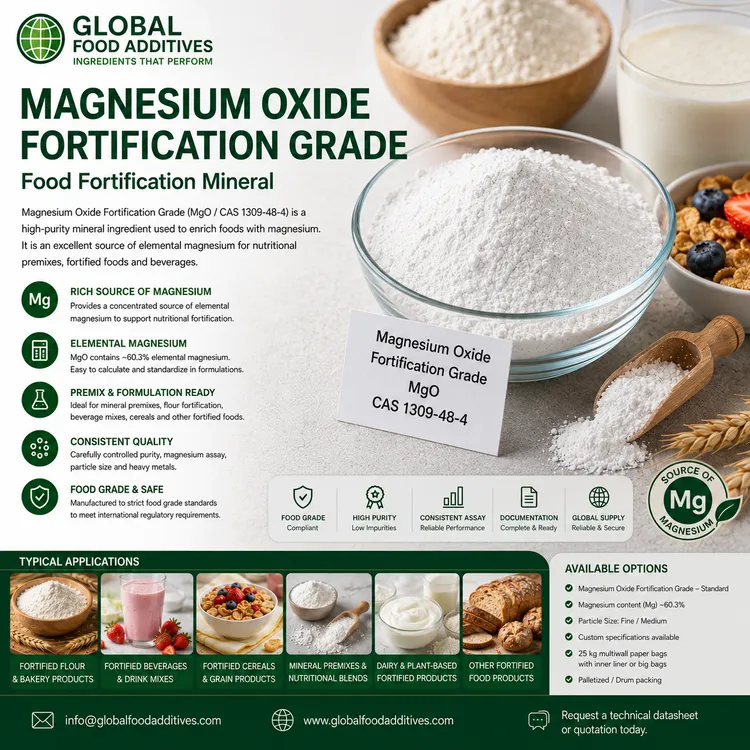
Product identity
| Product | Magnesium Oxide Fortification Grade |
|---|---|
| Chemical name | Magnesium Oxide |
| Common abbreviation | MgO |
| Category | Fortification Nutrients |
| Primary function | Vitamin, mineral or enrichment ingredient for food fortification |
| Secondary functionality | Dry mineral carrier, premix ingredient, powder-flow contributor or processing ingredient depending on application |
| CAS / identity | 1309-48-4 |
| Formula | MgO |
| Theoretical magnesium content | Approximately 60.3% elemental magnesium by molecular weight; practical value depends on MgO assay and lot specification |
| E / INS note | Food-additive status, nutrient-source status and labeling treatment must be confirmed by destination market and supplier documentation |
| Typical form | Fine powder, dense powder, light powder, granular grade or premix-ready grade |
| Key buyer check | Confirm food-grade status, MgO assay, elemental magnesium target, contaminant limits, particle size, sensory impact and final label suitability |
Application fit
Potential use areas may include products where magnesium enrichment, mineral premix stability and controlled dry-powder handling are important.
- Flour and cereal enrichment systems
- Breakfast cereals and grain-based fortified foods
- Powdered beverages and instant nutrition drinks
- Dairy powders, dairy analogues and nutrition blends
- Vitamin and mineral premixes
- Meal replacement, sports nutrition and wellness powders where permitted
- Infant, medical and specialized foods where specifically permitted
- Tablets, capsules, sachets and supplement-style formats where permitted
Technical purchasing notes
When reviewing Magnesium Oxide Fortification Grade, compare the supplier specification against the intended nutritional target, serving size, label claim, processing conditions, finished product matrix and local rules. For industrial purchasing, the most useful inquiry normally includes target magnesium per serving, MgO assay, elemental magnesium requirement, grade type, particle-size expectation, bulk density, packaging size, order quantity, destination country and required documents.
Fortification functionality
- Concentrated magnesium delivery: Magnesium Oxide provides high theoretical elemental magnesium content, allowing compact mineral addition where formula space is limited.
- Premix design: can be used in mineral premixes when particle size, density and flow are compatible with vitamins, minerals, carriers and minor ingredients.
- Dry-blend suitability: often evaluated in powders, cereals, flour systems and instant mixes where moisture control and blend uniformity are critical.
- Label target support: useful when manufacturers need to formulate toward a defined magnesium content per serving, subject to local labeling and claim rules.
- Processing compatibility: can support industrial dosing, blending, filling and repacking when the grade is matched to the equipment and product matrix.
Performance depends on
- MgO assay and elemental magnesium calculation
- Light or heavy grade selection
- Particle-size distribution and surface area
- Bulk density, tapped density and compressibility
- Blend ratio and compatibility with other nutrients
- Interaction with acids, flavors, colors, proteins and hydrocolloids
- Processing heat, hydration, pH and finished product moisture
- Packaging barrier, warehouse humidity and shelf-life target
Elemental magnesium calculation
Fortification formulas should be calculated using elemental magnesium delivered to the finished product, not only the weight of Magnesium Oxide added. Pure MgO has a theoretical elemental magnesium content of approximately 60.3%, but actual contribution depends on the supplier assay, purity, moisture, loss on ignition and batch-specific certificate of analysis.
| Calculation item | Industrial meaning |
|---|---|
| Target magnesium per serving | The required finished product magnesium value used for nutrition labeling, customer specification or claim positioning. |
| MgO assay | The purity or assay value used to correct theoretical magnesium contribution for the actual supplied grade. |
| Elemental magnesium factor | The conversion from MgO to magnesium. Buyers should calculate with the supplier-approved assay rather than a generic value alone. |
| Manufacturing overage | Additional mineral input may be considered to compensate for process variability, analytical tolerance and shelf-life expectations, subject to legal maximum levels. |
| Serving-size basis | All calculations should match the declared serving size and the analytical method used for finished product verification. |
| Regulatory ceiling | Maximum permitted levels, population-group restrictions and nutrition claim thresholds must be checked in the destination market. |
Specification parameters to evaluate
A professional Magnesium Oxide Fortification Grade inquiry should include measurable quality parameters. Procurement teams should compare the technical data sheet, certificate of analysis and buyer specification before approving the material for production.
| Parameter | Why it matters |
|---|---|
| MgO assay | Confirms active mineral purity and supports supplier comparison, formulation control and nutritional calculation. |
| Elemental magnesium content | Critical for fortified food design, supplement-style formulas, nutrition labeling and finished product specification. |
| Loss on ignition / moisture | Indicates volatile content, possible hydration or carbonate contribution, storage condition and formula correction needs. |
| Particle-size distribution | Affects blend uniformity, dusting, segregation, mouthfeel, suspension, tablet performance and filling accuracy. |
| Bulk density and tapped density | Helps evaluate premix volume, hopper flow, volumetric dosing, bag yield, pallet planning and container loading. |
| Acid-insoluble matter | Supports purity assessment and helps identify unwanted insoluble mineral residues. |
| pH and acid reactivity | Relevant for beverage powders, acidified foods, effervescent systems and formulas sensitive to pH shift. |
| Calcium oxide, chloride, sulfate and iron | Useful for checking impurity profile, sensory impact, color risk, compatibility and customer-specific limits. |
| Heavy metals | Lead, arsenic, cadmium and mercury limits should match food-grade, nutrition-grade and destination-market requirements. |
| Microbiological limits | Important for ready-to-mix powders, infant or medical foods where permitted, nutrition products and low-moisture foods. |
| Allergen, GMO, halal, kosher and vegan status | Often required by brand owners, retailers, importers, certification bodies and private-label manufacturers. |
| Analytical method | Supports traceability between raw-material COA, premix verification and finished product magnesium testing. |
| Shelf life and storage | Defines warehouse planning, humidity protection, unopened-bag stability and first-expired-first-out inventory control. |
Premix and formulation considerations
Blend uniformity
Mineral fortification usually requires consistent distribution at relatively low inclusion levels. Particle size and density should be compatible with carriers, vitamins, other minerals and the base food powder to reduce segregation during blending, transport, discharge and filling.
Sensory impact
Magnesium Oxide can influence mouthfeel, chalkiness, sediment, opacity or flavor perception in some matrices. Beverage powders, dairy systems and low-dose nutrition products should be tested for taste, dispersion and sediment under real preparation conditions.
Acidic systems
In acidified powders or beverages, MgO can react with acids and influence pH, buffering, solubility, sediment and reconstitution behavior. R&D teams should evaluate the final formula rather than testing the mineral source alone.
Overage strategy
Overage should be based on legal limits, analytical tolerance, processing loss, shelf-life target and finished product claim requirements. Excessive addition can create sensory, compliance or safety concerns, especially for sensitive population groups.
Heat and process exposure
Fortified bakery, cereal and dairy systems may expose the mineral premix to heat, hydration, pressure, shear or drying. The grade should be evaluated for stability, uniformity and final magnesium recovery after processing.
Competing minerals
When used with calcium, iron, zinc or phosphate salts, the formula should be reviewed for mineral interactions, pH effects, sediment, color change, taste and analytical recovery in the finished product.
Application examples
| Application area | Typical reason for evaluation | Buyer questions to confirm |
|---|---|---|
| Flour and cereal enrichment | Magnesium fortification, dry premix addition and stable distribution in grain-based matrices | Does the grade blend uniformly with flour or cereal carriers? Are legal enrichment levels and label claims allowed in the target market? |
| Powdered beverages | Compact magnesium delivery in instant drinks, wellness powders and nutrition beverages | Does the grade affect pH, sediment, turbidity, mouthfeel, flavor release or reconstitution speed? |
| Dairy powders and nutrition blends | Mineral fortification in dry nutritional systems | Is the mineral compatible with proteins, stabilizers, phosphates, flavors and heat-processing requirements? |
| Vitamin and mineral premixes | High-magnesium mineral input with controlled assay and traceability | Can the supplier provide consistent particle size, low heavy metals, microbiology data and batch-specific COA? |
| Meal replacement and sports nutrition | Magnesium contribution for nutrition positioning and mineral profile design | Does the product meet sensory, dispersibility, label, claim and population-group requirements? |
| Infant, medical and specialized foods where permitted | Controlled mineral delivery under strict formula and regulatory requirements | Is the grade approved for the specific category and destination? Are contaminant limits, microbiology and documentation strict enough? |
| Tablets, capsules and sachets | Compact elemental magnesium source and premix-ready mineral input | Are flow, density, compressibility, disintegration, label declaration and regulatory category suitable? |
Quality and compliance documents to request
- Product specification or technical data sheet with exact identity, formula, CAS number and food-grade statement
- Certificate of analysis for the offered batch or representative current lot
- MgO assay and calculated elemental magnesium contribution
- Safety data sheet where applicable
- Origin statement, manufacturer statement and country-of-origin documentation
- Allergen declaration, GMO declaration and BSE/TSE statement when required
- Halal, kosher, vegan or vegetarian status when required by the buyer or destination market
- Heavy-metal limits, microbiological limits and contaminant declarations
- Particle-size distribution, bulk density, tapped density and loss-on-ignition data when available
- Analytical method or test reference for magnesium assay when required
- Shelf-life, storage, unopened-bag handling and humidity protection guidance
- Label draft, packaging details, pallet configuration and container loading information
- Market-specific declarations required by the destination country, importer, retailer or brand owner
Regulatory and labeling review
Magnesium Oxide Fortification Grade may be handled differently depending on whether it is used as a nutrient source, food additive, supplement ingredient, mineral premix component or processing aid. The buyer should confirm the destination-market rules for permitted magnesium compounds, food category, maximum level, minimum claim threshold, nutrition label declaration, target population and any warning statement or certification requirement.
Packaging, storage and logistics notes
Magnesium Oxide Fortification Grade is normally supplied as a dry mineral powder or granular ingredient. Packaging should protect the product from moisture uptake, bag damage, dust release, contamination and excessive compaction during transport. For export shipments, buyers should confirm bag size, liner type, net weight, pallet type, pallet wrapping, batch coding, label language, container loading plan and document legalization needs before order confirmation.
Typical packing options to confirm
- Multi-wall paper bags with PE liner
- PE-lined woven bags for selected export routes
- Fiber drums or cartons for specialty nutrition grades
- 25 kg net bag format where available
- Palletized or non-palletized container loading
- Neutral-label, customer-label or private-label options when permitted
Warehouse controls
- Keep bags tightly closed when not in use
- Store in a cool, dry and well-ventilated area
- Avoid direct contact with floor moisture
- Protect from acids, strong odors and incompatible chemicals
- Use first-expired-first-out inventory rotation
- Protect from damaged pallets, torn bags, dust contamination and humidity exposure
Supplier qualification checklist
How to request this product
Send the product name, target grade, reference specification, intended food application, required elemental magnesium per serving, serving size, first order quantity, annual demand, destination country, delivery term, packaging preference, expected shipment date and document requirements. If you already purchase Magnesium Oxide Fortification Grade, attach your current specification, certificate of analysis, label, safety data sheet or approved supplier document so available sourcing options can be compared accurately.
For faster review, include whether the required material is for flour enrichment, cereal fortification, powdered beverages, dairy powders, nutritional premixes, supplements, infant or medical foods where permitted, repacking, private label, tender supply or distributor inventory. This helps Global Food Additives match the inquiry with the correct specification level, documentation package and logistics route.
Useful answers
What is Magnesium Oxide Fortification Grade used for in food manufacturing?
Magnesium Oxide Fortification Grade is typically evaluated for magnesium enrichment, nutritional premixes, fortified cereals, flour enrichment, beverage powders, nutrition blends, tablets, capsules and specialized food applications where permitted. Exact suitability depends on grade, application, process, dosage, regulation and supplier documents.
Why is elemental magnesium content important?
Fortification formulas are normally built around elemental magnesium delivered per serving. The weight of Magnesium Oxide added is not the same as the magnesium declared on the label, so buyers should calculate using MgO assay, elemental magnesium factor and finished-product serving size.
Is Magnesium Oxide Fortification Grade the same in every supplier offer?
No. Supplier offers may differ by assay, light or heavy grade, manufacturing route, surface area, particle size, bulk density, pH behavior, acid reactivity, heavy-metal limits, microbiological limits and documentation. Buyers should compare the technical data sheet and certificate of analysis before approval.
Which documents should be requested?
Buyers commonly request a technical data sheet, certificate of analysis, safety data sheet, food-grade statement, origin statement, shelf-life information, storage guidance, allergen declaration, GMO declaration, halal or kosher certificate where needed, packaging details and pallet configuration.
Which specification details are most important?
Important details include MgO assay, elemental magnesium content, CAS number, particle-size distribution, bulk density, tapped density, pH, loss on ignition, acid-insoluble matter, calcium oxide, iron, chloride, sulfate, heavy metals, microbiology and shelf life.
Can Magnesium Oxide affect taste or texture?
Yes. Depending on particle size, dosage and product matrix, Magnesium Oxide may influence chalkiness, sediment, opacity, mouthfeel, pH or flavor perception. Beverage powders and nutrition blends should be tested under real preparation conditions.
Can Magnesium Oxide be used in infant or medical foods?
Only where specifically permitted by destination-market rules and customer specification. These categories often require stricter contaminant limits, microbiology, formula control, traceability and regulatory documentation.
Is this product permitted in every country?
No. Permission depends on destination-market rules, food category, intended nutritional purpose, maximum permitted level, label declaration, claims, population group and buyer responsibility. Local regulatory verification is required before use.
Can Global Food Additives source Magnesium Oxide Fortification Grade?
Global Food Additives can review sourcing options for Magnesium Oxide Fortification Grade according to the requested grade, nutritional target, application, quantity, destination, delivery term, packaging and documentation requirements.
What information should I include in a quotation request?
Include product name, target grade, exact specification, required elemental magnesium per serving, application, quantity, destination country, preferred packaging, delivery term, required documents, shipment timing and any existing COA or approved-supplier specification.
Tell us which food additive or ingredient you need.
Send product names, target specifications, quantity, destination country, packaging preference, delivery term, and document requirements. Our team will review your inquiry and respond from orders@foodgradeadditives.com.
Your message has been received. You will be redirected to the home page.