
Magnesium Sulphate
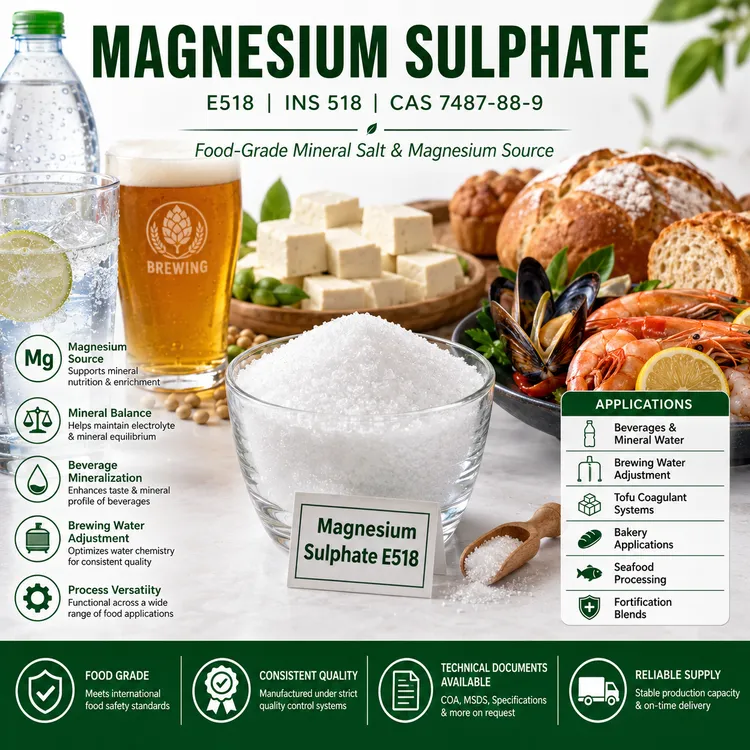
Magnesium Sulphate is a food-grade mineral salt used by food and beverage manufacturers for magnesium contribution, mineral balance, brewing water adjustment, beverage mineralization, selected coagulant systems, tofu-style applications, bakery and fermentation support, seafood and meat process-water control, mineral premixes and formulated salt systems.
For industrial sourcing, Magnesium Sulphate should be evaluated by hydrate form, assay basis, elemental magnesium content, sulfate contribution, solubility, pH, particle size, moisture, impurity profile, heavy metals, microbiological limits, label expectations and destination-market rules. Anhydrous, monohydrate and heptahydrate forms deliver different magnesium percentages, so they should never be substituted on equal weight without recalculation.
Product identity
| Product | Magnesium Sulphate |
|---|---|
| Alternative spelling | Magnesium Sulfate |
| Common name | Epsom salt, especially for magnesium sulfate heptahydrate; food-grade suitability must be documented |
| Category | Phosphates, Salts & Sequestrants |
| Function | Salt / phosphate / sequestrant / mineral-control ingredient |
| E / INS number | E518 / INS 518 |
| CAS / identity | 7487-88-9 for anhydrous magnesium sulfate; hydrate forms should be confirmed separately |
| Chemical formula | MgSO4 for anhydrous form; hydrated forms include MgSO4·H2O and MgSO4·7H2O |
| Typical form | Powder, crystal, granule, fine powder, heptahydrate crystal, monohydrate grade, anhydrous grade or solution grade |
| Key technical focus | Hydrate form, elemental magnesium, assay, sulfate contribution, solubility, impurity limits, process fit and regulatory status |
Application fit
Potential use areas may include:
- Beverages, mineralized water, functional drinks and electrolyte-style systems where permitted
- Brewing water adjustment and fermentation mineral balance
- Tofu-style coagulant systems and plant-protein gel applications where suitable
- Bakery, yeast fermentation systems and mineral-adjusted dough processes
- Seafood and meat process waters requiring controlled mineral salt composition
- Processed cheese, dairy and protein systems where magnesium salts are specifically validated
- Vitamin-mineral premixes and magnesium fortification systems where permitted
- Dry blends, salt systems and mineral-control formulations
Technical overview
Magnesium Sulphate is an inorganic mineral salt that dissociates into magnesium ions and sulfate ions in water. In food manufacturing, it may be used as a mineral salt, acidity regulator, firming or coagulant-related ingredient, brewing salt, beverage mineral, magnesium source or formulation salt depending on market and application. Its contribution is not only “magnesium”; sulfate taste, ionic strength, solubility and hydrate water must also be considered.
The ingredient is highly grade-dependent. Food-grade Magnesium Sulphate must be distinguished from technical, agricultural, feed, bath-salt, pharmaceutical or industrial material. Human food applications require appropriate purity, impurity limits, heavy metal controls, traceability, food-grade statement and destination-market documentation. The label “Epsom salt” is not enough to confirm food suitability.
For manufacturing, the most important technical question is usually hydrate form. Anhydrous magnesium sulfate contains more elemental magnesium per kilogram than monohydrate or heptahydrate material. Heptahydrate crystals contain substantial water of crystallization and contribute less magnesium per unit weight. Supplier COA values should therefore be used for final dosing.
Functional benefits in food systems
Mineral balance
Provides magnesium and sulfate ions for mineralized beverages, brewing water, fermentation media and selected salt systems where ionic composition affects taste or process performance.
Coagulation support
May be reviewed in tofu-style or plant-protein coagulation systems where magnesium salts influence protein aggregation, gel texture and mineral taste.
Fortification potential
Can be evaluated as a magnesium source in fortified foods, beverages or premixes where permitted by local nutrient-source rules and validated for taste impact.
Process-water adjustment
Can help adjust mineral composition in brewing, fermentation, seafood, meat or beverage systems where water chemistry affects final quality.
Hydrate form and elemental magnesium calculation
Hydrate form is central to Magnesium Sulphate purchasing. Each form has a different molecular weight and therefore a different elemental magnesium percentage. This affects dosing, cost comparison, nutrient declaration, water contribution and inventory substitution.
| Common form | Typical identity note | Approximate elemental magnesium content | Purchasing caution |
|---|---|---|---|
| Anhydrous magnesium sulfate | MgSO4; CAS commonly referenced as 7487-88-9 | About 20.2% magnesium by formula weight | Highest magnesium percentage among the common forms; confirm moisture and assay basis. |
| Magnesium sulfate monohydrate | MgSO4·H2O; hydrate CAS should be confirmed by supplier | About 17.6% magnesium by formula weight | Requires different dosage than anhydrous material. |
| Magnesium sulfate heptahydrate | MgSO4·7H2O; commonly called Epsom salt | About 9.9% magnesium by formula weight | Contains substantial water of crystallization; not interchangeable with anhydrous grade by weight. |
| Solution grade | Magnesium sulfate dissolved in water | Supplier-specific | Dose by declared magnesium, magnesium sulfate or dry solids content shown on COA. |
| Premix-ready grade | May include carriers or particle-size standardization | Supplier-specific | Use declared elemental magnesium and carrier declaration for label and formulation calculations. |
Application engineering guidance
| Application | Technical objective | Key formulation review points |
|---|---|---|
| Beverages and mineralized water | Add magnesium and sulfate ions for mineral profile, taste design or nutritional positioning where permitted. | Review solubility, taste bitterness, sulfate level, pH, mineral balance, clarity, precipitation, label declaration and local maximum levels. |
| Brewing water adjustment | Modify brewing liquor mineral profile, magnesium availability and sulfate contribution. | Validate with source water, malt bill, yeast strain, sulfate/chloride ratio, bitterness perception, mash pH and finished beer sensory profile. |
| Tofu-style coagulant systems | Support plant-protein coagulation, gel formation and texture in selected systems. | Evaluate with soybean or plant protein source, heat treatment, pH, dosage, coagulant blend, water hardness, curd yield, texture and mineral flavour. |
| Bakery and yeast systems | Adjust mineral profile and support yeast or dough systems where magnesium balance is relevant. | Review yeast activity, flour mineral content, salt level, fermentation time, flavour, dough tolerance and label declaration. |
| Seafood processing | Adjust process-water or brine mineral balance in validated seafood applications. | Check ionic strength, water retention, texture, taste, freezing, glazing, purge, phosphate interaction and local rules. |
| Meat products | Support mineral balance or salt-system design where specifically validated. | Review salt, phosphates, proteins, injection brine, tumbling, cook yield, purge, flavour and permitted use status. |
| Processed cheese and dairy systems | Review as a mineral salt in specific formulations, not as a direct replacement for emulsifying phosphates. | Validate calcium balance, phosphate/citrate system, protein stability, melt, texture, pH and regulatory status. |
| Vitamin-mineral premixes | Provide a controlled magnesium source where Magnesium Sulphate is permitted. | Confirm hydrate form, elemental magnesium, particle size, carrier compatibility, segregation risk, taste impact and nutrient-source approval. |
| Fermentation media | Provide magnesium for microbial or yeast processes where allowed for food fermentation. | Review organism requirements, sulfate tolerance, pH, ionic strength, sterilization, contamination control and downstream label status. |
Solubility, taste and mineral interaction
Magnesium Sulphate is generally soluble enough for many aqueous food systems, but dissolution rate depends on particle size, temperature, agitation, hydrate form and concentration. In beverage or mineral water systems, solubility is only one part of the design: magnesium salts can contribute bitterness, mineral taste, dryness or sulfate notes if used at high levels.
Magnesium ions can interact with phosphates, carbonates, citrates, proteins, pectins, alginates, gums and other minerals. These interactions can affect clarity, precipitation, protein stability, gel texture, flavour and shelf life. Beverage and dairy systems should be validated under actual pH, mineral load, heat treatment and storage conditions.
| System factor | Possible effect | Industrial review |
|---|---|---|
| Carbonates and bicarbonates | May affect precipitation, haze or mineral balance depending on pH and concentration. | Test clarity, sediment, pH drift and shelf-life stability. |
| Phosphates | Can bind or interact with magnesium and change protein or mineral behaviour. | Validate in processed cheese, meat, dairy and beverage systems. |
| Citrates | May improve mineral solubility or modify taste, depending on ratio. | Review pH, citrate level, sensory profile and regulatory labeling. |
| Dairy proteins | Mineral salts can influence heat stability, sediment and protein interactions. | Test with real milk protein, pH, heat process and shelf-life storage. |
| Hydrocolloids | Divalent ions can influence gel strength or viscosity in some gum systems. | Validate with pectin, alginate, carrageenan, gellan, xanthan or starch systems separately. |
| Sweeteners and flavours | Mineral bitterness may be exposed or masked by flavour design. | Run sensory tests with the complete formula and target dosage. |
Specification and quality-control parameters
For industrial purchasing, Magnesium Sulphate should be compared by chemical identity, hydrate form, elemental magnesium content, purity and documentation quality. Supplier specifications should define the exact form, not only the product name.
Identity and assay
- Product name: Magnesium Sulphate / Magnesium Sulfate
- E number / INS number: E518 / INS 518
- CAS number for the supplied hydrate form
- Chemical formula and hydrate declaration
- Assay result and assay basis
- Elemental magnesium percentage and sulfate content
Physical properties
- Appearance, colour and odour
- Powder, crystal, granule or solution form
- Particle size distribution or mesh size
- Bulk density and flowability
- Solubility and dissolution rate
- Caking tendency and dusting potential
Chemical limits
- Water of crystallization, moisture or loss on drying
- pH of aqueous solution
- Insoluble matter
- Chloride, iron, calcium and related mineral impurities
- Lead, arsenic, cadmium and mercury limits where required
- Residual process chemicals or contaminants where applicable
Food safety controls
- Food-grade statement
- Total plate count, yeast and mould where relevant
- Specified pathogen absence where required
- Allergen and cross-contact declaration
- GMO, irradiation and nanomaterial statements where required
- Halal, kosher, vegan or vegetarian suitability where commercially required
Quality effects to validate
| Quality factor | Possible Magnesium Sulphate effect | Validation method |
|---|---|---|
| Elemental magnesium delivery | Hydrate form changes magnesium contribution per kilogram. | Calculate from supplier COA and confirm with analytical testing where required. |
| Mineral taste | Can add bitter, salty, dry or mineral notes depending on dosage and matrix. | Sensory panel in final formula and comparison against target mineral blend. |
| pH and ionic strength | May influence pH, buffering and salt perception in mineral systems. | Measure pH, conductivity and sensory profile after processing and storage. |
| Clarity and precipitation | Can interact with carbonates, phosphates or proteins and create haze or sediment. | Clarity test, accelerated storage, centrifuge test and shelf-life observation. |
| Protein functionality | May influence coagulation, gelation or protein stability in selected systems. | Texture analysis, yield measurement, curd test, protein stability and sensory review. |
| Powder handling | Hydrate crystals or fine powders may cake or segregate depending on humidity and particle size. | Flowability test, humidity chamber, caking test and packaging validation. |
| Premix uniformity | Mineral salts can segregate if particle size and density are mismatched. | Blend uniformity testing, sampling plan and finished-product magnesium assay. |
Premix and fortification considerations
If Magnesium Sulphate is used in a nutrient premix or fortification system, the specification must state elemental magnesium content and hydrate form. Premix designers should also evaluate particle size, density, hygroscopicity, compatibility with vitamins, mineral interactions, taste impact and segregation risk. Very low-dose mineral addition should be handled through validated premixing rather than direct addition into large batches.
Magnesium Sulphate may not be the ideal magnesium source for every fortification application. Other magnesium salts can offer different taste, solubility, magnesium percentage, label acceptance or processing behaviour. The correct source depends on market rules, finished-product category, nutrition target, sensory profile, cost and stability.
Processing and handling notes
Magnesium Sulphate should be stored in a clean, dry area with packaging sealed when not in use. Hydrated crystalline grades and fine powders can cake if exposed to humidity. Anhydrous material may absorb moisture depending on conditions. Production teams should control dust, avoid cross-contamination and use suitable weighing procedures for low-dose mineral addition.
In liquid systems, dissolve Magnesium Sulphate with adequate agitation before final pH and clarity checks. In dry blends, match particle size with carriers to reduce segregation. In beverages and mineralized waters, evaluate the complete mineral system rather than magnesium alone. In protein systems, add salts in a controlled order to avoid localized protein destabilization.
Regulatory and labeling review
Magnesium Sulphate is commonly associated with E518 / INS 518, but permitted applications, maximum levels, label wording and nutrient-source status vary by destination market. Buyers should verify whether the intended product category permits Magnesium Sulphate and whether the declaration should be “magnesium sulphate,” “magnesium sulfate,” “mineral salt,” “E518,” “magnesium,” or another locally accepted wording.
Food manufacturers should distinguish between technological use and nutrient fortification use. A formula using Magnesium Sulphate for mineral balance may have different labeling requirements than a formula making a magnesium nutrition claim. Special caution is required for infant foods, medical foods, supplements, electrolyte beverages and products aimed at vulnerable consumers.
Applications that imply therapeutic use, laxative effect, muscle relaxation or medical magnesium claims should be avoided on food labels unless specifically permitted and substantiated under the destination-market rules. This page is intended for food ingredient sourcing and formulation review, not medicinal use.
Industrial purchasing notes
When reviewing Magnesium Sulphate, compare the supplier specification against the intended food application, mineral target, process conditions, taste profile, label expectations and local rules. For industrial purchasing, the most useful inquiry normally includes target grade, hydrate form, assay, elemental magnesium percentage, physical form, particle size, packaging size, quantity, destination and required documents.
| Purchasing factor | Why it matters |
|---|---|
| Food-grade status | Confirms the material is intended for human food use and supported by suitable documentation. |
| Hydrate form | Determines elemental magnesium content, water contribution, dosage and substitution calculation. |
| Assay basis | Clarifies whether specification is expressed as MgSO4, magnesium, dried basis or hydrate basis. |
| Elemental magnesium | Critical for fortification, premix and nutrition label calculations. |
| Solubility and clarity | Important for beverages, mineral waters, liquid premixes and protein systems. |
| Impurity limits | Mineral salts require careful review of heavy metals, iron and insoluble matter. |
| Particle size and density | Important for dry blending, premix uniformity, powder flow and segregation control. |
| Documentation package | Complete specification, COA, food-grade, allergen, GMO, heavy metal, microbiology, halal, kosher and regulatory documents reduce approval delays. |
Documents to request
- Product specification or technical data sheet with E number and identity statement
- Certificate of analysis for available batch or lot
- Exact hydrate form declaration and chemical formula
- CAS number for the supplied form
- Assay method and assay result, including basis of expression
- Elemental magnesium percentage and dosage-calculation guidance
- Sulfate content or related identity confirmation where specified
- Food-grade statement and destination-market regulatory declaration
- Permitted nutrient-source statement for target market where relevant
- Safety data sheet and handling guidance
- Heavy metals and elemental impurity limits, including lead, arsenic, cadmium and mercury where required
- Iron, calcium, chloride, insoluble matter and other impurity information where relevant
- Microbiological limits where relevant to product grade and application
- Particle size distribution, bulk density and flowability data
- Solubility, pH and clarity information
- Origin, manufacturer, production site and change-control information
- Allergen, gluten, GMO, irradiation and nanomaterial statements where required
- Halal, kosher, vegan or vegetarian suitability documents where commercially required
- Shelf-life, storage condition and humidity-protection guidance
- Packaging details, net weight, inner liner, pallet configuration and batch coding
- Label declaration guidance and market-specific compliance statement
- Traceability and supplier quality-system information where required
How to request this product
Send the product name, target grade or reference specification, hydrate form, assay requirement, elemental magnesium requirement, particle size preference, quantity, destination country, packaging preference, expected shipment date and required documents. If you already purchase Magnesium Sulphate, attach or describe your existing specification, label, certificate of analysis, premix formula, mineral target or application so supplier options can be compared more accurately.
For faster technical review, include the final product type, target magnesium amount, desired function, process temperature, pH, water chemistry, other minerals in the formula, food-grade requirement, regulatory market, required certifications, preferred origin, annual consumption estimate and whether you need a laboratory sample, pilot quantity or commercial shipment.
Useful answers
What is Magnesium Sulphate used for in food manufacturing?
Magnesium Sulphate is used as a mineral salt where magnesium contribution, mineral balance, beverage mineralization, brewing water adjustment, tofu-style coagulation, fermentation support, premix formulation or process-water control is required. Suitability depends on grade, hydrate form, application and destination-market rules.
Is Magnesium Sulphate the same as magnesium?
No. Magnesium Sulphate is a salt that supplies magnesium ions and sulfate ions. The elemental magnesium contribution depends on the exact hydrate form and assay stated on supplier documentation.
Why is hydrate form important?
Anhydrous magnesium sulfate, monohydrate and heptahydrate forms have different molecular weights and different elemental magnesium percentages. Using the wrong hydrate assumption can cause incorrect dosing and label calculations.
Can Magnesium Sulphate be used in beverages?
It may be reviewed for mineralized water, brewing, functional beverages and electrolyte-style systems where permitted. Formulators must validate solubility, taste, bitterness, sulfate level, clarity, pH, mineral interactions and label requirements.
Can Global Food Additives source Magnesium Sulphate?
Global Food Additives can review sourcing options for Magnesium Sulphate according to target specification, hydrate form, assay, elemental magnesium content, particle size, application, quantity, destination, packaging and required documentation.
Which documents should be requested?
Buyers commonly request a technical data sheet, product specification, certificate of analysis, hydrate form declaration, elemental magnesium calculation, food-grade statement, safety data sheet, heavy metal limits, origin statement, allergen declaration, GMO declaration, shelf-life information and packing details.
Is Magnesium Sulphate permitted in every country?
No. Use depends on destination-market rules, food category, additive status, nutrient-source rules, maximum levels, label requirements and buyer responsibility. Final regulatory suitability should be verified before commercial use.
What should be checked before switching suppliers?
Check food-grade status, hydrate form, assay, elemental magnesium content, particle size, solubility, pH, insoluble matter, chloride, iron, heavy metals, microbiological limits where relevant, allergen status, GMO status, regulatory documents, shelf life and finished-product performance.
Tell us which food additive or ingredient you need.
Send product names, target specifications, quantity, destination country, packaging preference, delivery term and document requirements. For Magnesium Sulphate, please also include the hydrate form, assay basis, elemental magnesium target, particle size, application, food-grade requirement, premix or mineral-water use and required certificates. Our team will review your inquiry and respond from orders@foodgradeadditives.com.
Your message has been received. You will be redirected to the home page.