
Meat Starter Cultures
Meat Starter Cultures are food-grade microbial culture systems used to standardize fermentation, acidification, color development, flavor formation, aroma generation, nitrate reduction, competitive inhibition and process consistency in fermented meat manufacturing. They are commonly evaluated for dry sausage, semi-dry sausage, salami, sucuk, chorizo, pepperoni, snack sticks, fermented spreads, dry-cured meats and surface-ripened meat products.
Commercial starter cultures are not generic powders. They are strain-defined or supplier-defined microbial systems with specific fermentation speed, temperature range, salt tolerance, sugar utilization, acidification profile, nitrate-reductase activity, catalase activity, aroma contribution, surface-ripening behavior and storage sensitivity. The correct culture must be matched to the meat matrix, recipe, fermentation chamber, drying schedule, target pH curve, water activity, curing system and destination-market regulations.
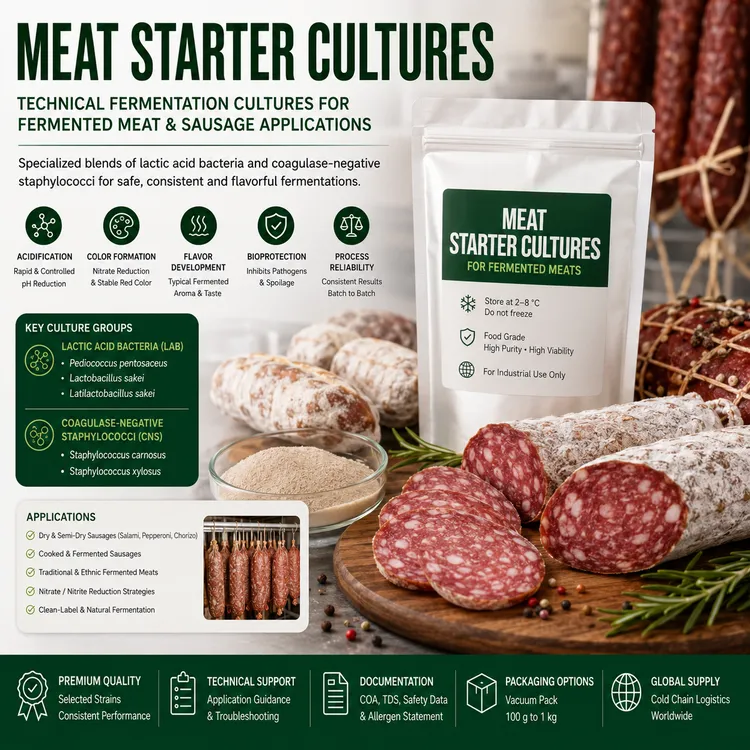
Product identity
| Product | Meat Starter Cultures |
|---|---|
| Category | Fermentation, Cultures & Bio-Protective Ingredients |
| Primary function | Fermentation control, acidification, color development, flavor formation, nitrate reduction, bioprotection and process standardization |
| E / INS number | Normally handled as microbial food cultures rather than a universal E-number additive; confirm by destination market and supplier documentation |
| CAS / identity | Culture blend; exact identity is strain- and supplier-specific |
| Typical culture types | Lactic acid bacteria, coagulase-negative staphylococci, selected yeasts, selected molds or multi-strain culture blends |
| Typical form | Freeze-dried culture, frozen pellet, direct-vat-set powder, pouch blend, sachet, protective culture or surface-ripening culture |
| Key purchasing basis | Strain identity, viable count, dosage, fermentation profile, application type, storage temperature, shelf life, halal / kosher status, allergen status and documentation |
Application fit
Potential use areas may include:
- Dry fermented sausages, salami, sucuk, chorizo, pepperoni and fuet-style products
- Semi-dry sausages, snack sticks and fermented ready-to-eat meat products
- Surface-ripened meats using selected mold or yeast cultures
- Color and flavor development in cured fermented meats
- Bioprotective systems for selected meat matrices where validated
- Fast-fermentation, traditional-fermentation or mild-aroma product styles
- Industrial process standardization for consistent pH, flavor, color and drying performance
Technical profile for meat manufacturers
Meat Starter Cultures are selected to guide microbial ecology during fermentation. In a controlled meat fermentation, desirable culture organisms should rapidly establish themselves in the product matrix, produce predictable acidification, support desired color and aroma reactions and help reduce the risk of uncontrolled spoilage flora. The strongest commercial programs define culture, carbohydrate source, salt level, nitrite / nitrate system, fermentation temperature, humidity, air velocity and drying profile as one connected process.
Starter cultures normally provide one or more functional roles. Lactic acid bacteria convert added fermentable carbohydrates into organic acids, lowering pH and contributing to texture, flavor and safety hurdles. Coagulase-negative staphylococci may support color formation, nitrate reduction, catalase activity and aromatic development. Selected yeasts and molds may contribute surface ripening, aroma development, oxygen management and characteristic appearance in dry-cured or mold-ripened products.
| Technical factor | Industrial relevance |
|---|---|
| Culture composition | Defines whether the blend primarily acidifies, develops color, protects against spoilage, creates aroma, ripens the surface or combines several functions. |
| Viable count | Determines the number of active cells delivered per gram or per dose. Viable count must be protected through cold-chain handling and correct storage. |
| Fermentation speed | Controls how quickly pH drops after stuffing. Fast cultures suit rapid processes; slow cultures may suit traditional flavor development. |
| Temperature range | Each culture has an effective growth and activity range. Wrong temperature can cause slow acidification, poor flavor or safety risk. |
| Salt tolerance | Meat systems contain salt and curing salts. Culture selection must match salt level, water activity and drying profile. |
| Sugar utilization | Different cultures use dextrose, sucrose, lactose, maltodextrin or other carbohydrates differently, changing acidification speed and final pH. |
| Nitrate-reductase activity | Relevant for cured fermented meats where nitrate / nitrite conversion and stable cured color are part of the process design. |
| Catalase activity | Can help reduce oxidative stress and support flavor stability in selected fermented meat systems. |
| Aroma contribution | Selected strains contribute to proteolysis, lipolysis and volatile aroma development, influencing traditional or mild flavor profiles. |
| Bioprotective behavior | Some cultures are selected for competitive inhibition or bacteriocin production, but these effects must be validated in the final product and process. |
| Storage sensitivity | Freeze-dried and frozen cultures can lose activity if exposed to heat, humidity, oxygen or repeated temperature abuse. |
Culture families and industrial roles
Different culture groups are selected for different manufacturing outcomes. A fast-acidifying lactic culture is not equivalent to a color-forming staphylococcal culture and a surface mold is not equivalent to an internal sausage starter. Industrial buyers should define the function required before selecting a culture.
| Culture group | Typical function | Common application direction |
|---|---|---|
| Lactic acid bacteria | Acidification, pH reduction, texture contribution and fermentation control. | Dry sausage, semi-dry sausage, snack sticks, rapid-fermented meats and products requiring predictable pH drop. |
| Pediococcus species | Fast acidification and reliable fermentation in many sausage systems. | Rapid fermentation, semi-dry sausage, pepperoni-style products and processes needing short pH-drop time. |
| Lactobacillus / Latilactobacillus species | Acidification, flavor contribution and adaptation to meat fermentation environments. | Traditional fermented sausages, salami-style products and controlled dry-curing systems. |
| Coagulase-negative staphylococci | Nitrate reduction, color stability, catalase activity, aroma development and flavor complexity. | Dry fermented meats, cured sausages, nitrate-containing systems and traditional aroma development. |
| Selected yeast cultures | Surface aroma development, oxygen consumption, pH interaction and ripening support. | Surface-ripened meats, dry-cured products and specialty fermented meat systems. |
| Selected mold cultures | Controlled surface coverage, surface drying control, aroma development and visual identity. | White-mold salami, dry-cured sausages and mold-ripened meat specialties. |
| Protective cultures | Competitive inhibition, spoilage control or pathogen-risk reduction where validated. | Selected fermented or chilled meat systems requiring additional microbial hurdle support. |
| Multi-strain blends | Combination of acidification, color, aroma, bioprotection and process robustness. | Industrial fermented sausage production, export-oriented product standardization and multi-hurdle fermentation design. |
Fermentation design and process controls
Starter culture performance depends on the complete fermentation environment. Culture selection should be aligned with recipe, raw material quality, fat particle size, meat pH, salt, curing salts, carbohydrate type, casing type, stuffing diameter, fermentation temperature, relative humidity, air speed and drying schedule. A culture that performs well in a small-diameter semi-dry product may not perform the same way in a large-diameter traditional salami.
| Process variable | Why it matters |
|---|---|
| Meat quality and initial pH | Raw material quality affects fermentation speed, water binding, microbial competition, color formation and final texture. |
| Salt level | Controls water activity, microbial selection, protein extraction, flavor and drying behavior. Culture must tolerate the intended salt level. |
| Nitrite / nitrate system | Impacts cured color, safety hurdles and culture selection. Nitrate-reducing cultures may be needed for nitrate-based processes. |
| Carbohydrate source | Dextrose, sucrose, lactose or other sugars influence acidification speed and flavor. The culture must be able to ferment the selected carbohydrate. |
| Fermentation temperature | Determines culture activity and pH-drop speed. Temperature outside the recommended range can cause process failure. |
| Relative humidity | Controls surface drying, case hardening risk, mold development, moisture loss and water activity reduction. |
| Airflow | Influences drying uniformity, surface flora, weight loss, casing behavior and final product appearance. |
| Casing type and diameter | Changes oxygen transfer, drying time, surface culture performance and core fermentation profile. |
| Target pH curve | Defines fermentation completion, texture development, microbial inhibition and flavor profile. |
| Water activity target | Critical for finished-product stability, shelf life and regulatory compliance in dry and semi-dry products. |
Application guidance by product type
Dry fermented sausage and salami
Dry fermented sausage typically requires a culture system that balances controlled pH drop, flavor development, color formation and drying performance. Slow or medium fermentation cultures may be preferred for traditional-style products where aroma complexity and gradual ripening are important.
- Key requirements: predictable acidification, stable color, aroma development, drying compatibility and low spoilage risk.
- Common culture logic: lactic acid bacteria plus coagulase-negative staphylococci; optional surface mold depending on style.
- Critical tests: pH curve, weight loss, water activity, color stability, aroma profile, surface appearance and pathogen-control validation.
Sucuk, chorizo and regional fermented sausages
Regional fermented sausages often require specific acidification speed, spice compatibility, garlic or paprika tolerance, cured color and characteristic flavor development. Culture selection should respect target sensory profile and local processing style.
- Key requirements: spice compatibility, controlled sourness, color development, aroma balance and drying performance.
- Common culture logic: selected lactic cultures for pH control plus aroma / color cultures where appropriate.
- Critical tests: pH drop, sensory sourness, color, spice aroma, casing behavior, water activity and microbial quality.
Pepperoni and fast-fermented products
Fast-fermented products may require rapid pH reduction, reliable color and strong process repeatability. Culture activity must match high-throughput processing, thermal steps where applicable and short production schedules.
- Key requirements: fast acidification, consistent pH endpoint, robust performance, sliceability and low process variation.
- Common culture logic: fast-acidifying lactic acid bacteria, often supported by color-forming cultures if needed.
- Critical tests: pH at defined time points, cook / dry yield, sliceability, texture, color, microbial counts and shelf-life behavior.
Semi-dry sausage and snack sticks
Semi-dry products often rely on controlled fermentation followed by heat treatment or drying, depending on product design. The starter culture must perform within the process window and support product consistency without excessive sourness or texture defects.
- Key requirements: reliable acidification, mild or defined tang, texture stability, process compatibility and finished-product safety.
- Common culture logic: rapid or medium acidification cultures selected by target pH, temperature and flavor profile.
- Critical tests: pH curve, heat process compatibility, water activity, moisture-protein ratio, texture and validated lethality / stabilization program.
Surface-ripened fermented meats
Surface-ripened products may use selected molds or yeasts to develop visual identity, aroma, surface ecology and drying balance. Surface cultures must be compatible with casing, humidity, air velocity, salt, smoke and cleaning programs.
- Key requirements: controlled surface coverage, low undesirable mold risk, aroma development, moisture balance and consistent appearance.
- Common culture logic: selected mold or yeast cultures, sometimes combined with internal starter cultures.
- Critical tests: surface growth rate, color, aroma, casing adhesion, absence of undesirable molds, drying uniformity and sensory profile.
Bioprotective meat applications
Protective cultures may be evaluated where the goal is to support competitive inhibition or reduce spoilage risk. These cultures must be validated in the actual meat matrix because performance depends on temperature, pH, salt, water activity, packaging atmosphere and native flora.
- Key requirements: strain-defined safety, validated inhibition effect, no negative flavor, regulatory acceptance and process compatibility.
- Common culture logic: selected lactic acid bacteria or supplier-defined protective blends with documented application data.
- Critical tests: challenge testing where required, spoilage indicators, pathogen-control validation, sensory profile and shelf-life study.
Specification checklist for purchasing
For industrial sourcing, Meat Starter Culture quotations should be compared by strain profile, activity, function, storage, application guidance and documentation. A lower-cost culture may create higher total cost if it causes slow acidification, inconsistent color, weak aroma, failed drying, temperature sensitivity, poor shelf life or regulatory delays.
| Specification area | Recommended buyer requirement |
|---|---|
| Culture identity | Request strain list, species declaration or supplier-controlled identity statement according to confidentiality and regulatory needs. |
| Viable count | Request CFU level, count method, shelf-life count guarantee and minimum activity at end of shelf life. |
| Culture function | Define acidification, color development, nitrate reduction, aroma development, bioprotection, surface ripening or combined function. |
| Recommended dosage | Request dosage per kg of meat batter, inoculation method, direct addition guidance and rehydration instructions if applicable. |
| Fermentation profile | Request target pH behavior, recommended temperature range, carbohydrate compatibility and process notes. |
| Salt and curing compatibility | Confirm performance in intended salt, nitrite, nitrate, ascorbate, erythorbate, spices, smoke and pH conditions. |
| Storage requirement | Confirm frozen, refrigerated or ambient stability, temperature limits, shelf life, shipping method and thaw / refreeze restrictions. |
| Carrier system | Identify carrier ingredients such as lactose, dextrose, sucrose, maltodextrin, skim milk powder or other carriers for allergen and label review. |
| Microbiological purity | Request absence or limits for pathogens and indicator organisms according to the supplier specification and destination market. |
| Safety assessment | Request culture safety documentation, QPS / GRAS-style support where applicable, non-toxigenic status, non-pathogenic status and antibiotic resistance information where required. |
| Regulatory status | Confirm strain acceptability, label declaration, meat-processing permissions, import status and market-specific culture requirements. |
| Dietary declarations | Allergen statement, GMO statement, gluten status, halal, kosher and carrier-origin declarations where required. |
| Packaging | Confirm sachet size, pouch size, batch-dose format, oxygen / moisture barrier, label information and cold-chain packaging. |
Food safety and process validation considerations
Starter cultures are part of a hurdle system, not a stand-alone safety solution. A successful fermented meat process requires validated control of raw material hazards, sanitation, formulation, curing, fermentation, drying, thermal treatment where applicable, packaging and storage. The culture should be selected only after the buyer defines the final product category, target pH, target water activity, processing schedule and regulatory pathway.
| Control area | Buyer responsibility |
|---|---|
| Raw material control | Use approved meat suppliers, defined microbiological criteria, temperature-controlled intake and traceability. |
| Sanitation and hygiene | Maintain hygienic processing, validated cleaning, environmental monitoring and cross-contamination controls. |
| Fermentation monitoring | Record time, temperature, humidity, pH drop and batch-specific deviations. |
| Drying and water activity | Validate water activity reduction, drying uniformity, case-hardening prevention and finished-product stability. |
| Curing system | Control nitrite, nitrate, salt, ascorbate, erythorbate and curing chemistry according to local rules. |
| Pathogen control | Use validated lethality, stabilization, challenge studies or regulatory-compliant process validation where required. |
| Finished-product testing | Confirm pH, water activity, microbiological criteria, sensory quality, shelf life and package integrity. |
| Cold-chain culture handling | Protect cultures before use to prevent activity loss and fermentation inconsistency. |
Handling, dosage and inoculation guidance
Meat Starter Cultures are living systems. Their performance can be reduced by heat exposure, moisture, oxygen, expired shelf life, incorrect thawing, repeated temperature cycling, poor distribution in the meat batter or addition to unsuitable formulations. Follow the supplier's instructions exactly for storage, opening, dosing, direct addition, rehydration and mixing.
Recommended trial protocol
- Define product type, casing diameter, meat block, fat ratio, salt level, curing system, sugar source and target pH curve.
- Select candidate cultures based on acidification speed, temperature range, flavor target and color-development needs.
- Run bench or pilot trials under the intended fermentation temperature, humidity and drying schedule.
- Measure pH at defined time points, including initial pH, fermentation endpoint and post-drying pH.
- Track weight loss, water activity, color, aroma, texture, surface appearance and microbial quality.
- Run challenge testing, shelf-life validation or regulatory process validation where required.
- Confirm documentation, label declaration, import eligibility and customer specifications before commercial order.
Common process failures
- Slow pH drop due to temperature mismatch, low viable count, wrong sugar source or culture abuse
- Excessive sourness due to overly fast acidification or excessive fermentable carbohydrate
- Poor cured color due to unsuitable nitrate / nitrite system or missing color culture
- Weak aroma because the culture does not match the traditional style or ripening time
- Surface defects from humidity imbalance, airflow problems or uncontrolled mold flora
- Case hardening caused by excessive early drying or high air velocity
- Uneven fermentation caused by poor culture distribution in the meat batter
- Culture activity loss from warm storage, moisture exposure or expired product
- Regulatory mismatch between strain, label declaration and destination-market requirements
Culture selection by target performance
Buyers should translate product goals into technical culture requirements. The table below can help define RFQ language before samples are requested.
| Target performance | Culture selection direction |
|---|---|
| Fast pH reduction | Request fast-acidifying lactic acid bacteria suited to the intended fermentation temperature and sugar system. |
| Mild traditional flavor | Request slower or medium acidification with aroma-supporting cultures and a ripening profile suitable for dry sausage. |
| Stable cured color | Request cultures with documented color-development or nitrate-reducing functionality where permitted and appropriate. |
| Complex aroma | Request strains selected for proteolytic, lipolytic, catalase or aroma-supporting behavior in fermented meats. |
| Controlled white surface mold | Request defined surface mold cultures with application guidance for spraying, dipping, humidity and casing compatibility. |
| Bioprotective effect | Request protective cultures with documented target-organism data and validate performance in the final product. |
| Export-ready process standardization | Request strain documentation, cold-chain logistics, batch traceability, stable dosage format and destination-market support documents. |
Regulatory, label and positioning considerations
Microbial culture regulations vary by country and product category. Some cultures may be considered traditional food cultures, while others may require strain-specific review, safety documentation or import approval. Meat regulations may also include separate requirements for fermented sausage, ready-to-eat meats, nitrite / nitrate use, pathogen reduction, water activity, pH, drying, smoking, thermal treatment and shelf-stability claims.
| Regulatory question | Buyer action |
|---|---|
| How should the culture be declared? | Request supplier label guidance and verify whether local rules require “starter culture,” “culture,” species names, carrier declaration or no separate declaration. |
| Are all strains acceptable? | No. Strain acceptability can be market-specific. Request strain safety documentation and verify destination-market rules. |
| Can bioprotective claims be made? | Do not assume claim permission. Claims require regulatory review, substantiation and validated finished-product evidence. |
| Are allergen declarations needed? | Culture carriers may contain milk, lactose, soy, wheat, maltodextrin or other ingredients. Request full carrier and allergen statements. |
| Are halal or kosher certificates needed? | Certification must match the exact culture blend, carrier system, production site and supply chain. |
| Are meat-process documents needed? | Yes, many customers require HACCP support, process validation, pH / water activity records and finished-product specifications. |
Quality, safety and compliance documents to request
- Product specification or technical data sheet with culture function and application range
- Strain declaration, species list or supplier-controlled strain identity statement where available
- Certificate of analysis for available batch or representative lot
- Viable count, activity guarantee and shelf-life viability information
- Recommended dosage, inoculation method, rehydration guidance and process parameters
- Food-grade declaration and destination-market compliance statement
- Safety data sheet where applicable for handling, storage and transport review
- Allergen statement, carrier declaration, GMO statement, gluten statement and cross-contact information
- Halal, kosher, organic suitability or other certificates when required
- Non-pathogenic / non-toxigenic statement and strain safety support where required
- Antibiotic resistance information where required by customer or market
- Microbiological specification for contaminants and indicator organisms
- Origin statement, manufacturing site information and traceability documents
- Cold-chain storage requirements, shelf-life statement and temperature-abuse guidance
- Packaging specification, sachet size, pouch size, net weight and carton configuration
Packaging, storage and cold-chain handling
Meat Starter Cultures are commonly supplied as freeze-dried powders, frozen pellets, direct-vat-set sachets or protective culture blends. Many grades require refrigerated or frozen storage to maintain activity. Even freeze-dried cultures can lose viability if exposed to heat, moisture or oxygen. Culture inventory should be managed with strict first-expiry-first-out control and temperature records.
| Common packaging | Small-dose sachets, pouches, foil packs, cartons, frozen pellets or bulk culture packs depending on supplier and production volume. |
|---|---|
| Storage conditions | Follow the supplier's exact storage temperature. Some cultures require frozen storage; others may be refrigerated or freeze-dried with controlled shelf life. |
| Moisture control | Open packs only when ready to use. Moisture exposure can reduce culture flowability and viability. |
| Temperature control | Avoid warm storage, repeated thawing, extended time at room temperature and transport without validated cold-chain protection. |
| Handling | Use hygienic handling, clean utensils, correct dosing and thorough distribution in the meat batter. |
| Shelf life | Supplier-specific. Request shelf-life statement, viable-count guarantee and storage condition limits before order confirmation. |
| Logistics | Confirm HS code, cold-chain requirement, dry ice or gel-pack need, transit time, import clearance and destination temperature-monitoring expectations. |
Technical purchasing notes
When reviewing Meat Starter Cultures, compare supplier specifications against the intended meat application, fermentation schedule, temperature profile, target pH, drying program, flavor target, color requirement, label expectations and local rules. The most useful inquiry normally includes product style, target fermentation speed, culture function, batch size, dosage format, storage capability, destination country, packaging preference and documentation requirements.
Cost comparison should be based on cost-in-use and process reliability rather than price per gram. A technically suitable culture can reduce failed fermentations, inconsistent color, flavor variation, drying defects, microbiological risk and customer complaints. A cheaper culture may be more expensive if it requires longer process time, tighter control, additional corrective action or higher rejection rates.
How to request this product
Send the product name, fermented meat type, target culture function, desired fermentation speed, batch size, dosage preference, destination country, storage conditions, expected shipment date and required documents. If you already purchase Meat Starter Cultures, attach or describe your existing specification, strain profile, certificate of analysis, pH curve, fermentation temperature, drying schedule, label declaration or trial result so supplier options can be compared more accurately.
Recommended RFQ information
- Product name: Meat Starter Cultures / Fermented Meat Starter Culture / Salami Starter Culture
- Required function: acidification, color development, nitrate reduction, aroma development, bioprotection, surface ripening or combined performance
- Application: salami, sucuk, chorizo, pepperoni, dry sausage, semi-dry sausage, snack stick, dry-cured meat or surface-ripened product
- Target culture type: lactic acid bacteria, staphylococcal color culture, protective culture, yeast, mold or multi-strain blend
- Process conditions: meat type, fat ratio, casing diameter, salt level, nitrite / nitrate system, sugar source, fermentation temperature, humidity and drying schedule
- Performance target: pH curve, fermentation time, final pH, water activity, flavor profile, color stability, aroma, mold coverage or spoilage control
- Batch details: batch size, dosage format, direct-addition preference, rehydration capability and mixing equipment
- Quality requirements: viable count, strain declaration, microbiological purity, non-GMO, allergen status, halal, kosher or organic suitability
- Cold-chain requirement: frozen, refrigerated or freeze-dried storage; required shelf life and destination transit time
- Destination: country, port, incoterm, import documents and customs temperature-control requirements
- Packaging: sachet size, pouch size, carton size, dose per batch, pallet configuration or sample format
- Documentation: TDS, COA, strain / species information, dosage guide, SDS, food-grade declaration, allergen, GMO, origin, microbiology, shelf life and storage guidance
- Commercial requirement: sample quantity, first commercial order, annual forecast, target price basis, shipment date, payment term and preferred delivery schedule
Useful answers
What are Meat Starter Cultures used for in food manufacturing?
Meat Starter Cultures are used for controlled fermentation, acidification, color development, flavor formation, aroma generation, nitrate reduction, competitive inhibition and process standardization in fermented meat products. Exact suitability depends on culture strain, product style, process, regulations and supplier documents.
Which microorganisms are common in meat starter cultures?
Commercial cultures may include lactic acid bacteria such as Pediococcus, Lactobacillus or Latilactobacillus species; coagulase-negative staphylococci such as Staphylococcus carnosus or Staphylococcus xylosus; and selected yeast or mold cultures for surface-ripened products. Exact strain identity is supplier- and market-specific.
Do starter cultures make fermented meat safe by themselves?
No. Starter cultures are one part of a complete food safety system. Meat fermentation also requires raw material control, sanitation, correct formulation, temperature and humidity control, pH monitoring, water activity control, curing control, validated lethality or stabilization where required and finished-product testing.
Which culture should I request?
The correct culture depends on product style and process target. Fast-fermented pepperoni may require rapid acidification. Traditional salami may require slower flavor development. Nitrate-cured products may need color-forming cultures. Surface-ripened products may need selected molds or yeasts. Buyers should define pH curve, fermentation temperature, sugar source, salt level, drying schedule and target flavor.
Can Global Food Additives source Meat Starter Cultures?
Global Food Additives can review sourcing options for Meat Starter Cultures according to target product, culture function, strain profile, process conditions, quantity, destination, cold-chain needs, packaging and required documentation.
Which documents should be requested?
Buyers commonly request a technical data sheet, specification, certificate of analysis, viable count, dosage guidance, strain or species information where available, safety data sheet where applicable, allergen statement, GMO statement, origin statement, shelf-life information, storage guidance, label recommendation and market-specific declarations.
Is this product permitted in every country?
No. Culture use depends on destination-market rules, strain acceptability, meat category, process validation, label requirements, import rules and buyer responsibility. Buyers should verify regulatory status and final suitability before commercial use.
Tell us which food additive or ingredient you need.
Send product names, target specifications, quantity, destination country, packaging preference, delivery term and document requirements. Our team will review your inquiry and respond from orders@foodgradeadditives.com.
Your message has been received. You will be redirected to the home page.