
Mycoprotein Ingredient
Mycoprotein Ingredient is a fermentation-derived fungal protein ingredient considered for protein enrichment, fibrous texture design, water binding, bite improvement, juiciness support, emulsification support and clean-label formulation in modern food manufacturing. It is especially relevant for alternative protein, hybrid meat, dairy alternative, bakery, ready-meal and nutrition applications where formulators need more than simple protein addition.
This page is prepared as a technical starting point for industrial sourcing, specification review, supplier comparison, regulatory document collection, pilot-trial planning and quotation requests for food manufacturers and ingredient distributors.
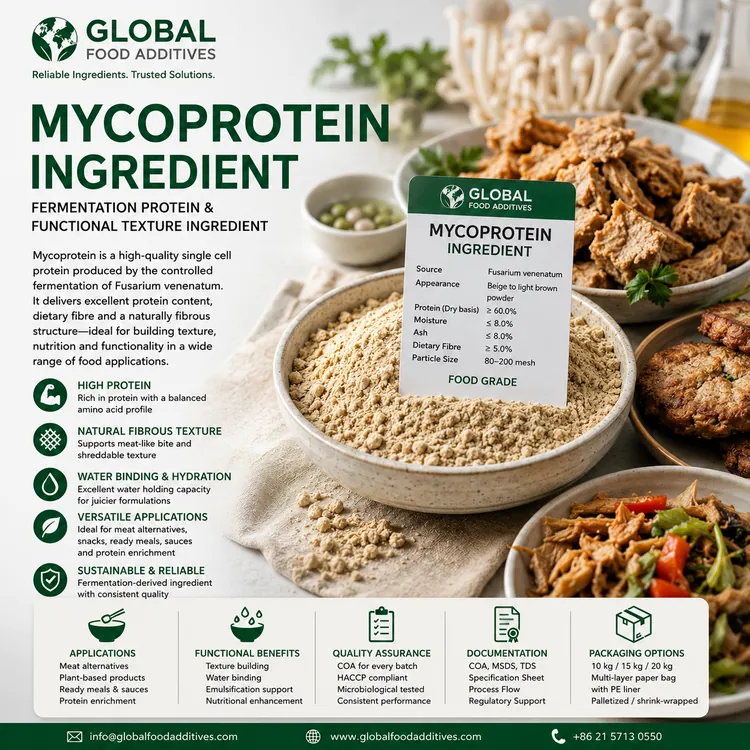
Product identity
| Product | Mycoprotein Ingredient |
|---|---|
| Ingredient family | Fermentation-derived fungal biomass / mycelial protein |
| Category | Proteins, Texturizers & Functional Ingredients |
| Function | Functional protein, fibre or texture-building ingredient |
| E / INS number | Confirm by destination market, organism, strain, process and supplier documentation |
| CAS / identity | Supplier-specific fungal protein ingredient; identity depends on organism and production process |
| Typical form | Powder, flake, minced texture, hydrated ingredient, frozen biomass, textured granule or application-ready blend |
| Key review areas | Protein content, fibre profile, moisture, particle size, hydration, microbiology, allergen status, labelling and regulatory clearance |
Application fit
Potential industrial use areas may include:
- Plant-based meat and seafood analogues
- Hybrid meat products with animal and non-animal protein
- Bakery fillings, savoury pastries and ready meals
- Dairy alternatives and fermented-style foods
- Nutrition products, high-protein foods and meal components
- Sauces, soups and prepared foods requiring texture or body
Technical overview for manufacturers
Mycoprotein is valued because fungal biomass can contribute protein, dietary fibre and natural microstructure at the same time. Unlike isolated protein powders that mainly increase protein percentage, mycoprotein may also influence bite, chew, water retention, visual fibre formation and finished-product juiciness. For food manufacturers, this makes it useful in applications where texture, nutrition and processing tolerance must be developed together.
The exact performance depends strongly on the producing organism, strain, fermentation method, downstream heat treatment, drying method, particle size, moisture, binder system and any carrier or seasoning system supplied with the product. Buyers should therefore review mycoprotein as a technical ingredient family, not as a single commodity with identical performance across suppliers.
Functionality in food systems
Mycoprotein can be used to support several formulation goals. The most relevant technical benefit depends on whether the buyer needs a dry ingredient, hydrated paste, textured format, frozen block, minced ingredient or complete premix.
- Protein enrichment: helps increase protein contribution in plant-based, flexitarian, nutrition and ready-meal products.
- Fibrous texture design: fungal mycelial structure may support meat-like bite, chew and fibrous visual appearance.
- Water binding: can help manage moisture retention, cooking yield, juiciness and reheating performance when correctly hydrated.
- Fat and emulsion support: may help distribute oil, flavour systems and binders in formulated meat-alternative matrices.
- Clean-label development: can reduce overreliance on multiple hydrocolloids or starches in some applications, depending on formulation design.
- Hybrid formulation: may be blended with meat, poultry, fish, vegetable proteins or dairy components to adjust cost, nutrition, texture and sustainability positioning.
Production and processing considerations
Commercial mycoprotein ingredients are typically produced through controlled fermentation followed by harvesting and downstream processing. Depending on supplier technology, the process may include biomass separation, heat treatment, washing, moisture adjustment, drying, freezing, texturizing, milling, blending or standardization. These steps have a major effect on ingredient quality and manufacturing performance.
Fermentation checkpoints
- Organism and strain identity
- Food-grade fermentation substrate and nutrient source
- Absence of unauthorized processing aids or contaminants
- Control of pH, temperature, aeration and contamination risk
- Traceability of fermentation batch and downstream lot
- Validated process controls for food safety and consistency
Downstream checkpoints
- Heat treatment or stabilization method
- RNA / nucleic acid control where relevant to the supplier specification
- Moisture, water activity and storage stability
- Particle size, fibre length or texture grade
- Drying, freezing or hydrated-pack handling requirements
- Microbiological release criteria and shelf-life basis
Application guidance by industry
Mycoprotein selection should be matched to the finished product format. A powder intended for protein enrichment will not necessarily perform like a fibrous hydrated ingredient designed for meat alternatives and a frozen texture format may require different logistics, formulation and shelf-life validation.
Plant-based and hybrid meat systems
Mycoprotein may be used in burgers, nuggets, sausages, mince, strips, kebab-style products, dumpling fillings and hybrid meat blends. Development work should focus on hydration, particle alignment, binding system, fat distribution, thermal stability and flavour masking.
- Check compatibility with methylcellulose, starches, fibres, gums, proteins and oil systems.
- Evaluate bite, springiness, chew, fibrous appearance and cooking yield.
- Confirm whether the product is suitable for vegan, vegetarian, halal or kosher positioning.
- Validate freeze-thaw stability, pan-frying, oven heating, steaming or retort conditions.
Bakery, ready meals and savoury fillings
In bakery fillings, ready meals and prepared foods, mycoprotein may contribute body, protein and water management. It can be reviewed in pies, pastries, lasagne, pasta fillings, sauces, soups, frozen meals and meal kits.
- Review water release during baking, reheating or freeze-thaw cycles.
- Check flavour carry, spice absorption and colour development.
- Validate holding stability in chilled, frozen or ambient systems.
- Confirm finished-product nutrition values and label declaration.
Dairy alternatives and fermented-style foods
Some mycoprotein formats may be considered for creamy, fermented-style or high-protein non-dairy products, depending on sensory profile, particle size and process tolerance. The ingredient must be evaluated for mouthfeel, sedimentation, acidity tolerance and compatibility with cultures or flavour systems.
- Check pH tolerance and viscosity impact.
- Review smoothness, graininess and suspension stability.
- Confirm allergen and vegan suitability.
- Validate shelf-life, phase separation and microbial stability.
Nutrition and high-protein products
For nutrition products, the key purchasing questions are protein quality, digestibility basis, fibre contribution, amino acid profile, taste, dispersibility and regulatory claim support. Finished-product claims should be supported by market-specific nutrition rules.
- Request protein, fibre, fat, carbohydrate, ash and sodium values.
- Request amino acid profile and digestibility information where available.
- Confirm suitability for bars, powders, meal bases or ready-to-eat formats.
- Check flavour impact and processing compatibility.
Formulation and process-control notes
Mycoprotein can behave differently from soy protein, pea protein, wheat gluten, starches and hydrocolloids. Pilot trials should be designed around ingredient hydration, shear sensitivity, heat treatment, flavour loading, moisture migration and final texture after cooling or storage.
- Hydration: establish water addition, mixing time, temperature and rest time before scaling production.
- Shear control: excessive shear may damage desired texture, while insufficient mixing may cause uneven dispersion.
- Binder system: test with starch, methylcellulose, alginate, gums, egg, dairy proteins, wheat gluten or other binders as relevant.
- Thermal processing: validate frying, baking, steaming, retort, pasteurization, extrusion or reheating performance.
- Flavour design: fungal, cereal, savoury or fermentation notes may require flavour balancing depending on the grade.
- Colour management: confirm compatibility with colours, browning systems, spice blends and finished-product appearance targets.
- Moisture migration: evaluate syneresis, purge, freeze-thaw stability and water activity in the finished food.
Specification checkpoints before purchasing
For industrial purchasing, mycoprotein should be evaluated using a complete specification package. The best option is not simply the lowest price per kilogram; it is the ingredient that meets regulatory, functional, sensory, nutritional and logistics requirements for the buyer’s product and market.
Core quality parameters
- Protein content and analytical method
- Moisture, water activity and shelf-life basis
- Dietary fibre and carbohydrate profile
- Fat, ash, sodium and full nutritional declaration
- Amino acid profile and digestibility data where available
- Particle size, texture grade or fibre structure
- Hydration ratio and water-binding behaviour
- Microbiological limits and pathogen absence criteria
- Heavy metals, contaminants and mycotoxin declarations
Commercial and compliance checks
- Organism, strain and manufacturing-process identity
- Food-grade and intended-use statement
- Regulatory status by destination country
- Allergen, GMO, vegan and vegetarian declarations
- Halal, kosher or other certification if required
- Country of origin and manufacturing site information
- Packaging size, pallet format and logistics temperature
- Minimum order quantity, lead time and available shelf life
Regulatory and labelling considerations
Mycoprotein is not automatically covered by one universal additive number or one global approval route. Depending on the country, it may be reviewed as a food ingredient, alternative protein, novel food, fermentation-derived biomass, processing-related ingredient or supplier-specific approved material. The regulatory conclusion can depend on the fungal species, strain, production substrate, downstream process, composition, use level and intended food category.
Before commercial use, buyers should confirm whether the ingredient is permitted in the destination market, how it must be declared on the label, whether novel food or GRAS-type documentation is required, whether nutrition or protein claims are allowed and whether allergen, fungal-source or vegetarian/vegan statements need special wording.
Food safety and QA validation
A complete QA review is essential because mycoprotein is a fermentation-derived macro-ingredient. Buyers should evaluate both the ingredient and the finished-food system. Supplier approval should include hazard assessment, traceability, processing controls and batch-release documentation.
- Microbiology: request limits for total plate count, yeast and mould, coliforms, Enterobacteriaceae, Salmonella, Listeria and other relevant organisms.
- Contaminants: request heavy metal, mycotoxin, pesticide, residual solvent or process-contaminant declarations as relevant to the production route.
- Allergen review: confirm fungal-source declaration, cross-contact risks, gluten, soy, milk, egg, sesame, nuts and other regulated allergens.
- GMO and strain control: request GMO status, strain identity and production-organism information according to customer requirements.
- Stability: validate shelf life under actual storage, transport and processing conditions.
- Traceability: ensure lot coding, batch record access, recall procedure and certificate linkage are suitable for industrial customers.
- Sensory safety: check off-notes, colour drift, rancidity, fermentation notes and texture changes during storage.
Industrial trial and scale-up plan
Successful implementation usually requires a structured trial process. Bench-top success does not always transfer directly to industrial equipment, especially in high-shear mixers, extrusion lines, forming lines, fryers, retorts, chilled ready-meal systems or frozen distribution.
- Document screening: review specification, regulatory status, composition, allergen declarations and storage requirements.
- Bench formulation: test hydration, flavour impact, colour, binder compatibility and target inclusion rate.
- Pilot production: run the ingredient through the intended mixing, forming, cooking, cooling and packing process.
- Analytical testing: confirm protein, moisture, water activity, microbiology, nutrition values and any market-specific limits.
- Shelf-life study: test chilled, frozen or ambient stability under realistic distribution conditions.
- Sensory review: assess bite, chew, juiciness, flavour, aftertaste, appearance and reheating performance.
- Commercial approval: finalize specification, label declaration, supplier approval, pricing, MOQ and lead time.
Storage, handling and logistics
Storage conditions depend on whether the mycoprotein is supplied dry, hydrated, chilled, frozen or as a formulated blend. Dry powders normally require moisture protection and controlled warehouse conditions. Hydrated or frozen formats may require refrigerated or frozen logistics, shorter shelf life and stricter hygiene controls after opening.
Packaging options to confirm
- Net weight per carton, bag, pail, drum or frozen block
- Inner liner, oxygen barrier and moisture protection
- Chilled, frozen or ambient storage requirement
- Batch code, production date and expiry format
- Pallet configuration and container loading data
- Label language and export marking requirements
Purchasing information to provide
- Target product application and process type
- Preferred form: powder, flake, textured, hydrated or frozen
- Required protein content or reference specification
- First order quantity and annual volume estimate
- Destination country and delivery term
- Required certifications and supplier approval documents
Documents to request
The document package should be agreed before purchase, especially for regulated markets, major food manufacturers, private-label customers and export projects.
- Product specification or technical data sheet
- Certificate of analysis for available batch or lot
- Safety data sheet where applicable
- Food-grade, intended-use and regulatory compliance statement
- Organism, strain and manufacturing-process identity statement where available
- Full nutritional profile, amino acid profile and fibre declaration where available
- Microbiological specification and pathogen absence statement
- Heavy metal, contaminant and mycotoxin declarations
- Allergen, GMO, vegan, vegetarian, halal and kosher declarations where required
- Origin, manufacturer, shelf-life and storage information
- Label draft, packaging details and pallet configuration
- Market-specific declarations required by the destination country
How to request this product
Send the product name, target grade or reference specification, intended application, desired physical form, quantity, destination country, packaging preference, delivery term, expected shipment date and required documents. If you already purchase Mycoprotein Ingredient, attach or describe your current specification, label, certificate of analysis or benchmark sample so supplier options can be compared more accurately.
Useful answers
What is Mycoprotein Ingredient used for in food manufacturing?
Mycoprotein Ingredient is typically discussed for protein enrichment, texture design, water binding, fibre contribution, gelation support, emulsification support, juiciness and clean-label formulation. Exact suitability depends on grade, application, process, regulations and supplier documents.
Is Mycoprotein Ingredient an additive or a food ingredient?
It is usually reviewed as a food ingredient or alternative protein rather than a simple additive with one universal E-number. The correct classification depends on the destination market, organism, strain, manufacturing process, composition and finished-food application.
Which applications commonly review Mycoprotein Ingredient?
Common applications include plant-based meat analogues, hybrid meat products, bakery fillings, ready meals, dairy alternatives, savoury sauces, nutrition products and other foods requiring protein plus texture functionality.
What quality parameters should be checked?
Buyers should check protein content, moisture, water activity, fibre, fat, ash, amino acid profile, microbiological limits, contaminant declarations, allergen status, GMO status, hydration behaviour, particle size, sensory profile and shelf-life basis.
Can Global Food Additives source Mycoprotein Ingredient?
Global Food Additives can review sourcing options for Mycoprotein Ingredient according to target specification, application, quantity, destination, packaging, required certifications and documentation requirements.
Which documents should be requested?
Buyers commonly request a technical data sheet or specification, certificate of analysis, safety data sheet where applicable, origin statement, shelf-life information, label and packaging details, allergen and GMO declarations, microbiological limits, contaminant declarations and market-specific compliance documents.
Is Mycoprotein Ingredient permitted in every country?
No. Food ingredient permission depends on destination-market rules, food category, organism or strain history, process, use level, claims, label requirements and buyer responsibility. Regulatory status should be verified before commercial use.
How should Mycoprotein Ingredient be validated?
Validation should include document review, bench formulation, pilot production, hydration testing, texture and sensory evaluation, microbiological testing, shelf-life study, nutrition verification, allergen review and final label approval.
Tell us which food additive or ingredient you need.
Send product names, target specifications, quantity, destination country, packaging preference, delivery term and document requirements. Our team will review your inquiry and respond from orders@foodgradeadditives.com.
Your message has been received. You will be redirected to the home page.