
Octyl Gallate E311
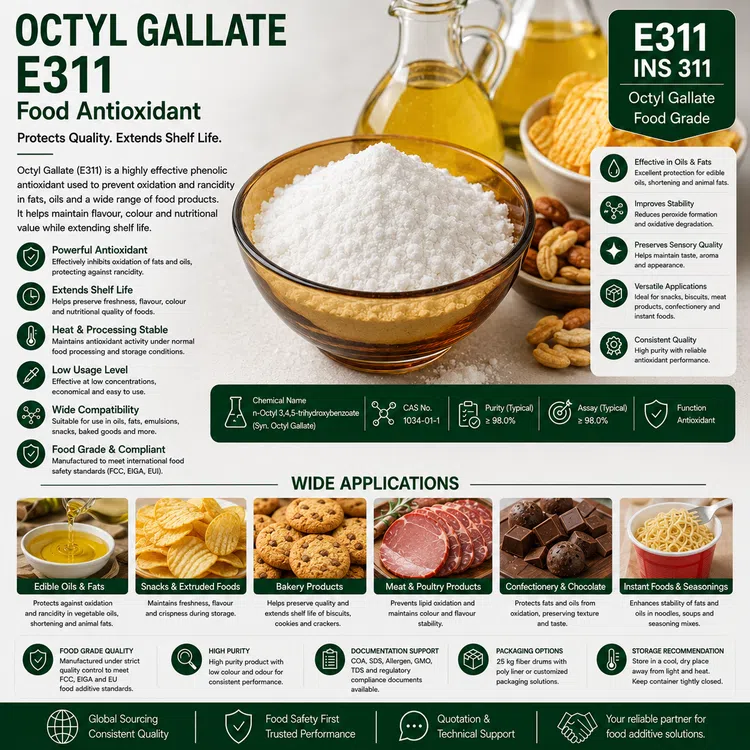
Octyl Gallate is a food-grade antioxidant used where permitted to help protect fats, oils, lipid-containing ingredients, colours, flavours, vitamins and sensitive finished products from oxidative deterioration. This page is prepared as an industrial sourcing and specification-review guide for food manufacturers, distributors and procurement teams evaluating Octyl Gallate E311 for oxidation control, shelf-life support and technical document collection.
Product identity
| Product | Octyl Gallate |
|---|---|
| Common names | Octyl Gallate E311, INS 311, gallic acid octyl ester, octyl 3,4,5-trihydroxybenzoate |
| Category | Antioxidants & Oxidation Control |
| Function | Antioxidant / oxidation-control ingredient |
| E / INS number | E311 / INS 311 |
| CAS / identity | 1034-01-1 |
| Chemical type | Ester of gallic acid and octyl alcohol |
| Molecular formula | C15H22O5 |
| Typical form | Powder, crystalline powder, oil-dispersible grade or liquid antioxidant blend |
| Primary technical role | Protection of fat phases and lipid-soluble components from oxidation, rancidity and off-flavour development |
Application fit
Potential use areas may include:
- Edible oils and specialty fats
- Snack seasonings and lipid-containing snack systems
- Meat systems, rendered fats and processed fat phases
- Bakery fats, margarines, shortenings and fillings
- Flavour preparations, colour preparations and vitamin premixes
- Nut products, nut pastes and fat-rich spreads
- Oxidation-sensitive dry blends where a fat-soluble antioxidant is permitted
Industrial function and antioxidant mechanism
Octyl Gallate belongs to the gallate antioxidant family. In practical food systems, its function is to slow oxidative chain reactions that can damage fats, oils, flavours, colours and vitamins. Oxidation is accelerated by oxygen, heat, light, metal ions, high surface area, poor packaging barrier, repeated frying cycles, long storage and insufficient process control. Octyl Gallate is reviewed when the manufacturer needs an antioxidant that works primarily in the lipid phase and can be blended into oils, fats or oil-based ingredient systems.
Where Octyl Gallate adds value
Fats and oils
Octyl Gallate may be evaluated for oils, shortenings, bakery fats, frying fats and specialty lipid systems where oxidative rancidity, peroxide formation and off-flavour development are critical quality risks.
- Helps protect unsaturated lipid fractions where permitted
- Can support longer storage stability in suitable oil systems
- Should be tested with actual oil type and packaging format
- Often reviewed with peroxide value, anisidine value and sensory data
Snacks and dry systems
Snack products, seasonings and dry blends may contain surface oils or fat-based flavour carriers. Oxidation control is important because large surface area and oxygen exposure can accelerate stale notes.
- Relevant for oil-coated snacks and seasoning systems
- Useful where fat-based flavour carriers require stabilization
- Must be compatible with salt, spices, powders and packaging film
- Residual oxygen and pack leakage should be controlled
Meat and processed fat systems
In selected meat systems and rendered fat applications, antioxidants may help reduce lipid oxidation, warmed-over flavour and quality loss during chilled or frozen storage. Use must be verified for the food category and local regulation.
- Relevant for fat-containing formulations and cooked meat systems
- Should be evaluated with salt, nitrite, phosphates and spice systems
- Requires sensory, TBARS or other oxidation monitoring where applicable
- Does not replace cold-chain control or hygienic production
Flavours, colours and vitamins
Some flavour oils, natural colours and fat-soluble vitamins are sensitive to oxidation. Octyl Gallate may be considered as part of a stabilizing system if it is allowed in the target market and compatible with the carrier.
- Useful for oil-based flavour and colour preparations
- May support vitamin stability in premixes or oil carriers
- Compatibility with carriers and emulsifiers must be checked
- Documentation should clarify whether the additive carries through to finished food
Application guidance by food system
| Food system | Technical objective | Key evaluation points |
|---|---|---|
| Edible oils and frying fats | Delay peroxide formation, rancidity and oxidative off-notes | Oil type, fatty acid profile, initial peroxide value, heat exposure, fryer turnover, metal traces and packaging oxygen barrier |
| Bakery fats and shortenings | Protect fat phase during storage and processing | Melting profile, processing temperature, dough interaction, flavour neutrality, label rules and shelf-life target |
| Snack products | Reduce stale notes and fat oxidation in oil-coated products | Surface oil level, seasoning compatibility, water activity, residual oxygen, film barrier and distribution temperature |
| Nut pastes and spreads | Protect high-fat matrices against rancidity and flavour deterioration | Roasting conditions, particle size, metal contamination, headspace oxygen, oil separation and sensory shelf life |
| Meat systems | Control lipid oxidation and warmed-over flavour where permitted | Fat level, salt, nitrite, spice system, cooking temperature, packaging atmosphere and chilled/frozen storage |
| Flavour and colour preparations | Protect oxidation-sensitive aroma compounds, pigments and carrier oils | Carrier type, solubility, emulsifier compatibility, light exposure, oxygen level and carry-over declaration |
| Vitamin premixes | Support stability of fat-soluble vitamins in suitable carrier systems | Carrier oil, powder carrier, humidity, mineral interactions, packaging barrier and storage temperature |
Formulation and process considerations
Octyl Gallate is normally evaluated as a low-dose antioxidant. For best performance, it must be uniformly dispersed in the fat phase or suitable carrier system. Poor dispersion can cause inconsistent protection, localized over-dosing, specking, sedimentation or weak shelf-life results. Food manufacturers should validate the ingredient in the actual process rather than relying only on supplier literature.
Solubility and dispersion
Octyl Gallate is more relevant to lipid-containing systems than water-based systems. The buyer should confirm whether the offered grade is a pure powder, oil-dispersible powder, pre-dispersed solution or antioxidant blend.
- Check oil solubility or dispersibility in the target carrier
- Confirm mixing temperature and mixing time
- Validate absence of visible particles or sediment
- Review compatibility with emulsifiers and carriers
Synergy and antioxidant systems
Octyl Gallate may be reviewed alongside other antioxidants or synergists depending on local permissions and product design. Citric acid, phosphates, tocopherols, ascorbyl palmitate, BHA, BHT or TBHQ may be part of comparison trials where permitted.
- Compare single antioxidant versus blend performance
- Evaluate metal chelation and oxygen control together
- Check cumulative additive limits and label impact
- Confirm all ingredients are permitted in the finished food
Packaging interaction
Antioxidant use should be paired with suitable packaging. Oxygen barrier, headspace control, nitrogen flushing, light protection and seal integrity can strongly influence the result.
- Measure residual oxygen in the finished pack
- Check film oxygen transmission rate and light barrier
- Control seal leakage and pinhole risk
- Validate shelf life under real distribution conditions
Quality monitoring
Oxidation control should be confirmed through analytical and sensory testing. Typical programs compare treated and untreated controls across accelerated and real-time storage.
- Peroxide value and anisidine value
- TBARS or other matrix-specific oxidation markers
- Sensory testing for rancid, cardboard or stale notes
- Colour, aroma, vitamin or flavour retention where relevant
Specification parameters to request
A complete Octyl Gallate quotation should be supported by a clear technical specification. Buyers should not compare suppliers using price only; assay, impurity limits, documentation, physical form, regulatory status and packaging quality can be equally important for industrial approval.
| Parameter | Why it matters |
|---|---|
| Assay / purity | Confirms active content and allows accurate dosage calculation in the fat phase or finished product. |
| Identity | May include IR, HPLC, melting range or other identity tests depending on supplier specification. |
| Appearance | White to off-white powder or crystalline powder should be checked for discoloration, foreign matter and caking. |
| Melting range | Useful for identity and quality comparison between lots or suppliers. |
| Loss on drying / moisture | Important for storage stability, flowability and consistent weighing. |
| Residue on ignition / ash | Indicates inorganic residue and supports supplier quality comparison. |
| Heavy metals | Relevant for regulatory compliance, customer specifications and food safety approval. |
| Residual solvents | Important when manufacturing process or customer standards require solvent control. |
| Microbiology | May be requested for food-grade approval, especially where the antioxidant is used in sensitive premixes or low-heat processes. |
| Particle size | Affects handling, dusting, dispersion and blending uniformity. |
| Solubility / dispersibility | Critical for oils, fats, flavour carriers and antioxidant blends. |
| Regulatory declaration | Should confirm E311 / INS 311 status, intended food-grade use and suitability for the destination market where available. |
Technical purchasing notes
When reviewing Octyl Gallate, compare the supplier specification against the intended food application, process conditions, target function, label expectations and local rules. For industrial purchasing, the most useful inquiry normally includes target grade, assay or active content, physical form, solubility requirement, packaging size, quantity, destination and document requirements.
Regulatory and label review
Octyl Gallate may be identified as Octyl Gallate, E311 or INS 311 depending on the applicable regulatory system and label format. However, an E number or INS number does not automatically mean the additive is permitted for every food category or every country. Buyers should confirm whether Octyl Gallate is permitted in the destination market, whether maximum use levels are calculated on total food weight or fat content, whether carry-over rules apply and whether the label must declare the antioxidant by name, function or number.
Regulatory checks
- Destination-country food additive status
- Approved food categories and restrictions
- Maximum permitted levels and calculation basis
- Carry-over status from flavours, colours or premixes
- Customer-specific restricted additive lists
Label and claim checks
- Correct additive name or number declaration
- Antioxidant function declaration where required
- Clean-label or natural-positioning impact
- Halal, kosher, vegan or vegetarian requirements
- Country-language and import-label requirements
Handling, storage and safety
Octyl Gallate should be handled as a fine food additive powder unless supplied in a liquid or oil-dispersed format. Store in tightly closed original packaging, protected from heat, moisture, direct sunlight, strong odors and incompatible materials. Production areas should control dust, prevent cross-contamination and follow the supplier safety data sheet. Personnel should use appropriate personal protective equipment according to site risk assessment and SDS guidance.
Incoming quality control
Receiving checks
- Verify product name, E number, batch number and net weight
- Check packaging integrity and tamper evidence
- Compare certificate of analysis with purchase specification
- Confirm shelf life and recommended storage conditions
- Inspect powder appearance for discoloration, caking or foreign matter
Laboratory checks
- Assay or active content confirmation where required
- Moisture or loss on drying
- Melting range or identity confirmation
- Heavy metals and residual solvents where specified
- Application trial in the buyer's fat or product matrix
Application trial checks
- Dispersibility in the selected oil, fat or carrier
- Comparison against untreated control
- Accelerated oxidation testing
- Real-time shelf-life confirmation
- Sensory review for off-flavour or bitterness risk
Release documentation
- Approved supplier status
- Lot-specific certificate of analysis
- Food-grade declaration
- Regulatory and allergen documentation
- Traceability and retention sample records
Documents to request
Buyers should request a complete document package before approving a new Octyl Gallate supplier. Documentation requirements vary by country, customer audit standard and product category, but the following documents are commonly requested:
- Product specification or technical data sheet
- Certificate of analysis for available batch or lot
- Safety data sheet
- Food-grade declaration or food additive compliance statement
- E311 / INS 311 declaration where applicable
- Origin, manufacturer and production-site information
- Allergen statement
- GMO statement or non-GMO declaration if required
- Halal, kosher, vegan or vegetarian statement where required
- Heavy metals and residual solvent declaration
- Microbiological statement where applicable
- Shelf-life and storage information
- Label draft, packaging details and pallet configuration
- Market-specific declarations required by the destination country
Packaging and logistics
Octyl Gallate may be supplied in small fiber drums, cartons, bags, foil-lined packs, plastic containers, or formulated liquid packaging depending on supplier and grade. Packaging selection should protect the antioxidant from moisture, contamination and light exposure while supporting accurate weighing and safe plant handling. For export shipments, buyers should confirm net weight, gross weight, HS code, pallet configuration, container conditions, labeling language, shelf-life remaining at dispatch and any transport classification stated in the SDS.
| Packaging item | What to confirm |
|---|---|
| Primary pack | Bag, liner, bottle, drum or container material suitable for food-grade antioxidant storage. |
| Net weight | Common commercial sizes may vary by supplier; confirm whether the buyer needs lab packs, cartons, drums or pallet quantities. |
| Moisture protection | Important for powder flow, appearance, shelf life and easy dosing in production. |
| Light protection | Recommended for quality preservation where the grade is sensitive to prolonged light exposure. |
| Batch coding | Each unit should show product name, lot number, net weight, manufacturer or supplier reference and expiry or retest date. |
| Palletization | Confirm pallet dimensions, cartons or drums per pallet, stretch wrapping, container loading and export label requirements. |
Commercial comparison with other antioxidants
Octyl Gallate is usually compared with other oxidation-control options such as propyl gallate, dodecyl gallate, tocopherols, ascorbyl palmitate, BHA, BHT, TBHQ, rosemary extract, citric acid and metal-chelating systems. The correct choice depends on the food category, fat type, permitted use level, label strategy, solubility, heat exposure, flavour neutrality, cost-in-use and customer acceptance.
| Alternative or complement | Reason to compare | Buyer note |
|---|---|---|
| Propyl gallate | Another gallate antioxidant with different solubility and use profile | Compare regulatory status, dosage basis, cost-in-use and application performance. |
| Dodecyl gallate | Longer-chain gallate antioxidant | May differ in lipid compatibility and market approval status. |
| Tocopherols | Often selected for natural-origin or vitamin E positioning | Performance and cost vary by concentration, isomer profile and oil type. |
| Ascorbyl palmitate | Fat-soluble ascorbate antioxidant | Often reviewed in combination with tocopherols or other systems. |
| BHA / BHT / TBHQ | Strong synthetic antioxidants for selected food systems | Permitted food categories, label acceptance and regional rules must be checked carefully. |
| Rosemary extract | Alternative antioxidant system for some label strategies | May bring flavour, colour or cost differences and requires application testing. |
How to request this product
Send the product name, target grade or reference specification, required assay, quantity, destination country, packaging preference, expected shipment date and required documents. If you already purchase Octyl Gallate, attach or describe your existing specification, label, certificate of analysis, grade type, current dosage and application so supplier options can be compared more accurately.
For R&D and QA teams
- Target food category and application matrix
- Oil or fat type and fat percentage
- Current antioxidant system or benchmark
- Target shelf life and oxidation test method
- Processing temperature, packaging format and storage conditions
- Required documents, claims and label wording
For purchasing teams
- Annual, monthly or trial quantity
- Preferred pack size and pallet configuration
- Destination country, port and delivery term
- Required certifications and compliance statements
- Target lead time, shipment schedule and price basis
- Any supplier approval or audit requirements
Useful answers
What is Octyl Gallate used for in food manufacturing?
Octyl Gallate is typically discussed for protection of fats, oils, colours, flavours, vitamins and oxidation-sensitive finished products. Exact suitability depends on grade, application, process, regulations and supplier documents.
How does Octyl Gallate help shelf life?
It helps slow lipid oxidation reactions that can cause rancidity, stale notes, colour loss and flavour deterioration. It should be validated through peroxide value, anisidine value, sensory testing, accelerated storage and real-time shelf-life studies.
Can Octyl Gallate be used in water-based products?
Octyl Gallate is generally more relevant to fat-containing or oil-carrier systems than purely water-based systems. For beverages or emulsions, solubility, dispersion, carrier selection and regulatory permission must be reviewed carefully.
Which documents should be requested?
Buyers commonly request a technical data sheet or specification, certificate of analysis, safety data sheet, food-grade declaration, E311 or INS 311 declaration, origin statement, shelf-life information, label draft, packaging details and market-specific declarations.
Is Octyl Gallate permitted in every country?
No. Food additive use depends on destination-market rules, food category, maximum use level, carry-over status, label requirements and buyer responsibility. Always verify local compliance before import or commercial use.
What should be included in a quotation request?
Include the target grade, assay, application, fat or oil type, quantity, destination, packaging preference, delivery term, required documents and any current specification or certificate of analysis used for comparison.
Can Global Food Additives source Octyl Gallate?
Global Food Additives can review sourcing options for Octyl Gallate according to target specification, quantity, destination, packaging and required documentation.
Can Octyl Gallate replace another antioxidant directly?
Not automatically. Replacement should be validated through lab trials, pilot production, sensory testing, oxidation measurements, label review and local regulatory confirmation. Dosage, solubility and food-category permissions may differ from other antioxidants.
Tell us which food additive or ingredient you need.
Send product names, target specifications, quantity, destination country, packaging preference, delivery term and document requirements. For Octyl Gallate E311, please include application, required assay, fat or oil type, target dosage, regulatory destination and any current antioxidant specification. Our team will review your inquiry and respond from orders@foodgradeadditives.com.
Your message has been received. You will be redirected to the home page.