
Potassium Chloride
Potassium Chloride, commonly identified as KCl, E508 or INS 508, is a food-grade mineral salt used for sodium reduction, salt replacement, potassium contribution, ionic-strength control, brine formulation and mineral balance where permitted.
For industrial manufacturers, Potassium Chloride is most valuable in applications where part of the sodium chloride load must be replaced while preserving saltiness, process functionality and product stability. It is widely evaluated in low-sodium salt blends, processed meat, seafood, sauces, dressings, bakery, dairy systems, beverages, electrolyte products and potassium-enriched formulations.
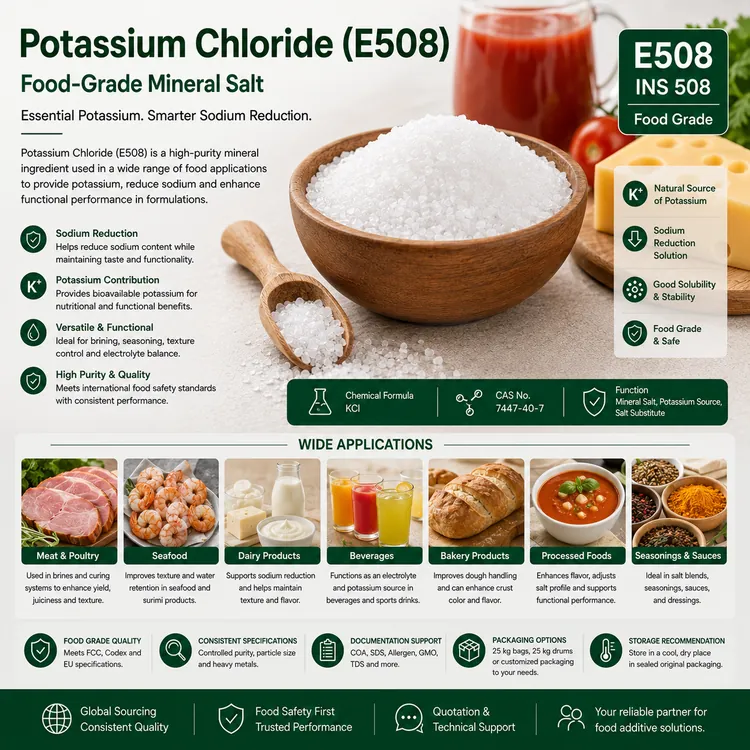
Product identity
| Product name | Potassium Chloride |
|---|---|
| Common names | KCl, potassium salt, muriate of potash |
| Category | Phosphates, Salts & Sequestrants |
| Function | Mineral salt, sodium-reduction ingredient, salt substitute, electrolyte source, brine component and ionic-strength control ingredient where permitted |
| E / INS number | E508 / INS 508 |
| CAS / identity | 7447-40-7 |
| Chemical formula | KCl |
| Approximate molecular weight | 74.55 g/mol |
| Approximate potassium contribution | About 52.4% potassium by mass; final calculation should follow the supplier assay and buyer specification |
| Approximate chloride contribution | About 47.6% chloride by mass; relevant for brine design, electrolyte balance and mineral declaration where applicable |
| Typical physical form | White crystalline powder, fine crystal, granule, compacted particle, salt-like crystal or solution grade depending on supplier and specification |
| Functional character | Water-soluble ionic mineral salt with salty taste, potassium contribution and sodium-replacement functionality |
| Handling focus | Moisture protection, caking control, particle-size consistency, clean handling, dust control and accurate dosing |
Application fit
Potential use areas may include the following when permitted by local food law, finished-product specification and nutrition-labelling rules:
- Low-sodium salt blends and sodium-reduced seasoning systems
- Processed meat, poultry and cured-product brines
- Seafood, surimi, injected products and brine-treated proteins
- Sauces, dressings, condiments, marinades and savoury products
- Bakery, dough systems and savoury bakery mixes
- Dairy systems, processed cheese-style applications and cheese-seasoning systems
- Beverages, electrolyte drinks and mineral-fortified liquid systems
- Nutrition powders, dry premixes and potassium-enriched formulations
Technical purchasing notes
When reviewing Potassium Chloride, compare the supplier specification against the intended food application, sodium-reduction target, potassium contribution, saltiness target, process conditions, particle-size requirement, solubility requirement, sensory expectations, label wording and destination-market rules. A technically complete inquiry should include target grade, assay, potassium content, sodium content, physical form, particle size if relevant, anti-caking treatment if any, packaging size, quantity, destination country, delivery term and document requirements.
Potassium Chloride is often evaluated as part of a complete sodium-reduction system rather than as a one-to-one replacement for sodium chloride. Performance depends on replacement ratio, product pH, water activity, protein system, brine concentration, cooking process, spice profile, flavour maskers, yeast extracts, acids, sweeteners, bitterness blockers and the consumer taste expectation for the finished product.
Industrial formulation considerations
Sodium reduction and salt replacement
Potassium Chloride is commonly used to replace part of sodium chloride in sodium-reduced foods. It can provide salt-like taste and ionic functionality, but higher replacement levels may create bitter, metallic or mineral notes that require formulation balancing.
- Define the target sodium reduction before selecting the replacement ratio.
- Evaluate blends of sodium chloride and potassium chloride rather than assuming full replacement.
- Use sensory trials to evaluate bitterness, metallic notes, saltiness curve and aftertaste.
- Review flavour-balancing tools such as acids, yeast extracts, flavour enhancers, spices or bitterness modifiers where permitted.
- Confirm sodium and potassium declarations from finished-product analytical data when label claims are planned.
Protein functionality and brine design
In meat, poultry, seafood and plant-protein systems, mineral salts influence ionic strength, protein extraction, water binding, texture, cook yield, purge control and flavour. Potassium Chloride may partially replace sodium chloride, but process trials are needed to confirm functionality.
- Check brine concentration, injection level, tumbling time, dwell time and cook schedule.
- Evaluate water-binding performance against sodium chloride control batches.
- Monitor purge, cook loss, texture, sliceability, colour and flavour.
- Review compatibility with phosphates, lactates, acetates, starches, fibres and proteins.
- Confirm whether potassium declaration, salt-substitute declaration or warning language is required.
Specification parameters to compare
| Parameter | Why it matters for food manufacturers |
|---|---|
| Assay / KCl content | Confirms active Potassium Chloride content used for dosage, cost-in-use comparison, release testing and nutrient calculation. |
| Potassium content | Critical for electrolyte positioning, potassium declaration, sodium-reduction systems and nutrition-panel calculations. |
| Sodium content | Important for low-sodium claims, reduced-sodium formulations and comparison with sodium chloride replacement targets. |
| Identity testing | Verifies that the supplied material matches declared Potassium Chloride identity and is not another potassium salt or industrial-grade material. |
| Moisture / loss on drying | Important for flowability, caking risk, salt blends, dry premixes, brine concentration and shelf-life performance. |
| Insoluble matter | Relevant for clear beverages, brines, injection systems, filtration-sensitive products and dosing equipment. |
| Particle size / crystal grade | Affects dissolution rate, dry blending, dusting, segregation, topical adhesion, sensory perception and packaging flow. |
| Anti-caking treatment | Some grades may contain anti-caking agents; this must be compatible with the application, label and destination-market rules. |
| Heavy metals / elemental impurities | Required for food safety review, customer specifications and destination-market compliance. |
| Microbiological profile | Usually low risk for mineral salts, but may still be required for dry blends, nutrition products and sensitive categories. |
| Solubility and clarity | Important for brines, beverages, liquid concentrates, injection systems and reconstituted products. |
| Packaging material | Protects against moisture uptake, caking, contamination, odour pickup and transport damage. |
| Shelf life and storage conditions | Supports inventory planning, QA release and long-term functional performance. |
Food manufacturing applications
Low-sodium salt and seasoning blends
Potassium Chloride is widely evaluated in partial sodium chloride replacement systems. In salt blends, seasoning salts and savoury dry mixes, formulators should optimize KCl ratio, crystal size, flavour masking, flow behaviour, caking control and declaration requirements.
Processed meat and poultry
In meat and poultry products, Potassium Chloride may contribute ionic strength and sodium reduction while influencing protein extraction, water binding, cook yield and flavour. The replacement ratio should be validated through brine trials, tumbling tests, texture analysis and sensory review.
Seafood and surimi systems
Seafood applications require careful salt balance because ionic strength affects protein gelation, texture, water retention and taste. Potassium Chloride should be trialled with the actual seafood matrix, phosphate system, cryoprotectants, brine process and cooking conditions.
Sauces, dressings and condiments
In sauces, dressings, marinades and condiments, KCl may help reduce sodium while maintaining savoury impact. Formulation review should include acid balance, sweetness, bitterness, viscosity, preservative performance, salt perception and aftertaste.
Bakery and dough systems
Salt influences dough strength, yeast activity, fermentation, flavour and shelf life. Potassium Chloride can be evaluated as a partial replacement for sodium chloride, but trials should check dough handling, fermentation rate, crumb texture, browning and final taste.
Dairy and processed cheese-style systems
In dairy systems and processed cheese-style products, potassium salts may affect mineral balance, pH, protein interactions, melt behaviour, texture and taste. KCl should be assessed alongside emulsifying salts, calcium balance, phosphate systems and thermal processing conditions.
Beverages and electrolyte products
Potassium Chloride may be used in electrolyte beverages, hydration drinks, mineral waters and beverage powders where potassium and chloride contribution is desired. Application review should include solubility, clarity, pH, flavour balance, bitterness, mineral taste and label requirements.
Nutrition powders and premixes
For dry nutrition systems, Potassium Chloride can contribute potassium and chloride while supporting electrolyte balance. Premix manufacturers should review particle size, bulk density, segregation risk, hygroscopicity, carrier compatibility and finished-product nutrient verification.
Sodium-reduction design and process guidance
Potassium Chloride is most successful when used as part of a full sodium-reduction strategy. A practical formulation approach normally combines partial NaCl replacement, flavour balancing, process optimization and analytical verification. The best replacement ratio depends on the product matrix and consumer expectation: a ratio that works in a soup may not work in bread, cheese, meat, seasoning powder or electrolyte beverage.
- Start with a sodium chloride control formula and replace sodium chloride gradually in controlled trials.
- Track sodium reduction, potassium increase, water activity, pH, sensory profile and processing performance together.
- Evaluate particle size because crystal size affects dissolution rate, topical salt perception and blending uniformity.
- Use finished-product analysis rather than only theoretical calculations for nutrition labels and claims.
- Check whether potassium-related warning language is required for salt substitutes or specific consumer groups in the destination market.
- Validate shelf-life, caking, colour, flavour stability and microbiological performance after reformulation.
Process engineering and plant handling
Potassium Chloride is generally practical to handle in food plants, but industrial use still requires controls for dust, moisture, caking, dosing accuracy and cross-contamination. Solid grades should be stored in sealed packaging, protected from humidity and transferred through clean handling systems. Solution grades should be checked for concentration, microbial control, packaging compatibility and dosing-pump calibration.
- Use calibrated scales or automated dosing systems where sodium or potassium declaration is critical.
- Control dust during bag opening, tipping, dry blending and premix preparation.
- Protect open bags from humidity to reduce caking and flowability problems.
- Confirm complete dissolution before filtration, injection, filling or thermal processing in liquid systems.
- Validate premix uniformity through sampling and analytical verification.
- Check compatibility with brine tanks, injection needles, spray systems, screw feeders and packaging equipment.
- Apply FIFO or FEFO inventory control and retain batch documentation for traceability.
Quality, safety and compliance checklist
- Confirm food-grade status and the exact standard referenced by the supplier.
- Request assay, potassium content, sodium content, moisture, insoluble matter, particle size and heavy metal limits.
- Check whether the material is untreated KCl or contains anti-caking agents or processing aids.
- Confirm whether the particle grade is suitable for dry blending, topical use, brines, beverage dissolution or premix use.
- Verify destination-market rules for E508 / INS 508, potassium addition, low-sodium claims and label wording.
- Review interaction with sodium chloride, phosphates, lactates, citrates, proteins, starches, fibres, sweeteners and flavour systems.
- Validate final-product sodium and potassium content when either is declared or claimed.
- Assess sensory impact, including saltiness, bitterness, metallic notes, mineral taste and aftertaste.
- Verify lot traceability from manufacturer to exporter, including batch number, production date and expiry or retest date.
- Request allergen, GMO, vegan, halal, kosher and irradiation statements when required by the buyer or destination market.
- Do not approve sodium-reduction claims, potassium claims, electrolyte claims or health-related positioning without local regulatory review.
Documents to request
- Product specification or technical data sheet
- Certificate of analysis for the offered batch or lot
- Safety data sheet where applicable
- Food-grade declaration and intended-use statement
- E508 / INS 508 additive-status statement where available
- Country of origin, manufacturer statement and lot traceability declaration
- Shelf-life, retest period and storage-condition statement
- Assay, potassium-content and sodium-content declaration
- Anti-caking agent declaration if applicable
- Heavy metals, elemental impurities and contaminant declaration
- Microbiological specification for nutrition-sensitive applications
- Allergen, GMO, vegan, halal, kosher and irradiation statements when required
- Packaging specification, net weight, pallet pattern and container-loading information
- Market-specific declarations required by the destination country or buyer quality system
Packaging, handling and storage
Potassium Chloride should be stored in tightly closed original packaging in a dry, clean and well-ventilated warehouse. The material should be protected from moisture, strong odours, contamination and unnecessary exposure to air. Opened packaging should be resealed promptly and identified with the lot number, opening date and remaining quantity.
For export shipments, buyers should confirm net weight, packaging type, inner liner, bag or drum specification, pallet configuration, label language, batch marking, container-loading details, moisture protection and whether the receiving warehouse can maintain dry storage conditions. For low-sodium salt blends, brines and beverage applications, particle consistency, packaging cleanliness and lot traceability are especially important for QA approval.
Quotation and sourcing variables
| Inquiry item | Information to provide |
|---|---|
| Target grade | Food grade, E508 / INS 508, customer specification, salt-substitute grade, beverage grade or nutrition grade. |
| Physical form | Powder, fine crystal, coarse crystal, granule, compacted particle, premix-ready form or solution grade. |
| Assay / mineral basis | Required KCl assay, potassium content, sodium content, chloride basis and impurity limits. |
| Application | Salt blend, meat brine, seafood, sauce, bakery, dairy system, beverage, electrolyte product, nutrition powder or premix. |
| Functional target | Sodium reduction, potassium contribution, salt replacement, brine performance, ionic strength, flavour balance or electrolyte positioning. |
| Process requirements | Target sodium reduction, replacement ratio, particle size, solubility, clarity, brine concentration, thermal process or sensory target. |
| Quantity | Trial quantity, first commercial order, annual demand and shipment frequency. |
| Destination | Country, port, delivery address, Incoterms preference and import documentation requirements. |
| Packaging | Bag, carton, drum, liner, net weight, pallet requirement and container-loading preference. |
| Documentation | COA, TDS, SDS, food-grade declaration, potassium declaration, sodium declaration, origin, shelf life, allergen/GMO/halal/kosher statements and market-specific documents. |
How to request this product
Send the product name, target grade or reference specification, required assay, sodium content, potassium content, physical form, intended application, target sodium reduction or potassium contribution if applicable, quantity, destination country, preferred packaging, delivery term, expected shipment date and documentation checklist. If you already purchase Potassium Chloride, attach your current specification, certificate of analysis, label requirement or formulation target so supplier options can be compared more accurately.
Useful answers
What is Potassium Chloride used for in food manufacturing?
Potassium Chloride is used as a mineral salt, sodium-reduction ingredient, salt substitute, electrolyte source, brine component and ionic-strength control ingredient in permitted food applications such as low-sodium salt blends, meat, seafood, sauces, bakery, dairy systems, beverages and nutrition powders.
Is Potassium Chloride a salt substitute?
Yes. Potassium Chloride can partially replace sodium chloride in low-sodium products. Full replacement is not always practical because higher levels may create bitter, metallic or mineral notes, so replacement ratios should be validated by sensory and process trials.
What is the E number for Potassium Chloride?
Potassium Chloride is commonly identified as E508 or INS 508. Buyers should confirm permitted use, food category restrictions, use level, potassium declaration, sodium-reduction claims and label wording in the destination market.
Why is particle size important?
Particle size affects dissolution rate, topical saltiness, dry-blend uniformity, dusting, segregation, brine preparation and packaging flow. The best grade depends on whether the product is a dry mix, salt blend, brine, beverage or premix.
Can Potassium Chloride support low-sodium claims?
It may support sodium-reduction strategies by replacing part of sodium chloride, but any low-sodium, reduced-sodium, potassium, electrolyte or health-related claim must be confirmed against local regulation and finished-product analytical results.
Can Global Food Additives source Potassium Chloride?
Global Food Additives can review sourcing options according to target specification, food-grade requirement, assay, particle size, quantity, destination, packaging preference and documentation needs.
Which documents should be requested?
Buyers commonly request a technical data sheet, certificate of analysis, safety data sheet, food-grade declaration, potassium-content statement, sodium-content statement, origin statement, shelf-life statement, storage conditions, packaging details, traceability information and market-specific declarations.
Is this product permitted in every country?
No. Food additive use, salt-substitute positioning, potassium levels, sodium-reduction claims, warning statements and labelling depend on destination-market rules, food category, use level and buyer responsibility.
Tell us which food additive or ingredient you need.
Send product names, target specifications, quantity, destination country, packaging preference, delivery term and document requirements. Our team will review your inquiry and respond from orders@foodgradeadditives.com.
Your message has been received. You will be redirected to the home page.