
Potassium Sulphate E515
Potassium Sulphate is a food-grade inorganic mineral salt used in selected food and beverage applications for potassium contribution, mineral balance, ionic-strength adjustment, seasoning support and formulation control. It is especially relevant where a manufacturer needs a potassium-containing salt without sodium chloride contribution, while maintaining a controlled sulphate profile, low impurity level and consistent physical form.
This page is prepared for purchasing teams, R&D formulators, QA departments, importers and industrial food manufacturers who need a structured technical starting point for grade comparison, specification review, documentation collection and quotation requests.
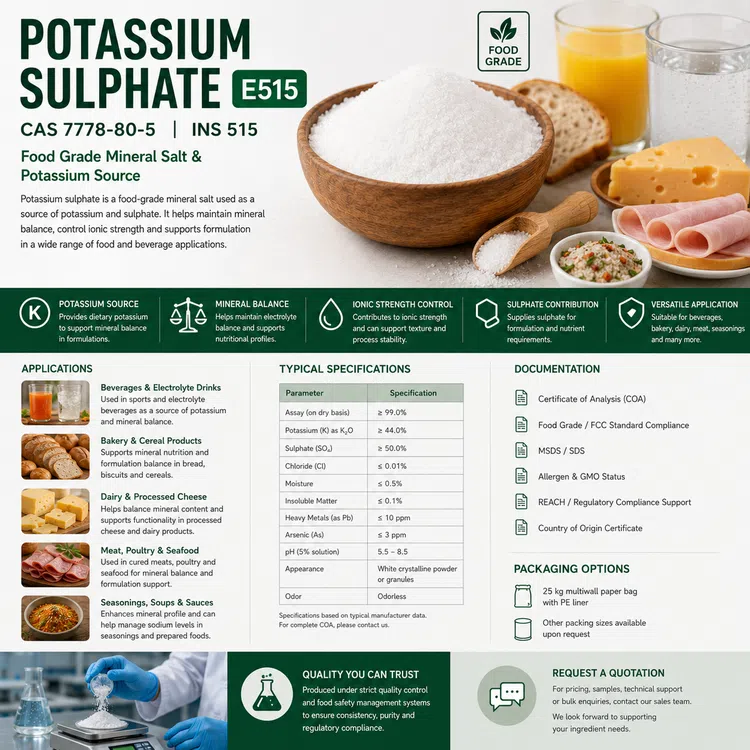
Product identity
| Product | Potassium Sulphate |
|---|---|
| Alternative spelling | Potassium Sulfate |
| Common references | E515, INS 515, dipotassium sulphate, sulphate of potash, K2SO4 |
| Category | Phosphates, Salts & Sequestrants |
| Function | Mineral salt, potassium source, ionic-strength control ingredient, seasoning support and formulation aid |
| E / INS number | E515 / INS 515 |
| CAS / identity | 7778-80-5 |
| Chemical formula | K2SO4 |
| Theoretical potassium content | Approx. 44.9% potassium by molecular weight for pure anhydrous K2SO4 |
| Typical form | White powder, crystal, granule, compacted granule, fine powder or solution grade |
| Main buying issue | Food-grade purity, assay, potassium content, solubility, particle size, impurity limits and destination-market compliance must match the intended application |
Application fit
Potential use areas may include, subject to grade and local regulation:
- Processed cheese and dairy-style mineral systems
- Meat, poultry and seafood formulations
- Beverages, electrolyte systems and beverage powders
- Bakery mixes, dough systems and premixes
- Seasonings, savoury blends and sodium-reduction concepts
- Nutrition products and mineral-fortified formulations
- Fermentation, yeast-nutrient and process-mineral systems
- Food applications requiring controlled potassium and sulphate contribution
Industrial functionality overview
Potassium Sulphate is primarily evaluated as a potassium-containing mineral salt. In food formulation, potassium ions can affect ionic strength, taste balance, protein behaviour, mineral profile, electrolyte positioning and sodium-reduction strategies. Sulphate ions can contribute to the overall mineral salt profile and may influence taste, solubility and compatibility with other minerals.
It is important to distinguish Potassium Sulphate from phosphates, sulphites and bisulphates. Potassium Sulphate does not provide the same emulsifying-salt functionality as phosphate salts, does not provide sulphite preservative activity and is not the same as acidic potassium bisulphate. Commercial approval should therefore be based on the exact salt identity, grade code, assay, intended function and regulatory market.
Functional benefits by application
Beverages and electrolyte systems
In beverages, powdered drinks and electrolyte systems, Potassium Sulphate may be reviewed as a potassium source or mineral-balancing ingredient. It should be evaluated for solubility, taste impact, haze risk, mineral compatibility, final pH and label declaration.
- Can contribute potassium without adding sodium chloride.
- Supports mineral profile adjustment in selected beverage systems.
- Requires solubility and clarity testing at the actual dosage and temperature.
- Should be tested with acids, colours, flavours, sweeteners, preservatives and other minerals.
Seasonings and sodium-reduction systems
In savoury blends and seasoning systems, Potassium Sulphate may be compared with potassium chloride, potassium lactate, potassium citrate and other mineral salts. Its taste contribution, bitterness, saltiness and aftertaste must be evaluated in the finished product.
- Can support potassium-based mineral balancing.
- May be part of sodium-reduction or mineral-salt systems where permitted.
- Requires sensory testing for bitterness, mineral notes and aftertaste.
- Particle size should match other dry-blend components to reduce segregation.
Processed cheese and dairy-style systems
In processed cheese and dairy-style systems, Potassium Sulphate may be reviewed for mineral balance or ionic strength. It should not be assumed to replace phosphate or citrate emulsifying salts, because it does not deliver the same calcium-chelation and casein-emulsification functions.
- Can contribute potassium and sulphate ions to the mineral profile.
- May influence ionic strength and taste balance.
- Not a direct replacement for emulsifying salts such as phosphates or citrates.
- Requires testing with proteins, calcium, fat, stabilizers and heat treatment.
Meat, poultry and seafood products
In meat and seafood formulations, Potassium Sulphate may be considered where a potassium mineral salt is required for formulation balance. It should be evaluated alongside sodium chloride, potassium chloride, phosphates, lactates, acetates and proteins.
- Can contribute to mineral balance in selected formulations.
- May affect ionic strength, flavour and water-phase composition.
- Should not be assumed to deliver phosphate-like water-binding functionality.
- Requires validation for taste, yield, texture, purge and regulatory status.
Bakery mixes and dough systems
In bakery mixes, Potassium Sulphate may be reviewed as a mineral salt or potassium source. Dough systems are sensitive to salt type, ionic strength, yeast performance, gluten behaviour and water absorption, so application trials are necessary.
- Can adjust mineral content in dry bakery formulations.
- May influence yeast activity and dough behaviour at higher use levels.
- Requires testing for dough strength, fermentation, volume and crumb quality.
- Dry-mix particle size and moisture control are important for uniform distribution.
Nutrition and mineral-fortified foods
In nutritional products, meal replacements, powders and fortified foods, Potassium Sulphate may be evaluated as a source of potassium and sulphate. The final selection depends on mineral bioavailability expectations, taste, solubility, claim rules and nutrition-panel requirements.
- Can support potassium contribution in mineral systems.
- Requires nutrition calculation based on assay and potassium content.
- May need masking or balancing if mineral taste is noticeable.
- Regulatory review is required for potassium claims and permitted use.
E515 subtype clarification
In some additive classification systems, E515 may refer to potassium sulphates, including potassium sulphate and potassium bisulphate / potassium hydrogen sulphate. These are not the same material. Potassium sulphate is a neutral mineral salt, while potassium bisulphate is acidic and behaves differently in pH control, taste, solubility and formula calculations.
| Subtype | Typical reference | Industrial review point |
|---|---|---|
| Potassium sulphate | K2SO4, CAS 7778-80-5, often referenced as E515(i) | Reviewed as a potassium mineral salt. Confirm assay, potassium content, sulphate content, solubility and sensory impact. |
| Potassium bisulphate | Potassium hydrogen sulphate, KHSO4, often referenced as E515(ii) | Acidic salt with different pH behaviour. Do not substitute for K2SO4 without formulation approval. |
| Potassium sulphite | E225 sulphite preservative | Different additive family. Provides sulphite chemistry, not sulphate mineral-salt functionality. |
| Potassium phosphate salts | Phosphate salts such as E340 family | Different chelation, buffering and protein functionality. Not equivalent to potassium sulphate. |
Technical grade selection criteria
Food-grade Potassium Sulphate should be selected by exact identity, assay, purity, solubility, particle size, sensory impact, documentation and cost-in-use. A technical or fertilizer-grade material should not be substituted for food use without full food-grade documentation and QA approval.
| Selection factor | Why it matters |
|---|---|
| Assay / purity | Determines active mineral contribution, formulation calculations, cost-in-use and compliance with the approved specification. |
| Potassium content | Important for nutrition panels, electrolyte formulas, potassium claims and restricted-diet product design. |
| Sulphate content | Relevant to mineral balance, impurity review, formula calculations and sensory profile. |
| Solubility | Critical for beverages, liquid premixes, brines, syrups and fast-dissolving systems. |
| pH of solution | Confirms whether the grade behaves as neutral potassium sulphate or an acidic sulphate subtype. |
| Particle size | Affects dissolution speed, dry blending, segregation, dusting, flowability and dosing accuracy. |
| Impurity profile | Chloride, sodium, magnesium, calcium, iron, insoluble matter and heavy metals may affect food-grade approval. |
| Sensory profile | Potassium salts can create bitterness or mineral notes; taste testing is necessary in sodium-reduction products. |
| Source and production route | Mining, purification and crystallization route may affect impurity profile, origin documents and customer acceptance. |
| Regulatory destination | Permission, maximum use level and label wording depend on country, application and final product category. |
Specification points to request
A complete sourcing review should be based on the supplier’s current technical data sheet and batch-specific certificate of analysis. Depending on grade, form and destination market, buyers commonly request the following parameters:
- Product identity: Potassium Sulphate / Potassium Sulfate / E515 / INS 515.
- CAS number, chemical formula and molecular weight.
- Assay or purity, normally expressed on dried basis where applicable.
- Potassium content and sulphate content.
- pH of aqueous solution at specified concentration.
- Solubility and dissolution behaviour at the intended process temperature.
- Appearance, colour, odour and physical form.
- Moisture, loss on drying or volatile matter.
- Chloride, sodium, calcium, magnesium, iron and insoluble matter limits.
- Heavy metals, arsenic, lead, cadmium and mercury according to applicable standard.
- Particle size distribution, bulk density, flowability and dust level for powder grades.
- Microbiological limits where required by customer or application.
- Food-grade declaration, E515 declaration and destination-market compliance statement.
- Shelf-life, storage conditions, packaging type and pallet configuration.
Processing and formulation guidance
Potassium Sulphate performance depends on dissolution, dosage, pH, mineral interactions, water hardness, processing temperature and the complete food matrix. For industrial use, the material should be validated in the final formulation rather than only in water.
- Dissolution: confirm dissolution time at the actual processing temperature and concentration.
- Dry blending: match particle size with other dry ingredients to avoid segregation during transport and filling.
- Mineral balance: account for potassium, sulphate, sodium, calcium, magnesium and chloride from all formulation sources.
- Sensory testing: evaluate bitterness, saltiness, mineral notes and aftertaste at the target dosage.
- Beverages: test for haze, precipitation, sediment and compatibility with acids, colours and flavours.
- Protein systems: validate effects on protein solubility, emulsion behaviour, texture and heat stability.
- Scale-up: confirm that laboratory solubility, mixing and dosing results work in production tanks, powder mixers and filling lines.
Application-specific process controls
Beverage control points
- Target potassium level and nutrition-panel calculation.
- Solubility in concentrate and final beverage.
- pH, acidity and mineral compatibility.
- Haze, sediment and package stability.
- Sensory balance with sweeteners and acids.
Seasoning control points
- Mineral taste and bitterness threshold.
- Particle-size match with salt, spices and flavour powders.
- Flowability, caking and humidity response.
- Sodium-reduction positioning and label wording.
- Blend uniformity after vibration and transport.
Dairy and cheese control points
- Compatibility with milk proteins and calcium salts.
- Interaction with emulsifying salts, stabilizers and pH adjusters.
- Texture, melt, viscosity and heat stability.
- Mineral balance and final taste profile.
- Not a direct replacement for phosphate or citrate emulsifying salts.
Meat and seafood control points
- Ionic strength and salt-system balance.
- Interaction with sodium chloride, potassium chloride, phosphates and proteins.
- Yield, purge, texture and sensory impact.
- Permitted-use and label review in the destination market.
- Cold processing, tumbling, injection or mixing conditions.
Compatibility with other ingredients
Potassium Sulphate should be evaluated inside the complete formulation because salts can affect solubility, taste, protein functionality, hydrocolloid hydration and mineral stability.
Other potassium salts
Potassium chloride, potassium citrate, potassium lactate, potassium phosphate and potassium carbonate provide different flavour, pH and functional effects.
- Compare potassium contribution and taste.
- Review pH and buffering effect.
- Do not substitute without formula testing.
Proteins and dairy minerals
Potassium salts can influence protein solubility, casein behaviour, mineral balance and heat stability in dairy or plant-protein systems.
- Check protein stability and sediment.
- Evaluate heat treatment effects.
- Measure viscosity and mouthfeel.
Hydrocolloids and starches
Ionic strength may influence hydration, viscosity and gel behaviour of gums, pectins, carrageenan, alginate and modified starches.
- Confirm hydration sequence.
- Monitor viscosity and gel strength.
- Check syneresis and phase separation.
Acids and minerals
Acid systems and minerals can affect sulphate solubility and final sensory profile. Use the full formulation for compatibility checks.
- Test with citrates, phosphates and calcium salts.
- Watch for haze or precipitation.
- Measure pH after equilibration.
Quality, compliance and documentation
For international sourcing, documentation quality is critical because Potassium Sulphate may be available in fertilizer, technical, feed, pharmaceutical or food-grade qualities. Global Food Additives can support supplier communication and document collection before purchase and export.
Core documents
- Technical data sheet or product specification.
- Certificate of analysis for the available batch or lot.
- Safety data sheet where applicable.
- Manufacturing origin and country-of-origin statement.
- Shelf-life and recommended storage conditions.
- Packaging, net weight and pallet configuration.
Potassium sulphate documents
- E515 / INS 515 declaration where applicable.
- CAS number and chemical identity statement.
- Food-grade declaration and intended-use statement.
- Assay, potassium content and sulphate content.
- Impurity profile for chloride, sodium, magnesium, calcium and heavy metals.
- Solubility, pH and particle-size data where required.
Customer-standard documents
- Allergen statement.
- GMO status statement where required.
- Halal or kosher certificate if required.
- Vegan or vegetarian suitability statement where applicable.
- Heavy metal and contaminant statement where required.
- Non-fertilizer / food-grade suitability statement where relevant.
Supply-chain review
- Manufacturer identity and approved supplier status.
- Batch coding and lot traceability.
- Food safety certification such as HACCP, ISO 22000, FSSC 22000 or equivalent where available.
- Specification revision control and change notification.
- Lead time, minimum order quantity and sample availability.
- Export documents and import requirements for the destination country.
Storage, handling and packaging considerations
Potassium Sulphate should be stored according to the supplier’s specification in closed original packaging, protected from moisture, contamination, direct sunlight, excessive heat and strong odours. Powder and crystal grades should be handled carefully to maintain flowability and avoid caking.
- Keep bags, cartons, drums or containers sealed when not in use.
- Store in a cool, dry, clean warehouse away from water and non-food chemicals.
- Use first-expiry-first-out stock rotation where shelf-life is specified.
- Protect from humidity, condensation and damaged pallets.
- Use dust-control practices during weighing, transfer and dry blending.
- Inspect incoming goods for caking, odour change, discoloration, contamination, water damage or packaging damage.
- Confirm bag size, carton size, drum size, pallet pattern, container loading quantity and export packaging before shipment.
Technical purchasing notes
When reviewing Potassium Sulphate, compare the supplier specification against the intended food application, process conditions, target function, label expectations and destination-market rules. For industrial purchasing, the most useful inquiry normally includes exact E515 subtype, assay, potassium content, physical form, particle size, packaging size, quantity, destination and document requirements.
Buyers should avoid approving Potassium Sulphate only by product name. A stronger approval process links the exact supplier grade with the intended food category, potassium target, solubility requirement, sensory target, impurity limits, particle size, process conditions and destination-market label requirement.
| Information to include | Example details |
|---|---|
| Target identity | Potassium sulphate / potassium sulfate, E515(i), CAS 7778-80-5, K2SO4 or existing supplier reference. |
| Application | Beverage, electrolyte powder, seasoning, processed cheese, dairy system, meat product, seafood, bakery mix, nutrition product or mineral premix. |
| Target function | Potassium source, mineral balance, ionic-strength adjustment, seasoning support, sodium-reduction support, formulation aid or process-mineral control. |
| Quality target | Assay, potassium content, sulphate content, pH, solubility, low chloride, low sodium, particle size or heavy-metal limit. |
| Physical form | Fine powder, crystal, granule, compacted granule, low-dust grade, solution grade or current specification. |
| Process conditions | Dry blending, dissolution, hot processing, beverage concentrate, protein system, filling process, storage temperature or humidity exposure. |
| Quantity | Sample, trial quantity, bag quantity, drum quantity, pallet quantity, container quantity, monthly demand or annual contract volume. |
| Destination | Country, port, city, delivery term and import-document requirements. |
| Documents | TDS, specification, COA, SDS, E515 declaration, CAS confirmation, food-grade declaration, allergen, GMO, halal, kosher, origin and shelf-life documents. |
Documents to request
- Product specification or technical data sheet.
- Certificate of analysis for available batch or lot.
- Safety data sheet where applicable.
- Food-grade, E515 / INS 515 or regulatory status statement where relevant.
- CAS number, formula and exact subtype declaration.
- Assay, potassium content, sulphate content and pH information.
- Solubility, particle size, bulk density and moisture information.
- Origin, manufacturer, shelf-life and production-route information.
- Allergen, GMO, halal, kosher, vegan or vegetarian statements where required.
- Microbiological, heavy metal and contaminant statements where required.
- Packaging details, net weight, pallet configuration and container loading information.
- Market-specific declarations required by the destination country.
How to request this product
Send the product name, exact subtype, target specification, intended application, target function, potassium-content requirement, physical form, particle-size preference, quantity, destination country, packaging preference, expected shipment date and required documents. If you already purchase Potassium Sulphate, attach or describe your existing specification, label, supplier reference, assay, potassium content, particle size or certificate of analysis so supplier options can be compared more accurately.
Useful technical answers
What is Potassium Sulphate used for in food manufacturing?
Potassium Sulphate is used as a mineral salt, potassium source and formulation aid in selected food and beverage systems. It is commonly reviewed for mineral balance, ionic-strength control, electrolyte formulations, seasoning systems, sodium-reduction concepts, bakery mixes, meat products and dairy-style mineral systems. Exact suitability depends on grade, assay, solubility, sensory impact, application, regulation and supplier documents.
Is Potassium Sulphate the same as Potassium Bisulphate?
No. Potassium sulphate is K2SO4, while potassium bisulphate or potassium hydrogen sulphate is KHSO4. Potassium bisulphate is acidic and behaves differently in pH control, taste and formulation. Buyers should confirm the exact subtype and CAS number.
Can Potassium Sulphate replace phosphate salts?
Usually no. Potassium Sulphate can contribute potassium and sulphate ions, but it does not provide the same calcium-chelation, protein-emulsification or buffering behaviour as phosphate salts. Any replacement should be validated by R&D, QA and regulatory teams.
Which documents should be requested?
Buyers commonly request a technical data sheet, product specification, certificate of analysis, safety data sheet where applicable, E515 / INS 515 declaration, CAS confirmation, food-grade statement, assay, potassium content, sulphate content, impurity profile, allergen statement, GMO statement, halal or kosher certificate, shelf-life information, storage conditions, packaging details and market-specific compliance declarations.
Can Global Food Additives source Potassium Sulphate?
Global Food Additives can review sourcing options for Potassium Sulphate according to target specification, application, potassium content, particle size, quantity, destination, packaging preference, delivery term and required documentation.
Is this product permitted in every country?
No. Food additive use depends on destination-market rules, food category, use level, label requirements, subtype and buyer responsibility. Always confirm local regulatory status before commercial use.
Tell us which Potassium Sulphate grade you need.
Send product name, exact subtype, application, target function, assay, potassium-content requirement, physical form, particle-size preference, specification, quantity, destination country, packaging preference, delivery term and document requirements. Our team will review your inquiry and respond from orders@foodgradeadditives.com.
Your message has been received. You will be redirected to the home page.