
Pregelatinized Starch
Pregelatinized Starch is a food-grade starch ingredient processed to deliver cold-water swelling, rapid hydration, viscosity build, texture improvement, binding, bulking, moisture control and carrier functionality. It is used in industrial food systems where manufacturers need thickening or structure without full cooking in the final process. This page is prepared as a detailed technical sourcing guide for purchasing, R&D, production, QA and regulatory teams.
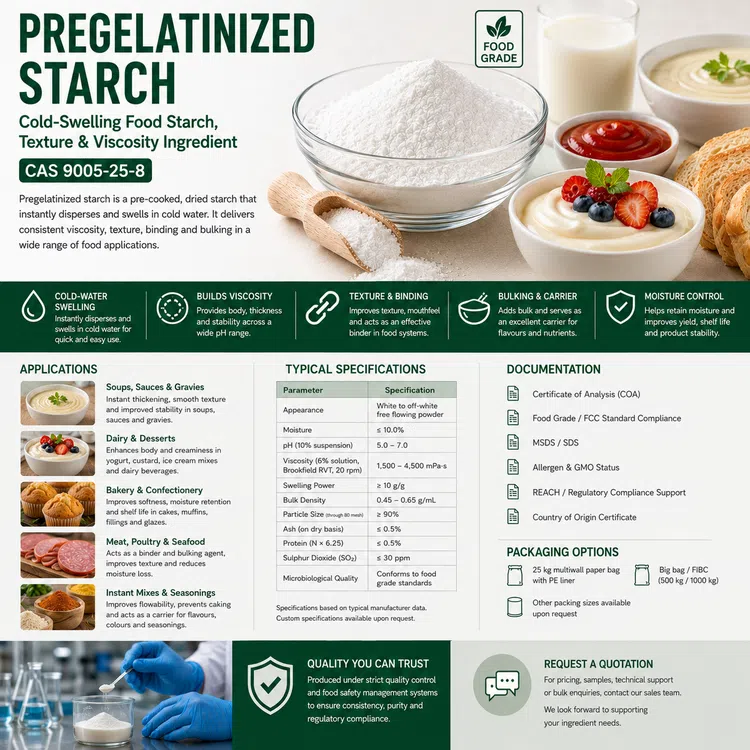
Product identity
| Product | Pregelatinized Starch |
|---|---|
| Common names | Cold-swelling starch; instant starch; pre-cooked starch; pregel starch |
| Category | Modified Starches, Fibres & Bulking Agents |
| Function | Cold-swelling thickener, texture ingredient, binder, bulking agent, carrier and moisture-control ingredient |
| E / INS number | Confirm by destination market, botanical source, modification type and supplier documentation |
| CAS / identity | 9005-25-8 |
| Typical source | Corn, waxy maize, potato, tapioca, rice, wheat or other declared botanical starch source |
| Typical form | Powder, granule, agglomerated powder or instantized grade |
| Functional profile | Cold hydration, viscosity development, water absorption, binding, texture control and process convenience |
| Grade options | Native pregelatinized, physically modified, chemically modified, clean-label, low-viscosity, high-viscosity, agglomerated or application-specific grades |
Application fit
Potential use areas may include food systems where instant viscosity, binding, texture and moisture management are required:
- Instant soups, sauces, gravies, dressings and dry culinary mixes
- Bakery fillings, creams, cake mixes, dough systems and gluten-free formulations
- Meat products, poultry systems, seafood preparations and restructured protein products
- Snack seasonings, coating systems, batters and breading applications
- Dairy desserts, puddings, fruit preparations and spoonable products
- Plant-based foods, meat alternatives, vegan fillings and protein systems
- Carrier systems for flavours, colours, seasonings, enzymes, vitamins and dry blends
Technical overview
Pregelatinized Starch is produced by processing starch with heat, moisture and mechanical energy so that the starch granule structure is partially or fully gelatinized before use by the food manufacturer. This gives the ingredient the ability to hydrate and build viscosity in cold water or low-temperature systems, depending on grade and processing method. Common production technologies may include drum drying, spray cooking, extrusion, roll drying or other controlled pregelatinization systems.
In industrial food production, Pregelatinized Starch is not selected only by botanical source or price. Functional performance depends on the degree of gelatinization, particle size, cold-water swelling, viscosity profile, solubility, water absorption, paste clarity, flavour neutrality, process tolerance, shear resistance, freeze-thaw behaviour and compatibility with salts, sugars, acids, proteins, fats and other hydrocolloids.
Industrial functions
- Cold viscosity: develops body and thickness without requiring full cooking in the final product.
- Water absorption: binds water and helps manage moisture migration in dry, semi-dry and hydrated systems.
- Texture control: contributes creaminess, body, firmness, short texture or spoonable consistency depending on grade.
- Binding: improves cohesion in meat, plant-based, bakery and formed food systems.
- Bulking: provides solids, structure and formulation volume in dry mixes and processed foods.
- Carrier functionality: supports distribution of flavours, colours, seasonings, active ingredients and minor additives.
- Process convenience: reduces cooking time and supports instant, quick-preparation or low-energy processing systems.
Specification review points
Industrial buyers should compare every offered grade against the target application and internal quality standard. Common review parameters include:
- Botanical source and starch type
- Native, physically modified or chemically modified status
- Cold-water viscosity and measurement method
- Degree of gelatinization or cold-water solubility where declared
- Particle size, mesh profile, agglomeration and dispersibility
- Moisture content, water activity and caking risk
- pH, ash, protein, fat and fibre-related parameters where applicable
- Bulk density, flowability and dusting behaviour
- Microbiological limits including total plate count, yeast, mould and pathogens where required
- SO2, heavy metals, pesticide residues or contaminants where required by the buyer
Hydration and processing behaviour
Pregelatinized Starch is valued because it can hydrate quickly, but rapid hydration can also cause lumping if dispersion is poor. In dry mixes, the starch may need to be blended with sugar, salt, maltodextrin, flour, proteins or other dry ingredients to improve distribution before water addition. In liquid systems, agitation speed, powder addition rate, water temperature, solids level and order of addition can strongly influence final viscosity and texture.
Cold-swelling performance should be tested under real manufacturing conditions. A laboratory viscosity value may not fully predict behaviour in a high-solids sauce, acidic fruit filling, salty meat brine, bakery cream, plant-protein matrix or dry seasoning system. Production teams should evaluate hydration time, lump formation, shear stability, holding stability, viscosity after heating, viscosity after cooling and texture after storage.
Process and formulation considerations
- Define whether the starch will be used in cold water, hot water, dry blend, brine, fat-containing system or high-solids matrix.
- Confirm the correct addition order to prevent lumping, fish-eyes or incomplete hydration.
- Measure viscosity at the actual solids level, pH, salt level, temperature and shear history of the product.
- Evaluate compatibility with gums, proteins, emulsifiers, fibres, sugars, acids, salts and preservatives.
- Test freeze-thaw stability, retort tolerance, bake stability or refrigerated shelf-life stability when relevant.
- Check whether the ingredient affects flavour release, colour, opacity, mouthfeel or label declaration.
- Run pilot trials before changing supplier, botanical source, particle size or viscosity grade.
Quality assurance checklist
- Confirm supplier, manufacturer, country of origin and batch traceability.
- Check Certificate of Analysis values against the approved specification.
- Verify botanical source, GMO status, allergen status and gluten relevance where applicable.
- Review microbiological criteria for the target food category.
- Confirm moisture level, caking condition, odour, appearance and packaging integrity at receipt.
- Request change-control notification for source, process, modification type or production-site changes.
Application-specific purchasing guidance
For instant soups, sauces and dry culinary mixes, buyers usually focus on cold or hot preparation viscosity, lump resistance, flavour neutrality, colour, opacity, mouthfeel and tolerance to salt, acid and heat. Agglomerated grades may improve dispersion in instant products, while finer grades may hydrate faster but require stronger dry-blend control.
For bakery and fillings, Pregelatinized Starch may support moisture control, viscosity, bake stability, cream texture and fruit preparation structure. The grade should be tested for syneresis, freeze-thaw behaviour, heat stability, sweetness level, acidity and interaction with pectin, gums, flour, egg, dairy proteins or vegetable fats.
For meat, poultry, seafood and plant-based foods, the key performance targets are water binding, yield improvement, texture, bite, sliceability, purge reduction and compatibility with salt, phosphate, proteins and thermal processing. The correct grade depends on mixing energy, hydration time, cook step, chilled or frozen storage and finished product texture requirements.
For carrier and dry-blend systems, buyers should evaluate flowability, dusting, flavour release, colour carry, hygroscopicity, bulk density, segregation risk and compatibility with active ingredients. Pregelatinized Starch can be useful as a carrier, but the correct particle size and moisture profile are essential for stable dry mixes.
Botanical source and label considerations
Pregelatinized Starch may be derived from corn, waxy maize, potato, tapioca, rice, wheat or other botanical sources. Each source can deliver different viscosity, texture, clarity, flavour, granule behaviour and label implications. Waxy maize may support smooth viscosity and stability in some systems, potato starch may deliver high swelling and body, tapioca starch may provide a neutral profile, and wheat-derived starch may require allergen or gluten-related review.
Buyers should clarify whether the project requires non-GMO, clean-label, gluten-free, allergen-free, halal, kosher, vegan, organic, native-only or modified-starch status. The regulatory and label treatment of starches varies by country and by modification type, so supplier documentation should be reviewed before label finalization.
Compatibility with other ingredients
Pregelatinized Starch is often used alongside gums, fibres, proteins, emulsifiers, maltodextrins, flours, sugars and salts. It can work with xanthan gum, guar gum, cellulose derivatives, carrageenan, pectin, alginate, locust bean gum, proteins and modified starches to create specific viscosity curves, textures and stability profiles. The right combination depends on whether the product requires short texture, elastic texture, creamy mouthfeel, freeze-thaw stability, suspension, gel structure or water binding.
It should not automatically be treated as a direct one-to-one replacement for native starch or chemically modified starch. Native starch usually requires cooking to develop full viscosity, while some chemically modified starches are designed for stronger acid, shear, freeze-thaw or thermal tolerance. The buyer should define the technical function before approving substitution.
Typical physical forms
Pregelatinized Starch is usually supplied as a powder, granule or agglomerated grade. Fine powders may hydrate quickly but can be dustier and more prone to lumping if not dispersed properly. Agglomerated grades may improve wet-out, reduce dust and support easier handling in instant systems. Granular grades may provide better flowability in dry blends and automatic dosing systems.
When requesting a quotation, buyers should specify whether the material will be used in manual addition, automatic powder dosing, dry blending, liquid premix preparation, cold hydration, hot processing or high-shear mixing. This helps identify the correct particle-size profile, viscosity grade and packaging format.
Storage and handling
Store Pregelatinized Starch in original, tightly closed packaging in a clean, dry, cool and well-ventilated warehouse. Protect the product from moisture, condensation, direct sunlight, foreign odours, pests and contamination. Because starch powders may absorb moisture and lose flowability, opened packaging should be resealed immediately after use and handled according to the supplier's recommendations.
Before production release, check the product name, batch number, expiry or retest date, packaging condition, appearance, odour and any signs of caking, wetting, infestation or contamination. Production teams should follow FIFO or FEFO stock rotation and maintain traceability from warehouse receipt to finished product batch.
Packaging and logistics
Packaging depends on supplier, grade and order quantity. Common industrial formats may include multi-wall paper bags with inner liners, polyethylene-lined bags, cartons, fibre drums, big bags or palletized export units. For international shipments, buyers should confirm net weight, gross weight, pallet dimensions, container loading plan, batch coding, label language, storage marks and document requirements before dispatch.
- Small sample packs for laboratory screening and pilot production trials
- Bagged powder or granular grades for regular industrial production
- Fibre drums or cartons for sensitive grades or customer-specific packing
- Big bags for high-volume users with suitable handling and dosing equipment
- Palletized export packing with batch labels, moisture protection and handling marks
Regulatory and compliance notes
Pregelatinized Starch may be treated as a food ingredient, starch ingredient or modified starch depending on its botanical source, processing method, chemical modification status and destination-market rules. Buyers must verify the regulatory status of the offered grade in the destination market and confirm that it matches the final food category, label declaration, customer standard and any retailer-specific requirements.
For export supply, customers may require halal, kosher, vegan, non-GMO, allergen, gluten-free, BSE/TSE, residual sulphur dioxide, heavy metal, microbiological, pesticide, contaminant, origin and food safety declarations. The exact document package should be agreed before order confirmation, especially for retailer-controlled, private-label, infant, gluten-free, organic or clean-label product lines.
Documents to request
- Product specification or technical data sheet
- Certificate of Analysis for the available batch or lot
- Safety Data Sheet where applicable
- Botanical source declaration and country of origin information
- Native, physically modified or chemically modified starch status declaration
- Cold-water viscosity method, concentration, temperature and testing condition details
- Particle size, moisture, pH, ash, bulk density and microbiological specification
- Allergen, gluten, GMO, BSE/TSE, halal, kosher and vegan declarations where required
- SO2, heavy metal, pesticide or contaminant information where applicable
- Shelf-life, storage and handling information
- Label draft, packaging details, pallet configuration and batch traceability information
- Market-specific declarations requested by the destination country or final customer
Commercial sourcing guidance
When reviewing Pregelatinized Starch, compare the supplier specification against the intended food application, process conditions, target viscosity, label expectations and local rules. For industrial purchasing, the most useful inquiry normally includes botanical source, target viscosity, modification status, application, pH range, physical form, packaging size, quantity, destination, Incoterm, delivery schedule and document requirements.
If the product is used in a technical texture or dry-blend system, the buyer should describe the complete application: product category, preparation method, water temperature, mixing method, pH, salt level, sugar level, heat process, desired viscosity, desired texture, storage temperature, packaging format and shelf-life objective. This helps determine whether the correct Pregelatinized Starch grade, native starch, modified starch or hydrocolloid blend should be evaluated.
How to request this product
Send the product name, botanical source, target viscosity, modification status, reference specification, application, pH range, quantity, destination country, packaging preference, expected shipment date and required documents. If you already purchase Pregelatinized Starch, attach or describe your existing specification, label, Certificate of Analysis, viscosity target or approved supplier standard so supplier options can be compared more accurately.
Useful answers
What is Pregelatinized Starch used for in food manufacturing?
Pregelatinized Starch is typically used for cold viscosity, texture, binding, bulking, carrier functionality, moisture control and process stability. It may help with instant thickening, water absorption, dry-mix performance and structure development. Exact suitability depends on grade, botanical source, application, process, dosage, regulations and supplier documents.
Which applications commonly use Pregelatinized Starch?
It may be evaluated in soups, sauces, dressings, dry mixes, bakery products, fillings, meat products, plant-based foods, snacks, dairy desserts, fruit preparations, coating systems and carrier blends where cold-swelling or instant viscosity is technically useful.
Which documents should be requested?
Buyers commonly request a technical data sheet or specification, Certificate of Analysis, Safety Data Sheet where applicable, botanical source declaration, origin statement, shelf-life information, storage guidance, viscosity method, microbiological specification, allergen statement, GMO statement, halal or kosher documents where required, label details and packaging information.
Can Global Food Additives source Pregelatinized Starch?
Global Food Additives can review sourcing options for Pregelatinized Starch according to target specification, botanical source, viscosity grade, application, quantity, destination, packaging and required documentation.
Is this product permitted in every country?
No. Food ingredient or additive status depends on destination-market rules, botanical source, modification type, food category, use level, label requirements and buyer responsibility. The buyer should verify regulatory status before commercial use.
How should buyers compare different Pregelatinized Starch suppliers?
Buyers should compare botanical source, viscosity method, gelatinization profile, particle size, hydration behaviour, application performance, Certificate of Analysis values, regulatory documents, microbiological limits, contaminant controls, packaging, shelf life, minimum order quantity, lead time, origin, price stability and supplier change-control practices.
Tell us which food additive or ingredient you need.
Send product names, target specifications, quantity, destination country, packaging preference, delivery term, and document requirements. Our team will review your inquiry and respond from orders@foodgradeadditives.com.
Your message has been received. You will be redirected to the home page.