
Resistant Dextrin
Resistant Dextrin is a food-grade starch-derived soluble fibre ingredient used in industrial food systems for fibre enrichment, bulking, sugar reduction, low-viscosity body building, carrier functionality, moisture management and process-stable formulation support. It is especially useful where formulators need a fibre source that can be incorporated into beverages, soups, sauces, dressings, bakery, meat products, nutrition powders, bars, cereals and snacks without the high viscosity normally associated with many hydrocolloids. This page is prepared for purchasing teams, R&D formulators, QA departments, nutrition developers, beverage technologists and import coordinators who need a structured starting point for grade selection, specification review, application trials, document collection and quotation requests.
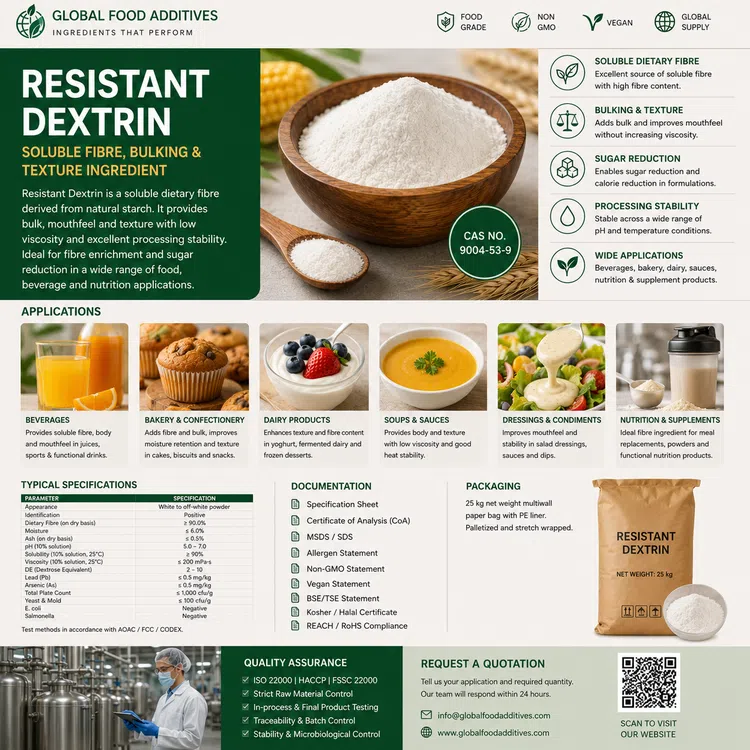
Product identity
| Product | Resistant Dextrin |
|---|---|
| Common commercial references | Resistant dextrin, resistant maltodextrin, soluble dietary fibre, dextrin fibre, indigestible dextrin, low-viscosity fibre |
| Category | Modified Starches, Fibres & Bulking Agents |
| Primary function | Soluble fibre ingredient, bulking ingredient, low-viscosity solids builder, carrier, moisture-control ingredient and texture modifier |
| E / INS number | Confirm by destination market and supplier documentation; often handled as a fibre ingredient or starch-derived ingredient rather than a universal E-number additive |
| CAS / identity | 9004-53-9 |
| Typical source | Starch-derived dextrin from corn, wheat, tapioca, potato or other approved starch source depending on supplier |
| Typical form | Fine powder, granule, agglomerated powder, instantised grade, low-dust grade or custom fibre premix |
| Typical technical focus | Dietary fibre content, solubility, clarity, viscosity, dextrose equivalent where relevant, particle size, moisture, pH, colour, flavour and digestive tolerance |
| Typical use concept | Fibre enrichment, sugar reduction, calorie reduction, body replacement, solids adjustment, carrier function and process-stable soluble fibre addition |
Application fit
Potential use areas may include:
- Soups, sauces, dressings, gravies and savoury wet systems
- Bakery products, biscuits, cakes, breads, muffins and high-fibre baked goods
- Meat products, poultry systems, hybrid products and processed protein systems
- Beverages, drink powders, low-sugar drinks and fortified beverage systems
- Dairy products, dairy alternatives, yoghurts, desserts and cream systems
- Nutrition powders, meal replacements, protein blends and wellness products
- Bars, cereals, granola, extruded snacks and confectionery systems
- Encapsulation, flavour carriers, dry blends and instant powder applications
Technical purchasing notes
When reviewing Resistant Dextrin, compare the supplier specification against the intended application, target fibre declaration, label expectation, calorie value, process conditions, water activity, sensory profile, digestive tolerance target and local rules. For industrial purchasing, the most useful inquiry normally includes target dietary fibre content, source starch, physical form, solubility or clarity requirement, viscosity target, particle size, packaging size, quantity, destination country and required documentation.
Industrial role and functional performance
Resistant Dextrin is selected when manufacturers need soluble fibre enrichment without excessive viscosity, gumminess or flavour impact. In finished products, it can help increase declared fibre, replace some sugar or carbohydrate solids, improve body, support mouthfeel, act as a carrier for flavours or actives and improve dry-blend handling. Because it usually contributes less thickening than gums, pectins or beta-glucans, it is useful in applications where high fibre levels are needed while maintaining drinkability, pourability or clean sensory profile.
Soluble fibre enrichment
Resistant Dextrin can help increase dietary fibre content in beverages, bakery, dairy alternatives, snacks, nutrition powders and bars. Finished-product fibre claims should be supported by approved analytical methods and destination-market labelling rules.
Low-viscosity formulation
Compared with many hydrocolloids, suitable Resistant Dextrin grades can add soluble solids and fibre with relatively low viscosity. This is useful in beverages, sauces and liquid nutrition products that must remain pourable or drinkable.
Sugar and calorie reduction
Resistant Dextrin may help rebuild body and solids when sugar is reduced. It does not deliver full sucrose sweetness, browning, crystallisation or fermentation functionality, so sweeteners and texture systems may be needed.
Carrier and processing aid role
Powder grades can function as carriers for flavours, colours, acids, vitamins, sweeteners and active ingredients. Spray drying, dry blending and instantisation performance should be tested with the full ingredient system.
Grade selection guide
Different Resistant Dextrin grades can behave differently in production. The correct grade should be selected according to fibre content, source starch, solubility, clarity, viscosity, particle size, flavour neutrality, instantisation requirement, application method and regulatory market.
| Grade or format | Industrial relevance | Purchasing note |
|---|---|---|
| Standard powder grade | General-purpose option for bakery, dry blends, sauces, soups, nutrition powders and bars. | Request fibre content, moisture, pH, solubility, viscosity, colour, flavour and microbiological specification. |
| Beverage-grade Resistant Dextrin | Designed for drinks, syrups, liquid concentrates and ready-to-drink systems where clarity and low sediment are important. | Confirm clarity, haze, solubility, pH compatibility, heat stability and sediment behaviour. |
| Agglomerated or instantised grade | Useful for instant drinks, meal replacements, protein powders and consumer powders requiring fast wetting. | Request wettability, dispersibility, bulk density, lecithin or carrier declaration and dusting data. |
| High-fibre grade | Useful where the buyer needs strong fibre contribution at lower inclusion rate. | Compare fibre assay, cost per fibre unit, tolerance, viscosity and label rules. |
| Low-colour / neutral-flavour grade | Relevant for clear beverages, dairy, vanilla products, light sauces and delicate flavour systems. | Request sensory data, colour specification, odour profile and sample testing in the final matrix. |
| Carrier or spray-drying grade | Used as a carrier for flavours, colours, extracts, acids, vitamins or active ingredients. | Review glass transition behaviour, bulk density, hygroscopicity, encapsulation compatibility and flowability. |
| Custom fibre premix | May combine Resistant Dextrin with inulin, polydextrose, fibres, sweeteners, gums, minerals or vitamins. | Request full composition, fibre calculation, label declaration, blend uniformity and compatibility data. |
Key specification parameters to compare
A strong Resistant Dextrin offer should include both nutritional and functional data. Buyers should compare fibre assay, source identity, solubility, viscosity, clarity, pH, DE where relevant, sugar profile, moisture, microbiology, heavy metals, allergen status and batch consistency before approving a commercial grade.
| Parameter | Why it matters | Recommended buyer action |
|---|---|---|
| Dietary fibre content | Determines fibre claim potential, dosage calculation and cost-in-use. | Request fibre assay method, specification limit and batch COA value. |
| Source starch | Corn, wheat, tapioca, potato or other starch sources can affect allergen, GMO, gluten and origin declarations. | Confirm raw material source and required origin or identity statements. |
| Solubility | Important for beverages, liquid foods, syrups, dairy alternatives and sauces. | Test in the actual process water, pH, minerals, sugars, acids, stabilisers and heat process. |
| Viscosity | Determines suitability for drinkable, pourable, spoonable or bakery applications. | Request viscosity data at relevant concentration, temperature and solids level. |
| Clarity / haze | Critical for clear beverages, syrups and transparent gel systems. | Run clarity and sediment tests in the finished beverage or syrup. |
| Dextrose equivalent / reducing sugars | Can influence sweetness, browning, Maillard reaction, hygroscopicity and nutritional calculation. | Ask for DE or reducing sugar information where relevant to the application. |
| Moisture and water activity | Affects flowability, caking, microbial stability and shelf life. | Confirm moisture limits, storage guidance and packaging barrier performance. |
| Particle size and bulk density | Influences blending, dusting, dissolution rate, dosing accuracy and packaging fill volume. | Request mesh size, D10/D50/D90, bulk density and flowability data. |
| Microbiological quality | Important for ready-to-mix powders, dairy systems, nutrition products and sensitive customer standards. | Request total plate count, yeast and mould, coliforms, pathogens and customer-specific limits. |
| Heavy metals and contaminants | Critical for food safety, import clearance and customer approval. | Request limits and batch values for lead, arsenic, cadmium, mercury and other required contaminants. |
Application guidance by industry
Soups, sauces and dressings
Resistant Dextrin can add soluble fibre and solids to soups, sauces, dressings, gravies and savoury wet systems without the heavy viscosity increase associated with many gums. It can support body, mouthfeel and nutrition positioning while leaving primary thickening to starches, gums or emulsifiers.
- Useful target: fibre enrichment with controlled pourability.
- Watch point: acid, salt, heat treatment and emulsion systems can affect texture and flavour balance.
- RFQ note: provide pH, heat process, oil level, target viscosity and fibre claim target.
Bakery and baked goods
In bread, cakes, biscuits, muffins, bars and high-fibre bakery, Resistant Dextrin can increase fibre and solids. Formulators should adjust water addition, dough handling, spread, browning, softness, crumb structure and shelf-life texture when replacing sugar or flour solids.
- Useful target: fibre enrichment and sugar-reduced bakery body.
- Watch point: fibre addition can change water absorption and texture over shelf life.
- RFQ note: specify flour system, water level, baking profile and target fibre per serving.
Meat and processed protein systems
Resistant Dextrin may be used in processed meat, poultry, seafood or hybrid meat systems where fibre enrichment, solids adjustment, water management or calorie reduction is required. Compatibility with salt, phosphates, proteins, fat level, cooking yield and freezing should be evaluated.
- Useful target: fibre addition and solids contribution in savoury protein systems.
- Watch point: excess soluble solids can affect purge, bite, sweetness perception or browning.
- RFQ note: provide fat level, cooking process, target yield and finished texture.
Beverages and drink powders
Suitable Resistant Dextrin grades are often evaluated in still drinks, functional beverages, powdered beverages, syrups and low-sugar drinks because they can add soluble fibre with relatively low viscosity. Trials should check clarity, sediment, sweetness balance, acid stability and processing retention.
- Useful target: drinkable fibre enrichment and low-sugar solids replacement.
- Watch point: clarity, haze and sediment must be tested in final packaging.
- RFQ note: provide pH, Brix, heat process, clarity target and fibre dose.
Dairy and plant-based products
In yoghurts, dairy desserts, plant-based drinks, creams and frozen desserts, Resistant Dextrin can support fibre enrichment, body and solids balance. Protein system, stabilisers, heat process, pH and flavour masking should be reviewed together.
- Useful target: fibre enrichment without excessive gumminess.
- Watch point: stabiliser and protein interactions can affect mouthfeel and sediment.
- RFQ note: provide pH, fat level, heat process, stabiliser system and packaging.
Nutrition powders, bars and snacks
Resistant Dextrin can be used in meal replacements, protein powders, cereal bars, granola, extruded snacks and confectionery where fibre enrichment and bulking are required. Finished-product trials should evaluate powder flow, wetting, bar hardness, moisture migration, sweetness, chew and shelf-life texture.
- Useful target: fibre addition and body in nutrition-positioned products.
- Watch point: high fibre levels can affect digestive tolerance and texture.
- RFQ note: specify fibre target, moisture, protein level, sweetener system and serving size.
Formulation and processing notes
Resistant Dextrin should be validated in the finished product because pH, heat, solids level, sugar replacement, sweetener system, proteins, starches, gums, minerals, acids and packaging can change sensory and processing behaviour. For sugar-reduced products, it can help rebuild bulk and body, but formulators may still need high-intensity sweeteners, polyols, fibres, hydrocolloids, starches, emulsifiers or flavour systems to replace the complete function of sugar.
Hydration and dissolution
Add Resistant Dextrin under adequate mixing to avoid lumps and local over-concentration. In high-solids systems, control addition order, temperature and shear to support complete dispersion.
Viscosity management
Although many grades are low-viscosity, viscosity still depends on dosage, solids, temperature and other hydrocolloids. Measure finished-product viscosity at process and consumption temperature.
Digestive tolerance
High fibre inclusion can affect tolerance. Product developers should consider serving size, fibre dose per serving, consumer instructions and gradual-use recommendations where appropriate.
Claim validation
Fibre claims should be based on approved analytical methods, finished-product formulation, serving size, label tolerances and destination-market rules.
Functionality and finished-product considerations
| Consideration | Technical impact | Factory recommendation |
|---|---|---|
| Fibre claim target | Final claim depends on fibre assay, inclusion rate, serving size and local regulations. | Calculate on finished-product basis and verify with approved analytical method. |
| Sugar replacement | Resistant Dextrin can replace bulk but not full sweetness, crystallisation, browning or fermentation function. | Develop bulking, sweetness and texture systems together. |
| Water activity | Soluble solids can influence moisture migration, texture and microbial stability. | Measure water activity and texture over shelf life. |
| Heat treatment | Pasteurisation, baking, extrusion or retort may affect colour, flavour and interaction with other ingredients. | Test after the actual process rather than only in bench solutions. |
| pH and acid systems | Acidic beverages and sauces can affect flavour balance, clarity and stability. | Test at final pH and after storage. |
| Powder handling | Particle size and hygroscopicity can influence dusting, caking, flow and dosing accuracy. | Select agglomerated or low-dust grade where line performance requires it. |
Quality, safety and compliance review
For import, customer approval and factory quality management, Resistant Dextrin should be reviewed as a starch-derived soluble fibre ingredient. Buyers should confirm food-grade status, source starch, dietary fibre assay, production method, label name, calorie value, allergen status, gluten status, GMO status, origin, microbiological quality, heavy metals, residual processing aids where relevant and destination-market rules for fibre declaration and nutrition claims.
Fibre declaration
Confirm whether the offered grade can be declared as dietary fibre in the destination market and which analytical method supports the value. Fibre terminology and label wording can differ by country.
Source and allergen review
Source starch matters. Wheat-derived grades may require gluten or allergen review, corn-derived grades may require GMO review, and tapioca or potato grades may be preferred for certain label programs.
Nutrition and claims
Claims such as source of fibre, high fibre, sugar-reduced, low calorie, prebiotic or digestive health must be checked against local rules and substantiated with finished-product data.
Customer standards
Retailers and manufacturers may require allergen, GMO, gluten-free, vegan, vegetarian, halal, kosher, heavy metal, pesticide, residual solvent and country-of-origin declarations before approval.
Documents to request
- Product specification or technical data sheet with grade name, source starch, physical form and intended use.
- Certificate of analysis for the offered batch or representative lot.
- Dietary fibre assay method and batch fibre content.
- Food-grade statement and market-specific fibre declaration where available.
- Safety data sheet with handling, dust-control and storage information.
- Solubility, viscosity, clarity, pH, moisture, ash, DE or reducing sugar data where relevant.
- Particle size, bulk density, flowability, hygroscopicity and caking information where available.
- Microbiological specification covering total plate count, yeast and mould, coliforms, pathogens and customer-specific limits.
- Heavy metal declaration covering lead, arsenic, cadmium, mercury and other required contaminants.
- Allergen, gluten, GMO, vegan, vegetarian, halal and kosher statements where required.
- Origin statement, manufacturer information, traceability details and raw material source information.
- Residual solvent, processing aid, pesticide or contaminant declarations where required.
- Shelf-life, storage temperature, humidity protection and after-opening handling information.
- Packaging details, net weight, pallet configuration and container loading information.
- Market-specific declarations required by the destination country or final customer.
Packaging, storage and logistics
Resistant Dextrin is typically supplied in multiwall paper bags, PE-lined bags, cartons, fibre drums, big bags or bulk formats depending on grade and order size. Store in a cool, dry, clean and odour-free warehouse, protected from moisture, high humidity, pests, direct sunlight and cross-contamination. Because soluble fibre powders can absorb moisture and odours, buyers should confirm packaging barrier, pallet wrapping, shelf-life remaining, warehouse conditions and whether the product will be repacked, blended or used directly in production.
| Packaging question | Why it matters |
|---|---|
| Is the product standard powder, agglomerated grade, instantised grade or custom premix? | Determines dosing, hydration, dusting, storage, handling and application fit. |
| What is the net weight per bag, drum or big bag? | Supports batch-size planning, warehouse handling and purchasing comparison. |
| Is the packaging moisture-protective? | Helps prevent caking, microbial risk, flow issues and quality deterioration. |
| What is the shelf life and recommended storage condition? | Important for stock rotation, customer audits and long-term supply planning. |
| Is the product suitable for automated feeding or manual dosing? | Particle size, bulk density and flowability affect line performance and dust control. |
| Are export and customs documents available before shipment? | Reduces clearance delay and speeds up customer approval. |
Commercial evaluation and cost-in-use
Resistant Dextrin should be evaluated by cost per delivered fibre unit and finished-product performance, not only by price per kilogram. A higher-fibre, better-dispersing or more neutral-tasting grade may be more economical if it allows lower dosage, faster mixing, improved clarity, fewer defects, stronger label compliance or better consumer acceptance. Buyers should compare fibre content, sensory impact, functionality, tolerance, regulatory documentation, MOQ, lead time, packaging, shelf-life remaining and supplier consistency before commercial approval.
Sample approval
Request a representative sample from the same grade and production origin proposed for commercial supply. Test it in the final formula, not only in water.
Application trial
Evaluate dissolution, viscosity, clarity, texture, sweetness balance, water activity, fibre claim, processing stability and shelf-life performance under real process conditions.
Label calculation
Confirm dietary fibre value, calorie contribution, serving-size contribution, claim eligibility and destination-market declaration before approving commercial packaging.
Supplier consistency
Review lot-to-lot fibre content, solubility, viscosity, colour, flavour, lead time, documentation speed, minimum order quantity and long-term availability.
How to request this product
Send the product name, intended application, target fibre content, source starch preference, grade type, solubility or clarity requirement, viscosity target, flavour restriction, claim requirement, regulatory market, required documentation, annual and first-order quantity, destination country, packaging preference, Incoterms and expected shipment date. If you already purchase Resistant Dextrin or another soluble fibre, attach your current specification, certificate of analysis, fibre method, dosage level or finished-product benchmark so supplier options can be compared more accurately.
Recommended RFQ checklist
- Product: Resistant Dextrin / resistant maltodextrin / soluble dietary fibre / CAS 9004-53-9
- Application: soup, sauce, dressing, bakery, meat product, beverage, dairy alternative, nutrition powder, bar, cereal, snack or confectionery
- Required format: fine powder, granule, agglomerated powder, instantised grade, low-dust grade or custom fibre premix
- Target dietary fibre content and required analytical method
- Source preference: corn, wheat, tapioca, potato or supplier-specific starch source
- Required solubility, clarity, viscosity, particle size, bulk density and flavour profile
- Formula details: pH, heat process, water activity, sugar reduction target, sweetener system, stabiliser system and serving size
- Required documents: TDS, specification, COA, fibre assay, SDS, allergen, gluten, GMO, origin, heavy metals and microbiology
- Required certifications: halal, kosher, vegan, non-GMO, gluten-free or organic where needed
- Destination country and target regulatory market
- Quantity for sample, pilot trial and commercial order
- Preferred packaging and pallet configuration
- Delivery term, port, airport or warehouse destination
- Existing approved reference sample, competitor specification or application benchmark if available
Useful answers
What is Resistant Dextrin used for in food manufacturing?
Resistant Dextrin is used as a soluble fibre, bulking ingredient, low-viscosity body builder, carrier and sugar-reduction support ingredient. It is commonly evaluated in beverages, soups, sauces, dressings, bakery, meat products, dairy alternatives, nutrition powders, bars, cereals, confectionery and snacks.
Is Resistant Dextrin the same as maltodextrin?
No. Standard maltodextrin is typically a digestible carbohydrate, while Resistant Dextrin or resistant maltodextrin is designed to resist digestion and is used for soluble fibre enrichment. Buyers should verify exact identity, source and fibre method in supplier documentation.
Can Resistant Dextrin be used in beverages?
Yes, suitable grades can be used in beverages because they can provide soluble fibre with relatively low viscosity. Beverage applications should be tested for clarity, haze, sediment, pH stability, heat process, sweetness balance and label requirements.
Does Resistant Dextrin thicken like a gum?
Usually no. Resistant Dextrin generally provides soluble solids and fibre with lower viscosity than many gums or hydrocolloids. If strong thickening, suspension or gelation is required, gums, starches or other texturizers may also be needed.
Can Resistant Dextrin replace sugar?
It can help replace some bulk and body when sugar is reduced, but it does not fully replace sugar sweetness, browning, crystallisation, fermentation substrate or all mouthfeel properties. Sweeteners and texture systems are often required.
Which quality parameters are important?
Important parameters include dietary fibre content, fibre assay method, source starch, solubility, clarity, viscosity, particle size, moisture, pH, colour, flavour, microbiology, heavy metals, allergen status, gluten status, GMO status, shelf life and packaging integrity.
Can Global Food Additives source Resistant Dextrin?
Global Food Additives can review sourcing options for Resistant Dextrin according to target fibre content, grade, source, application, required documents, quantity, destination, packaging preference and shipment schedule.
Which documents should be requested?
Buyers commonly request a technical data sheet, specification, certificate of analysis, fibre assay method, safety data sheet, food-grade statement, allergen statement, gluten statement, GMO statement, origin statement, heavy metal declaration, microbiological specification, shelf-life information and packing details.
Is this product permitted in every country?
No. Use, label declaration, dietary fibre calculation, fibre claims, nutrition claims, calorie value and permitted terminology depend on destination-market rules, food category, analytical method and buyer responsibility. Local regulations should be verified before commercial use.
Tell us which Resistant Dextrin grade or soluble fibre system you need.
Send product name, target fibre content, application, required grade, source preference, quantity, destination country, packaging preference, delivery term and document requirements. Our team will review your inquiry and respond from orders@foodgradeadditives.com.
Your message has been received. You will be redirected to the home page.