
Safflower Yellow
Safflower Yellow is a plant-derived yellow food colour or colouring-food ingredient obtained from Carthamus tinctorius. It is selected by manufacturers for yellow to orange-yellow shade development, natural colour positioning, colour standardisation and reformulation projects where a botanical colour source is preferred. This page is prepared for purchasing teams, R&D formulators, QA departments and import coordinators who need a structured starting point for specification review, application trials, documentation collection and quotation requests.
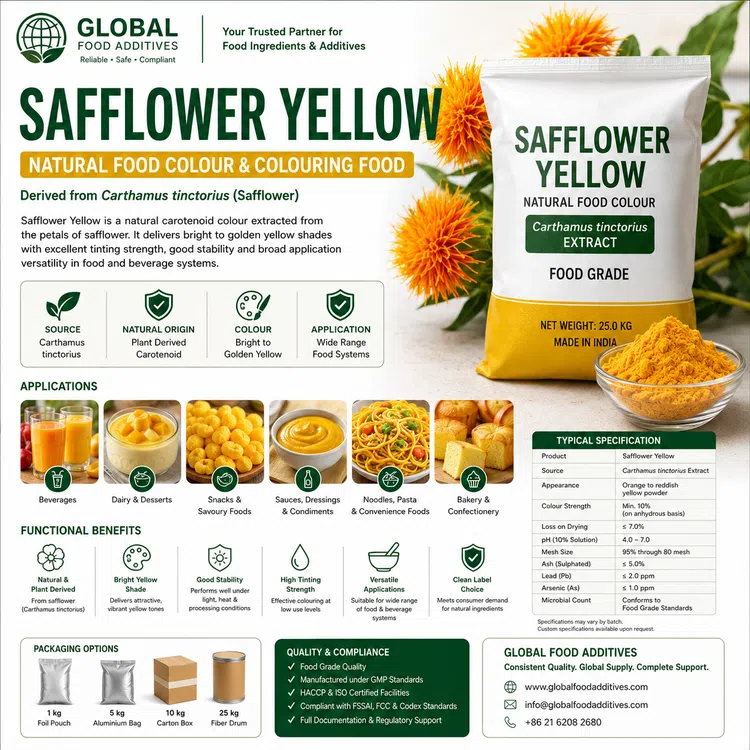
Product identity
| Product | Safflower Yellow |
|---|---|
| Common names | Carthamus Yellow, Safflower Extract Colour, Natural Yellow 5, Safflower Yellow Colour |
| Botanical source | Carthamus tinctorius flower / petal extract |
| Category | Colours & Colouring Foods |
| Function | Food colour, colouring food, yellow shade standardisation ingredient and natural colour system component |
| E / INS number | Confirm by destination market, supplier documentation and regulatory classification |
| CAS / identity | Carthamus tinctorius extract / safflower-derived yellow colour |
| Typical form | Powder, spray-dried powder, liquid extract, dispersion or compounded colour preparation |
| Typical shade | Yellow to orange-yellow, depending on concentration, carrier, pH, matrix and dosage |
| Typical positioning | Natural colour, plant extract colour or colouring food depending on supplier grade and market rules |
Application fit
Potential use areas may include:
- Still beverages, juice drinks, powdered drinks and beverage compounds
- Confectionery, gummies, jellies, hard candies and sugar systems
- Dairy desserts, plant-based desserts, puddings and fermented products
- Sauces, dressings, condiments and savoury wet systems
- Snack seasonings, extruded snacks, crackers and coated nuts
- Bakery fillings, icings, decorations and sweet toppings
- Instant noodles, soup powders, bouillons and dry mixes
- Prepared foods where yellow tone consistency is required
Technical purchasing notes
When reviewing Safflower Yellow, compare the supplier specification against the intended application, target shade, colour strength, process conditions, pH, heat treatment, packaging exposure, label expectations and local rules. For industrial purchasing, the most useful inquiry normally includes target grade, colour value or active pigment strength, physical form, carrier system, solubility requirement, packaging size, quantity, destination country and document requirements.
Industrial role and colour performance
Safflower Yellow is used when a manufacturer needs a botanical yellow shade in a food or beverage matrix. It can support clean-label reformulation, synthetic colour replacement, shade matching, seasonal product standardisation and brand-colour consistency. The final appearance depends on the grade, pigment concentration, pH, dissolved solids, water activity, processing temperature, light exposure, oxygen exposure, packaging type and interaction with other ingredients.
Shade development
Produces yellow to orange-yellow shades depending on dosage and matrix. It can be used alone or blended with annatto, beta-carotene, curcumin, paprika, riboflavin, caramel, chlorophyll or anthocyanin systems to build customised colour tones.
Water compatibility
Safflower Yellow grades are commonly evaluated in water-based products such as beverages, gels, syrups, sauces and dessert systems. Oil-only systems may require a dispersion, emulsion or specially formulated colour preparation.
Colour standardisation
Industrial users should compare offers by colour value, absorbance method, dosage performance and final shade rather than by kilogram price alone. A stronger grade may deliver lower cost-in-use even when the unit price is higher.
Natural colour positioning
Safflower Yellow can support botanical colour positioning, but claims such as natural, colouring food, no artificial colours or clean label must be checked against the destination market and final product label.
Grade selection guide
Different Safflower Yellow grades can behave differently in factory trials. The correct grade should be selected according to the product matrix, required colour intensity, label strategy, solubility, heat process, shelf-life target and packaging exposure.
| Grade or format | Industrial relevance | Purchasing note |
|---|---|---|
| Water-soluble powder | Useful for dry blends, powdered beverages, instant mixes, bakery premixes and applications requiring low transport weight. | Request colour value, carrier declaration, particle size, moisture, solubility and dust-control information. |
| Spray-dried powder | Common for standardised colour preparations with carriers such as maltodextrin, gum arabic or other permitted carriers. | Confirm full composition, carrier source, allergen status, GMO statement and dosage recommendation. |
| Liquid extract | Useful for beverage compounds, sauces, syrups, dairy desserts and products where direct liquid dosing is preferred. | Check solids content, preservative system, pH, microbial limits, storage temperature and shelf-life after opening. |
| Dispersion or emulsion | Relevant when the matrix contains fat, oil, clouding systems or low-water phases that need better colour distribution. | Request droplet stability, emulsifier declaration, viscosity, separation behaviour and processing compatibility. |
| Compounded colour blend | May combine safflower with other natural colours to achieve a specific lemon, mango, peach, honey, golden or savoury yellow tone. | Request full colour composition, label declaration, stability data and replacement-ratio guidance. |
| Colouring-food style extract | May be relevant for markets or brands seeking colour from edible-source processing rather than additive-style declarations. | Confirm extraction method, concentration level, selectivity, legal classification and customer acceptance. |
Key specification parameters to compare
A professional Safflower Yellow offer should include technical colour data, not only a product name and price. Buyers should compare colour value, test method, shade curve, carrier system, physical form, microbiological quality, contaminant limits and batch consistency before approving a commercial grade.
| Parameter | Why it matters | Recommended buyer action |
|---|---|---|
| Colour value / absorbance | Determines actual colouring strength and cost-in-use. | Request the analytical wavelength, dilution method, solvent system and calculation basis. |
| Shade and hue angle | Controls whether the finished product appears lemon yellow, golden yellow, orange-yellow or dull brownish yellow. | Ask for shade panels or trial samples in the target matrix. |
| Carrier system | Carriers affect label declaration, solubility, allergen status, viscosity, cost and processing behaviour. | Request full composition and market-specific label wording. |
| Solubility and dispersibility | Important for beverages, clear gels, sauces, dry blends and instant products. | Run a dissolution test in the actual process water and finished formula. |
| pH stability | Acidic beverages, neutral dairy systems and alkaline products can show different shade and stability behaviour. | Test across the product’s real pH range, not only in water. |
| Heat stability | Pasteurisation, UHT, baking, retorting or hot-fill processing can affect colour intensity. | Evaluate after the full heat process and again after shelf-life storage. |
| Light and oxygen stability | Transparent packaging, oxygen headspace and display lighting may accelerate colour change. | Conduct accelerated light and storage trials using the final packaging format. |
| Microbiological profile | Important for liquids, high-water products, cold-fill systems and sensitive dairy or beverage applications. | Request total plate count, yeast and mould, coliforms, pathogens and preservative information where relevant. |
| Heavy metals and contaminants | Critical for food safety, customer approval and import clearance. | Request limits and COA values for lead, arsenic, cadmium, mercury and other required contaminants. |
| Pesticide and botanical-origin data | Botanical extracts may require origin, crop, pesticide and traceability review. | Ask for origin statement, pesticide compliance and lot traceability. |
Application guidance by industry
Beverages and beverage compounds
Safflower Yellow can be evaluated in still drinks, juice drinks, powdered beverages, isotonic drinks, syrups and beverage bases. Colour development should be tested after pH adjustment, pasteurisation or hot fill, dilution, carbonation where applicable and storage under light exposure.
- Useful target: lemon, tropical fruit, honey, peach or golden beverage tones.
- Watch point: transparent bottles can increase light-stability risk.
- RFQ note: provide pH, heat process, packaging and target shade.
Confectionery and gummies
In gummies, jellies, hard candies, panned sweets and sugar systems, Safflower Yellow may support bright yellow shade development. Trial work should include acid type, cooking temperature, final solids, water activity and interaction with flavours.
- Useful target: bright yellow shades in fruit-flavoured confectionery.
- Watch point: high-temperature sugar cooking may reduce colour intensity.
- RFQ note: specify gelatin, pectin, starch or sugar-boiled application.
Dairy and plant-based desserts
Safflower Yellow can be tested in puddings, custards, yoghurts, frozen desserts, dairy alternatives and fermented dessert systems. Protein, fat, pH, fermentation and heat treatment can influence final shade and colour uniformity.
- Useful target: vanilla, custard, mango, banana or cream-yellow tones.
- Watch point: fermentation pH and storage can shift colour perception.
- RFQ note: define fat level, pH and heat treatment.
Sauces, dressings and condiments
In wet savoury systems, Safflower Yellow may be used to build golden, mustard, curry, cheese-style or vegetable-based colour profiles. Compatibility with acids, salt, emulsifiers, starches, gums and oil phases should be checked.
- Useful target: yellow savoury identity and batch-to-batch shade control.
- Watch point: oil separation or poor dispersion can cause colour streaking.
- RFQ note: share pH, oil phase percentage and thermal process.
Snacks and seasonings
For extruded snacks, chips, crackers, coated nuts and dry seasonings, Safflower Yellow can be included in topical seasoning systems or dry premixes. Particle size, carrier, oil adhesion and dust control are important for colour distribution.
- Useful target: cheese-style, curry, honey-mustard or savoury yellow shades.
- Watch point: powder segregation can cause inconsistent colour on the line.
- RFQ note: specify topical seasoning, dough inclusion or slurry application.
Bakery and fillings
Safflower Yellow can be evaluated in icings, fillings, creams, glazes, bakery decorations and selected baked systems. High heat, high pH, reducing sugars and fat systems should be tested because the shade after baking may differ from the raw mix.
- Useful target: lemon, vanilla, custard, fruit or decorative yellow tones.
- Watch point: baking may reduce colour strength or create shade shift.
- RFQ note: specify bake temperature, bake time and water activity.
Processing and formulation notes
Colour performance should be validated in the finished food, not only in water. Safflower Yellow may behave differently in clear beverages, protein systems, emulsions, high-sugar confectionery, acidic sauces, starch gels and dry seasoning blends. Manufacturers should run bench trials, pilot trials and shelf-life studies before replacing an approved colour system.
Dosage optimisation
Develop a dosage curve in the real product matrix and measure colour immediately after production, after thermal processing and throughout shelf life. Avoid over-dosing, which can create dullness or unexpected orange tones.
Blend compatibility
Safflower Yellow can be blended with other natural colours to obtain lemon, mango, peach, cheese, curry or golden shades. Check colour interactions, haze, sediment, solubility and label declaration for the complete blend.
pH and acid system
Citric acid, malic acid, lactic acid, acetic acid and phosphate systems can influence final colour perception. Evaluate under the product’s real pH, acid blend and processing conditions.
Packaging interaction
Colour retention can depend on packaging opacity, oxygen barrier, headspace, display lighting and storage temperature. Compare transparent, amber, opaque and multilayer packaging where relevant.
Stability and shelf-life considerations
| Condition | Potential impact | Factory recommendation |
|---|---|---|
| Low pH beverages | May show different colour intensity or hue compared with neutral water. | Test in finished beverage concentrate and ready-to-drink dilution. |
| High heat processing | Pasteurisation, hot fill, retort, baking or UHT may reduce intensity or shift shade. | Evaluate after the actual thermal process and after accelerated storage. |
| Light exposure | Retail display lighting and transparent packaging may affect colour retention. | Conduct light-box or window-display simulation using final packaging. |
| Oxygen exposure | Headspace oxygen can influence colour stability in some natural colour systems. | Compare oxygen barrier packaging, nitrogen flushing or antioxidant systems where appropriate. |
| Minerals and salts | Calcium, iron, magnesium, sodium chloride and buffer systems may affect colour clarity or haze. | Test with the final mineral profile and processing water. |
| Proteins and emulsions | Dairy proteins, plant proteins and emulsions may change colour distribution and visual intensity. | Evaluate homogenisation, pH, fat phase and stabiliser interactions. |
Quality, safety and compliance review
For import, customer approval and factory quality management, Safflower Yellow should be reviewed as both a colour ingredient and a botanical extract. Buyers should confirm botanical identity, extraction method, carrier composition, colour value, contaminant profile, microbiological limits, allergen status, GMO status, pesticide status, country of origin and market-specific regulatory classification.
Regulatory classification
Confirm whether the product is treated as a food colour additive, colouring food, plant extract or compounded colour preparation in the destination country. Classification can affect permitted uses, label wording and documentation.
Botanical authenticity
Request botanical source information, extraction details and batch traceability. For natural colour programs, source authenticity and adulteration control are important parts of supplier approval.
Clean-label review
Claims such as natural colour, no artificial colour, plant-based, vegan, non-GMO or colouring food should be checked against local rules, customer standards and the exact composition of the supplied grade.
Contaminant control
Botanical colour extracts may require pesticide, heavy metal, mycotoxin, solvent, microbiological and foreign-matter controls depending on origin, process and customer requirements.
Documents to request
- Product specification or technical data sheet with grade name, physical form, botanical source and intended use.
- Certificate of analysis for the offered batch or representative lot.
- Safety data sheet, especially for concentrated liquids, powders or preparations containing carriers.
- Food-grade statement and market-specific colour/additive/colouring-food declaration.
- Colour value, absorbance method, wavelength, dilution method and test solvent information.
- Full composition, carrier declaration and processing aid declaration where applicable.
- Botanical origin statement, country of origin and traceability information.
- Allergen, GMO, gluten, vegan, vegetarian, halal and kosher statements where required.
- Pesticide, heavy metal, residual solvent, mycotoxin and microbiological declarations.
- Shelf-life, storage temperature, humidity protection and after-opening handling information.
- Packaging details, net weight, pallet configuration and container loading information.
- Application guidance, dosage range and stability data if available for the target product category.
Packaging, storage and logistics
Safflower Yellow powders are typically supplied in sealed bags, cartons, drums or fibre drums with moisture-protective inner liners. Liquid grades may be supplied in HDPE containers, drums or IBCs depending on concentration and order volume. Store in a cool, dry, clean and odour-free area, protected from direct sunlight, excessive heat, humidity and contamination. For colour consistency, keep containers closed after opening and avoid unnecessary exposure to air, light and process-room moisture.
| Packaging question | Why it matters |
|---|---|
| Is the product powder, liquid, dispersion or compounded blend? | Determines dosing equipment, storage conditions, shelf life and factory handling. |
| What is the colour value and net active strength? | Supports accurate cost-in-use comparison and dosage calculation. |
| Which carrier or solvent system is used? | Affects label declaration, allergen status, solubility and regulatory classification. |
| Is the packaging light- and moisture-protective? | Helps protect colour strength, powder flow and shelf-life stability. |
| What is the recommended storage temperature? | Important for colour retention, microbial control and shelf-life management. |
| Are export and customs documents available before shipment? | Reduces customs delay and speeds up customer approval. |
Commercial evaluation and cost-in-use
Natural colour purchasing should be evaluated by performance in the final product, not only by price per kilogram. A high-strength Safflower Yellow grade can be more economical if it requires lower dosage, offers better stability, gives cleaner label wording or reduces rework. Buyers should compare colour value, dosage, shade match, process loss, shelf-life retention, supplier consistency, documentation speed, MOQ, lead time and packaging format before commercial approval.
Sample approval
Request samples from the same grade and production origin proposed for commercial supply. Compare against the current colour system using the exact formula, process and packaging.
Shade matching
Use instrument colour data such as L*, a*, b* values together with visual panel review. A technically acceptable colour must also match brand and consumer expectations.
Scale-up check
Confirm that bench results transfer to pilot and production scale. Pay attention to solubility, dispersion, dosing accuracy, filtration, sediment and colour uniformity.
Supplier consistency
Review lot-to-lot colour value, botanical origin, crop season, production lead time, documentation speed, MOQ and long-term availability.
How to request this product
Send the product name, intended application, target shade, physical form, colour value requirement, carrier preference, regulatory market, required documentation, annual and first-order quantity, destination country, packaging preference, Incoterms and expected shipment date. If you already purchase Safflower Yellow or another yellow colour, attach your current specification, certificate of analysis, dosage rate, colour target or finished product photo so supplier options can be compared more accurately.
Recommended RFQ checklist
- Product: Safflower Yellow / Carthamus Yellow / Carthamus tinctorius extract
- Application: beverage, confectionery, dairy dessert, sauce, snack, bakery, seasoning or prepared food
- Required format: powder, spray-dried powder, liquid extract, dispersion or compounded blend
- Target shade: lemon yellow, golden yellow, orange-yellow, mango, peach, curry, cheese-style or custom colour
- Colour value, absorbance method or reference standard if available
- Required solubility: clear water-soluble, dispersible, emulsion-compatible or dry-blend format
- Processing conditions: pH, heat treatment, light exposure, packaging and shelf-life target
- Required documents: TDS, specification, COA, SDS, allergen, GMO, origin, pesticide, heavy metal and microbiology
- Regulatory market and intended label claim: food colour, natural colour, colouring food, no artificial colour or other claim
- Quantity for sample, pilot trial and commercial order
- Preferred packaging and pallet configuration
- Delivery term, port, airport or warehouse destination
- Existing approved reference sample, competitor specification or target L*a*b* values if available
Useful answers
What is Safflower Yellow used for in food manufacturing?
Safflower Yellow is used for yellow to orange-yellow shade development, colour standardisation and botanical colour positioning in selected food and beverage applications. It is commonly evaluated in beverages, confectionery, dairy desserts, sauces, snacks, bakery systems, dry mixes and prepared foods.
Is Safflower Yellow natural?
Safflower Yellow is derived from Carthamus tinctorius, a botanical source. However, whether it can be labelled as natural, colouring food, plant extract or food colour depends on the exact grade, processing method, carrier system, destination market and customer policy.
Is Safflower Yellow the same as saffron?
No. Safflower Yellow is derived from safflower, while saffron is derived from Crocus sativus. Safflower may provide colour but should not be represented as saffron flavour or saffron spice.
Which grade should a food manufacturer request?
The buyer should specify powder, liquid, dispersion or compounded blend; target colour value; carrier system; solubility; shade requirement; pH range; heat treatment; packaging; shelf-life target; documentation requirements and destination country.
How should colour strength be compared?
Compare Safflower Yellow grades using colour value, absorbance method, dosage in the finished product, visual shade, L*a*b* data, process loss and shelf-life retention. Price per kilogram alone can be misleading.
Can Safflower Yellow be used in oil-based products?
Many Safflower Yellow grades are designed for aqueous systems. Oil-based or high-fat applications may require a dispersion, emulsion or compounded colour preparation. Compatibility should be confirmed through trials.
Can Global Food Additives source Safflower Yellow?
Global Food Additives can review sourcing options for Safflower Yellow according to target specification, shade requirement, application, required documents, quantity, destination, packaging preference and shipment schedule.
Which documents should be requested?
Buyers commonly request a technical data sheet, product specification, certificate of analysis, safety data sheet, colour value method, botanical source statement, allergen statement, GMO statement, origin statement, pesticide declaration, heavy metal declaration, microbiology, shelf-life information and packing details.
Is this product permitted in every country?
No. Regulatory status depends on destination-market rules, product category, use level, additive versus colouring-food classification, label wording and buyer responsibility. Local regulations should be verified before commercial use.
Tell us which Safflower Yellow grade or food colour you need.
Send product name, target shade, application, colour value requirement, quantity, destination country, packaging preference, delivery term and document requirements. Our team will review your inquiry and respond from orders@foodgradeadditives.com.
Your message has been received. You will be redirected to the home page.