
Salt Substitute Potassium Chloride
Salt Substitute Potassium Chloride is a food-grade mineral salt ingredient used in sodium-reduction programs, savoury formulation systems and industrial food applications where manufacturers need to reduce sodium chloride while preserving salt perception, process functionality and consumer-acceptable taste. This page is prepared for purchasing teams, R&D formulators, quality departments and import coordinators who need a structured starting point for grade selection, specification comparison, documentation review and quotation requests.
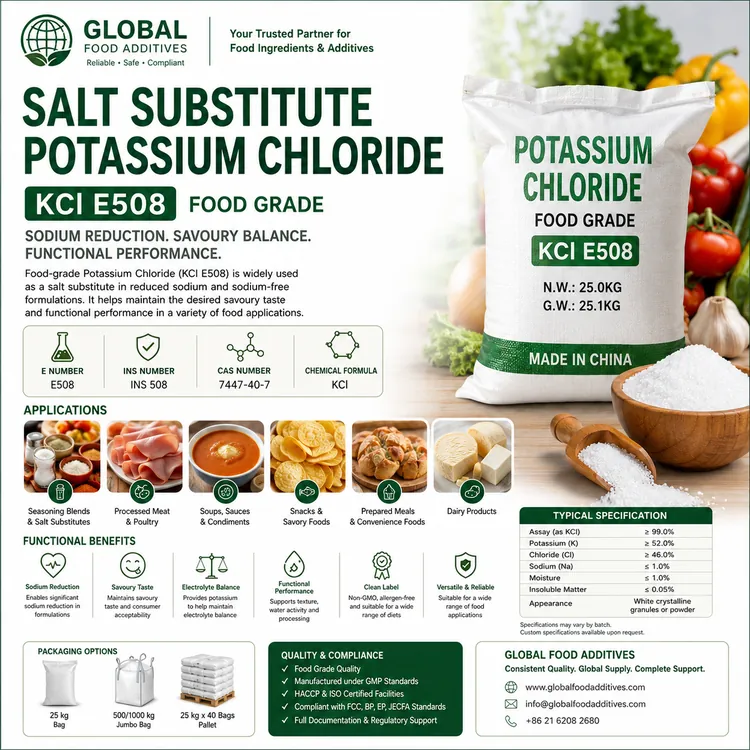
Product identity
| Product | Salt Substitute Potassium Chloride |
|---|---|
| Chemical name | Potassium chloride |
| Formula | KCl |
| Category | Flavour Enhancers & Taste Modifiers |
| Functional positioning | Salt substitute, sodium-reduction ingredient, mineral salt, taste modifier and savoury system component |
| E / INS number | E508 / INS 508 where applicable; confirm by destination market and intended use |
| CAS / identity | 7447-40-7 |
| Typical form | Fine powder, granule, crystalline grade, compacted grade, agglomerated grade, premix blend or solution |
| Typical sensory profile | Salty, mineral and slightly bitter at higher replacement levels |
| Typical use concept | Partial sodium chloride replacement supported by flavour balancing, masking or savoury enhancement systems |
Application fit
Potential use areas may include:
- Reduced-sodium seasonings and spice blends
- Instant soups, bouillons, broth powders and dry mixes
- Sauces, dressings, marinades and condiments
- Extruded snacks, chips, crackers and coated nuts
- Processed meat, poultry, seafood and plant-based meat analogues
- Bakery products, savoury biscuits and dough systems
- Cheese-style, dairy-style and fermented savoury products
- Ready meals, frozen foods and convenience food systems
Technical purchasing notes
When reviewing Salt Substitute Potassium Chloride, compare the supplier specification against the intended food application, sodium-reduction target, taste profile, particle-size requirement, process conditions, packaging format, local regulations and customer documentation standards. For industrial purchasing, the most useful inquiry normally includes target grade, purity or assay, particle size, anti-caking status, sodium limit, heavy metal limits, microbiological expectations, packaging size, quantity, destination and required documentation.
Industrial role in sodium reduction
Potassium Chloride is widely evaluated as a sodium chloride replacement because it contributes salty taste and ionic strength while reducing sodium contribution. In finished food systems, it is commonly used as part of a broader sodium-reduction strategy rather than as a direct one-to-one salt replacement. The best results are usually achieved through gradual sodium reduction, partial replacement, particle-size optimisation, flavour masking and the use of supporting savoury ingredients.
Salt perception
Potassium Chloride provides a salty mineral taste that can support sodium reduction in savoury products. Its sensory impact depends on replacement level, food matrix, water activity, fat content, pH, seasoning load and serving temperature.
Sodium reduction
By replacing part of sodium chloride with potassium chloride, manufacturers can reduce sodium content while maintaining a familiar salty profile. Sodium-reduction claims must be checked against local nutrition and labelling rules.
Functional salt contribution
In addition to taste, mineral salts can influence ionic strength, protein extraction, water binding, brine behaviour, dough handling, fermentation, seasoning adhesion and microbial hurdle systems depending on the product.
Taste balancing
At higher inclusion rates, Potassium Chloride can introduce bitterness, metallic notes or lingering mineral aftertaste. Yeast extract, MSG, nucleotides, acids, herbs, spices, flavours or dedicated masking systems may be used to improve taste acceptance.
Grade selection guide
Food-grade Potassium Chloride is available in different physical forms and specifications. The correct grade should be selected according to application method, sensory target, solubility requirement, particle-size distribution, dust control, blending behaviour, equipment capability and quality documentation expectations.
| Grade or format | Industrial relevance | Purchasing note |
|---|---|---|
| Fine powder | Useful for dry seasoning blends, instant mixes, soup powders and applications requiring rapid dissolution or uniform dispersion. | Check dusting tendency, flowability, anti-caking status, particle-size distribution and segregation risk in blends. |
| Granular or crystalline grade | Suitable for applications requiring visible salt-like particles, controlled dissolution or seasoning systems with granular texture. | Confirm mesh size, bulk density, appearance, dissolution rate and compatibility with existing salt-handling equipment. |
| Compacted or agglomerated grade | Can improve flow, reduce dust, support uniform dosing and reduce segregation in large dry blends. | Request particle-size curve, friability, bulk density and mixing trial data if available. |
| Low-sodium salt premix | May combine sodium chloride, potassium chloride and taste-balancing components for simplified factory dosing. | Request full composition, label declaration, sodium/potassium contribution and country-specific regulatory review. |
| Liquid solution or brine | Useful for injection, tumbling, marination, sauces, soups and wet seasoning systems. | Confirm concentration, pH, microbial limits, preservative status, storage stability and dosing calculation. |
| High-purity food/pharma-style grade | Relevant for customers with strict impurity, heavy metal or pharmacopeial-style requirements. | Clarify whether FCC, USP, EP or other quality expectations apply to the project. |
Key specification parameters to compare
A strong supplier offer should include both commercial terms and technical evidence. Buyers should compare the active assay, impurity profile, particle size, sensory behaviour, anti-caking system, regulatory declarations and packaging quality before approving a commercial grade.
| Parameter | Why it matters | Recommended buyer action |
|---|---|---|
| Assay / purity | Confirms potassium chloride content and supports nutritional calculations, dosing and supplier comparison. | Request the specification limit and certificate of analysis value for the offered batch. |
| Particle size distribution | Influences salt perception, dissolution rate, dry blending, seasoning adhesion, segregation and mouthfeel. | Specify mesh size or D10/D50/D90 expectations when particle behaviour is important. |
| Sodium content | Important for reduced-sodium claims and nutrition panel calculations. | Request sodium limit or typical sodium content where relevant. |
| Heavy metals | Critical for food safety, customer approval and import compliance. | Request limits and batch values for lead, arsenic, cadmium, mercury and other required elements. |
| Moisture / loss on drying | High moisture may affect clumping, flowability, stability and shelf life. | Confirm moisture specification and storage guidance. |
| Insoluble matter | Important for clear liquids, brines, sauces, injection systems and spray applications. | Ask for insoluble matter limits and conduct a dissolution test in the target process water. |
| Anti-caking agent status | Can affect label declaration, flowability, blending and customer acceptance. | Clarify whether the grade is anti-caked, non-anti-caked, silicon dioxide treated or supplied with another flow aid. |
| Microbiological profile | Relevant for ready-to-use solutions, wet applications and high-risk customer specifications. | Request microbial limits if the product is used in sensitive applications or without further kill step. |
| Bulk density and flowability | Impacts dosing, silo behaviour, bag emptying, screw feeding and automated seasoning systems. | Request bulk density range and run a plant-scale handling trial where possible. |
| Country and quality standard | Determines whether the product fits the buyer’s food-grade, additive, pharmacopeial or customer-specific requirements. | Specify destination country and required standard before quotation. |
Application guidance by industry
Seasonings and dry blends
Potassium Chloride can be used in reduced-sodium seasoning systems for snacks, instant noodles, spice blends, bouillons and tabletop salt substitutes. Particle size and bulk density should be matched with sodium chloride, sugar, spices and carriers to reduce segregation during transport and dosing.
- Useful target: reduced sodium with familiar salty impact.
- Watch point: bitterness may become noticeable at high replacement levels.
- RFQ note: provide target mesh size, sodium-reduction target and current salt specification.
Soups, sauces and condiments
In wet systems, Potassium Chloride dissolves readily and can support sodium reduction in soups, sauces, gravies, dressings, marinades and condiments. Formulators should test after heat treatment, pH adjustment, cooling and shelf-life storage because mineral notes may change over time.
- Useful target: reduced sodium while retaining savoury depth.
- Watch point: acidic sauces may highlight metallic notes.
- RFQ note: share pH, heat process and final sodium target.
Snacks and coated products
For chips, crackers, extruded snacks, coated nuts and savoury bakery toppings, Potassium Chloride can be included in topical seasoning or dough systems. Particle size, adhesion, oil pick-up, dusting and flavour release are critical for sensory performance.
- Useful target: surface saltiness with lower sodium contribution.
- Watch point: topical use may make bitterness more apparent than internal use.
- RFQ note: specify whether use is topical, internal or both.
Meat, poultry and seafood
Potassium Chloride is evaluated in brines, marinades, comminuted meats, injected products and processed meat systems. It can contribute ionic strength but may not fully replace sodium chloride’s effect on protein extraction, water binding, texture and preservation.
- Useful target: partial sodium replacement in brines and savoury systems.
- Watch point: texture, purge, cook yield and microbial control must be validated.
- RFQ note: include target brine strength, injection level and finished sodium target.
Plant-based meat analogues
In plant-based burgers, nuggets, sausages and fillings, Potassium Chloride can support reduced sodium positioning while maintaining savoury character. It should be tested with plant proteins, fibres, starches, gums, fats, flavours and colour systems.
- Useful target: lower sodium with balanced savoury flavour.
- Watch point: plant proteins can amplify bitter or mineral notes.
- RFQ note: share protein base, process temperature and flavour system constraints.
Bakery and dough systems
In breads, crackers, biscuits and savoury bakery products, Potassium Chloride may partially replace salt, but formulators should test dough handling, yeast activity, fermentation, texture, shelf life and consumer taste acceptance.
- Useful target: sodium reduction in savoury bakery formulas.
- Watch point: salt also affects dough strength and fermentation control.
- RFQ note: specify whether the application is yeast-leavened, chemically leavened or laminated.
Formulation strategy
Successful sodium reduction is normally a formulation project, not only a raw material substitution. Potassium Chloride can be combined with sodium chloride, flavour enhancers, yeast extracts, hydrolysed vegetable proteins, natural flavours, acids, herbs, spices and masking systems to achieve an acceptable taste profile. Pilot trials should compare control samples, step-down sodium reduction, different replacement levels and consumer or trained-panel feedback.
Partial replacement
Many products perform better when sodium chloride is reduced gradually and replaced only partially. A staged approach helps protect taste, process functionality and consumer acceptance.
Particle engineering
Smaller particles can increase surface contact and perceived saltiness in topical systems, while granular forms may better match visual and handling expectations. Particle size should be selected according to application.
Masking and enhancement
Bitter or metallic notes may be managed with yeast extract, MSG, nucleotides, amino acids, acids, spices, herbs, aroma systems or dedicated masking flavours, depending on the label strategy.
Process validation
Validate taste, texture, water activity, yield, microbiological stability, shelf life, caking, dosing accuracy and packaging interaction before commercial conversion.
Functional and sensory considerations
| Consideration | Technical impact | Factory recommendation |
|---|---|---|
| Replacement level | Higher replacement may increase bitterness or mineral aftertaste. | Evaluate multiple replacement levels through triangle tests or trained-panel review. |
| Food matrix | Fat, protein, acid, sugar, starch and water activity can change the perception of KCl. | Test directly in the final product, not only in water or simple seasoning blends. |
| Topical vs internal use | Topical application can deliver strong immediate saltiness but may expose bitterness. | Optimise particle size, oil adhesion and seasoning distribution. |
| Heat treatment | Thermal processing can change flavour balance and ingredient interactions. | Evaluate after the full process and after shelf-life storage. |
| Water activity and preservation | Sodium chloride reduction can affect water activity and microbial stability. | Do not assume equal preservation performance; validate the full hurdle system. |
| Nutrition declaration | Potassium contribution may need to be declared depending on market and claim strategy. | Calculate sodium and potassium contribution from the final formula. |
Quality, safety and compliance review
Potassium Chloride should be reviewed through technical, nutritional, regulatory and customer-specific lenses. The same product name can be offered in different grades for food, pharmaceutical, industrial or agricultural uses. Food manufacturers should ensure the quoted product is suitable for food use and supported by the necessary documentation for the importing country and final customer.
Food-grade status
Confirm that the offered grade is intended for food applications and not fertilizer, feed, industrial or water-treatment use. Request food-grade statements and relevant quality standard references.
Regulatory position
Check whether the product is declared as Potassium Chloride, E508, INS 508, mineral salt, salt substitute or another market-specific designation. Rules differ by country, food category and intended claim.
Health and warning review
Because Potassium Chloride increases potassium contribution, labels and marketing claims may require review for consumers who must manage potassium intake. Medical or disease-risk claims should not be made without regulatory approval.
Customer standards
Retailers and manufacturers may require allergen, GMO, gluten-free, vegan, vegetarian, halal, kosher, irradiation, BSE/TSE, residual solvent or heavy metal declarations before approval.
Documents to request
- Product specification or technical data sheet with grade name, physical form and intended food use.
- Certificate of analysis for the offered batch or representative lot.
- Safety data sheet with handling, storage and exposure information.
- Food-grade statement and applicable E508 / INS 508 or market-specific regulatory declaration.
- Assay, purity, sodium content, particle size, moisture and insoluble matter information.
- Heavy metal declaration covering lead, arsenic, cadmium, mercury and other required elements.
- Allergen, GMO, gluten, vegan, vegetarian, halal and kosher statements where required.
- Origin statement, manufacturer information, lot traceability and shelf-life information.
- Anti-caking agent declaration and full composition if supplied as a premix.
- Packaging details, pallet configuration, storage conditions and container loading information.
- Market-specific declarations required by the destination country or final customer.
Packaging, storage and logistics
Potassium Chloride is typically supplied in multiwall paper bags, PE-lined bags, woven PP bags, big bags, drums or bulk formats depending on grade and order size. It should be stored in a dry, clean and well-ventilated area, protected from moisture, odours, contamination and direct contact with incompatible materials. For high-volume users, packaging selection should consider dust control, bag emptying, dosing equipment, humidity protection, pallet strength and warehouse turnover.
| Packaging question | Why it matters |
|---|---|
| Is the product fine powder, granule, crystal, compacted grade or solution? | Determines dosing, dusting, dissolution, blending and equipment compatibility. |
| Is anti-caking agent included? | Affects flowability, label declaration, customer acceptance and technical behaviour. |
| What is the net weight per bag, drum or big bag? | Supports purchasing comparison, warehouse planning and batch-size calculation. |
| Is the packaging moisture-protective? | Helps prevent clumping, caking and reduced flowability during storage. |
| What is the shelf life and recommended storage condition? | Important for stock rotation, audit files and quality management. |
| Are export and customs documents available before shipment? | Reduces clearance delay and speeds up customer approval. |
Commercial evaluation and cost-in-use
Price per kilogram is only one part of the purchasing decision. Buyers should compare cost-in-use based on assay, dosage, sensory acceptance, sodium-reduction target, process losses, blending efficiency, shelf-life stability and documentation completeness. A cheaper grade may become more expensive if it creates dusting, caking, inconsistent particle size, unpleasant aftertaste, rejected customer documents or factory rework.
Sample approval
Request a representative sample from the same grade and plant proposed for commercial supply. Compare it against the current sodium chloride or low-sodium blend under real processing conditions.
Scale-up check
Confirm that bench results transfer to pilot and production scale. Pay attention to dosing accuracy, dusting, mixing time, segregation, dissolution and final sensory profile.
Supplier consistency
Review lot-to-lot consistency, lead time, production origin, documentation speed, pallet configuration, minimum order quantity and long-term availability.
Regulatory fit
Before commercial launch, confirm ingredient naming, E-number use, nutrition facts, claims, warnings and destination-market restrictions with the buyer’s regulatory team.
How to request this product
Send the product name, intended application, target grade, particle size, purity requirement, anti-caking preference, sodium-reduction target, required documentation, annual and first-order quantity, destination country, packaging preference, Incoterms and expected shipment date. If you already purchase Potassium Chloride, attach your current specification, certificate of analysis, SDS or label declaration so supplier options can be compared more accurately.
Recommended RFQ checklist
- Product: Salt Substitute Potassium Chloride / Potassium Chloride KCl / E508 where applicable
- Application: seasoning, soup, sauce, snack, meat, meat analogue, bakery, dairy-style or prepared food
- Required grade: fine powder, granular, crystalline, compacted, agglomerated, premix or solution
- Target particle size, mesh range or bulk density
- Purity, assay, sodium limit, moisture and insoluble matter requirements
- Anti-caking preference: with anti-caking agent, without anti-caking agent or customer-specific declaration
- Required documents: TDS, specification, COA, SDS, allergen, GMO, origin, halal, kosher, heavy metal declaration
- Destination country and target regulatory market
- Quantity for sample, pilot trial and commercial order
- Preferred packaging and pallet configuration
- Delivery term, port, airport or warehouse destination
- Any existing approved reference sample or competitor specification
Useful answers
What is Salt Substitute Potassium Chloride used for in food manufacturing?
Salt Substitute Potassium Chloride is used as a sodium-reduction ingredient, mineral salt and taste modifier in applications where manufacturers want to reduce sodium chloride while maintaining salty perception, savoury balance and process functionality. It is commonly evaluated in seasonings, soups, sauces, snacks, meat systems, meat analogues, bakery and prepared foods.
Is Potassium Chloride the same as table salt?
No. Table salt is sodium chloride, while Potassium Chloride is KCl. Potassium Chloride can provide salty taste, but it has a different mineral profile and may introduce bitter or metallic notes at higher use levels. It is often used as a partial replacement rather than a complete replacement.
What E number applies to Potassium Chloride?
Potassium Chloride is commonly associated with E508 / INS 508 where applicable. However, ingredient naming, additive status and label declaration should always be confirmed according to the destination market, product category and intended use.
Which grade should a food manufacturer request?
The buyer should specify food-grade Potassium Chloride, target purity, particle size, sodium limit, anti-caking status, heavy metal limits, packaging and documentation requirements. For strict applications, FCC, USP, EP or customer-specific specifications may be requested where relevant.
How can bitterness be managed?
Bitterness or metallic notes can often be reduced by using partial replacement, optimised particle size, yeast extracts, savoury flavours, acids, spices, herbs, amino acids, nucleotides or dedicated masking systems. The best solution depends on the product matrix and target label.
Can Global Food Additives source Salt Substitute Potassium Chloride?
Global Food Additives can review sourcing options for Salt Substitute Potassium Chloride according to target specification, application, required documents, quantity, destination, packaging preference and shipment schedule.
Which documents should be requested?
Buyers commonly request a technical data sheet, specification, certificate of analysis, safety data sheet, origin statement, shelf-life information, allergen statement, GMO statement, heavy metal declaration, food-grade declaration, anti-caking declaration and packing details.
Is this product permitted in every country?
No. Food additive use, ingredient naming, nutrition claims, sodium-reduction claims and potassium declarations depend on destination-market rules, food category, use level, label requirements and buyer responsibility.
Tell us which Potassium Chloride grade or food additive you need.
Send product name, target specification, application, quantity, destination country, packaging preference, delivery term and document requirements. Our team will review your inquiry and respond from orders@foodgradeadditives.com.
Your message has been received. You will be redirected to the home page.