
Sodium Carboxymethyl Cellulose
Sodium Carboxymethyl Cellulose, commonly known as Sodium CMC or cellulose gum, is a food-grade cellulose-derived hydrocolloid used for viscosity control, suspension, stabilization, water binding, texture design, freeze-thaw support and mouthfeel improvement where permitted. It is widely reviewed by manufacturers that need predictable thickening, particle suspension, emulsion support or clean processing performance in water-based food systems.
For industrial buyers, Sodium CMC should be selected by viscosity grade, degree of substitution, purity, particle size, hydration speed, pH tolerance, salt tolerance, thermal process compatibility, microbiological quality, documentation and destination-market compliance. Two CMC grades with the same E number can perform very differently in the plant because molecular weight, substitution level and particle design strongly affect hydration, viscosity and stability.
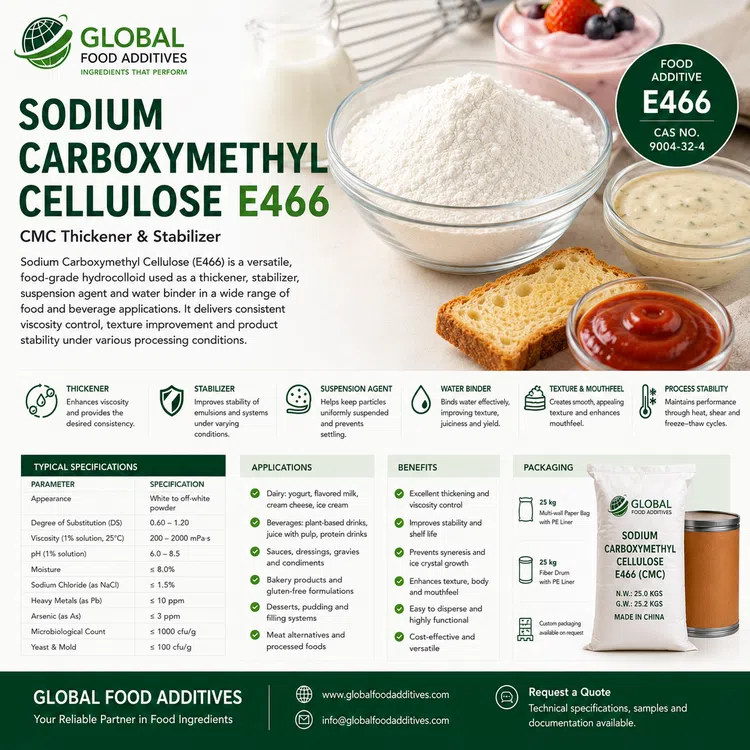
Product identity
| Product | Sodium Carboxymethyl Cellulose |
|---|---|
| Common names | Sodium CMC, CMC, cellulose gum, carboxymethylcellulose sodium |
| Category | Hydrocolloids, Gums & Gelling Agents |
| Function | Thickener / stabilizer / suspension agent / water binder / texture-control hydrocolloid |
| E / INS number | E466 / INS 466 |
| CAS / identity | 9004-32-4 |
| Ingredient family | Cellulose derivative / anionic hydrocolloid / cellulose gum |
| Typical form | Fine powder, low-dust powder, granule, agglomerated powder or instantized grade depending on supplier specification |
| Main technical role | Viscosity building, suspension, water binding, emulsion support, texture stabilization, syneresis reduction and mouthfeel improvement |
| Key grade variables | Viscosity grade, degree of substitution, purity, hydration speed, particle size, moisture, pH and microbiological quality |
| Use status | Confirm permitted food categories, use levels and label declaration by destination market |
Application fit
Potential use areas may include controlled and specification-driven systems such as:
- Dairy drinks, acidified milk drinks, yogurt-style systems and dairy desserts
- Beverages, powdered drink mixes, syrups and fruit preparations
- Sauces, dressings, condiments, soups and ready-meal systems
- Ice cream, frozen desserts and freeze-thaw-stable fillings
- Bakery fillings, glazes, toppings, creams and moisture-managed systems
- Meat alternatives, plant-based systems and textured prepared foods
- Confectionery, gels, coatings and low-fat formulations
- Dry premixes requiring controlled hydration, viscosity and suspension
Industrial function and formulation value
Sodium Carboxymethyl Cellulose is valued because it provides efficient viscosity, water binding and stabilization at relatively low use levels. In liquid systems, it can help suspend pulp, cocoa, minerals, spices, fruit particles or insoluble ingredients. In sauces and dressings, it can support body, pourability and storage stability. In dairy and frozen desserts, it can help improve texture, reduce ice crystal growth, manage syneresis and support smooth mouthfeel when properly hydrated.
CMC performance is grade-dependent. Low-viscosity grades may be used where dispersion and modest body are needed, while medium- and high-viscosity grades are selected for stronger thickening, suspension or texture. Highly purified grades may be preferred for sensitive foods, beverages and export products. Instantized or agglomerated grades may be preferred where fast hydration and reduced lumping are important.
Technical specification points to compare
Composition and grade identity
- Declared CMC grade and intended food application
- Viscosity value and test method, including concentration, temperature, spindle and shear conditions
- Degree of substitution and substitution uniformity where specified
- Purity, active matter or sodium carboxymethyl cellulose content
- Moisture, loss on drying and sodium content
- pH value of solution and solution clarity
- Compliance with food additive, FCC, JECFA, EU or customer-specific standards where required
Impurity and safety controls
- Heavy metals and elemental impurity limits
- Lead, arsenic, cadmium and mercury statements where required
- Sodium chloride and sodium glycolate limits where specified
- Etherification by-products and residual process-related substances where applicable
- Insoluble matter, foreign matter and visual contamination controls
- Microbiological specification for food-grade applications
- Allergen, GMO, irradiation and contamination statements where required
Physical properties
- Particle size or mesh distribution
- Bulk density and powder flowability
- Hydration speed and lumping tendency
- Dispersibility in cold water, warm water or dry premixes
- Dusting tendency and operator handling behavior
- Color, odor and visual appearance
- Caking tendency, moisture sensitivity and packaging barrier requirement
Process compatibility
- Suitability for beverages, dairy, sauces, frozen desserts, bakery fillings, dry blends or meat alternatives
- Compatibility with acids, salts, sugars, proteins, hydrocolloids, starches, minerals, colors and flavors
- Effect on viscosity, shear thinning, suspension, mouthfeel, syneresis and storage stability
- Behavior under pasteurization, UHT, hot-fill, retort, freezing, thawing and high-shear mixing where relevant
- Performance in low-pH, high-salt, high-sugar or calcium-rich systems
- Influence on additive declaration, texture claims and customer specifications
Formulation and application guidance
Sodium CMC should be selected according to the target function and process. If the objective is beverage suspension, the formulator should evaluate particle load, pH, acidity, minerals, heat process, storage time and mouthfeel. If the objective is sauce viscosity, shear profile, pourability, salt level and thermal stability become important. If the objective is frozen-dessert texture, the key factors include water binding, ice crystal control, freeze-thaw stability, protein interaction and hydrocolloid synergy.
- Dairy systems: evaluate protein stability, calcium interaction, pH, heat treatment, syneresis control, mouthfeel and storage behavior.
- Acidified beverages: review pH, pulp suspension, viscosity, flavor release, cloud stability, pasteurization and sediment control.
- Sauces and dressings: test viscosity, shear thinning, pourability, emulsion stability, salt tolerance, acid tolerance and storage stability.
- Frozen desserts: assess ice crystal control, meltdown, creaminess, freeze-thaw stability, overrun and hydrocolloid blend design.
- Bakery fillings: evaluate water binding, bake stability, pumpability, syneresis control, fruit suspension and clean cut.
- Meat alternatives: review moisture retention, bite, binding, juiciness, freeze-thaw behavior and interaction with plant proteins.
- Dry premixes: confirm particle-size match, segregation risk, dusting, hydration sequence, caking and label declaration.
Hydration, dispersion and viscosity development
Hydration strategy is one of the most important practical factors when using Sodium CMC. If the powder is added directly into water without proper dispersion, it can form surface-hydrated lumps that slow down complete hydration. Industrial plants often improve dispersion by dry-blending CMC with sugar, salt or other dry ingredients, adding it slowly under strong agitation, using eductors or selecting agglomerated or instantized grades.
Viscosity develops as CMC hydrates and the polymer chains expand in water. Final viscosity depends on grade, concentration, water quality, temperature, mixing energy, shear history, pH, salt level and hydration time. Because viscosity testing conditions vary by supplier, buyers should compare values only when test methods are aligned.
Performance drivers
- Viscosity grade and molecular weight profile
- Degree of substitution and substitution uniformity
- Particle size, instantization and dispersion method
- Water temperature, mixing speed and hydration time
- pH, salts, calcium, sugar and acid concentration
- Presence of proteins, starches, gums and emulsifiers
- Heat treatment, shear process and storage conditions
Typical validation work
- Viscosity curve at target concentration and temperature
- Hydration and lumping test under plant mixing conditions
- Suspension and sedimentation testing
- pH, salt and heat-stability screening
- Syneresis, freeze-thaw and storage-stability testing
- Mouthfeel, flavor-release and sensory evaluation
- Label and regulatory confirmation before launch
Suspension, water binding and texture stabilization
Sodium CMC can increase viscosity and build a weak stabilizing network that helps suspend insoluble particles. This is useful in beverages with fruit pulp, cocoa, minerals or cloud systems; sauces with spices or herbs; and fillings with fruit solids. It can also bind water and reduce separation in systems prone to syneresis, especially when combined with starches, pectins, carrageenan, guar gum, xanthan gum or proteins.
Texture design should be balanced carefully. Too little CMC may not prevent sedimentation or water separation, while excessive viscosity can create slimy mouthfeel, poor pourability or slow flavor release. The most successful formulations select the minimum effective grade and level based on real shelf-life trials and sensory targets.
Freeze-thaw, heat and process stability
In frozen desserts, fillings, sauces and prepared foods, Sodium CMC can help manage water migration and freeze-thaw damage. By binding water and supporting stable viscosity, it may reduce ice crystal growth, phase separation, drip loss and texture breakdown. Performance depends on the complete formulation, including sugar, salts, proteins, fats, starches and other hydrocolloids.
CMC can tolerate many common food processes, but grade selection is important for low-pH, high-salt, high-shear or mineral-rich systems. Buyers should confirm whether the grade is designed for acid stability, salt tolerance, beverage clarity, rapid hydration, high viscosity or low viscosity before approving a supplier.
Sodium CMC compared with related hydrocolloids
Sodium Carboxymethyl Cellulose belongs to a wider group of hydrocolloids and stabilizers. It should not be substituted one-for-one with xanthan gum, guar gum, pectin, carrageenan, alginate, methylcellulose, hydroxypropyl methylcellulose, modified starch or cellulose without formulation and regulatory review. Each ingredient provides different hydration behavior, viscosity profile, gelation, mouthfeel, pH tolerance, heat stability and label impact.
| Ingredient | Typical consideration |
|---|---|
| Sodium Carboxymethyl Cellulose | Cellulose gum used for thickening, stabilization, suspension, water binding, freeze-thaw support and mouthfeel improvement. |
| Xanthan Gum | Strong shear-thinning stabilizer with excellent suspension; different mouthfeel and viscosity profile from CMC. |
| Guar Gum | Galactomannan gum used for viscosity and water binding; hydration and texture differ from CMC. |
| Pectin | Fruit-derived hydrocolloid often used for gels and acidified dairy or fruit systems; requires specific pH, solids and calcium conditions. |
| Carrageenan | Seaweed-derived hydrocolloid used for dairy stabilization and gel textures; interacts strongly with milk proteins. |
| Alginate | Hydrocolloid used for calcium-set gels and restructuring systems; not equivalent to CMC thickening behavior. |
| Modified Starch | Provides body, process tolerance and texture in many systems, with different clarity, flavor release and viscosity behavior. |
| Methylcellulose / HPMC | Cellulose ethers with thermal gelation properties used in selected bakery and meat-alternative systems; different from Sodium CMC. |
Quality and food safety review
A robust Sodium Carboxymethyl Cellulose sourcing review should include more than product name and E number. Buyers should confirm exact viscosity grade, degree of substitution, purity, moisture, pH, particle size, hydration behavior, microbiological specification, impurity profile, packaging integrity, shelf life, origin, traceability, supplier qualification and change-control capability.
For audited beverage, dairy, sauce, dessert, bakery, meat-alternative, dry-mix and export supply chains, documentation quality can be as important as hydrocolloid performance. Before commercial approval, compare the supplier specification against the intended product category, process conditions, target technical function, customer requirements and destination-market additive rules.
Regulatory and labeling considerations
Sodium Carboxymethyl Cellulose is associated with E466 / INS 466, but permission depends on destination market, food category, use level, technical need and declaration format. Some markets may require declaration as cellulose gum, sodium carboxymethyl cellulose, carboxymethylcellulose sodium, thickener, stabilizer, E466, INS 466 or another market-specific wording.
Label and claim review is important for clean-label, natural-positioned, organic, infant food, gluten-free, vegan or specialty-diet products. Customer standards may restrict hydrocolloids even where local regulations permit them. Buyers should also verify whether the grade meets the purity and microbiological expectations for the target application.
Global Food Additives can support supplier communication and document collection; however, final responsibility for regulatory approval, use level, finished-product labeling, claims, customer approval and market placement remains with the buyer, importer, brand owner or manufacturer.
Documents to request
- Product specification or technical data sheet
- Batch-specific certificate of analysis for available lot
- Safety data sheet in the required language or format
- Food-grade or intended-use declaration
- Viscosity grade, viscosity test method and viscosity range
- Degree of substitution, purity, moisture, pH and active content information
- Particle-size distribution, hydration behavior and solubility guidance where relevant
- Sodium chloride, sodium glycolate or related impurity data where required
- Heavy metal and elemental impurity statements
- Microbiological specification and pathogen statements where required
- Allergen, GMO, vegan, gluten-free, irradiation and contamination statements where required
- Origin, manufacturer, shelf-life and storage information
- Label draft, packaging details and pallet configuration
- Manufacturing site certification such as GMP, HACCP, ISO, FSSC or food-safety certification where available
- Market-specific declarations requested by the destination country, customer or importer
- Change-control, traceability and recall-support information for audited supply chains
Packaging, storage and logistics
Sodium Carboxymethyl Cellulose packaging should protect the powder from moisture, contamination, caking, odor pickup and handling damage. Depending on supplier format and order volume, it may be supplied in multi-wall bags with inner liners, PE-lined bags, cartons, drums, pails or big bags. Packaging should support clean dosing, traceability and preservation of viscosity performance through the declared shelf life.
- Packaging size: confirm net weight per bag, carton, drum, pail or big bag and whether trial quantities are available.
- Moisture protection: request information on inner liner, sealing method, pallet wrapping and recommended storage humidity.
- Dry handling: review particle size, dusting tendency, bulk density, flowability, caking risk and operator exposure controls.
- Hydration control: confirm whether the grade is standard powder, low-dust, agglomerated, granulated or instantized for the buyer's mixing system.
- Storage: keep in original packaging, tightly closed, dry, cool, odor-free and protected from humidity, pests and damaged pallets.
- Transport: confirm HS code guidance, label requirements, pallet configuration, food-grade transport expectations and country-specific import documents.
- Traceability: ensure each package is clearly labeled with product name, batch number, net weight, shelf life, grade code and supplier identification.
Commercial purchasing notes
For industrial purchasing, quotation accuracy depends on the quality of the inquiry. The most useful request normally includes target CMC grade, viscosity range, test method, degree of substitution if required, purity requirement, particle size, intended application, hydration method, packaging size, quantity, destination country, delivery term, required documents and expected shipment date.
If the buyer already uses Sodium Carboxymethyl Cellulose, sharing an existing COA, label, TDS, SDS, sample specification or viscosity method helps compare alternatives more accurately. It is also useful to mention the final product type, pH, salt level, heat process, desired viscosity, hydration equipment, current processing issue, domestic or export market and whether fine powder, low-dust powder, granule, agglomerated or instantized grade is preferred.
Best-fit inquiry details
- Product name: Sodium Carboxymethyl Cellulose
- Accepted names: Sodium CMC, CMC or cellulose gum
- Required food grade and intended application
- E466 / INS 466 declaration requirement
- Viscosity grade and viscosity test method
- Degree of substitution, purity, pH, moisture and particle-size expectations
- Fine powder, granule, low-dust, agglomerated or instantized grade preference
- Target use in dairy, beverage, sauce, dessert, bakery, meat alternative or dry mix
- Quantity, annual forecast and repeat-order potential
- Destination country and delivery term
- Preferred packaging and labeling language
- Required certificates, declarations and regulatory documents
What we can coordinate
- Supplier specification comparison
- Viscosity-grade and particle-size discussion
- Hydration and application-fit document review
- Food-grade and additive documentation collection
- Packaging and logistics communication
- Export-ready quotation support
- Customer-specific documentation requests
How to request this product
Send the product name, target grade or reference specification, required viscosity range, viscosity test method, intended application, quantity, destination country, packaging preference, expected shipment date and required documents. If you already purchase Sodium Carboxymethyl Cellulose, attach or describe your existing specification, label, safety data sheet, certificate of analysis or viscosity data so supplier options can be compared more accurately.
Useful answers
What is Sodium Carboxymethyl Cellulose used for in food manufacturing?
Sodium Carboxymethyl Cellulose is used as a thickener, stabilizer, suspension agent, water binder and texture-control hydrocolloid in selected food systems. It is commonly reviewed for dairy systems, beverages, sauces, desserts, bakery fillings, frozen foods, meat alternatives and dry mixes.
Is Sodium Carboxymethyl Cellulose the same as cellulose gum?
Yes. Sodium Carboxymethyl Cellulose is commonly called Sodium CMC, CMC or cellulose gum. Commercial grades differ by viscosity, degree of substitution, particle size, hydration speed and purity.
Does Sodium CMC form gels?
Sodium CMC is mainly used for thickening, stabilization, suspension and water binding. It does not behave like a universal gel former; gel texture depends on the wider formulation and any other hydrocolloids, proteins, salts or solids used.
Why does viscosity grade matter?
Viscosity grade controls how much body and suspension the ingredient provides at a given use level. Low-, medium- and high-viscosity grades are not interchangeable without testing because they affect mouthfeel, processing, pumping, filling and stability differently.
Can Global Food Additives source Sodium Carboxymethyl Cellulose?
Global Food Additives can review sourcing options for Sodium Carboxymethyl Cellulose according to target specification, viscosity grade, food grade, particle size, application, quantity, destination, packaging and required documentation.
Which documents should be requested?
Buyers commonly request a technical data sheet or specification, certificate of analysis, safety data sheet, food-grade declaration, viscosity data, degree of substitution, purity, moisture, pH, particle-size information, microbiological data, shelf-life information, label and packing details and market-specific declarations.
Is this product permitted in every country?
No. Food additive use depends on destination-market rules, food category, use level, additive declaration, label requirements, technical need and buyer responsibility.
Tell us which food additive or ingredient you need.
Send product names, target specifications, quantity, destination country, packaging preference, delivery term and document requirements. Our team will review your inquiry and respond from orders@foodgradeadditives.com.
Your message has been received. You will be redirected to the home page.