
Sodium Hexametaphosphate
Sodium Hexametaphosphate, commonly abbreviated as SHMP, is a condensed sodium phosphate used in selected food and beverage systems for sequestration, mineral control, water-hardness management, dispersion, protein stabilization, buffering support and process consistency where permitted. It is especially relevant where calcium, magnesium, iron, copper or other metal ions can affect clarity, color, flavor, texture, emulsion stability or shelf-life performance.
For industrial buyers, Sodium Hexametaphosphate should be evaluated as a functional phosphate system rather than a generic salt. The correct grade depends on phosphate assay, P2O5 value, chain length distribution, pH, solubility, insoluble matter, particle size, sodium contribution, impurity limits, packaging quality, destination-market compliance and the intended food matrix.
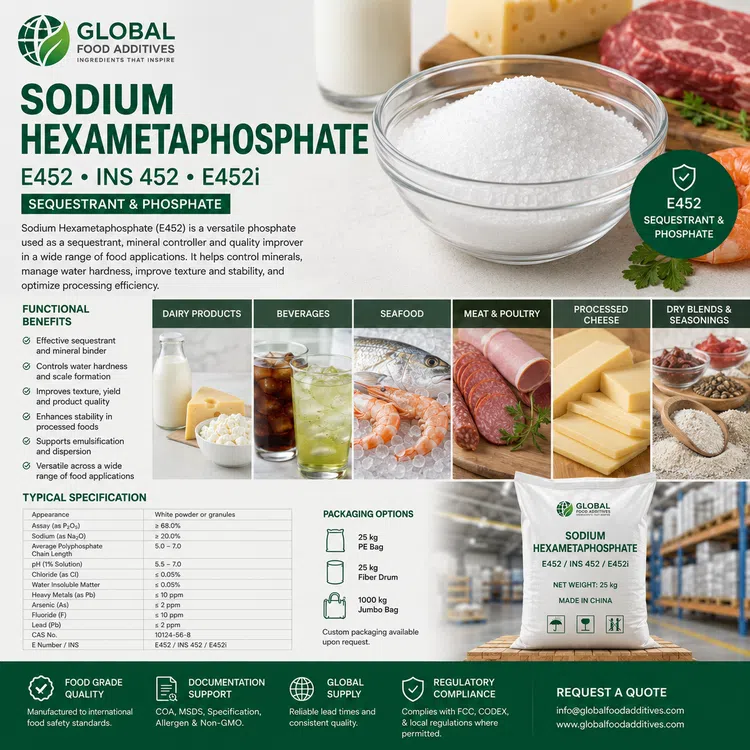
Product identity
| Product | Sodium Hexametaphosphate |
|---|---|
| Common abbreviation | SHMP |
| Commercial names | Sodium polymetaphosphate, hexasodium metaphosphate, Graham's salt depending on grade and market convention |
| Category | Phosphates, Salts & Sequestrants |
| Function | Phosphate sequestrant / mineral-control ingredient / stabilizer / dispersing salt |
| E / INS number | E452 / INS 452; often referenced within sodium polyphosphates |
| CAS / identity | 10124-56-8; related sodium polymetaphosphate references may appear in supplier documents |
| Idealized formula | (NaPO3)6 |
| Ingredient family | Condensed sodium phosphate / sodium polyphosphate |
| Typical form | White powder, glassy granule, crystalline powder, flake or solution grade depending on supplier specification |
| Main technical role | Sequestration, water-hardness control, protein and mineral stabilization, dispersion and phosphate functionality |
| Use status | Confirm permitted food categories, maximum phosphate levels and label declaration by destination market |
Application fit
Potential use areas may include:
- Beverages, syrups and mineral-sensitive liquid systems
- Dairy systems, processed cheese and cheese preparations
- Seafood, fish fillets, shrimp and surimi applications
- Meat, poultry, brines and prepared-food systems where permitted
- Ice cream, frozen desserts and dessert preparations
- Sauces, dressings, soups and ready-meal components
- Bakery, dough systems and dry ingredient blends
- Starch, protein, flavor, color and mineral premix systems
Industrial function and formulation value
Sodium Hexametaphosphate is primarily valued for its sequestration and mineral-control performance. It can interact with calcium, magnesium and trace metals, helping reduce precipitation, cloudiness, scale formation, color instability, oxidative quality loss and unwanted protein-mineral interactions. In liquid products, this can support clarity and processing consistency. In dairy, cheese, seafood, meat and prepared foods, it may support texture, hydration, dispersion and emulsion stability depending on the formulation.
The commercial value of SHMP is usually measured by cost-in-use and consistency rather than only price per kilogram. A lower-priced grade may create problems if it has poor solubility, high insoluble matter, unsuitable pH, inconsistent chain length, excessive impurities, caking, slow dissolution or weak documentation. Buyers should compare supplier options using application trials, analytical documents, logistics reliability and regulatory suitability.
Technical specification points to compare
Composition and phosphate assay
- Declared phosphate type and commercial grade name
- Total phosphate content on the supplier's stated basis
- P2O5 value or phosphate assay where specified
- Polyphosphate or metaphosphate content where available
- Chain length distribution or degree of polymerization where relevant
- Sodium contribution to the finished formulation
- pH of solution and buffering behavior
- Compliance with food additive, FCC, JECFA, EU or customer-specific standards where required
Impurity and safety controls
- Heavy metals and elemental impurity limits
- Lead, arsenic, cadmium and mercury statements where required
- Fluoride limits where applicable to phosphate ingredients
- Water-insoluble matter and solution clarity
- Orthophosphate, pyrophosphate or related phosphate fraction where specified
- Foreign matter, color, odor and appearance controls
- Microbiological statement where relevant to the supplied grade
- Allergen, GMO, irradiation and contamination statements where required
Physical properties
- Particle size or mesh distribution
- Bulk density and flowability
- Solubility and dissolution speed in cold or warm water
- Dusting tendency and handling behavior
- Moisture content and loss on drying
- Hygroscopicity, caking tendency and hydrolysis risk during storage
- Compatibility with automatic dosing, solution preparation or dry premixes
Process compatibility
- Suitability for dry blending, solution preparation, brines, beverage systems or cheese processing
- Compatibility with proteins, minerals, acids, salts, hydrocolloids, starches, colors and flavors
- Effect on water hardness, pH, buffering capacity and ionic strength
- Impact on clarity, precipitation, sedimentation, emulsion stability and texture
- Stability under heat treatment, chilled storage, freezing, thawing and long hold times
- Influence on sodium declaration, phosphate labeling and customer specifications
Formulation and application guidance
Sodium Hexametaphosphate should be selected according to the target technical function. If the main requirement is beverage clarity, the formulator should evaluate water hardness, pH, mineral content, color stability and precipitation risk. If the target is dairy or processed cheese stability, calcium control, protein hydration and heat behavior become more important. If the target is seafood or meat performance, solubility, brine clarity, phosphate level, texture, yield and label restrictions should be reviewed.
- Beverages and syrups: evaluate water hardness, calcium and magnesium control, clarity, sediment prevention, pH behavior, color stability and compatibility with acids, sweeteners and preservatives.
- Dairy and processed cheese: review calcium sequestration, casein hydration, heat stability, melt behavior, viscosity, emulsion stability and pH target.
- Seafood and surimi: assess water retention, texture, drip loss, freeze-thaw performance, brine solubility, glazing compatibility and permitted phosphate limits.
- Meat and poultry systems: validate water-holding capacity, protein extraction, brine stability, injection performance, cook yield, purge control and sensory impact.
- Ice cream and frozen desserts: check mineral stabilization, protein interaction, emulsion performance, texture, meltdown behavior and freeze-thaw stability.
- Sauces and ready meals: test emulsion stability, mineral interaction, starch and protein behavior, viscosity, heat stability and finished-product sensory quality.
- Dry premixes: evaluate particle size match, segregation risk, dusting, flowability, moisture protection and shelf-life stability.
Sequestration and water-hardness control
One of the most valuable functions of Sodium Hexametaphosphate is its ability to manage dissolved minerals. In hard-water systems, calcium and magnesium can cause precipitation, scale, cloudiness, sediment, flavor instability and reduced performance of other ingredients. SHMP can help control these interactions by binding or sequestering minerals, supporting a more stable liquid or semi-solid matrix.
Trace metals such as iron and copper can also contribute to oxidation, discoloration and flavor deterioration in sensitive products. By reducing metal-ion reactivity, SHMP may help protect color, aroma and shelf-life performance as part of a complete formulation system. The effect depends on pH, mineral load, competing ions, processing temperature, storage time and the selected phosphate grade.
Performance drivers
- Water hardness and mineral profile
- Calcium, magnesium, iron and copper sensitivity
- Target pH and buffering requirement
- SHMP chain length and solubility
- Salt concentration and ionic strength
- Protein, hydrocolloid, starch and mineral interactions
- Heat treatment, cooling profile and storage time
Typical validation work
- Solubility and clarity testing
- Hard-water compatibility screening
- Calcium and magnesium precipitation checks
- pH and buffering-curve comparison
- Heat-treatment and storage-stability trials
- Texture, viscosity and emulsion checks where relevant
- Finished-product sensory and label review
Protein, dairy and texture functionality
In protein-containing systems, Sodium Hexametaphosphate can influence hydration, mineral balance and protein-mineral interactions. In processed cheese and dairy systems, phosphate selection affects calcium binding, casein behavior, melt profile, viscosity, emulsion stability and heat tolerance. In meat and seafood systems, phosphate functionality may influence water retention, texture and process yield where permitted.
The correct phosphate choice depends on the product's pH, protein type, calcium level, salt content, thermal process and desired texture. SHMP may be used alone or as part of a phosphate blend when a formulation requires both sequestration and additional phosphate functions. Substitution with STPP, SAPP, TSPP or sodium citrate should be validated through plant trials because each ingredient has different pH, solubility and mineral-binding behavior.
Sodium Hexametaphosphate compared with related phosphates
Sodium Hexametaphosphate belongs to the broader family of sodium polyphosphates. It should not be substituted one-for-one with sodium tripolyphosphate, sodium acid pyrophosphate, tetrasodium pyrophosphate, trisodium phosphate, monosodium phosphate or sodium citrate without formulation and regulatory review. Each ingredient provides different pH behavior, sequestration strength, solubility, protein functionality, sodium contribution and label impact.
| Ingredient | Typical consideration |
|---|---|
| Sodium Hexametaphosphate | Strong sequestration and mineral-control profile; often selected for hard-water, beverage, dairy, seafood and mineral-sensitive systems. |
| Sodium Tripolyphosphate | Common meat and seafood phosphate; often selected for water retention, protein functionality and brine systems. |
| Tetrasodium Pyrophosphate | Alkaline phosphate used in selected protein, seafood, meat and processed-food systems where pH and functionality fit. |
| Sodium Acid Pyrophosphate | Acid phosphate used in leavening systems, color control and selected processing applications; not directly equivalent to SHMP. |
| Monosodium / Disodium Phosphate | Orthophosphate salts used for buffering and pH adjustment with different sequestration and texture effects. |
| Sodium Citrate | Common buffer and calcium-control ingredient with different flavor, pH and label profile from polyphosphates. |
Quality and food safety review
A robust Sodium Hexametaphosphate sourcing review should include more than basic identity and price. Buyers should confirm exact phosphate grade, food-grade suitability, assay, P2O5 value, pH, solubility, insoluble matter, impurity profile, microbiological statement, packaging integrity, shelf life, origin, traceability and supplier change-control capability.
For audited beverage, dairy, cheese, meat, seafood, bakery, sauce and export supply chains, documentation quality can be as important as product performance. Before commercial approval, compare the supplier specification against the intended product category, process conditions, technical function, customer requirements and destination-market additive rules.
Regulatory and labeling considerations
Sodium Hexametaphosphate is associated with E452 / INS 452 and is often discussed within the sodium polyphosphate group. Permission depends on the destination market, food category, maximum permitted phosphate level and technical need. Some markets may require declaration by additive class, E number, INS number or ingredient name. Phosphate addition may also affect nutrition labeling, sodium declaration, customer restrictions and clean-label positioning.
Global Food Additives can support supplier communication and document collection; however, final responsibility for regulatory approval, use level, finished-product labeling, nutrition claims, phosphate declaration and market placement remains with the buyer, importer, brand owner or manufacturer.
Documents to request
- Product specification or technical data sheet
- Batch-specific certificate of analysis for available lot
- Safety data sheet in the required language or format
- Food-grade or intended-use declaration where available
- Phosphate type, assay, P2O5 value and pH information
- Solubility, insoluble matter and particle-size data where relevant
- Heavy metal, fluoride and impurity statements
- Microbiological statement or specification where relevant
- Allergen, GMO, vegan, halal or kosher statements where required
- Origin, manufacturer, shelf-life and storage information
- Label draft, packaging details and pallet configuration
- Manufacturing site certification such as GMP, HACCP, ISO or FSSC where available
- Market-specific declarations requested by the destination country, customer or importer
- Change-control, traceability and recall-support information for audited supply chains
Packaging, storage and logistics
Sodium Hexametaphosphate is commonly supplied in sealed bags, cartons, drums, big bags or supplier-specific packaging systems designed to protect the product from moisture, contamination, caking and handling damage. Packaging should be matched to the customer's production scale, dosing system, warehouse conditions and documentation requirements.
- Packaging size: confirm net weight per bag, carton, drum or big bag and whether small-pack options are available for trials or pilot production.
- Moisture protection: request information on inner liner, sealing method, pallet wrapping and recommended storage humidity.
- Handling: review dusting tendency, PPE recommendations and safe weighing procedures for powder, granular or glassy phosphate grades.
- Warehouse control: keep packaging closed, dry and protected from humidity, strong odors, contamination and damaged pallets.
- Solution preparation: confirm recommended mixing sequence, dissolution temperature, hold time and filtration needs where relevant.
- Transport: confirm HS code guidance, labeling requirements, country-specific import documents and pallet configuration.
- Traceability: ensure each package is clearly labeled with product name, batch number, net weight, shelf life and supplier identification.
Commercial purchasing notes
For industrial purchasing, quotation accuracy depends on the quality of the inquiry. The most useful request normally includes target grade, exact phosphate type, reference specification, required assay, P2O5 value, pH target, solubility requirement, particle size, quantity, destination country, Incoterms preference, packaging size, required documents and expected shipment date.
If the buyer already uses Sodium Hexametaphosphate, sharing an existing COA, label, TDS, SDS or internal specification helps compare alternatives more accurately. It is also useful to mention the final application, current phosphate system, process water quality, target pH, mineral sensitivity, heat process, domestic or export market and whether dry or solution-grade material is preferred.
Best-fit inquiry details
- Product name: Sodium Hexametaphosphate
- Accepted abbreviation: SHMP
- Required food grade and intended application
- E452 / INS 452 declaration requirement
- Assay, P2O5, pH, solubility and impurity expectations
- Powder, glassy granule, crystalline, flake or solution format preference
- Quantity, annual forecast and repeat-order potential
- Destination country and delivery term
- Preferred packaging and labeling language
- Required certificates, SDS and regulatory declarations
What we can coordinate
- Supplier specification comparison
- Document collection and pre-shipment review
- Packaging and logistics communication
- Export-ready quotation support
- Alternative phosphate or phosphate-blend discussion
- Customer-specific documentation requests
How to request this product
Send the product name, target grade or reference specification, phosphate assay requirement, quantity, destination country, packaging preference, expected shipment date and required documents. If you already purchase Sodium Hexametaphosphate, attach or describe your existing specification, label, safety data sheet or certificate of analysis so supplier options can be compared more accurately.
Useful answers
What is Sodium Hexametaphosphate used for in food manufacturing?
Sodium Hexametaphosphate is used as a sequestrant, mineral-control ingredient, phosphate stabilizer and dispersing salt in selected food systems where permitted. It is often reviewed for hard-water control, beverage clarity, dairy stabilization, seafood texture, meat brine systems and processed cheese functionality.
Is Sodium Hexametaphosphate the same as SHMP?
Yes. SHMP is the common abbreviation for Sodium Hexametaphosphate. Supplier documents may also use terms such as sodium polymetaphosphate or sodium polyphosphate depending on the commercial grade.
Can Sodium Hexametaphosphate replace Sodium Tripolyphosphate?
Not automatically. SHMP and Sodium Tripolyphosphate have different sequestration, pH, solubility and protein-functionality profiles. Substitution should be validated through application trials, sensory review, process testing and regulatory confirmation.
Why is water hardness important when using SHMP?
Water hardness affects calcium and magnesium availability, which can influence precipitation, clarity, texture and ingredient performance. SHMP is often selected when a formula needs mineral-control support in hard-water or mineral-sensitive systems.
Can Global Food Additives source Sodium Hexametaphosphate?
Global Food Additives can review sourcing options for Sodium Hexametaphosphate according to target specification, phosphate assay, quantity, destination, packaging and required documentation.
Which documents should be requested?
Buyers commonly request a technical data sheet or specification, certificate of analysis, safety data sheet, origin statement, shelf-life information, label and packing details, impurity statements, phosphate assay, P2O5 value, pH data and market-specific declarations.
Is this product permitted in every country?
No. Food additive use depends on destination-market rules, food category, maximum permitted phosphate level, label declaration, technical need, sodium contribution and buyer responsibility.
Tell us which food additive or ingredient you need.
Send product names, target specifications, quantity, destination country, packaging preference, delivery term and document requirements. Our team will review your inquiry and respond from orders@foodgradeadditives.com.
Your message has been received. You will be redirected to the home page.