
Sodium Selenite
Sodium Selenite is an inorganic selenium source used in carefully controlled food, nutrition and fortification systems where a standardized trace mineral input is required. Because selenium is dosed at very low levels, successful industrial use depends on validated specification review, premix dilution, homogeneous distribution, batch traceability and destination-market regulatory approval.
This page is prepared for purchasing teams, R&D formulators, quality managers and import coordinators who need a practical technical basis for sourcing Sodium Selenite, comparing supplier documents, requesting quotations and confirming suitability before commercial use.
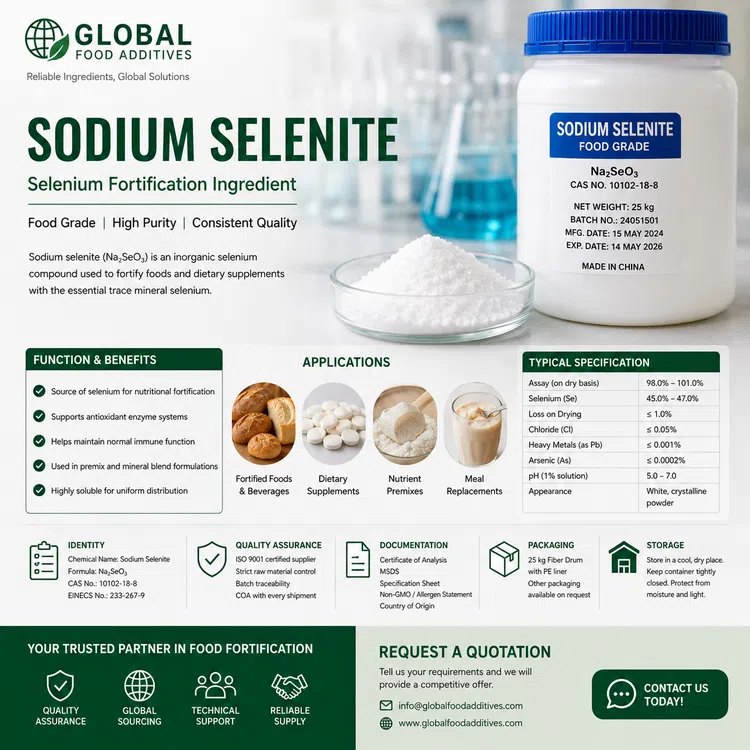
Product identity
| Product | Sodium Selenite |
|---|---|
| Common name | Disodium selenite |
| Category | Fortification Nutrients |
| Function | Trace mineral fortification ingredient and selenium source |
| Chemical formula | Na2SeO3 |
| CAS / identity | 10102-18-8 |
| Molecular weight | Approximately 172.94 g/mol for anhydrous material |
| Typical form | Fine powder, diluted premix, granule, beadlet or solution grade depending on supplier specification |
| Use status | Confirm permission, food category, use level and labeling rules by destination market |
Application fit
Potential use areas may include controlled selenium fortification in:
- Vitamin and mineral premixes
- Flour, cereal and grain-based fortification systems where permitted
- Dairy, powdered beverage and nutrition blends
- Infant, medical and special nutrition products where permitted
- Tablet, capsule, sachet and dry-blend nutritional applications
- Industrial premix operations requiring low-dose mineral standardization
Industrial function and value
Sodium Selenite provides selenium in a highly concentrated inorganic form. In food and nutrition manufacturing, its value is not based on bulk addition but on precision: micro-dosing, uniform dispersion and consistent mineral contribution across finished batches. For this reason, many manufacturers do not dose neat Sodium Selenite directly into the main mixer. Instead, they request a diluted premix or pre-blended carrier system that improves weighing accuracy, reduces segregation risk and supports better batch-to-batch repeatability.
For industrial buyers, the main technical questions are: whether the grade is suitable for food or nutrition use, whether the assay and impurity profile match the target specification, whether the physical form is compatible with the process, and whether the documentation package is strong enough for import, quality approval and customer audits.
Technical specification points to compare
Composition and assay
- Assay of Sodium Selenite or selenium content basis
- Anhydrous or hydrate status, where applicable
- Calculation basis for selenium contribution in finished product
- Batch-to-batch consistency and tolerance range
- Compatibility with premix dilution and carrier systems
Purity and contaminants
- Heavy metals and elemental impurity limits
- Arsenic, lead, cadmium and mercury limits where required
- Microbiological requirements for food or nutrition applications
- Residual solvent or process impurity statements where applicable
- Compliance with buyer, customer or market-specific specifications
Physical properties
- Particle size or mesh range
- Bulk density and flowability
- Solubility or dispersibility expectations
- Moisture level and hygroscopicity considerations
- Color, odor and appearance control
Process behavior
- Suitability for dry blending, premixing or solution preparation
- Risk of segregation in low-inclusion formulations
- Compatibility with carriers such as maltodextrin, starch, dextrose or mineral premix bases
- Stability under expected storage and processing conditions
- Recommended addition point in the manufacturing process
Formulation and premix guidance
Because Sodium Selenite is a concentrated trace mineral source, inclusion levels are normally very low. In practical production, the best approach is often to convert the ingredient into a controlled premix with a validated carrier and an agreed dilution ratio. This can improve operator safety, weighing reliability, distribution uniformity and documentation traceability.
- For dry products: request information on particle size, carrier compatibility, anti-caking needs, blending sequence and segregation risk during transport or hopper discharge.
- For powdered beverages and nutrition blends: confirm solubility expectations, visual impact, pH sensitivity, interaction with vitamins or other minerals, and finished-product mineral declaration basis.
- For cereal and flour systems: verify the legal fortification framework, target selenium level, premix distribution method and process validation requirements.
- For special nutrition products: request stricter documentation, contaminant controls, allergen statements, change-control commitments and batch-specific certificates.
Quality and food safety review
A serious Sodium Selenite sourcing review should go beyond price comparison. Buyers should compare supplier qualification, manufacturing controls, specification limits, batch analytical results, packaging integrity, traceability and the ability to support audits or customer questionnaires. For sensitive nutrition applications, the buyer may also request information about HACCP, GMP, ISO, FSSC, halal, kosher or other certification status where relevant.
Recommended quality checks
- Confirm food, nutrition or supplement grade suitability
- Review assay and selenium calculation basis
- Check heavy metal and impurity limits
- Confirm shelf life and storage conditions
- Request batch-specific COA before shipment where possible
- Review packaging photos, label draft and pallet configuration
Operational risk controls
- Use controlled weighing procedures for micro-ingredients
- Prefer premix dilution for very low dosing levels
- Validate blending time and uniformity
- Prevent cross-contamination during handling
- Train operators on SDS and PPE requirements
- Keep batch traceability from raw material to finished product
Regulatory and labeling considerations
Sodium Selenite may be treated differently depending on whether the finished product is a conventional food, fortified staple, food supplement, infant formula, medical nutrition product or animal nutrition product. The buyer should confirm whether Sodium Selenite is an allowed selenium source, which food categories are permitted, what maximum levels apply, how selenium must be declared, and whether any nutrition or health claims are allowed.
Global Food Additives can support document collection and supplier communication, but final approval for formulation, claims, labeling and market placement remains the responsibility of the buyer, importer, brand owner or manufacturer.
Documents to request
- Product specification or technical data sheet
- Batch-specific certificate of analysis
- Safety data sheet in the required language or format
- Food-grade, nutrition-grade or intended-use declaration where available
- Heavy metal and impurity statement
- Allergen, GMO, vegan, halal or kosher statements where required
- Origin, manufacturer, shelf-life and storage information
- Label draft, packaging details and pallet configuration
- Manufacturing site certification such as GMP, HACCP, ISO or FSSC where available
- Market-specific declarations requested by the destination country, customer or importer
- Change-control, traceability and recall-support information for audited supply chains
Packaging, storage and logistics
Packaging should protect Sodium Selenite from moisture, contamination and handling damage. Common options may include sealed bags, fiber drums, cartons, composite drums or supplier-specific inner liner systems. For premix-diluted versions, packaging may also depend on the carrier material, bulk density and the customer's dosing equipment.
- Packaging size: confirm net weight per bag, drum or carton and whether small-pack options are available for low-volume users.
- Moisture protection: request information on liner type, sealing method and recommended storage humidity.
- Transport: confirm HS code guidance, dangerous goods status where applicable, labeling requirements and country-specific import documents.
- Storage: keep tightly closed in original packaging, away from incompatible materials, excessive humidity and uncontrolled production areas.
- Traceability: ensure each package is clearly labeled with product name, batch number, net weight, shelf life and supplier identification.
Commercial purchasing notes
For quotation accuracy, the most useful inquiry includes the target specification, required assay, annual forecast, first order quantity, destination country, packaging size, Incoterms preference, required documents and expected delivery window. If the buyer already purchases Sodium Selenite, an existing COA, label, TDS or reference specification can help compare alternatives more accurately.
Best-fit inquiry details
- Product name: Sodium Selenite
- Required grade and intended use
- Assay or selenium-content target
- Neat material or diluted premix requirement
- Quantity, forecast and repeat-order potential
- Destination country and delivery term
- Preferred packaging and labeling language
- Required certificates and declarations
What we can coordinate
- Supplier specification comparison
- Document collection and pre-shipment review
- Packaging and logistics communication
- Export-ready quotation support
- Alternative grade or premix discussion
- Customer-specific documentation requests
How to request this product
Send the product name, target grade or reference specification, quantity, destination country, packaging preference, expected shipment date and required documents. If you already purchase Sodium Selenite, attach or describe your existing specification, label or certificate of analysis so supplier options can be compared more accurately.
Useful answers
What is Sodium Selenite used for in food manufacturing?
Sodium Selenite is used as a controlled selenium source in fortification, enrichment and nutritional premix systems where permitted. Because it is a concentrated trace mineral ingredient, it is normally handled through accurate dosing systems or diluted premixes.
Is Sodium Selenite the same as selenium?
No. Sodium Selenite is a sodium salt that provides selenium. Formulators normally calculate the selenium contribution based on assay, molecular basis and supplier specification.
Can Global Food Additives source Sodium Selenite?
Global Food Additives can review sourcing options for Sodium Selenite according to target specification, grade, quantity, destination, packaging and required documentation.
Should Sodium Selenite be purchased as neat powder or premix?
Many industrial users prefer a diluted premix because selenium dosing levels are low and require excellent distribution uniformity. The best format depends on the customer's process, equipment, target use level and quality system.
Which documents should be requested?
Buyers commonly request a specification, certificate of analysis, safety data sheet, origin statement, shelf-life data, storage conditions, impurity profile, packaging details and market-specific declarations.
Is this product permitted in every country?
No. Food additive, fortification and nutrition ingredient use depends on destination-market rules, food category, use level, label requirements, claims and buyer responsibility.
Tell us which food additive or ingredient you need.
Send product names, target specifications, quantity, destination country, packaging preference, delivery term, and document requirements. Our team will review your inquiry and respond from orders@foodgradeadditives.com.
Your message has been received. You will be redirected to the home page.