
Sodium Sulphite E221
Sodium Sulphite is a food-grade sulphiting agent used in industrial food manufacturing for antioxidant protection, oxygen scavenging, browning control, colour retention, reducing activity and microbial shelf-life support in selected applications. It is commonly evaluated in beverages, wine-related systems, dried fruits, potato products, sauces, seafood, crustaceans, selected bakery ingredients and processing systems where sulphite use is legally permitted.
For professional purchasing, Sodium Sulphite should be reviewed by food-grade identity, E / INS status, CAS identity, assay as Na2SO3, sulphur dioxide equivalence, residual sulphite contribution, solubility, oxidation sensitivity, particle size, pH, impurity profile, allergen or sulphite declaration, packaging suitability, shelf life and destination-market regulations. Because sulphites can trigger mandatory labelling and consumer-sensitivity requirements, regulatory review is essential before use.
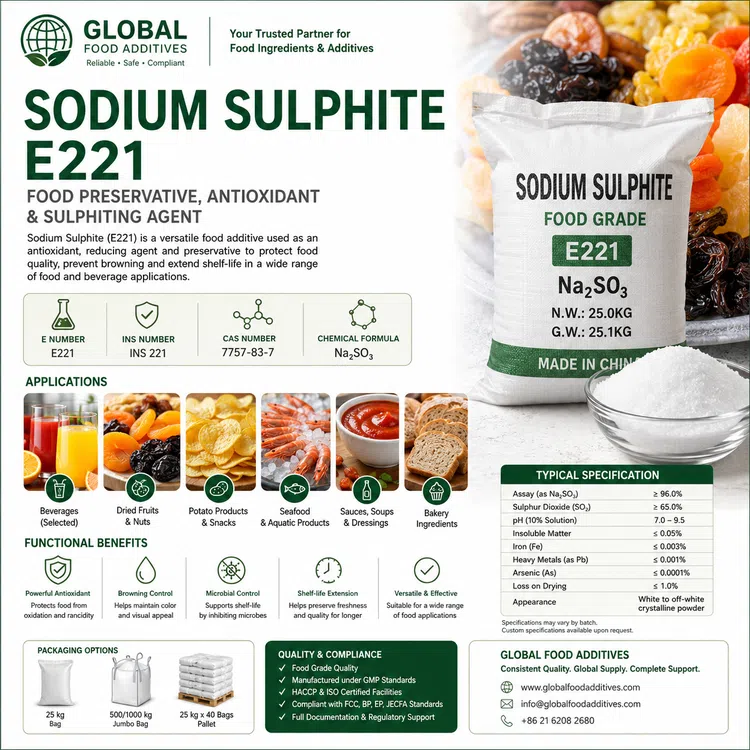
Product identity
| Product | Sodium Sulphite |
|---|---|
| Category | Preservatives & Antimicrobials |
| Function | Preservative / antioxidant / reducing agent / sulphiting agent / browning-control ingredient |
| E / INS number | E221 / INS 221 |
| CAS / identity | 7757-83-7 |
| Formula | Na2SO3 |
| Common spelling variants | Sodium sulphite, sodium sulfite |
| Typical form | White crystalline powder, crystals or granules; liquid solution grades are supplier-specific if offered |
| Technical character | Water-soluble sulphite salt with reducing, antioxidant and sulphur dioxide equivalent functionality |
Application fit
Potential use areas may include:
- Beverages, wine-related systems and acidified drink applications where permitted
- Dried fruits, fruit preparations and colour-sensitive fruit systems
- Potato products and vegetable-processing systems where sulphite use is allowed
- Sauces, condiments, syrups and culinary products requiring oxidation control
- Seafood, shrimp and crustacean-processing systems where permitted
- Selected bakery ingredients, dough conditioners or processing aids where legally suitable
- Sugar, starch or ingredient-processing systems requiring reducing conditions
- Industrial food applications needing oxygen scavenging, colour protection or browning control
Industrial functionality
Sodium Sulphite is selected when a food or ingredient system requires reducing conditions, oxygen management, enzymatic browning control, oxidative colour protection or sulphite-based preservation. In practical industrial use, it may help inhibit browning in certain fruit or vegetable systems, protect colour-sensitive ingredients, reduce oxidative deterioration, support microbial stability in selected acidic systems and contribute sulphur dioxide equivalents to the finished product. Its performance is strongly influenced by pH, oxygen exposure, heat process, residual sulphite level, raw material quality, packaging and storage conditions.
Functional contribution
- Antioxidant protection: helps reduce oxidative colour and flavour deterioration in selected food and beverage systems.
- Oxygen scavenging: reacts with oxygen and oxidative species, supporting protection in oxygen-sensitive formulations.
- Browning control: can help limit enzymatic and non-enzymatic browning in suitable fruit, vegetable and ingredient systems.
- Reducing agent function: supports process conditions where a reducing environment is required.
- Sulphiting action: contributes sulphite / SO2 equivalents that must be calculated and controlled for regulatory compliance.
- Microbial shelf-life support: may assist preservation in selected acidic systems when used with proper pH, sanitation, heat process and packaging.
Application engineering notes
- Beverages: evaluate pH, dissolved oxygen, residual SO2, flavour impact, colour stability and labelling requirements.
- Dried fruits: review colour retention, residual sulphite, moisture, water activity, packaging barrier and sensory impact.
- Potato and vegetable systems: test browning control, blanching conditions, residual sulphite, texture and regulatory suitability.
- Seafood: validate melanosis control, dip concentration, contact time, uptake, residual sulphite and market-specific limits.
- Sauces and syrups: check pH, oxygen exposure, headspace, metal-ion interaction, flavour, colour and preservative compatibility.
- Bakery and ingredient systems: confirm legal permission, intended role, reducing effect, dough impact and customer label restrictions.
Sulphite performance factors
Sodium Sulphite should be evaluated in the finished product and process, not only in water. The same dosage can behave differently depending on pH, dissolved oxygen, heat exposure, transition metals, product solids, water activity, packaging, residual sulphite testing and storage temperature. In many markets, sulphites are also treated as sensitivity-related ingredients requiring special declaration above defined thresholds, so both technical and regulatory teams should review the formulation before launch.
| Factor | Why it matters industrially |
|---|---|
| pH of the system | Influences sulphite species, antimicrobial effect, SO2 activity, flavour impact and stability. |
| Dissolved oxygen | Higher oxygen exposure can consume sulphite faster and reduce residual protection. |
| Heat process | Heating may reduce residual sulphite, affect flavour and change the balance between process protection and final declaration. |
| Metal ions | Iron, copper and other metals can accelerate oxidation and influence sulphite demand. |
| Raw material load | High enzymatic activity, phenolics, pigments or microbial load can increase sulphite requirement. |
| Residual SO2 target | Regulatory compliance often depends on final residual sulphite or SO2 equivalent, not only the addition rate. |
| Packaging barrier | Oxygen transmission, headspace and seal integrity influence shelf-life protection. |
| Consumer labelling | Sulphite declaration requirements can affect label design, market access and customer acceptance. |
Typical specification points to compare
Exact limits vary by manufacturer, grade and applicable food-additive standard. The following parameters are practical checkpoints for procurement, R&D and QA teams when comparing suppliers or approving a new Sodium Sulphite grade.
| Parameter | Why it matters industrially |
|---|---|
| Assay as Na2SO3 | Confirms active sodium sulphite content and enables accurate dosage calculation. |
| SO2 equivalence | Supports regulatory calculations, residual sulphite control and label review. |
| pH in solution | Relevant for compatibility with beverage, sauce, seafood dip and ingredient-processing systems. |
| Sulphate content | Indicates oxidation level and possible loss of active reducing capacity. |
| Thiosulphate and related sulphur species | Useful impurity checks for food-grade quality and process consistency. |
| Insoluble matter | Important for solution clarity, filters, injectors, dip tanks and beverage or syrup applications. |
| Particle size | Affects dry blending, dissolution speed, dosing accuracy, dusting and segregation. |
| Moisture / loss on drying | Important for caking, flowability, oxidation stability and storage life. |
| Iron | Low iron is important where colour, haze, oxidation or flavour stability is sensitive. |
| Heavy metals, lead and arsenic | Required for food safety, customer approval and destination-market compliance. |
| Microbiological limits | Relevant for ready-to-eat products, direct addition, dry blends and supplier approval. |
| Food-grade and sulphite declarations | Confirm suitability for food use and support regulatory, allergen and customer documentation review. |
Formulation and processing considerations
Sodium Sulphite may be added as a dry ingredient, dissolved into a solution, used in dip systems, included in premixes or applied as part of a controlled sulphiting step. Manufacturers should confirm addition point, dissolution method, water temperature, pH, contact time, oxygen exposure, residual sulphite testing and compatibility with acids, colours, flavours, metals, proteins, starches, enzymes, preservatives and packaging materials. Because sulphite can react during processing and storage, addition rate and residual level should both be monitored.
Production checkpoints
- Confirm whether the selected grade is intended for direct addition, dry blending, solution dosing or dip treatment.
- Validate solution preparation, mixing time, water temperature and complete dissolution before use.
- Check pH and acid interactions because acidification can influence sulphur dioxide release and sensory impact.
- Monitor residual sulphite / SO2 equivalents after processing and during shelf-life trials.
- Review interaction with colours, flavours, thiamine-sensitive ingredients, proteins, enzymes, metals and packaging oxygen barrier.
- Run sensory and shelf-life testing to balance colour protection, flavour quality, residual sulphite and label acceptance.
Quality-control checkpoints
- Compare each COA against the approved internal specification before release to production.
- Inspect packaging integrity, odour, colour, foreign matter, caking and moisture exposure at receipt.
- Keep lot traceability from goods receipt through finished product batches.
- Run internal checks where critical, such as solution clarity, pH, assay, sulphate or residual SO2.
- Use retention samples for supplier-change investigations and shelf-life troubleshooting.
- Request trend data if Sodium Sulphite is critical to colour protection, residual sulphite control, seafood quality or export compliance.
Application-specific value
The value of Sodium Sulphite depends on the target product matrix. In beverage systems, it can support oxidation control and residual sulphite management where permitted. In dried fruits and vegetable processing, it may protect colour and limit browning. In seafood, it may help control melanosis in crustaceans when local regulations allow. In sauces, syrups and ingredient systems, it may support antioxidant and reducing conditions. In every case, finished-product testing and label review are required.
| Application | Technical objective | Trial focus |
|---|---|---|
| Beverages and wine-related systems | Support antioxidant protection, microbial stability and oxygen management where permitted. | pH, dissolved oxygen, free and total SO2, flavour, colour, microbial stability and label declaration. |
| Dried fruits | Maintain colour and reduce oxidative browning. | Residual sulphite, colour retention, moisture, water activity, flavour, packaging barrier and storage stability. |
| Potato and vegetable products | Control enzymatic browning and support process colour stability. | Dip concentration, contact time, blanching, residual sulphite, texture, colour and legal permission. |
| Seafood and crustaceans | Reduce melanosis and support visual quality where allowed. | Dipping method, uptake, residual sulphite, sensory quality, thaw drip, export limits and customer specification. |
| Sauces, syrups and condiments | Support oxidation control and shelf-life design. | pH, headspace oxygen, colour, flavour, preservative system, heat process and residual sulphite. |
| Bakery and ingredient systems | Provide reducing effect or ingredient preservation where legally suitable. | Dough behaviour, gluten impact, colour, flavour, dosage, label restrictions and customer acceptance. |
| Industrial ingredient processing | Support reducing conditions and colour protection during manufacture. | Process pH, oxygen exposure, metal ions, residual sulphite, downstream labelling and specification limits. |
Regulatory, sulphite and label review
Sodium Sulphite is associated with E221 / INS 221, but approval and permitted use are not identical in every country, every food category or every formulation. Before commercial production, buyers should verify destination-market legislation, food category permissions, maximum use levels, residual SO2 limits, sulphite allergen or sensitivity declaration, carry-over rules, ingredient declaration, customer restricted-ingredient policies and export requirements.
- Destination-market approval: check the final country of sale, not only the country of manufacture.
- Food category: confirm that Sodium Sulphite or the relevant sulphite group is permitted in the specific product category.
- Residual sulphite: measure final residual SO2 equivalents where required, because processing can change active and residual levels.
- Label declaration: verify whether the product must be declared as Sodium Sulphite, E221, sulphites, preservative, antioxidant or according to local naming rules.
- Sensitivity and allergen rules: confirm mandatory sulphite declaration thresholds and customer-specific allergen policies.
- Nutrition and formulation impact: review sodium contribution and possible interactions with vitamins, colours or flavours.
- Food safety system: request available certificates such as FSSC 22000, ISO 22000, BRCGS, IFS, HACCP, GMP or equivalent where required.
Documents to request
For industrial procurement, the best supplier approval process combines product identity documents, batch documents, regulatory declarations, sulphite-specific statements and logistics information. Document availability can vary by manufacturer and market, so buyers should list mandatory documents at the inquiry stage.
- Product specification or technical data sheet
- Certificate of analysis for the offered batch or a recent representative lot
- Safety data sheet
- Food-grade statement and intended-use declaration
- Origin statement and manufacturing-site information where available
- Sulphite declaration, allergen statement, GMO statement, vegan statement, halal certificate and kosher certificate when required
- Assay, SO2 equivalence, pH, sulphate, thiosulphate, moisture, particle size and insoluble matter specification
- Heavy metals, lead, arsenic, iron, microbiology and contaminant declarations
- Residual solvent, pesticide, PAH, mineral oil or other market-specific declarations where required
- Shelf-life, storage and handling information
- Packaging specification, label draft, net weight, gross weight and pallet configuration
- Export documents, customs documents and legalization requirements for the destination country
Packaging, storage and logistics
Sodium Sulphite is commonly supplied in bags, cartons, drums or other manufacturer-specific packaging depending on grade and order volume. Because it is sensitive to moisture and air oxidation, buyers should consider moisture protection, oxygen exposure, pallet condition, warehouse humidity, odour control, caking risk and suitability for manual or automated dosing systems.
Packaging questions
- What is the standard net weight per bag, carton, drum or pallet?
- Is the inner liner food-grade, moisture-protective and suitable for oxidation-sensitive powder?
- Can the supplier provide batch coding on each unit and pallet?
- Is the product supplied as powder, crystal, granule or customer-specific particle size?
- What are the recommended loading quantity and container conditions?
- Are sample, partial pallet, mixed container or full-container options available?
Storage guidance
- Store in closed original packaging in a clean, cool, dry, food-grade warehouse.
- Protect from moisture, direct sunlight, air exposure, excessive heat and strong odours.
- Keep away from acids, oxidizing agents and non-food chemicals that may create reaction or contamination risk.
- Apply FIFO or FEFO stock rotation according to the declared shelf life.
- Seal opened packaging carefully and avoid foreign matter, water contamination and prolonged exposure to air.
- Review dust-control, ventilation and operator-protection procedures according to the safety data sheet and site rules.
Commercial sourcing checklist
When requesting Sodium Sulphite, provide enough technical and commercial detail to avoid unsuitable offers. The same product name can correspond to different assays, particle sizes, impurity profiles, packaging formats, document sets, SO2 equivalency data and application performance.
| Quotation item | Recommended buyer input |
|---|---|
| Target grade | Food grade Sodium Sulphite, E221 / INS 221, supplier reference grade or buyer specification. |
| Application | Beverage, dried fruit, potato product, seafood, sauce, bakery ingredient, processing aid or other use. |
| Required specification | Assay, SO2 equivalence, pH, sulphate, thiosulphate, particle size, moisture, iron, heavy metals and microbiology. |
| Functional target | Antioxidant protection, browning control, reducing effect, residual SO2 target, colour retention or shelf-life support. |
| Quantity | Sample, trial order, bag quantity, pallet quantity, container quantity, annual demand or call-off schedule. |
| Packaging | Bag, carton, drum, pallet format or site-specific handling preference. |
| Destination | Country, port, city, warehouse address and import-document requirements. |
| Delivery term | EXW, FCA, FOB, CFR, CIF, DAP or another requested Incoterms basis. |
| Documentation | COA, TDS, SDS, origin, sulphite/allergen declaration, halal, kosher, GMO, food-grade and regulatory declarations. |
| Timing | Required shipment date, target lead time, validity period and expected repeat demand. |
Supplier comparison checklist
When approving a new source, compare technical performance and documentation reliability, not only price per kilogram. Sodium Sulphite can affect colour stability, residual sulphite level, allergen declaration, oxidation protection, flavour quality, seafood appearance, export compliance and customer acceptance.
- Does the offered grade match your approved E221 / INS 221 requirement?
- Are CAS identity, assay, SO2 equivalence and food-grade status clearly documented?
- Do pH, sulphate, thiosulphate, insoluble matter, particle size, moisture and contaminant limits match your specification?
- Is the physical form suitable for your dosing, dry blending, dissolution, dipping, solution preparation or processing step?
- Does the material perform correctly in your pH range, oxygen exposure, heat process and packaging system?
- Does the supplier provide batch-specific COA data and traceable lot numbers?
- Are sulphite declaration, allergen, GMO, halal, kosher, origin and regulatory declarations available when required?
- Can packaging, palletization, lead time and freight terms support your production schedule?
- Has the ingredient been tested in pilot production, residual SO2 analysis, shelf-life studies or customer approval trials before commercial supplier change?
How to request this product
Send the product name, target grade or reference specification, application, required quantity, destination country, packaging preference, expected shipment date, delivery term and required documents. If you already purchase Sodium Sulphite, attach or describe your current specification, supplier grade, COA, residual sulphite target, label declaration, process method or customer document checklist so available sourcing options can be compared more accurately.
Useful answers
What is Sodium Sulphite used for in food manufacturing?
Sodium Sulphite is typically used as a sulphiting agent, antioxidant, preservative, reducing agent and browning-control ingredient. It is evaluated for oxygen scavenging, colour retention, residual SO2 contribution, microbial stability and shelf-life design. Exact suitability depends on grade, application, process, regulations and supplier documents.
Is Sodium Sulphite the same as sodium metabisulphite?
No. Sodium Sulphite and sodium metabisulphite are different sulphite additives with different chemical identities and SO2 equivalence. They should not be substituted one-to-one without recalculating active sulphite contribution, pH effect, residual SO2, label declaration and legal permission.
Which specification parameters should buyers compare?
Buyers commonly compare assay as Na2SO3, SO2 equivalence, pH, sulphate, thiosulphate, chloride, insoluble matter, particle size, moisture, iron, heavy metals, lead, arsenic, microbiology, shelf life, storage conditions and food-grade declarations.
Can Global Food Additives source Sodium Sulphite?
Global Food Additives can review sourcing options for Sodium Sulphite according to target specification, application, quantity, destination, packaging preference, delivery term and required documentation.
Which documents should be requested?
Buyers commonly request a technical data sheet, product specification, certificate of analysis, safety data sheet, food-grade statement, origin statement, shelf-life information, storage guidance, sulphite declaration, allergen statement, GMO statement, halal or kosher certificate where required, packaging details and market-specific regulatory declarations.
Is this product permitted in every country?
No. Food additive use depends on destination-market rules, food category, use level, residual sulphite level, label requirements and buyer responsibility. Buyers should verify regulatory status and final suitability for the intended application before commercial production.
Tell us which food additive or ingredient you need.
Send product names, target specifications, quantity, destination country, packaging preference, delivery term, and document requirements. Our team will review your inquiry and respond from orders@foodgradeadditives.com.
Your message has been received. You will be redirected to the home page.