
Sorbitol Syrup E420
Sorbitol Syrup is a food-grade polyol syrup used by food manufacturers as a humectant, sweetener, bulking ingredient, plasticizer and texture-management component. In industrial formulations, it is typically evaluated where moisture retention, softness, sugar replacement, crystallization control, viscosity contribution and stable processing performance are required.
Sourcing Sorbitol Syrup correctly requires more than confirming the product name. Buyers should compare dry substance, sorbitol content, reducing sugars, polyol profile, pH, clarity, colour, viscosity, microbiology, packaging, shelf life, origin, regulatory status and batch documentation against the intended food application and destination market.
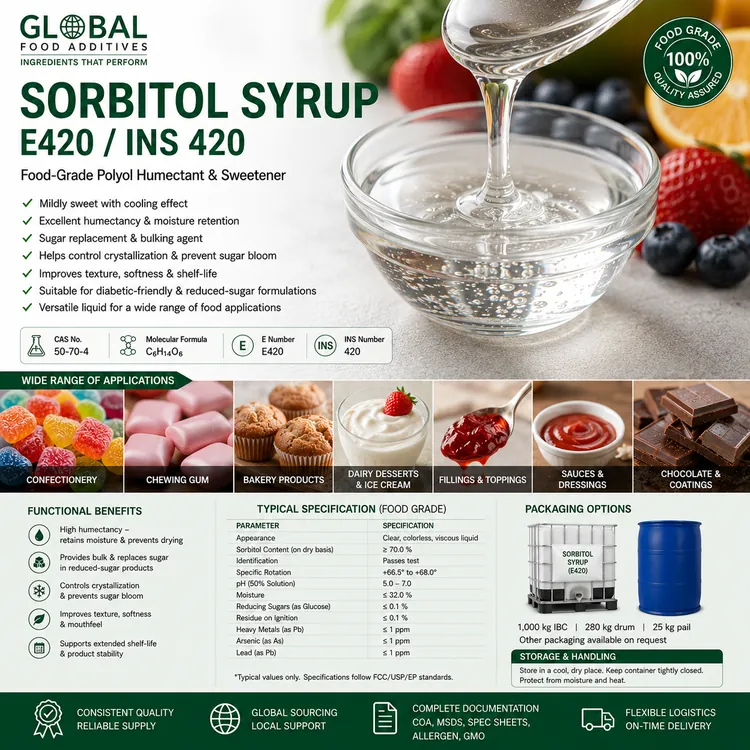
Product identity
| Product | Sorbitol Syrup |
|---|---|
| Category | Sweeteners & Polyols |
| Primary function | Humectant, sweetener, bulking ingredient, texture modifier and crystallization-control ingredient |
| E / INS number | E420 / INS 420 |
| CAS / identity | 50-70-4 |
| Chemical name | D-sorbitol / D-glucitol |
| Molecular formula | C6H14O6 |
| Typical form | Clear, viscous aqueous syrup; crystalline or powder grades may also be available depending on supplier portfolio |
| Typical industrial role | Partial sugar replacement, moisture management, body, mouthfeel, anti-crystallization support and softness retention |
Application fit
Potential use areas may include:
- Sugar-free and reduced-sugar confectionery
- Chewing gum and chewy candy systems
- Bakery fillings, icings, glazes and fondants
- Dairy desserts, frozen desserts and dessert sauces
- Fruit preparations, toppings, syrups and spreads
- Moisture-sensitive cakes, bars and soft bakery items
- Sauces, dressings and sweetened processed foods
- Food-adjacent oral-care and nutraceutical manufacturing, where the requested grade and regulations permit
Industrial functionality
Sorbitol Syrup is selected when a formulation needs more than sweetness. Its polyol structure gives it strong water-binding and humectant behaviour, helping reduce drying, hardening and texture loss in products that must remain soft during shelf life. It can also contribute body and viscosity, support smoother mouthfeel, help control sucrose crystallization in confectionery systems and improve flexibility in fillings, icings and pastes.
Formulation value
- Humectancy: helps retain moisture and reduce drying in soft confectionery, bakery fillings, creams and pastes.
- Texture control: supports softness, chew, flexibility and smooth eating quality in reduced-sugar systems.
- Bulking: replaces part of the mass normally provided by sugar while contributing solids and body.
- Crystallization management: helps reduce unwanted sugar crystallization in selected syrup, fondant and confectionery systems.
- Sweetness design: provides moderate sweetness and can be blended with high-intensity sweeteners when stronger sweetness is required.
- Process tolerance: can be considered in heat-processed systems, but final performance must be validated under the actual pH, temperature, solids and residence-time conditions.
Where technical review matters
- Reduced-sugar recipes: check sweetness balance, solids replacement, mouthfeel, label declaration and digestive tolerance warnings where applicable.
- Confectionery: review syrup solids, viscosity, crystallization behaviour, hygroscopicity and interaction with sucrose, glucose syrup, maltitol, glycerol or fibres.
- Bakery and fillings: evaluate moisture migration, water activity, softness over shelf life, browning profile and filling stability.
- Beverages and syrups: confirm solubility, clarity, pH stability, flavour impact, processing temperature and microbial controls.
- Dairy and frozen desserts: validate freezing point, sweetness, texture, total solids and compatibility with proteins, stabilizers and flavours.
Typical specification points to compare
Specifications vary by manufacturer and grade. The items below are practical purchasing checkpoints for technical, QA and procurement teams when comparing suppliers or approving a new source.
| Parameter | Why it matters industrially |
|---|---|
| Dry substance / solids | Controls dilution effect, sweetness contribution, viscosity, freight efficiency and formulation mass balance. |
| Sorbitol content on dry basis | Confirms active polyol profile and helps compare equivalent grades from different suppliers. |
| Reducing sugars / dextrose | Important for browning, Maillard reaction potential, colour development and process stability. |
| Other polyols | Mannitol, maltitol or hydrogenated saccharides may influence crystallization, mouthfeel, sweetness and viscosity. |
| pH | Affects compatibility with flavours, colours, preservatives, proteins, gums and finished-product stability. |
| Colour, clarity and turbidity | Critical for beverages, clear syrups, gels, glazes and light-coloured products. |
| Viscosity / density / refractive index | Relevant for pumping, dosing, mixing, heat transfer, filling and process repeatability. |
| Conductivity / ash | Indicates ionic load and can affect sensitive formulations or quality comparisons. |
| Heavy metals and contaminants | Required for food safety, regulatory compliance and customer approval. |
| Microbiological limits | Important for ready-to-eat applications, low-acid systems and products with limited downstream heat treatment. |
| Shelf life and storage | Supports warehouse planning, FIFO control, viscosity management and quality retention. |
Processing and handling considerations
As a viscous syrup, Sorbitol Syrup should be evaluated for pumpability, unloading conditions, dosing accuracy and mixing behaviour. In colder warehouses or winter shipments, viscosity may increase, so buyers should confirm recommended storage temperature, whether gentle warming is acceptable and whether the packaging format is suitable for the site’s handling equipment.
Manufacturing considerations
- Confirm whether the syrup can be dosed directly or should be pre-diluted before addition.
- Check mixing order with sugar, glucose syrup, high-intensity sweeteners, acids, flavours, gums, starches and proteins.
- Evaluate finished-product water activity and moisture migration during shelf-life trials.
- Validate colour, flavour and browning behaviour in heat-treated or baked systems.
- Confirm filtration or clarity needs for beverage, glaze and transparent gel applications.
- Run pilot trials before changing supplier, solids level, polyol profile or packaging format.
Storage and logistics
- Store closed containers in a clean, dry, food-grade area away from strong odours and incompatible materials.
- Protect drums, IBCs and bulk deliveries from contamination after opening.
- Use hygienic pumps, hoses and transfer lines suitable for viscous food-grade liquids.
- Apply FIFO stock rotation and keep batch numbers traceable from receipt to production use.
- Request pallet configuration, net weight, gross weight and loading quantity before confirming freight cost.
- For export shipments, confirm HS code, origin, document legalization needs and destination import requirements.
Quality, regulatory and label review
Sorbitol Syrup is commonly associated with E420 / INS 420, but regulatory approval is not universal for every food category, every use level or every market. Before commercial use, the buyer should verify permitted applications, additive class, maximum level if applicable, ingredient naming, nutrition declaration, warning statements where required and customer-specific restricted-substance policies.
- Food-grade status: request a food-grade declaration and confirm the material is produced, packed and transported under suitable food safety controls.
- Market compliance: check EU, UK, GCC, US, Codex or other destination-market rules according to the final product and sales country.
- Claims: validate any sugar-free, no-added-sugar, reduced-calorie, tooth-friendly, vegan, halal, kosher, non-GMO or allergen-related claims before label approval.
- Traceability: ensure each lot is supported by a COA, batch number, manufacturing or packing date, shelf life and origin information.
- Food safety systems: ask for available supplier certifications such as FSSC 22000, ISO 22000, BRCGS, IFS, HACCP, GMP or equivalent, where required by the customer.
Documents to request
For professional procurement, the strongest inquiry includes both commercial and technical document requirements. The following documents are commonly requested during supplier approval and import review:
- Product specification or technical data sheet
- Certificate of analysis for the offered batch or latest representative lot
- Safety data sheet where applicable
- Food-grade statement and intended-use declaration
- Origin statement and manufacturer or production-site information where available
- Shelf-life, storage and handling information
- Allergen, GMO, vegan, halal and kosher declarations when required
- Heavy metals, contaminants and microbiological limits
- Packaging specification, label draft, net weight and pallet configuration
- Market-specific regulatory declarations for the destination country
- Import, export, customs or legalization documents where required by shipment route
Packaging options and quotation details
Sorbitol Syrup may be offered in drums, IBC tanks, flexitanks, road tankers or other supplier-specific formats. The best packaging choice depends on annual volume, storage conditions, unloading equipment, hygiene control, production batch size and destination logistics.
| Quotation item | Recommended buyer input |
|---|---|
| Target grade | Food grade, E420 / INS 420, supplier reference grade or buyer specification. |
| Quantity | Trial quantity, pallet quantity, full container load, annual contract volume or call-off plan. |
| Packaging | Drum, IBC, bulk, flexitank or customer-preferred format. |
| Destination | Country, port, city, warehouse details and any import-document requirements. |
| Delivery term | EXW, FCA, FOB, CFR, CIF, DAP or other requested Incoterms. |
| Required documents | COA, TDS, SDS, origin, halal, kosher, allergen, GMO, food-grade and regulatory declarations. |
| Commercial timing | Required shipment date, target lead time, validity period and forecasted repeat demand. |
Supplier comparison checklist
When changing supplier or qualifying an alternative source, compare more than price per kilogram. A technically suitable source should match the formulation need, regulatory destination, handling conditions and customer approval process.
- Does the supplier specification match your current approved specification?
- Is sorbitol content reported on dry basis and supported by COA data?
- Are reducing sugars, ash, pH, colour and microbiology limits suitable for your product?
- Is the syrup viscosity compatible with your pumps, dosing system and production temperature?
- Can the supplier provide consistent batch-to-batch quality and traceability?
- Are documents available in the format required by your QA, customs broker or customer?
- Is the packaging suitable for your site’s unloading and hygiene procedures?
- Does the offered Incoterm and lead time support your production schedule?
How to request this product
Send the product name, target grade or reference specification, required quantity, destination country, packaging preference, expected shipment date, delivery term and required documents. If you already purchase Sorbitol Syrup, attach or describe your existing specification, label, COA or supplier reference grade so available sourcing options can be compared accurately.
Useful answers
What is Sorbitol Syrup used for in food manufacturing?
Sorbitol Syrup is typically used as a polyol sweetener, humectant, bulking ingredient, plasticizer and texture-management component. It is often evaluated for reduced-sugar confectionery, chewing gum, bakery fillings, icings, dairy desserts, sauces, syrups and food systems where softness and moisture retention are important.
What makes Sorbitol Syrup valuable in industrial formulations?
Its value comes from the combination of moderate sweetness, moisture retention, body, viscosity contribution and crystallization-control support. In many applications it helps replace part of the mass and functionality normally provided by sugar while improving softness and shelf-life texture stability.
Which specification parameters should be checked?
Important parameters include dry substance, sorbitol content on dry basis, reducing sugars, polyol profile, pH, conductivity, colour, clarity, viscosity, density or refractive index, ash, heavy metals, microbiological limits, shelf life, packaging and storage conditions.
Can Global Food Additives source Sorbitol Syrup?
Global Food Additives can review sourcing options for Sorbitol Syrup according to target specification, quantity, destination country, packaging preference, delivery term, document requirements and destination-market rules.
Which documents should be requested?
Buyers commonly request a technical data sheet, product specification, certificate of analysis, safety data sheet where applicable, food-grade statement, origin statement, shelf-life information, storage guidance, label and packaging details, halal or kosher certificate, allergen statement, GMO statement and market-specific regulatory declarations.
Is Sorbitol Syrup permitted in every country?
No. Food additive use depends on destination-market rules, food category, use level, label requirements and buyer responsibility. The buyer should verify final regulatory status and suitability for the intended application before commercial production.
Tell us which food additive or ingredient you need.
Send product names, target specifications, quantity, destination country, packaging preference, delivery term and document requirements. Our team will review your inquiry and respond from orders@foodgradeadditives.com.
Your message has been received. You will be redirected to the home page.