
Soy Protein Concentrate
Soy Protein Concentrate is a food-grade functional soy protein ingredient used by industrial food manufacturers for protein enrichment, water binding, fat absorption, emulsification, texture development and cost-effective plant-protein formulation. It is widely evaluated in plant-based foods, meat products, bakery, nutrition products, dairy alternatives, sauces, dry premixes and extruded systems where consistent protein functionality and practical cost-in-use are required. This page is prepared for purchasing teams, R&D technologists, QA departments, regulatory teams and import managers who need structured technical information before requesting a quotation.
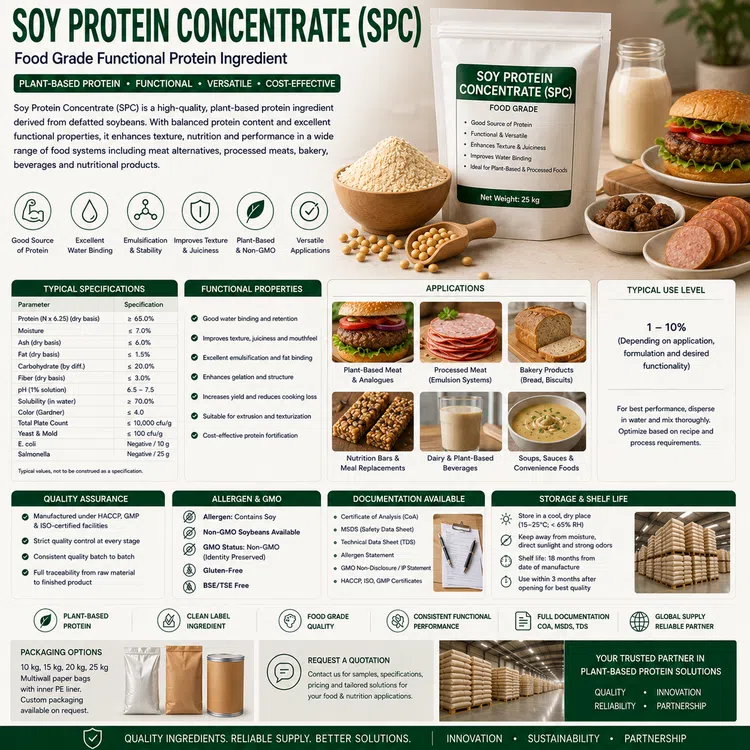
Product identity
| Product name | Soy Protein Concentrate |
|---|---|
| Common names | SPC, concentrated soy protein, food-grade soy protein concentrate, functional soy protein, textured soy protein concentrate |
| Source | Defatted soybean raw material processed to reduce soluble carbohydrates and increase protein concentration, depending on supplier and grade |
| CAS / identity | 9010-10-0 |
| E / INS number | Not typically managed as an E-number additive; confirm ingredient status and label wording by destination market and supplier documentation |
| Category | Proteins, Texturizers & Functional Ingredients |
| Primary function | Functional protein, protein enrichment ingredient, water-binding ingredient, emulsifier, texture builder and plant-protein ingredient |
| Typical protein level | Usually specified as a concentrated protein ingredient on dry basis; exact percentage must be confirmed by supplier specification and COA |
| Typical appearance | Light cream to pale yellow powder, flake, granule, textured granule, chunk or extruded piece depending on grade |
| Typical handling form | Dry powder for hydration or blending; textured concentrate for meat analogues, fillings, extenders or rehydrated food systems |
Application fit
Soy Protein Concentrate is evaluated where protein content, texture, water binding, fat retention or nutritional value is required. Potential use areas may include:
- Plant-based meat alternatives, burgers, sausages, nuggets, mince, patties, fillings and extruded meat analogues
- Processed meat, poultry, seafood and restructured products where permitted and label-compatible
- Bakery products, high-protein bread, biscuits, crackers, cereals, snacks and pasta-style products
- Nutrition powders, meal replacements, protein blends, bars and fortified dry mixes
- Dairy alternatives, plant-based drinks, creamers, desserts and cheese-style products
- Sauces, soups, emulsions, ready meals, seasonings and texturized food systems
Technical overview for industrial buyers
Soy Protein Concentrate is produced by removing part of the soluble carbohydrate fraction from defatted soybean material while retaining a concentrated protein fraction and some soybean fibre and non-protein components. Compared with Soy Protein Isolate, concentrate usually has lower protein purity but may offer useful water absorption, texture, fibre contribution, process tolerance and cost-in-use advantages. It is often selected where formulation performance depends on both protein functionality and textural bulk, rather than only maximum protein percentage.
For industrial procurement, Soy Protein Concentrate should be reviewed by protein content, moisture, ash, fat, fibre, carbohydrate, pH, solubility, PDI or NSI, water absorption, fat absorption, emulsifying capacity, particle size, bulk density, dispersibility, texture grade, hydration ratio, color, odor, flavour profile, microbiological limits, heavy metals, allergen status, GMO status, origin, shelf-life, packaging integrity and documentation completeness. A fine powder grade for bakery may not perform like a textured concentrate for plant-based meat, and a highly functional emulsifying grade may not match a simple protein-enrichment grade.
Functional role in formulation
- Protein enrichment: increases plant protein content in bakery, snacks, nutrition products, meat alternatives and dry mixes.
- Water binding: supports hydration, yield, juiciness and reduced purge in plant-based and processed-food systems.
- Fat absorption: helps retain oil or fat phases in meat analogues, fillings, patties, sauces and extruded products.
- Emulsification: contributes to fat-water interaction in processed meat, plant-based foods, sauces and ready meals.
- Texture building: supports bite, chew, fibrous texture, firmness and bulk in texturized and extruded systems.
- Cost-in-use control: can provide functional protein performance at a different cost profile than higher-purity isolates.
- Nutrition positioning: supports plant-protein, meat-reduction and protein-fortified product development where claims are permitted.
Key buying parameters
| Grade | Food grade; confirm final ingredient status, application suitability and destination-market compliance |
|---|---|
| Protein content | Confirm protein percentage, basis of calculation, test method and COA result |
| Functional type | Powder, bakery grade, meat grade, emulsifying grade, textured grade, extruded grade or nutrition grade |
| Solubility | Important for beverages, sauces, dispersible powders and protein-enrichment systems |
| PDI / NSI | Useful indicators of protein dispersibility, heat history and functional performance |
| Water absorption | Relevant for hydration, yield, juiciness, dough handling and texture design |
| Fat absorption | Important for plant-based meat, processed meat, fillings, sauces and fat-retention systems |
| Texture size | For textured SPC, confirm granule size, chunk size, hydration ratio and bite profile |
| Flavor profile | Review beany notes, bitterness, aroma and masking needs in the final product |
| Packaging | Commonly supplied in multiwall bags, lined bags, cartons, drums or palletized export packaging |
Industrial application notes
In plant-based meat alternatives, Soy Protein Concentrate can provide structure, bite, water retention and protein content. Textured grades can be hydrated and blended into burgers, sausages, meatballs, nuggets, fillings, mince and ready meals. Developers should evaluate hydration ratio, water temperature, hold time, mixing energy, salt level, oil type, flavour uptake, colour system, binders, methylcellulose, starches, fibres and heat process. Finished product evaluation should include cook yield, purge, bite, chew, juiciness, sliceability, freeze-thaw stability and flavour release.
In processed meat, poultry, seafood and restructured products, SPC may be evaluated for water binding, fat retention, texture, yield improvement and cost control where permitted. It can be used in emulsified sausages, comminuted products, patties, nuggets, meat extenders and fillings depending on local regulations. Buyers must verify label requirements, maximum use levels, meat-content rules and allergen declaration before use in animal-based food categories.
In bakery, snacks and cereal systems, Soy Protein Concentrate can improve protein content and influence dough hydration, structure, browning, flavour and texture. Because SPC contains protein and fibre fractions, it may increase water absorption and change dough handling. High-protein bakery formulas often require adjustment of hydration, mixing time, leavening system, gluten strength, emulsifiers, enzymes and baking profile. Finished product softness and flavour should be measured over shelf life.
In nutrition powders, protein blends and dry premixes, SPC can be used as a plant protein source with practical cost and texture benefits. Powder systems should be evaluated for wettability, dispersibility, sediment, mouthfeel, beany note, flowability, caking, dusting and flavour masking. If the finished product requires instant beverage performance, a more dispersible grade or blend with isolate, lecithin, hydrocolloids or flavour masking systems may be required.
Grade selection guide
- Functional powder grades: selected for water binding, emulsification, protein enrichment and dry blending.
- Textured grades: selected for hydrated bite, fibrous texture, granule structure and meat analogue applications.
- Meat-system grades: evaluated for yield, fat retention, texture and heat-process stability.
- Bakery grades: selected for protein enrichment, hydration control and dough compatibility.
- Nutrition grades: evaluated for protein level, flavour, particle size, dispersibility and microbiology.
- Extrusion grades: selected for expansion, fibrous structure, moisture control and thermal processing behavior.
- Custom blends: used when SPC is combined with isolates, textured proteins, fibres, starches, gums or flavours for a defined process target.
Process and handling considerations
- Confirm hydration ratio, water temperature, mixing speed and hold time recommended for the selected grade.
- For textured grades, hydrate fully before use unless the process is designed for direct dry addition.
- For meat and plant-based systems, control addition order relative to water, salt, oil, flavours, binders, gums and starches.
- For bakery, adjust water absorption and mixing because SPC can change dough development and texture.
- For dry blends, manage segregation, dusting, caking and powder flow during filling and transport.
- Protect from moisture, heat, contamination and strong odors during storage.
- Manage soy allergen cross-contact controls in warehouses, batching rooms and production lines.
- Maintain lot traceability from raw material receipt through finished product batch records.
Quality control checkpoints
Food manufacturers normally evaluate Soy Protein Concentrate through nutritional composition, physical handling and functional performance. Because the same protein percentage can behave differently depending on production route, heat history, particle size and texture grade, supplier approval should include application testing. Incoming QC should confirm that each lot matches the approved grade and performs consistently in the buyer’s process.
Typical laboratory checks
- Appearance, color, odor and foreign matter inspection
- Identification as Soy Protein Concentrate
- Protein content and basis of calculation
- Moisture or loss on drying
- Ash, fat, fibre and carbohydrate parameters where specified
- pH, solubility, PDI, NSI or dispersibility where required
- Water absorption, fat absorption and emulsifying capacity where specified
- Particle size, bulk density, flowability and wettability for powder grades
- Texture size, hydration ratio and rehydrated bite for textured grades
- Lead, arsenic, mercury, cadmium or other heavy metals according to destination rules
- Total plate count, yeast, mould, coliforms, Salmonella and other pathogen indicators where required
- Soy allergen, GMO, origin and lot traceability verification
- Lot number, manufacturing date and shelf-life verification
Functional performance checks
- Hydration rate and water absorption under plant conditions
- Water binding, purge control and cook yield in plant-based or meat systems
- Fat absorption and emulsion stability in processed foods
- Bite, chew, fibrous texture and juiciness in textured concentrate applications
- Texture performance after freezing, thawing, cooking and storage
- Dough hydration, mixing tolerance and finished texture in bakery applications
- Dry blend homogeneity, flowability, caking and reconstitution performance
- Flavour impact, beany note, bitterness and masking requirements
- Packaging seal integrity and pallet condition on receipt
Regulatory and compliance notes
Soy Protein Concentrate is generally handled as a functional food ingredient rather than as a typical E-number additive, but ingredient status, label wording, protein claims, allergen declaration, GMO rules and permitted uses differ by country and final application. Buyers should confirm whether the final product must declare it as soy protein concentrate, concentrated soy protein, soy protein, vegetable protein, textured soy protein, textured vegetable protein or another market-specific wording.
Because SPC is soy-derived, allergen and GMO review are central purchasing requirements. Buyers may need supplier declarations for soy allergen status, non-GMO or identity-preserved supply, country of origin, halal, kosher, vegan suitability, pesticide statement, residual solvent statement where relevant, heavy metals, microbiology and traceability. Claims such as high protein, source of protein, plant-based, meat-reduced, non-GMO, allergen-controlled or clean-label should be verified against the complete formula and local regulations, not assumed from the ingredient alone.
Recommended documents to request
- Product specification or technical data sheet with protein, physical, chemical and functional parameters
- Certificate of analysis for available batch or lot
- Safety data sheet where applicable
- Food-grade declaration and statement of intended food use
- Protein content, moisture, ash, fat, fibre, pH, solubility and microbiological specification
- PDI, NSI, water absorption, fat absorption, emulsification or texture-grade information where required
- Soy allergen declaration and cross-contact statement where required
- GMO status, identity-preserved supply statement or non-GMO certificate when required
- Origin statement, manufacturer information and traceability support
- Halal, kosher, vegan or animal-origin declarations when required
- Heavy metals statement and market-specific contaminant compliance where applicable
- Pesticide, residual solvent or processing-aid statement where required by customer specification
- Shelf-life, storage condition, humidity protection and handling recommendation
- Label draft, net weight, bag, carton or drum dimensions, pallet configuration and container loading estimate
- Batch coding format, recall-support documentation and change-control statement where available
Specification information useful for quotation
For a faster and more accurate quotation, provide the target specification, required protein level, functional grade, texture size if applicable, physical form, application, annual and first-order quantity, destination country, delivery term, packaging preference, required certifications, allergen and GMO requirements, inspection requirements and expected shipment date. If you already purchase Soy Protein Concentrate, share the existing COA, technical data sheet, product label, approved sample, protein target, hydration ratio, texture size, water absorption target, meat-system target, bakery target or benchmark supplier specification so equivalent options can be compared by functionality, flavour, microbiology, origin, documentation and logistics cost.
Packaging and logistics
Industrial Soy Protein Concentrate is usually quoted according to product form, texture size, net weight, packaging type, palletization, container loading, port of loading, Incoterms and destination. Moisture protection is important to maintain flowability, prevent caking and protect microbiological quality. Powder and textured shipments should be reviewed for bag integrity, pallet wrapping, container dryness, odor exposure, allergen control, shelf-life remaining, documentation deadlines and destination customs requirements.
Commercial evaluation criteria
- Food-grade status and documentation completeness
- Correct soy protein concentrate identity, soy source and destination-market regulatory fit
- Consistency of protein content, particle size, texture grade, moisture, microbiology and functional performance
- Suitability for plant-based foods, meat systems, textured products, bakery, nutrition powders or dairy alternatives
- Availability of soy allergen, GMO, non-GMO, halal, kosher, vegan, origin and traceability documentation when required
- Flavour profile, beany note control and compatibility with the target formula
- Lead time, stock position and minimum order quantity
- Packaging suitability for manual, semi-automatic or automated powder and granule handling
- Supplier change-control and batch traceability support
- Total landed cost and cost-in-use, not only unit price
How to request this product
Send the product name, required protein level, functional grade, physical form, texture size if applicable, application, quantity, destination country, packaging preference, expected shipment date and required documents. If the ingredient will be used in plant-based meat, processed meat, bakery, nutrition powders, dairy alternatives, sauces, soups, bars, snacks or extruded products, include the application category and key performance target such as protein enrichment, water binding, fat absorption, emulsion stability, texture, hydration ratio, flavour neutrality, freeze-thaw stability, reconstitution or extrusion performance.
Useful answers
What is Soy Protein Concentrate used for in food manufacturing?
Soy Protein Concentrate is used for protein enrichment, water binding, texture design, fat absorption, emulsification, plant-based meat systems, processed meat, bakery, nutrition products, dairy alternatives and dry premixes. Exact suitability depends on grade, process, dosage, regulations and supplier documentation.
How is Soy Protein Concentrate different from Soy Protein Isolate?
Soy Protein Concentrate normally has a lower protein percentage than Soy Protein Isolate and retains more non-protein soybean components such as fibre and carbohydrate fractions. Concentrate can be preferred for texture, cost-in-use, water absorption and meat or plant-based applications, while isolate is often selected when higher protein purity or higher solubility is required.
Is Soy Protein Concentrate an additive or an ingredient?
Soy Protein Concentrate is usually handled as a food ingredient or functional protein rather than a typical E-number additive. Label wording and permitted use depend on destination-market rules, final application and supplier documents.
Is Soy Protein Concentrate an allergen?
Yes, soy is a major allergen in many markets. Buyers should request soy allergen declarations, label-support documents, cross-contact information and destination-market compliance statements before commercial use.
Which applications commonly use Soy Protein Concentrate?
Common application areas include plant-based meats, textured protein products, processed meat systems, bakery, snacks, cereals, protein powders, bars, dairy alternatives, sauces, soups, ready meals and extruded products.
Which specification parameters matter most?
Important parameters include protein content, moisture, ash, fat, fibre, pH, solubility, PDI or NSI, water absorption, fat absorption, emulsifying capacity, particle size, texture grade, color, flavor, microbiological limits, heavy metals, allergen status, GMO status and origin.
Can Soy Protein Concentrate be used with other plant proteins?
Yes. It may be blended with soy protein isolate, pea protein, wheat protein, rice protein, fava bean protein, textured proteins, fibres, starches and hydrocolloids. Compatibility, texture, flavour, allergen labeling and nutrition claims should be validated in the final formulation.
Can Global Food Additives source Soy Protein Concentrate?
Global Food Additives can review sourcing options for Soy Protein Concentrate according to target specification, protein level, functional grade, physical form, texture grade, application, quantity, destination, packaging, certification needs and required documentation.
Which documents should be requested?
Buyers commonly request a technical data sheet, certificate of analysis, safety data sheet, food-grade declaration, origin statement, soy allergen declaration, GMO status, halal or kosher certificate, protein and microbiology information, shelf-life and storage information, label details and packing configuration.
Is this product permitted in every country?
No. Ingredient status, permitted use, protein claims, allergen declaration, GMO rules, label requirements and buyer responsibility vary by destination market. Always verify local regulations before commercial use.
Tell us which food additive or ingredient you need.
Send product names, target specifications, quantity, destination country, packaging preference, delivery term, and document requirements. Our team will review your inquiry and respond from orders@foodgradeadditives.com.
Your message has been received. You will be redirected to the home page.