
Starch Sodium Octenyl Succinate E1450
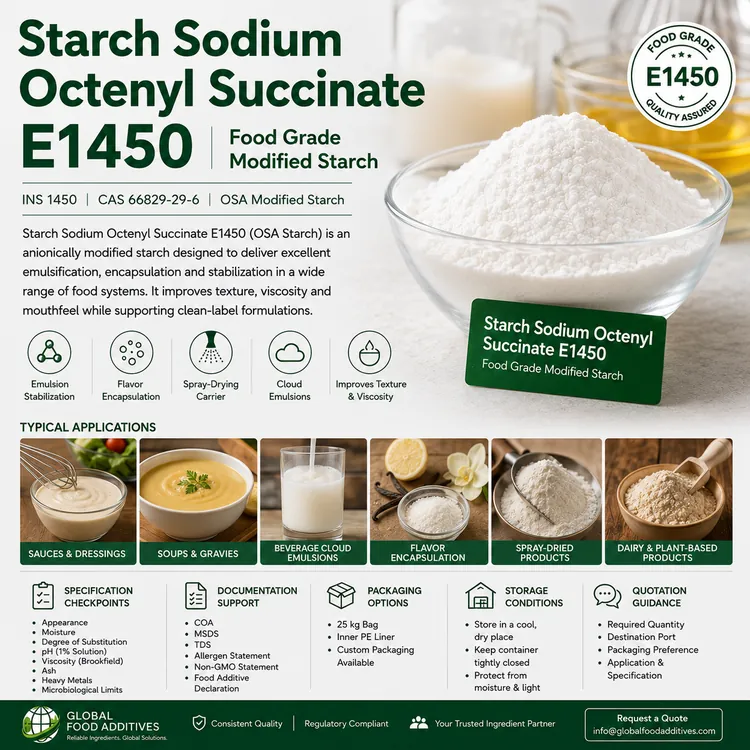
Starch Sodium Octenyl Succinate, commonly known as OSA starch or E1450, is a food-grade modified starch used by industrial food manufacturers for emulsion stabilization, flavor encapsulation, spray-drying, beverage cloud systems, texture support, viscosity control and process stability. It is especially valuable where formulators need a starch-based carrier that can interact with both water and oil phases, helping stabilize oil droplets and protect sensitive flavor, color or nutrient components during processing and storage. This page is prepared for purchasing teams, R&D technologists, QA departments, regulatory teams and import managers who need structured technical information before requesting a quotation.
Product identity
| Product name | Starch Sodium Octenyl Succinate |
|---|---|
| Common names | OSA starch, E1450 modified starch, sodium octenyl succinate starch, octenyl succinic anhydride modified starch |
| Chemical identity | Starch esterified with octenyl succinic anhydride and neutralized as the sodium salt; composition varies by starch source and modification level |
| CAS number | 66829-29-6 |
| E / INS number | E1450 / INS 1450 |
| Category | Modified Starches, Fibres & Bulking Agents |
| Primary function | Emulsifying starch, encapsulation carrier, spray-drying aid, stabilizer, texture modifier and viscosity-support ingredient |
| Typical starch sources | May include waxy maize, corn, tapioca, potato or other food-grade starch sources depending on supplier specification |
| Typical appearance | White to cream-colored powder, fine powder, agglomerated powder or instantized grade depending on production route |
| Typical handling form | Dry powder for hydration, emulsion preparation, spray-drying feed, dry blending or premix manufacturing |
Application fit
Starch Sodium Octenyl Succinate is evaluated where emulsion stabilization, oil encapsulation, carrier performance, texture, viscosity or powder conversion is required. Potential use areas may include:
- Beverage emulsions, cloud systems, citrus oils, flavor emulsions and drink concentrates
- Spray-dried flavors, powdered oils, encapsulated colors, aromas and sensitive ingredients
- Nutrition powders, protein drinks, meal replacements, vitamin systems and oil-soluble actives
- Sauces, dressings, soups, gravies, marinades and processed-food emulsions
- Dairy systems, plant-based alternatives, creamers and dessert preparations
- Bakery mixes, meat products, seasoning systems and dry premixes where permitted
Technical overview for industrial buyers
Starch Sodium Octenyl Succinate is made by modifying starch with octenyl succinic anhydride, creating a starch molecule with hydrophilic starch regions and hydrophobic octenyl succinate groups. This amphiphilic structure gives OSA starch surface-active properties that help stabilize oil-in-water emulsions, reduce droplet coalescence and form protective films around dispersed oil droplets. In spray-drying, the starch can act as both emulsifier and wall material, helping convert oils, flavors, colors or nutrient systems into stable free-flowing powders.
For industrial procurement, E1450 should be evaluated by more than the additive number. Important buying parameters include starch source, degree of substitution or octenyl succinyl group content, viscosity profile, cold-water solubility, gelatinization or pregelatinization status, pH, moisture, ash, particle size, bulk density, microbial quality, heavy metals, residual reagent statement where required, emulsion stability, oil load capacity, spray-drying yield, powder flow and documentation completeness. A grade optimized for beverage cloud emulsions may not be ideal for high-oil spray-dried flavors, soup viscosity or plant-based creamers.
Functional role in formulation
- Emulsion stabilization: helps stabilize oil droplets in beverage emulsions, flavor emulsions, sauces and dressings.
- Encapsulation carrier: supports spray-drying of flavors, oils, colors, nutrients and other sensitive ingredients.
- Cloud and opacity support: helps maintain uniform cloud or turbidity in selected beverage systems.
- Texture and viscosity: can contribute body, viscosity, mouthfeel and process stability depending on grade.
- Powder conversion: assists in converting liquid oils or emulsions into flowable dry powders.
- Oxidation protection: encapsulation can help reduce exposure of sensitive oil phases to oxygen, light and processing stress.
- Process tolerance: selected grades may support stability under heat, shear, acidity, homogenization and drying conditions.
Key buying parameters
| Grade | Food grade; confirm E1450 / INS 1450 identity and destination-market compliance |
|---|---|
| Starch source | Waxy maize, corn, tapioca, potato or other source depending on supplier and customer requirements |
| Modification level | Request degree of substitution, octenyl succinyl group information or supplier functional grade description where available |
| Solubility | Cold-water soluble, instant, pregelatinized or cook-up behavior should match the production process |
| Viscosity | Critical for emulsion preparation, spray-drying feed solids, pumping, atomization and finished texture |
| Particle size | Important for hydration speed, dusting, dry blending, lump formation and powder flow |
| Oil-load capacity | Relevant for spray-dried flavors, powdered oils, cloud systems and encapsulated nutrient preparations |
| Moisture | Controls flowability, caking tendency, microbiological stability and shelf life |
| Microbiology | Important for dry blends, beverage powders, nutrition products and low-heat applications |
| Packaging | Commonly supplied in multiwall bags, lined bags, cartons, big bags or palletized export packaging |
Industrial application notes
In beverage emulsions and cloud systems, Starch Sodium Octenyl Succinate can help stabilize citrus oils, flavor oils, weighting-agent systems, cloud emulsions and beverage concentrates. Manufacturers should evaluate droplet size, creaming, ringing, turbidity, pH stability, heat process, preservative compatibility, carbonation, dilution ratio and storage temperature. High-pressure homogenization, rotor-stator mixing and feed viscosity must be optimized together with the selected OSA starch grade to achieve long-term emulsion stability.
In spray-dried flavors, powdered oils and encapsulated actives, E1450 can act as an emulsifier and carrier matrix. It is used to prepare stable emulsions before spray-drying and to form a protective wall around the oil phase during drying. Key development parameters include starch hydration, oil-to-carrier ratio, emulsion solids, homogenization pressure, droplet size, inlet and outlet temperature, powder moisture, surface oil, encapsulation efficiency, flavor retention, oxidative stability and powder flowability.
In sauces, dressings, soups and processed-food systems, Starch Sodium Octenyl Succinate may contribute emulsion stability, viscosity, body and resistance to oil separation. Product developers should evaluate pH, salt, sugar, acids, heat treatment, shear, freeze-thaw exposure, retort or pasteurization conditions and interaction with proteins, gums, starches and emulsifiers. If the system requires clear appearance, OSA starch may not be suitable unless the supplier grade is designed for that specific requirement.
In dairy, plant-based and nutritional applications, OSA starch can help stabilize oil phases, flavors, vitamins, carotenoids or nutritionally relevant lipids. Plant-based systems require special testing because vegetable proteins, minerals, gums and oils can interact differently from dairy proteins and milk fat. In powdered nutrition products, the starch grade should be evaluated for dispersibility, wetting, caking, dusting, sensory effect, viscosity after reconstitution and label compatibility.
Grade selection guide
- Beverage emulsion grades: selected for fine droplet stabilization, low sediment, ring control and acid stability.
- Spray-drying grades: optimized for emulsion formation, high solids feed, encapsulation efficiency and powder flow.
- Instant grades: designed for cold-water hydration, dry mixes, nutrition powders and rapid dispersion.
- Cook-up grades: selected where starch hydration and viscosity development occur during heating.
- Low-viscosity grades: useful where high solids or high oil load is required before spray-drying.
- Texture grades: used where body, mouthfeel and viscosity are important in sauces, soups and processed foods.
Process and handling considerations
- Confirm hydration method, water temperature, mixing time and shear recommendation for the selected grade.
- Disperse powder properly to prevent lumping, fish-eyes or incomplete hydration.
- For emulsions, optimize oil phase addition rate, homogenization conditions and final droplet size.
- For spray-drying, control feed viscosity, total solids, atomization, inlet temperature and outlet moisture.
- Protect powder from moisture pickup, caking, contamination and strong odors during storage.
- Validate compatibility with acids, salts, minerals, proteins, hydrocolloids, preservatives, colors and flavors.
- Maintain lot traceability from raw material receipt through finished product batch records.
Quality control checkpoints
Food manufacturers normally evaluate Starch Sodium Octenyl Succinate through analytical specification and functional testing in the target application. Because E1450 performance depends strongly on starch source, modification level, viscosity and hydration behavior, incoming material should be compared against the approved grade rather than judged only by product name. Supplier change-control communication is especially important for beverage emulsions, flavor encapsulation and high-value nutrition systems.
Typical laboratory checks
- Appearance, color, odor and foreign matter inspection
- Identification as Starch Sodium Octenyl Succinate / E1450
- Starch source confirmation where required by buyer specification
- Degree of substitution, octenyl succinyl group level or functional grade description where available
- Moisture or loss on drying
- pH, ash and residue parameters where specified
- Viscosity profile under defined concentration, temperature and shear conditions
- Particle size, bulk density, flowability and dispersibility
- Cold-water solubility, gelatinization or hydration behavior
- Lead, arsenic, mercury, cadmium or other heavy metals according to destination rules
- Total plate count, yeast, mould, coliforms and pathogen indicators where required
- Lot number, manufacturing date and shelf-life verification
Functional performance checks
- Oil-in-water emulsion stability under heat, pH, shear and storage conditions
- Droplet size distribution after homogenization
- Creaming, ringing, sedimentation and turbidity change in beverage emulsions
- Spray-drying feed viscosity, powder yield and outlet moisture
- Surface oil, encapsulation efficiency and flavor or oil retention
- Powder flowability, caking, dusting and reconstitution behavior
- Finished product viscosity, mouthfeel and phase stability
- Compatibility with proteins, hydrocolloids, acids, minerals, preservatives and colors
- Packaging seal integrity and pallet condition on receipt
Regulatory and compliance notes
Starch Sodium Octenyl Succinate is commonly identified as E1450 or INS 1450. Permitted food categories, maximum use levels, modified starch declarations, source labeling, purity criteria and additive naming rules can differ by country and final application. Some products may declare it as modified starch, while other markets or customer specifications may require more specific wording. Buyers should confirm the required label declaration before commercial use.
Because E1450 may be derived from different botanical starch sources, buyers may request documentation about corn, waxy maize, tapioca, potato or other origin. Requirements for non-GMO, allergen-free, gluten-free, halal, kosher, vegan, organic-compatible, identity-preserved or clean-label positioning must be supported by supplier declarations and destination-market label review. These claims should not be assumed from the product name alone.
Recommended documents to request
- Product specification or technical data sheet with physical, chemical and functional parameters
- Certificate of analysis for available batch or lot
- Safety data sheet where applicable
- Food-grade declaration and statement of intended food use
- E1450 / INS 1450 identity confirmation and modified starch declaration support
- Starch source declaration, such as corn, waxy maize, tapioca or potato, where required
- Degree of substitution, octenyl succinyl group level or functional-grade information where available
- Viscosity, pH, moisture, ash, particle size, solubility and microbiological specification
- Residual reagent or processing-aid statement where required by buyer specification
- Origin statement and manufacturer information where available
- Allergen, GMO, gluten-free, vegan, halal, kosher or animal-origin declarations when required
- Heavy metals statement and market-specific contaminant compliance where applicable
- Shelf-life, storage condition, humidity protection and handling recommendation
- Label draft, net weight, bag, carton or big-bag dimensions, pallet configuration and container loading estimate
- Traceability information, batch coding format and recall-support documentation
Specification information useful for quotation
For a faster and more accurate quotation, provide the target specification, required starch source, grade type, application, physical form, annual and first-order quantity, destination country, delivery term, packaging preference, required certifications, inspection requirements and expected shipment date. If you already purchase Starch Sodium Octenyl Succinate, share the existing COA, technical data sheet, product label, approved sample, viscosity requirement, emulsion target, spray-drying target or benchmark supplier specification so equivalent options can be compared by functionality, starch source, modification level, particle size, microbiology, documentation and logistics cost.
Packaging and logistics
Industrial Starch Sodium Octenyl Succinate is usually quoted according to product form, net weight, packaging type, palletization, container loading, port of loading, Incoterms and destination. Moisture protection is important to maintain flowability, prevent caking and protect microbiological quality. Powder shipments should be reviewed for bag integrity, pallet wrapping, container dryness, odor exposure, shelf-life remaining, documentation deadlines and destination customs requirements.
Commercial evaluation criteria
- Food-grade status and documentation completeness
- Correct E1450 identity, starch source and destination-market regulatory fit
- Consistency of viscosity, particle size, moisture, microbiology and emulsion performance
- Suitability for beverage emulsions, spray-dried flavors, nutrition powders, sauces, dressings, soups or dry mixes
- Availability of allergen, GMO, gluten-free, vegan, halal, kosher, origin or starch-source documentation when required
- Lead time, stock position and minimum order quantity
- Packaging suitability for manual, semi-automatic or automated powder handling
- Supplier change-control and batch traceability support
- Total landed cost and cost-in-use, not only unit price
How to request this product
Send the product name, starch source if required, physical form, grade, application, quantity, destination country, packaging preference, expected shipment date and required documents. If the ingredient will be used in beverage emulsions, cloud systems, flavor encapsulation, spray-dried oils, nutrition powders, sauces, soups, dressings, dairy alternatives, bakery mixes or meat products, include the application category and key performance target such as emulsion stability, droplet size, oil load, spray-drying performance, viscosity, reconstitution, texture, mouthfeel or powder flow.
Useful answers
What is Starch Sodium Octenyl Succinate used for in food manufacturing?
Starch Sodium Octenyl Succinate is used as an emulsifying modified starch, spray-drying carrier, encapsulation matrix, stabilizer, texture modifier and viscosity-support ingredient. It is commonly evaluated for beverage emulsions, flavor encapsulation, cloud systems, powdered flavors, sauces, dressings, soups and nutrition powders.
Why is it called OSA starch?
OSA starch means starch modified with octenyl succinic anhydride. The modification gives the starch hydrophobic functionality, allowing it to interact with oil droplets while retaining water-compatible starch behavior.
Is E1450 mainly a thickener or an emulsifier?
It can contribute texture and viscosity, but many E1450 grades are selected especially for emulsification, oil droplet stabilization and encapsulation. The exact function depends on starch source, modification level, solubility, viscosity and application conditions.
Which applications commonly use Starch Sodium Octenyl Succinate?
Common application areas include beverage emulsions, cloud systems, flavor oils, spray-dried flavors, powdered oils, nutritional powders, sauces, dressings, soups, dairy alternatives, plant-based systems and dry premixes where permitted by local regulations.
Which specification parameters matter most?
Important parameters include starch source, degree of substitution or octenyl succinyl group level, viscosity, pH, moisture, particle size, cold-water solubility, ash, heavy metals, microbiological limits, emulsion stability and spray-drying performance.
Can it replace gum arabic in beverage emulsions?
Starch Sodium Octenyl Succinate can sometimes be evaluated as an alternative or complement to gum arabic, but it is not a universal one-for-one replacement. Droplet size, emulsion stability, viscosity, flavor release, label declaration and cost-in-use should be tested in the actual beverage system.
Can Global Food Additives source Starch Sodium Octenyl Succinate?
Global Food Additives can review sourcing options for Starch Sodium Octenyl Succinate according to target specification, starch source, physical form, application, quantity, destination, packaging, certification needs and required documentation.
Which documents should be requested?
Buyers commonly request a technical data sheet, certificate of analysis, safety data sheet, food-grade declaration, starch source statement, origin statement, allergen statement, GMO status, halal or kosher certificate, viscosity and microbiology information, shelf-life and storage information, label details and packing configuration.
Is this product permitted in every country?
No. Food additive use depends on destination-market rules, food category, use level, modified starch declaration, label requirements and buyer responsibility. Always verify local regulations before commercial use.
Tell us which food additive or ingredient you need.
Send product names, target specifications, quantity, destination country, packaging preference, delivery term, and document requirements. Our team will review your inquiry and respond from orders@foodgradeadditives.com.
Your message has been received. You will be redirected to the home page.