
Sucralose E955
Sucralose is a food-grade high-intensity sweetener used by industrial food and beverage manufacturers for sugar reduction, calorie reduction, sweetness optimization and sensory profile design. It is selected where strong sweetness, low use level, good solubility, broad formulation compatibility and process stability are required. This page is prepared for purchasing teams, R&D technologists, QA departments, regulatory teams and import managers who need structured technical information before requesting a quotation.
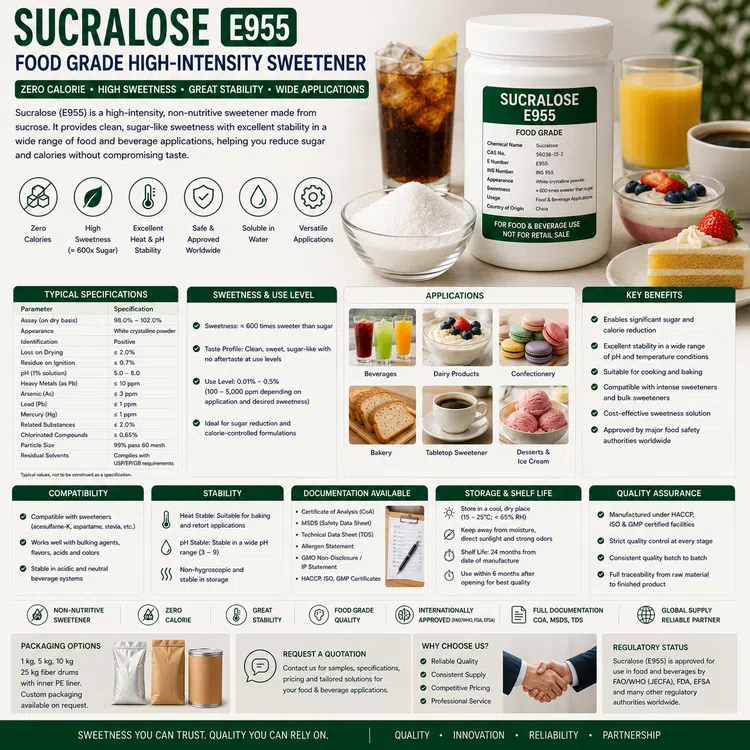
Product identity
| Product name | Sucralose |
|---|---|
| Common names | Sucralose E955, INS 955, high-intensity sweetener, non-nutritive sweetener |
| Chemical formula | C12H19Cl3O8 |
| CAS number | 56038-13-2 |
| E / INS number | E955 / INS 955 |
| Category | Sweeteners & Polyols |
| Primary function | High-intensity sweetener, sugar-reduction ingredient and sweetness-profile design tool |
| Typical sweetness | High-potency sweetness; dosage is normally far lower than sucrose and must be calculated carefully |
| Typical appearance | White to off-white crystalline powder or granular material depending on grade |
| Typical handling form | Pure powder, diluted powder blend, premix, granule, liquid preparation or customer-specific sweetener system |
Application fit
Sucralose is evaluated where sweetness is needed without adding the full sugar solids, calories or fermentable carbohydrate load of sucrose. Potential use areas may include:
- Carbonated soft drinks, still drinks, powdered drinks and beverage concentrates
- Dairy desserts, flavored milk drinks, yogurts, ice cream systems and plant-based alternatives
- Confectionery, chewing gum, hard candy, gummies and sweet fillings
- Tabletop sweeteners, sachets, tablets, drops and consumer sweetener blends
- Bakery products, fillings, glazes, sauces, syrups and toppings where permitted
- Nutrition products, protein powders, meal replacements and reduced-sugar formulations
Technical overview for industrial buyers
Sucralose is a high-intensity sweetener derived from sucrose through selective chlorination. In food manufacturing, it is valued because it can deliver strong sweetness at very low dosage while contributing little or no functional bulk. This makes it useful for reduced-sugar, no-added-sugar and calorie-reduction projects, but it also means that formulators must replace the physical functions of sugar separately. Sugar contributes solids, viscosity, mouthfeel, browning, freezing-point depression, fermentation behavior, water activity control and texture; Sucralose mainly contributes sweetness.
For industrial procurement, Sucralose should be evaluated by assay, purity, related substances, particle size, solubility, moisture, residue on ignition, heavy metal limits, appearance, odor, sensory profile, packaging protection, shelf-life, batch traceability and documentation completeness. Buyers should also review how the selected grade will be dosed. Pure Sucralose is very potent, so many manufacturing operations use premixes, diluted blends or liquid preparations to improve dosing accuracy and reduce the risk of over-dosing, hot spots or poor distribution.
Functional role in formulation
- Sweetness delivery: provides high sweetness intensity at low dosage in beverages, dairy, confectionery and tabletop systems.
- Sugar reduction: enables lower-sugar and reduced-calorie product development when paired with suitable bulking and texture systems.
- Sweetness profile design: can be blended with acesulfame K, stevia, erythritol, maltitol, allulose or other sweeteners where permitted.
- Process compatibility: suitable for many acidic, neutral, hot-filled, pasteurized or dry-blend systems when validated in the final product.
- Flavor support: may help maintain perceived sweetness in fruit, dairy, cocoa, coffee, cola, citrus and confectionery flavor systems.
- Low-use-rate economics: cost-in-use depends on sweetness target, formulation matrix, local regulations and blending strategy.
Key buying parameters
| Grade | Food grade; confirm E955 / INS 955 identity and destination-market compliance |
|---|---|
| Assay | Request Sucralose assay and test method on specification and COA |
| Purity profile | Review related substances, chlorinated by-products and market-specific impurity limits where required |
| Particle size | Important for dry blending, dissolution speed, dusting, segregation risk and dosing accuracy |
| Solubility | Critical for beverages, syrups, concentrates and liquid sweetener preparations |
| Moisture | Relevant for flowability, caking control, shelf life and dry mix stability |
| Sensory profile | Evaluate sweetness onset, linger, aftertaste and interaction with acids, flavors and other sweeteners |
| Packaging | Commonly supplied in sealed bags, cartons, fiber drums, HDPE containers or export pallet packaging |
Industrial application notes
In beverage production, Sucralose is commonly used in carbonated soft drinks, still drinks, fruit drinks, powdered beverages, energy drinks, flavored waters and beverage concentrates. Formulators should evaluate sweetness intensity, acid balance, flavor release, mouthfeel, preservative system, pasteurization, hot-fill conditions, carbonation, light exposure and storage temperature. In reduced-sugar beverages, Sucralose is often blended with other sweeteners to improve sweetness onset, reduce linger and create a more rounded sugar-like profile.
In dairy products and frozen desserts, Sucralose can support reduced-sugar formulations in yogurts, flavored milk drinks, puddings, ice cream and plant-based alternatives. Because sugar contributes body and freezing-point control, product developers may need fibres, polyols, milk solids, stabilizers or bulking systems to restore texture and spoonability. In cultured dairy products, Sucralose is not used as a fermentable sugar source, so fermentation targets and final acidity must be managed separately.
In confectionery and chewing gum, Sucralose is used for high-intensity sweetness in products where sugar reduction, long-lasting sweetness or sweetener blending is required. Gum and confectionery systems may require encapsulated or protected sweetener formats to manage sweetness release. Texture, crystallization, water activity, stickiness, glass transition, cooling effect and label declaration should be considered when replacing sugar or polyols.
In bakery and heat-processed products, Sucralose may provide sweetness, but it does not participate in Maillard browning, caramelization, yeast fermentation or sugar-based structure formation in the same way as sucrose. Reduced-sugar bakery formulas often require additional formulation work to rebuild volume, color, crumb softness, moisture retention and shelf-life quality. Heat process, pH, water activity and residence time should be tested in the buyer’s actual process.
Sweetener system design
- Define the target sweetness level using sensory panels, benchmark products or instrumental formulation targets.
- Decide whether Sucralose will be used alone or blended with other high-intensity sweeteners, polyols or bulking agents.
- Evaluate sweetness onset, sweetness peak, linger, aftertaste, flavor masking and mouthfeel in the final product matrix.
- Calculate dosage carefully because small weighing errors can create large sweetness differences.
- Use premixes or diluted blends when manufacturing equipment cannot dose pure Sucralose accurately.
- Validate stability under actual pH, heat treatment, storage time and packaging conditions.
Process and handling considerations
- Use accurate weighing systems suitable for low-dose high-intensity sweeteners.
- Pre-blend with carriers when needed to improve distribution in dry mixes.
- Prepare liquid solutions under controlled agitation to ensure full dissolution before dosing.
- Manage dusting, cross-contact and carryover during weighing, transfer and blending.
- Store tightly closed in a clean, dry area away from moisture, strong odors and contamination.
- Maintain lot traceability from raw material receipt through finished product batch records.
Quality control checkpoints
Food manufacturers usually evaluate Sucralose through chemical purity, physical handling and sensory performance. Because the ingredient is used at low levels, consistency and dosing accuracy are critical. A small variation in raw material distribution can create visible product-to-product sweetness differences, especially in sachets, tablets, dry blends and concentrated beverage systems.
Typical laboratory checks
- Appearance, color, odor and foreign matter inspection
- Identification as Sucralose / E955
- Assay or purity confirmation
- Related substances and impurity profile where specified
- Moisture or loss on drying
- Residue on ignition or ash where required
- Particle size distribution or sieve analysis
- Solubility and solution clarity for beverage or syrup applications
- Lead, arsenic, mercury, cadmium or other heavy metals according to destination rules
- Microbiological status where required by application and specification
- Lot number, manufacturing date and shelf-life verification
Functional performance checks
- Sweetness intensity at the intended dosage
- Sweetness onset, linger and aftertaste in the finished product
- Blend performance with acesulfame K, stevia, polyols, fibres or other sweeteners where used
- Stability under pH, heat process, pasteurization, hot-fill or storage conditions
- Dry blend homogeneity and segregation risk in powders and sachets
- Dissolution behavior in beverages, syrups and concentrates
- Flavor interaction in fruit, dairy, cola, cocoa, coffee, mint or citrus systems
- Packaging seal integrity and pallet condition on receipt
Regulatory and compliance notes
Sucralose is commonly identified as E955 or INS 955. Permitted food categories, maximum use levels, additive naming, tabletop sweetener rules, nutrition claims and label declarations can differ by country and final application. Some markets define maximum levels by food category, while others require specific sweetener statements, warnings or claim substantiation depending on product positioning.
Buyers should verify whether the final product will be sold as reduced sugar, no added sugar, sugar free, low calorie, diabetic-friendly, keto-positioned or another nutrition-related claim. These claims are not controlled only by the sweetener choice; they depend on the complete formulation, nutrition panel, serving size, local definitions and final label review. Documentation should be collected before shipment when the product is intended for export or private-label supply.
Recommended documents to request
- Product specification or technical data sheet with assay, purity and physical parameters
- Certificate of analysis for available batch or lot
- Safety data sheet where applicable
- Food-grade declaration and statement of intended food use
- Origin statement and manufacturer information where available
- Allergen, GMO, vegan, halal, kosher or animal-origin declarations when required
- Heavy metals statement and market-specific contaminant compliance where applicable
- Particle size, solubility, moisture and related-substance information where specified
- Shelf-life, storage condition and humidity-protection recommendation
- Label draft, net weight, drum, carton, bag or container dimensions, pallet configuration and container loading estimate
- Traceability information, batch coding format and recall-support documentation
Specification information useful for quotation
For a faster and more accurate quotation, provide the target specification, required grade, physical form, annual and first-order quantity, destination country, delivery term, packaging preference, required certifications, inspection requirements and expected shipment date. If you already purchase Sucralose, share the existing COA, technical data sheet, product label, particle size requirement, approved sample or benchmark supplier specification so equivalent options can be compared by assay, purity, particle size, solubility, origin, documentation and logistics cost.
Packaging and logistics
Industrial Sucralose is usually quoted according to product form, net weight, packaging type, palletization, container loading, port of loading, Incoterms and destination. Because Sucralose is used at low dosage and has high value per kilogram, packaging integrity, moisture protection, tamper evidence, batch traceability and customs documentation are especially important. Export shipments should be reviewed for shelf-life remaining, documentation deadlines, pallet wrapping, humidity exposure and destination import requirements.
Commercial evaluation criteria
- Food-grade status and documentation completeness
- Consistency of assay, purity, particle size, moisture and sensory performance
- Suitability for beverages, dairy, confectionery, bakery, tabletop or dry-blend applications
- Availability of allergen, GMO, vegan, halal, kosher or origin documentation when required
- Lead time, stock position and minimum order quantity
- Packaging suitability for low-dose, high-value ingredient handling
- Regulatory fit for the destination market and final product category
- Total landed cost and cost-in-use, not only unit price
How to request this product
Send the product name, grade, target specification, physical form, quantity, destination country, packaging preference, expected shipment date and required documents. If the ingredient will be used in beverages, dairy desserts, confectionery, chewing gum, tabletop sweeteners, bakery, sauces, nutrition products or dry blends, include the application category, target sweetness level, dosage format, blending strategy and any label claim requirement so the supplier review can focus on the most relevant technical and regulatory parameters.
Useful answers
What is Sucralose used for in food manufacturing?
Sucralose is used as a high-intensity sweetener for sweetness design, sugar reduction and calorie reduction in approved food and beverage applications such as drinks, dairy desserts, confectionery, chewing gum, tabletop sweeteners, sauces, syrups and selected bakery products.
Is Sucralose a bulking sweetener?
No. Sucralose provides sweetness at very low dosage but does not replace the bulk, texture, browning, freezing-point effect or humectancy of sugar. Reduced-sugar products often require separate bulking and texture-support ingredients.
Can Sucralose be blended with other sweeteners?
Yes. Sucralose is often evaluated with acesulfame K, stevia, erythritol, maltitol, allulose or other sweeteners where permitted. Blending can improve sweetness onset, reduce aftertaste, adjust cost-in-use and create a more balanced sensory profile.
Which applications commonly use Sucralose?
Common application areas include beverages, powdered drinks, dairy products, confectionery, chewing gum, tabletop sweeteners, nutrition products, sauces, syrups, fillings and reduced-sugar bakery systems where permitted by local regulations.
Which specification parameters matter most?
Important parameters include assay, purity, related substances, particle size, solubility, moisture, appearance, odor, heavy metals, microbiological status where required, shelf life, packaging protection and sensory performance in the buyer’s application.
Can Global Food Additives source Sucralose?
Global Food Additives can review sourcing options for Sucralose according to target specification, physical form, application, quantity, destination, packaging, certification needs and required documentation.
Which documents should be requested?
Buyers commonly request a technical data sheet, certificate of analysis, safety data sheet, food-grade declaration, origin statement, allergen statement, GMO status, halal or kosher certificate, particle size or solubility information, shelf-life and storage information, label details and packing configuration.
Is this product permitted in every country?
No. Food additive use depends on destination-market rules, food category, use level, label requirements and buyer responsibility. Always verify local regulations before commercial use.
Tell us which food additive or ingredient you need.
Send product names, target specifications, quantity, destination country, packaging preference, delivery term, and document requirements. Our team will review your inquiry and respond from orders@foodgradeadditives.com.
Your message has been received. You will be redirected to the home page.