
TBHQ
TBHQ, or Tert-Butylhydroquinone, is a food-grade phenolic antioxidant used in regulated applications to delay oxidative deterioration in edible oils, fats and lipid-containing foods.
Oxidation can produce hydroperoxides, aldehydes, ketones and other compounds associated with rancid odor, stale flavor, color changes, nutrient loss and reduced commercial shelf life. TBHQ is selected to interrupt free-radical chain reactions and extend the induction period before rapid oxidation develops.
Its industrial effectiveness depends on oil composition, unsaturation level, oxygen exposure, temperature, light, metal contamination, product water activity, packaging, processing time, dosage, incorporation method and interactions with other antioxidants or chelating agents.
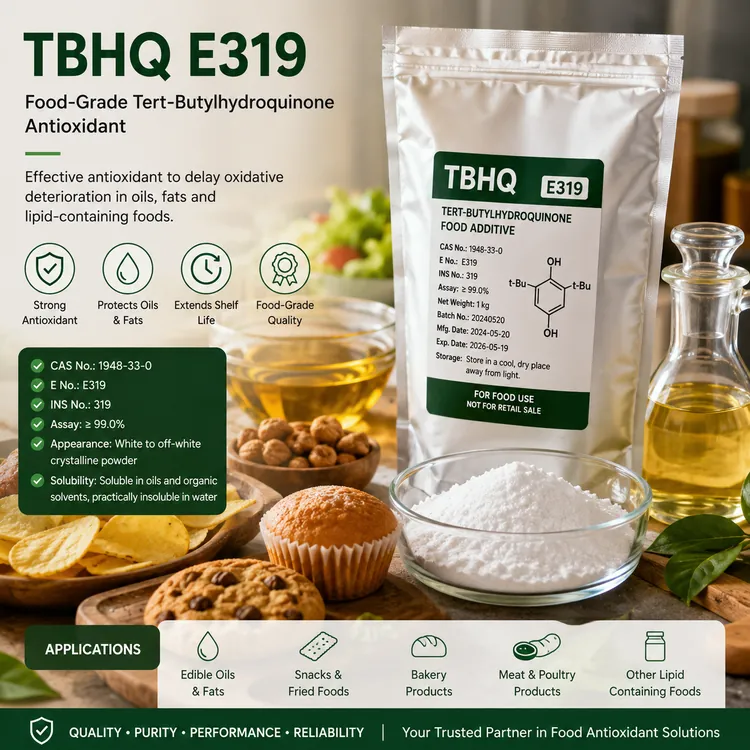
Product identity
| Product name | TBHQ |
|---|---|
| Chemical name | Tert-Butylhydroquinone |
| Alternative name | Tertiary Butylhydroquinone |
| Product category | Synthetic phenolic antioxidant and oxidation-control additive |
| E number | E319 |
| INS number | INS 319 |
| CAS number | 1948-33-0 |
| Chemical formula | C10H14O2 |
| Molar mass | Approximately 166.22 g/mol |
| Typical appearance | White to light-colored crystalline powder |
| Primary function | Free-radical scavenging and protection of fats and oils against oxidative deterioration |
| Application phase | Usually incorporated into the oil phase or through a validated premix |
| Water behavior | Limited direct water solubility; incorporation systems must be designed for the intended formulation |
| Typical commercial forms | High-purity powder, antioxidant blend, oil-dispersible premix or application-specific liquid preparation |
Primary industrial functions
- Delays initiation and propagation of lipid oxidation
- Extends the oxidative induction period of fats and oils
- Helps delay rancid odor and flavor development
- Supports stability during storage and distribution
- Can support frying-oil life within validated systems
- Helps protect lipid-based flavors and seasonings
- Supports stability of fat-soluble product components
- Can be used in multi-antioxidant stabilization systems
- May reduce oxidation accelerated by heat and oxygen exposure
- Supports more consistent finished-product shelf life
How TBHQ protects fats and oils
Lipid oxidation commonly proceeds through initiation, propagation and termination stages. Heat, light, oxygen, enzymes and trace metals can generate lipid radicals from unsaturated fatty acids.
These radicals react with oxygen to form peroxyl radicals and lipid hydroperoxides. Hydroperoxides can later decompose into volatile and nonvolatile secondary products associated with rancid flavor, odor, color changes and nutritional deterioration.
TBHQ acts as a chain-breaking antioxidant. Its phenolic structure can donate hydrogen to reactive lipid-derived radicals, producing a more stable antioxidant radical and slowing propagation of the oxidation chain.
Primary oxidation control
TBHQ can delay the formation of lipid hydroperoxides during the early stages of oxidation. This may be reflected by a slower increase in peroxide value or a longer induction period.
Secondary oxidation control
By delaying primary oxidation, TBHQ can also delay formation of aldehydes and other secondary compounds associated with rancid aroma. Secondary oxidation should still be measured directly during shelf-life validation.
Metal management
Iron and copper can accelerate oxidation. TBHQ does not replace effective metal control, equipment maintenance or chelating systems. Antioxidant performance often improves when trace-metal exposure is minimized.
Oxygen and light management
Antioxidants work best as part of a broader stability system that controls oxygen pickup, headspace oxygen, package permeability, ultraviolet exposure and storage temperature.
Technical parameters to evaluate
Food-grade TBHQ should be purchased against a signed specification that references the required food-additive or compendial standard. Exact limits differ by supplier and destination market, so the parameters below are specification categories rather than universal acceptance limits.
| Parameter | Industrial significance | Purchasing guidance |
|---|---|---|
| Assay | Confirms the concentration of TBHQ in the commercial material. | Specify minimum and maximum assay, analytical method and reporting basis. |
| Identification | Confirms that the material matches the approved TBHQ identity. | Require compliance with the selected food-grade or compendial identification tests. |
| Appearance | Provides a rapid indication of color, contamination, oxidation or storage damage. | Define acceptable crystalline form, color and visible contamination criteria. |
| Melting range | Supports identity and purity evaluation. | Specify the required range and test procedure. |
| Related substances | Controls chemical impurities and possible manufacturing by-products. | Request individual and total impurity limits where required by the relevant standard. |
| Hydroquinone-related impurity control | May be relevant to purity verification depending on the manufacturing route and applicable standard. | Confirm supplier limits and analytical method. |
| Loss on drying | Indicates moisture or volatile-related mass loss. | Include a maximum limit and defined drying method. |
| Sulfated ash or residue on ignition | Indicates inorganic residue. | Set an acceptance limit according to the required standard. |
| Particle size | Influences dissolution, dispersion, dusting and premix uniformity. | Specify screen distribution where processing performance is sensitive. |
| Bulk density | Affects bag volume, feeder calibration and premix handling. | Confirm whether loose or tapped bulk density is required. |
| Solubility profile | Determines suitability for oil, solvent or carrier-based incorporation. | Request application data using approved food-grade carriers or solvents. |
| Heavy metals | Supports food-safety and regulatory compliance. | Define limits according to destination-market requirements. |
| Lead | A critical elemental-contaminant parameter. | Include a specific maximum value and approved analytical method. |
| Arsenic | May be controlled separately from total heavy metals. | Confirm the applicable regulatory or customer limit. |
| Residual solvents | May be relevant to the manufacturing and purification process. | Request a declaration or analytical limits where required. |
| Microbiological status | Dry crystalline antioxidants normally present low microbial growth potential, but hygienic manufacture remains important. | Include microbiological limits where required by customer policy. |
Available presentation and delivery systems
High-purity crystalline powder
Powder provides flexibility for industrial premix production and direct incorporation into a suitable oil or carrier system. Accurate low-level weighing and dust control are important.
Oil-dispersible preparation
An oil-dispersible grade can simplify incorporation into edible oils, shorten preparation time and improve dose uniformity. The carrier oil and active concentration must be declared.
Liquid antioxidant blend
Liquid systems may combine TBHQ with carriers, chelators or other approved antioxidants. Buyers should calculate dosage from the declared active-TBHQ concentration rather than total blend weight.
Dry antioxidant premix
A dry premix may improve low-dose distribution in seasonings, powders or fat-containing dry blends. Carrier composition, homogeneity, segregation risk and allergen status require review.
Industrial food applications
Edible oils and frying fats
- Vegetable oils
- Frying oils
- Shortenings
- Margarine fat phases
- Specialty fat blends
- Oil-based food ingredients
The antioxidant should be distributed uniformly before extended thermal use. Frying stability also depends on oil turnover, food moisture, crumb load, filtration, temperature and exposure to air.
Snack foods
- Potato chips
- Corn and cereal snacks
- Fried pulse snacks
- Extruded snacks
- Nut and seed snacks where permitted
- Oil-based seasoning systems
Protection may be delivered through the frying oil, topical oil, seasoning carrier or another validated route. Package oxygen is often a major shelf-life variable.
Bakery fats and fillings
- Shortening systems
- Fat-based bakery fillings
- Biscuits and cookies
- Crackers
- Pie and pastry fats
- Fat-containing premixes
Antioxidant performance should be evaluated after baking and throughout storage because heat, product moisture and packaging can alter oxidation behavior.
Instant foods and dry mixes
- Instant noodles
- Soup powders
- Dehydrated meals
- Seasoning blends
- Fat powders
- Foodservice dry systems
TBHQ is generally introduced through the fat or oil component. Uniformity and segregation should be assessed in the complete dry mix.
Meat, poultry and seafood products
- Fat-containing processed meats
- Dried meat snacks
- Fried poultry coatings
- Seafood products containing added oil
- Rendered fats and flavor systems
Use must be confirmed for the specific food category. Oxidation control may also require oxygen-barrier packaging, low-temperature storage and control of heme iron.
Flavor and seasoning systems
- Oil-soluble flavors
- Spice oleoresins
- Flavor emulsions
- Encapsulated fat systems
- Oil-based color preparations
Compatibility should be checked with flavor solvents, carriers, emulsifiers and packaging materials.
Factors affecting antioxidant demand
| Factor | Effect on oxidation risk | Technical implication |
|---|---|---|
| Degree of unsaturation | Oils containing more polyunsaturated fatty acids are generally more oxidation sensitive. | Higher-risk oils may require stronger packaging and antioxidant systems. |
| Free fatty acids | Elevated levels can indicate hydrolysis or oil deterioration. | Antioxidants cannot reverse poor incoming-oil quality. |
| Existing peroxide value | High initial oxidation reduces remaining shelf-life potential. | Add antioxidant before substantial oxidation has developed. |
| Trace metals | Iron and copper can accelerate peroxide decomposition. | Review equipment contact, water, salt, spices and raw materials. |
| Natural antioxidants | Tocopherols and other natural compounds influence baseline stability. | Measure oil stability rather than assuming performance from oil type alone. |
| Processing history | Refining, deodorization, heating and storage alter oxidative condition. | Qualify the actual commercial oil, not only its specification name. |
| Light exposure | Light can accelerate photooxidation. | Use protective packaging and storage where appropriate. |
| Oxygen exposure | Headspace, dissolved oxygen and package permeability influence oxidation rate. | Control filling, nitrogen flushing and package integrity. |
| Storage temperature | Higher temperatures generally accelerate oxidation reactions. | Include realistic distribution temperatures in shelf-life tests. |
Incorporation and dosing guidance
TBHQ must be incorporated uniformly at a concentration that is technically effective and legally permitted. Poor dispersion can create underprotected portions of the batch and localized areas with excessive additive concentration.
- Confirm the legal dosage basis. Determine whether the maximum is calculated against total food, fat content, oil content or another regulatory basis.
- Calculate the active concentration. Distinguish between pure TBHQ and a diluted commercial premix.
- Select a suitable incorporation medium. Use an approved oil, fat, solvent or carrier compatible with the finished food.
- Control dissolution temperature. Moderate warming may assist incorporation, but excessive heat or prolonged holding should be avoided unless supported by supplier data.
- Use effective agitation. Ensure complete distribution without excessive oxygen entrainment.
- Add before severe oxidation develops. Antioxidants delay oxidation but do not restore already oxidized oil.
- Protect the concentrate. Limit unnecessary exposure to air, light, heat and reactive metals.
- Verify batch homogeneity. Use sampling and analytical verification where dosage accuracy is critical.
- Record actual addition. Maintain lot, quantity, batch and operator traceability.
- Review carry-over. Account for TBHQ entering the finished food through treated oils, fats, seasonings or premixes.
Synergy with other formulation controls
TBHQ is often most effective as part of a complete oxidation-control program. The final system may include other approved antioxidants, chelators, oxygen-control measures and protective packaging.
| System component | Potential contribution | Evaluation point |
|---|---|---|
| Citric acid or citrate systems | Can support trace-metal management in suitable formulations. | Confirm oil-phase compatibility, pH effects and regulatory status. |
| Other phenolic antioxidants | May broaden protection or improve performance in certain fats. | Total antioxidant limits and permitted combinations must be checked. |
| Tocopherols | May contribute natural lipid-phase antioxidant activity. | Performance varies with tocopherol composition, concentration and oil type. |
| Ascorbyl palmitate | May support lipid-phase antioxidant systems where permitted. | Evaluate solubility, processing stability and combined dosage. |
| Metal chelators | Can reduce oxidation promoted by iron or copper. | Confirm technical need and regulatory permission. |
| Nitrogen flushing | Reduces oxygen in product headspace. | Measure residual oxygen and package seal integrity. |
| Oxygen absorbers | Can reduce oxygen during packaged-product storage. | Confirm absorber capacity, package barrier and food-contact suitability. |
| Light-barrier packaging | Reduces photooxidation in light-sensitive products. | Evaluate actual retail and warehouse light exposure. |
| Low-temperature storage | Slows oxidation reaction rates. | Include distribution abuse conditions in shelf-life validation. |
Managing oxidation in heated oil systems
Frying oils experience repeated exposure to heat, oxygen, food moisture, crumbs, metals and polar degradation products. Antioxidant treatment is only one part of frying-oil management.
TBHQ may improve initial oxidative stability, but antioxidant concentration can change during extended heating. Its practical effect should be measured under the actual frying temperature, oil turnover and food-loading conditions.
- Start with oil that meets incoming quality specifications.
- Verify uniform TBHQ incorporation before frying begins.
- Control frying temperature and avoid unnecessary overheating.
- Remove crumbs and carbonized material through filtration.
- Maintain appropriate fresh-oil turnover.
- Reduce idle heating and exposure to air.
- Monitor free fatty acids and total polar materials where applicable.
- Track sensory quality and finished-product shelf life.
- Do not use antioxidant dosage to conceal exhausted frying oil.
Recommended analytical measurements
No single test fully describes lipid oxidation. Industrial qualification should combine primary oxidation, secondary oxidation, accelerated stability and sensory measurements.
| Test | What it indicates | Interpretation note |
|---|---|---|
| Peroxide value | Measures primary lipid oxidation products. | Values can decline after hydroperoxides decompose, so low values do not always indicate fresh oil. |
| p-Anisidine value | Indicates selected secondary aldehydic oxidation products. | Useful alongside peroxide value for processed oils. |
| TOTOX value | Combines peroxide and p-anisidine information. | Provides a broader oxidation index but remains method dependent. |
| Rancimat or oxidative stability index | Estimates the induction period under accelerated conditions. | Useful for comparing formulations but does not directly equal ambient shelf life. |
| Active oxygen method | Provides accelerated oxidation comparison under defined conditions. | Method conditions must be identical when comparing suppliers. |
| Headspace hexanal | Can indicate secondary oxidation in certain linoleic-rich systems. | Relevance depends on oil type and product matrix. |
| Conjugated dienes | Indicate structural changes associated with early oxidation. | Best used as part of a multi-test program. |
| Free fatty acids | Indicate hydrolytic deterioration rather than oxidation alone. | Important in frying and moisture-exposed oils. |
| Total polar materials | Indicate accumulated frying-oil degradation products. | Commonly used for frying-oil management where required. |
| Sensory evaluation | Detects rancid, cardboard, painty, stale or oxidized notes. | Use trained assessors and controlled sample preparation. |
Building a realistic oxidation study
- Define the untreated control. Compare TBHQ-treated product against an equivalent formulation without added antioxidant where legally and technically appropriate.
- Include the commercial packaging. Package oxygen transmission and headspace strongly affect results.
- Use representative raw materials. Oil quality and ingredient metal content should match production.
- Evaluate multiple batches. One laboratory batch does not establish commercial robustness.
- Test realistic temperatures. Include expected warehouse, transport and retail conditions.
- Measure more than peroxide value. Include secondary oxidation and sensory endpoints.
- Confirm antioxidant retention where needed. Processing and storage can change active concentration.
- Define failure criteria in advance. Establish analytical, sensory and commercial acceptance limits.
- Validate the declared shelf life. Accelerated testing should be supported by real-time data.
Recommended industrial trial measurements
| Trial stage | Measurements to consider |
|---|---|
| Incoming TBHQ | Appearance, lot, expiry date, package integrity, assay and certificate-of-analysis review. |
| Incoming oil or fat | Peroxide value, free fatty acids, p-anisidine value, color, odor and baseline oxidative stability. |
| Premix preparation | Dissolution time, clarity, sediment, temperature, mixing and active concentration. |
| Batch addition | Scale accuracy, addition sequence, agitation, temperature and homogeneity. |
| Thermal processing | Product temperature, residence time, oxygen exposure and antioxidant retention where relevant. |
| Finished product | Initial oxidation markers, sensory quality, package oxygen and fat distribution. |
| Accelerated stability | Induction period, peroxide value, secondary oxidation and sensory change. |
| Real-time shelf life | Rancidity, flavor stability, color, nutrient retention and package performance. |
| Regulatory verification | Actual TBHQ level, carry-over, total antioxidant level and ingredient declaration. |
Common processing observations
| Observation | Possible causes | Areas to investigate |
|---|---|---|
| TBHQ does not dissolve completely | Unsuitable carrier, low temperature, high concentration, insufficient mixing or coarse particles. | Review carrier system, temperature, concentration, agitation and product grade. |
| Premix develops sediment | Poor solubility, cooling, incompatible carrier or excessive active concentration. | Revalidate the concentrate formula and holding conditions. |
| Short shelf life despite TBHQ | Poor incoming oil, high oxygen, metal contamination, light, high storage temperature or inadequate dose. | Review the complete oxidation-control system. |
| High peroxide value at production | Oxidized incoming oil or excessive thermal exposure before antioxidant addition. | Strengthen incoming-oil controls and addition timing. |
| Peroxide value is low but flavor is rancid | Hydroperoxides may already have decomposed into secondary products. | Measure p-anisidine, volatile markers and sensory quality. |
| Uneven protection within the batch | Poor mixing, inaccurate premix addition or fat-phase segregation. | Review addition point, mixing time and sampling plan. |
| Finished product has unexpected odor | Oxidized carrier oil, flavor interaction, excessive heat or unrelated raw-material deterioration. | Compare untreated control, carrier blank and full formulation. |
| Frying oil deteriorates quickly | Low turnover, excessive temperature, crumbs, moisture, metal contact or exhausted oil. | Review frying management rather than antioxidant level alone. |
| Analytical TBHQ level is inconsistent | Sampling error, premix nonuniformity, process loss or analytical variation. | Review sampling, extraction method, calibration and batch mixing. |
| Powder cakes in storage | Moisture exposure, damaged liner, humid warehouse or opened bags. | Improve packaging integrity and opened-pack controls. |
Use levels, carry-over and labeling
TBHQ permission differs between countries and food categories. Some jurisdictions permit TBHQ in selected fats, oils and lipid-containing foods, while others restrict or do not permit it in particular applications.
Legal limits may be expressed relative to the fat or oil content, the finished food, or the total concentration of one or more antioxidants. Buyers must verify the correct calculation basis before approving a formulation.
Regulatory review
- Destination-country permission for E319 or INS 319
- Permitted food category
- Maximum use level
- Calculation basis
- Permitted antioxidant combinations
- Carry-over provisions
- Ingredient-list designation
Formulation accounting
- TBHQ added directly
- TBHQ supplied through treated oil
- TBHQ supplied through seasoning or flavor premix
- Total fat and oil content
- Total antioxidants from all sources
- Processing losses where legally relevant
Supplier compliance
- Food-grade purity standard
- Current specification and methods
- Lot-specific certificate of analysis
- Traceability and recall capability
- Change-notification system
- Food-fraud and food-defense controls
Market declarations
- Country of origin
- Manufacturing location
- GMO statement where requested
- Allergen and cross-contact statement
- Halal and kosher certification
- Vegan or vegetarian suitability
Industrial powder-handling precautions
Food-grade status does not eliminate occupational handling hazards. Concentrated TBHQ powder can generate dust and may irritate the eyes, skin or respiratory system. Handling procedures should follow the supplier's current Safety Data Sheet.
- Minimize airborne dust during bag opening and weighing.
- Use local exhaust ventilation where dust may form.
- Wear suitable eye protection and work gloves.
- Use respiratory protection where required by risk assessment.
- Avoid direct eye contact and prolonged skin exposure.
- Keep away from incompatible oxidizing materials.
- Use clean, dry and dedicated weighing utensils.
- Clean spills using methods that avoid dispersing dry dust.
- Maintain accurate inventory and batch traceability.
Documents to request before approval
- Current signed product specification
- Technical data sheet
- Lot-specific certificate of analysis
- Safety Data Sheet
- Food-grade compliance declaration
- E319 or INS 319 identity declaration
- Applicable purity-standard declaration
- Country-of-origin statement
- Manufacturing-site statement
- Allergen and cross-contact declaration
- GMO statement where requested
- Heavy-metal and elemental-impurity limits
- Related-substance specification
- Residual-solvent statement where applicable
- Analytical methods or referenced compendial standard
- Halal and kosher certificates where required
- Vegan or vegetarian suitability statement
- Food-safety certification and audit scope
- Packaging and food-contact compliance declaration
- Shelf-life and storage statement
- Traceability and recall procedure
- Change-notification policy
- Irradiation statement where required
- Nanomaterial statement where required
Industrial packing, storage and shipment
| Primary packaging | Sealed food-grade bags, pouches, drums or containers with a suitable moisture and contamination barrier. |
|---|---|
| Typical commercial pack | Pack sizes depend on supplier and grade. Smaller packs may reduce repeated opening and low-dose handling risk. |
| Bag or container labeling | Product name, grade, lot, net weight, production date, best-before date, storage conditions and responsible supplier should be identifiable. |
| Storage | Store tightly closed in a cool, dry, clean and ventilated area, protected from heat, moisture, light and incompatible materials. |
| Light protection | Use packaging and storage conditions that minimize unnecessary light exposure. |
| Moisture protection | Maintain liner and closure integrity to prevent caking and contamination. |
| Shelf life | Shelf life depends on purity, packaging and storage. Confirm the supplier's declared period and required remaining shelf life. |
| Transport | Containers and vehicles should be dry, clean, covered, odor-free and suitable for food ingredients. |
| Opened packages | Reseal promptly, identify the opening date and protect the remaining product from moisture and cross-contamination. |
| Stock rotation | Apply first-expired, first-out control and retain full lot traceability. |
Compare cost-in-use, not price per kilogram alone
Two TBHQ products can have different commercial value because of differences in assay, physical form, premix concentration, dissolution behavior, packaging, freight and technical support.
A complete comparison may include:
- Delivered price per kilogram
- Certified TBHQ assay
- Cost per kilogram of active TBHQ
- Required dose in the target application
- Premix preparation time
- Dissolution or dispersion performance
- Dust and handling loss
- Oxidative-stability improvement
- Finished-product shelf-life extension
- Packaging and storage efficiency
- Batch-to-batch consistency
- Minimum order quantity
- Production and shipment lead time
- Regulatory-document quality
- Technical application support
- Supply continuity and alternative-origin options
Information to include in a sourcing request
- Product name: TBHQ or Tert-Butylhydroquinone
- Required designation: E319 or INS 319
- CAS number: 1948-33-0
- Required food-grade or compendial standard
- Minimum assay
- Maximum related substances
- Melting-range requirement
- Loss-on-drying limit
- Residue-on-ignition or ash limit
- Lead, arsenic and other contaminant limits
- Residual-solvent requirements where relevant
- Powder, liquid, oil-dispersible or premix format
- Particle-size or bulk-density requirement
- Intended food application
- Target oil or fat system
- Expected use level
- Processing temperature and holding time
- Required shelf-life improvement
- Packaging format and net pack weight
- Trial quantity and annual demand
- Destination country and delivery address
- Preferred Incoterm
- Required shipment date
- Minimum remaining shelf life
- Required certificates and declarations
Recommended qualification workflow
- Confirm that TBHQ is permitted in the intended food and market.
- Define the required purity and physical specification.
- Review the supplier's technical, regulatory and safety documents.
- Obtain a representative sample of the proposed commercial grade.
- Verify identity, assay, appearance and melting behavior.
- Test incorporation in the actual oil, fat or premix system.
- Confirm dose accuracy and batch homogeneity.
- Conduct accelerated oxidation comparisons.
- Evaluate real-time shelf life in commercial packaging.
- Measure primary oxidation, secondary oxidation and sensory quality.
- Confirm TBHQ retention where required.
- Verify final additive level, carry-over and labeling.
- Approve the product specification, packaging and use procedure.
- Compare the first commercial lot with the approved sample.
- Establish routine certificate review and periodic verification testing.
Frequently asked questions
What is TBHQ used for in food manufacturing?
TBHQ is used to delay oxidative deterioration in edible oils, fats and lipid-containing foods. It can help delay rancid flavor and odor development when used within applicable regulations.
What is the E number for TBHQ?
TBHQ is commonly identified as E319 in the European additive numbering system and INS 319 in the International Numbering System.
What is the chemical formula of TBHQ?
The chemical formula is C10H14O2, and the molar mass is approximately 166.22 g/mol.
How does TBHQ prevent rancidity?
TBHQ donates hydrogen to lipid-derived free radicals and helps interrupt oxidation chain reactions. This delays formation of hydroperoxides and secondary rancidity compounds.
Is TBHQ water soluble?
TBHQ has limited direct water solubility. It is commonly incorporated into an oil phase or through a suitable food-grade carrier, solvent or premix.
Can TBHQ be added directly to frying oil?
TBHQ can be incorporated into suitable edible oils, but the addition method must provide complete dissolution or dispersion, accurate dosing and uniform distribution before use.
Does TBHQ kill bacteria or mold?
TBHQ is primarily an antioxidant and should not be relied upon as a general antimicrobial preservative. Microbiological shelf life requires separate validated controls.
Can TBHQ restore oxidized oil?
No. TBHQ can delay further oxidation but cannot remove rancid flavors or reverse oxidation that has already occurred.
How is TBHQ effectiveness measured?
Common measurements include peroxide value, p-anisidine value, TOTOX, oxidative stability index, volatile oxidation markers and sensory evaluation.
Can TBHQ be combined with other antioxidants?
Combination systems may be technically useful, but permitted antioxidant combinations and total use levels differ by market and food category. Compatibility and legal status must be verified.
Which documents should buyers request?
Buyers should request a signed specification, certificate of analysis, Safety Data Sheet, food-grade compliance declaration, purity data, contaminant limits, origin statement, packaging specification, shelf-life information and relevant certifications.
Can Global Food Additives source different TBHQ formats?
Global Food Additives can review high-purity powder, oil-dispersible, liquid or blended antioxidant options according to the required standard, application, quantity, destination, packaging and documentation requirements.
Send your TBHQ specification and application details.
Include the required food-grade standard, assay, physical form, intended oil or food application, target use level, processing conditions, quantity, destination, packaging preference, delivery term and documentation requirements. Our team will review your inquiry and respond from orders@foodgradeadditives.com .
Your message has been received. You will be redirected to the home page.