
Thiamine Mononitrate
Thiamine Mononitrate is a crystalline vitamin B1 source used in food enrichment, fortification and nutritional premixes. It is particularly suited to dry products such as flour, cereal, rice, pasta, bakery premixes, nutrition powders and tablet or capsule systems where controlled potency, low-dose distribution and dry storage stability are required.
Thiamine, also called thiamin or vitamin B1, is a water-soluble essential nutrient. Thiamine Mononitrate supplies the positively charged thiamin molecule as a nitrate salt. Commercial formulation calculations must distinguish between the weight of the complete mononitrate salt, the raw-material assay and the amount declared as thiamin or vitamin B1.
The ingredient is normally handled as a fine crystalline powder or as a standardized dry premix. It should not automatically be treated as a freely soluble liquid-fortification ingredient: Thiamine Mononitrate is less water soluble than Thiamine Hydrochloride, and direct use in beverages can create slow dissolution, haze or sediment unless the formulation and process are validated.
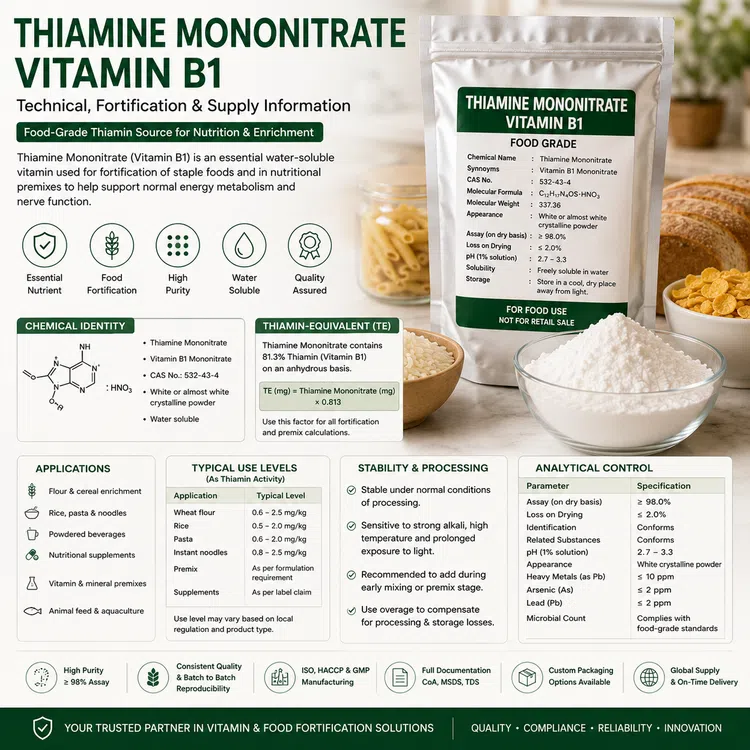
Product identity
| Product name | Thiamine Mononitrate |
|---|---|
| Alternative spelling | Thiamin Mononitrate |
| Nutrient identity | Vitamin B1 / Thiamin |
| Chemical type | Mononitrate salt of the thiamin cation |
| Chemical formula | C12H17N5O4S |
| Approximate molecular weight | 327.36 g/mol |
| CAS number | 532-43-4 |
| Theoretical thiamin equivalent | Approximately 81.1% thiamin cation by molecular-weight calculation before raw-material assay correction |
| Conventional E / INS number | Not normally assigned as a conventional food-additive E number; regulated as an authorized vitamin B1 source |
| Typical appearance | White to off-white crystalline powder |
| Typical odor | Mild or characteristic; free from objectionable foreign odor |
| Water behavior | Water soluble but substantially less soluble than Thiamine Hydrochloride; dissolution is formulation- and temperature-dependent |
| Hygroscopicity | Generally lower than Thiamine Hydrochloride, supporting dry premix and cereal applications |
| Primary function | Vitamin B1 enrichment and fortification |
| Typical commercial forms | Pure powder, standardized dilution, granulated premix, protected preparation or multi-vitamin blend |
Primary industrial functions
- Mandatory enrichment: supplies vitamin B1 where grain or flour standards require restoration of nutrients removed during milling.
- Voluntary fortification: increases thiamin content to a defined nutritional target in permitted food categories.
- Nutrition-premix component: provides a standardized vitamin B1 source in multi-nutrient blends.
- Label-claim support: may contribute toward legally defined “source,” “high,” Daily Value or nutrient-reference-value claims.
- Process-loss compensation: can be applied with a validated overage to account for expected manufacturing and storage losses.
- Dry-system compatibility: supports low-moisture flour, cereal, powder, tablet and capsule applications.
- Micronutrient standardization: allows production batches to meet a controlled thiamin range.
Thiamine Mononitrate, thiamin and vitamin B1 equivalents
Fortification errors can occur when the target is expressed as thiamin but the weighing instruction is calculated as Thiamine Mononitrate without applying the correct conversion.
| Quantity | Meaning | Calculation requirement |
|---|---|---|
| Thiamine Mononitrate mass | Total mass of the vitamin B1 nitrate salt | Used for warehouse, dispensing and batch-weighing instructions |
| Raw-material assay | Measured purity or potency of the commercial lot | Correct the theoretical conversion using the lot-specific COA |
| Thiamin cation equivalent | Nutritionally active thiamin portion of the salt | Theoretical fraction is approximately 0.8106 before assay correction |
| Declared vitamin B1 | Amount reported on the finished-food nutrition label | Must follow the destination-market definition and units |
| Premix potency | Thiamin or Thiamine Mononitrate per kilogram of premix | Confirm whether the supplier states salt weight or vitamin equivalent |
| Finished-product release result | Measured vitamin B1 after manufacturing | Compare against legal limits, label target and analytical tolerance |
Thiamine Mononitrate compared with Thiamine Hydrochloride
| Selection factor | Thiamine Mononitrate | Thiamine Hydrochloride |
|---|---|---|
| Typical positioning | Dry enrichment and fortification | Liquid, soluble or pharmaceutical-style systems |
| Water solubility | Lower | Higher |
| Hygroscopicity | Generally lower | Generally higher |
| Dry premix handling | Often preferred for flour and cereal premixes | May require additional moisture and caking control |
| Direct liquid addition | May dissolve slowly or incompletely at practical concentrations | Usually easier to dissolve |
| Molecular-weight conversion | Requires mononitrate-to-thiamin conversion | Requires hydrochloride-to-thiamin conversion |
| Regulatory suitability | Must be confirmed for the exact destination market and food category | |
| Final selection | Should be based on solubility, process, stability, purity, premix compatibility, claims and applicable legislation | |
Technical purchasing specification framework
The exact release limits depend on the selected pharmacopoeial, food-chemical, national or customer specification. The purchase order should name the controlling standard and revision rather than relying only on the phrase “food grade.”
| Parameter | Purchasing requirement | Industrial significance |
|---|---|---|
| Identity | Confirmed as Thiamine Mononitrate using a validated compendial or chromatographic method | Prevents confusion with Thiamine Hydrochloride or a standardized premix |
| Chemical formula | C12H17N5O4S | Supports identity and equivalent calculations |
| Assay | Controlled range on the stated as-is or dried basis | Primary input for fortification and premix calculations |
| Thiamin-equivalent basis | Supplier declaration of the conversion used | Prevents under- or over-fortification |
| Appearance | White to off-white crystalline powder | Color change can indicate contamination or deterioration |
| Identification tests | Chemical, spectroscopic or chromatographic compliance | Confirms the thiamin and nitrate salt identity |
| Loss on drying / water | Controlled maximum using a defined method | Influences potency, caking, flow and stability |
| Residue on ignition / sulfated ash | Controlled maximum | Supports control of inorganic manufacturing residues |
| Related substances | Individual and total impurities controlled where required | Supports synthesis consistency and shelf-life quality |
| Nitrate identity or content | Confirmed according to the controlling standard | Distinguishes the mononitrate salt |
| Residual solvents | Complies with the manufacturing route and applicable standard | Relevant to synthesis and purification controls |
| Elemental impurities | Lead, arsenic, cadmium, mercury and other required elements | Supports food, supplement and special-nutrition compliance |
| Particle size | Sieve or laser-diffraction profile suited to the premix | Affects homogeneity, dust, dissolution and segregation |
| Bulk density | Typical or controlled range | Relevant to volumetric feeding, packaging and premix matching |
| Flowability | Supplier or application-specific criterion | Affects micro-dosing, hopper discharge and blend uniformity |
| Microbiological quality | Risk-based limits, especially for formulated or diluted grades | Pure crystalline material and carrier-containing products may require different controls |
Pure powder, standardized dilution and protected preparations
| Commercial form | Primary characteristics | Key purchasing questions |
|---|---|---|
| Pure crystalline powder | High-potency Thiamine Mononitrate with no intentional carrier | Assay, particle size, density, dusting and micro-dosing capability |
| Standardized dry dilution | Vitamin blended with starch, maltodextrin, flour or another approved carrier | Thiamin potency, carrier identity, homogeneity, allergens, microbiology and label impact |
| Granulated grade | Engineered particles intended to improve flow, reduce dust or match a premix particle profile | Binder composition, active content, dissolution and segregation |
| Protected preparation | Coated or matrix-protected vitamin intended to improve handling or stability in a defined application | Coating composition, release, bioavailability, process retention and legal status |
| Multi-vitamin premix | Thiamin combined with other vitamins and a controlled carrier system | Full composition, potency tolerances, incompatibilities, overages and blend uniformity |
| Enrichment premix | Thiamin combined with riboflavin, niacin, folic acid, iron or other nutrients required by a grain standard | Legal nutrient ratios, iron compatibility, feed rate and flour homogeneity |
Heat, moisture, pH, sulfite and storage effects
Thiamine Mononitrate offers useful dry-state stability, but vitamin B1 is not chemically inert. Stability can decline after hydration or during severe processing and prolonged storage.
| Risk factor | Potential effect | Control strategy |
|---|---|---|
| Moisture | Increases molecular mobility, caking and degradation risk | Use moisture-barrier packaging and control premix water activity |
| Heat | Can reduce thiamin retention during baking, extrusion, pasteurization or long hot holding | Measure process retention and minimize unnecessary thermal exposure |
| Alkaline pH | Thiamin is generally less stable in neutral-to-alkaline aqueous systems | Control pH, heating time and addition point |
| Acidic pH | Often provides better aqueous stability than alkaline conditions | Confirm final pH, taste and compatibility rather than assuming full stability |
| Sulfites | Can cleave and destroy thiamin in susceptible systems | Avoid direct incompatibility or validate the complete sulfite-containing product |
| Reducing sugars | Can contribute to degradation during heat and storage, especially in moist systems | Test actual sugar composition, water activity and temperature |
| Oxidizing or reducing agents | May alter the thiazolium-containing vitamin structure | Complete compatibility testing with the full premix |
| Light | May contribute to loss in exposed liquid or premix systems | Use protective packaging and limit open handling |
| Trace metals | Can catalyze reactions indirectly through oxidation chemistry | Control raw materials, water and equipment contact |
| Long storage | Gradual potency decline can reduce end-of-shelf-life compliance | Establish real-time stability and a justified overage |
Process retention and overage strategy
Overage is the additional nutrient added above the declared or minimum target to compensate for predictable losses. It should be established from process and shelf-life data, not selected as an arbitrary fixed percentage.
| Stage | Possible loss mechanism | Measurement point |
|---|---|---|
| Premix manufacture | Weighing loss, dust, incomplete transfer or blend non-uniformity | Released premix potency and homogeneity |
| Plant dosing | Feeder error, line retention, segregation or incorrect calibration | Fortified intermediate after complete mixing |
| Fermentation or resting | Moisture, pH, enzymes and time-dependent reaction | Product before thermal processing |
| Baking or extrusion | Heat, moisture, pressure, shear and chemical reaction | Finished product after cooling |
| Drying | Heat exposure and prolonged residence time | Product after final moisture equilibration |
| Packaging | Dust loss, segregation or product retained in equipment | Composite sample from packaged production |
| Shelf life | Moisture, oxygen, heat, light and ingredient interaction | Scheduled real-time stability intervals |
Overage calculation
Initial target = required end-of-shelf-life thiamin ÷ expected retained fraction
For example, an expected retained fraction of 0.85 represents 85% retention. The resulting initial target must still comply with maximum levels, safety requirements, analytical tolerances and applicable nutrition-labeling rules.
Thiamin-equivalent and batch-addition calculations
Thiamin equivalent in raw material
Thiamin-equivalent fraction = Thiamine Mononitrate assay fraction × 0.8106
Use the supplier’s certified conversion where the controlling standard specifies a different reporting convention.
Pure raw-material addition
Raw material, kg = target thiamin, mg/kg × batch mass, kg ÷ (1,000,000 × thiamin-equivalent fraction)
Add the validated overage to the target before completing the calculation.
Premix addition
Premix, kg = required thiamin, mg ÷ premix potency, mg/kg
Confirm whether premix potency is expressed as thiamin, Thiamine Mononitrate or another vitamin B1 basis.
Nutrition-label contribution
Thiamin per serving = finished-product thiamin, mg/kg × serving mass, g ÷ 1,000
Percent reference value or Daily Value should be calculated using the destination market’s current reference intake.
Retention calculation
Retention, % = measured thiamin after processing ÷ measured or calculated thiamin before processing × 100
Premix dilution factor
Dilution factor = final premix mass ÷ pure vitamin mass
The dilution factor should provide a practical plant feed rate without creating excessive premix freight or carrier addition.
Low-dose blending, carrier selection and homogeneity
Directly adding a few grams of pure vitamin into several tonnes of food creates a high risk of poor distribution. Industrial systems generally use geometric dilution or a standardized premix.
Recommended premix sequence
- Calculate the active requirement. Convert the nutritional target to actual Thiamine Mononitrate or premix weight.
- Select a compatible carrier. Match particle size, density, moisture, flow and regulatory status.
- Prepare an initial concentrate. Blend the vitamin with a small, controlled amount of carrier.
- Apply geometric dilution. Increase the blend mass progressively while maintaining uniform distribution.
- Control blend energy. Use enough mixing to achieve uniformity without excessive heat, attrition or electrostatic charging.
- Verify homogeneity. Take representative samples using a statistically justified plan.
- Protect the premix. Fill promptly into moisture- and light-resistant packaging.
- Validate plant feeding. Confirm that the premix remains uniform through conveying, hopper storage and final dosing.
Carrier-selection criteria
- Destination-market authorization
- Particle-size compatibility
- Bulk-density compatibility
- Low moisture and water activity
- Low electrostatic tendency
- Good flow and feeder behavior
- Neutral odor, flavor and color
- Allergen and GMO status
- Analytical compatibility
Common segregation drivers
- Large particle-size differences
- Large bulk-density differences
- Vibration during transport
- Long free-fall distance
- Air classification during pneumatic transfer
- Electrostatic charging
- Particle attrition
- Excessive handling between blending and use
Potential food and nutrition applications
The following are technical evaluation areas. Permitted forms, minimum and maximum levels, enrichment requirements, claims and label declarations vary by jurisdiction and food category.
| Application | Potential purpose | Critical validation points |
|---|---|---|
| Wheat flour | Mandatory or voluntary enrichment and restoration of milling losses | Legal enrichment range, premix feed rate, flour homogeneity, baking loss and analytical control |
| Maize flour and cornmeal | Vitamin B1 enrichment or public-health fortification | National standard, particle matching, nixtamalization, cooking loss and premix segregation |
| Rice | Enrichment through coated kernels, extruded kernels or dusting systems | Wash loss, cooking retention, kernel distribution, color and legal process requirements |
| Breakfast cereals | Vitamin B1 fortification and nutrition-claim support | Extrusion or toasting loss, topical coating, serving size, package moisture and shelf life |
| Pasta and noodles | Enrichment or restoration of refined-grain nutrients | Dough distribution, drying temperature, cooking-water loss and finished-product analysis |
| Bakery premixes | Controlled vitamin addition before industrial baking | Premix homogeneity, fermentation, sulfites, reducing sugars and oven retention |
| Nutrition powders | Multi-vitamin fortification in meal-replacement and nutrition systems | Moisture, mineral interactions, serving dose, reconstitution and storage stability |
| Dry beverage mixes | Vitamin B1 fortification in powder format | Dissolution, haze, sediment, final pH and consumer preparation |
| Liquid beverages | Vitamin B1 fortification where the selected form is technically suitable | Solubility, pH, heat, light, sulfite, package life and comparison with Thiamine Hydrochloride |
| Food supplements | Tablet, capsule, sachet or powder vitamin B1 source | Authorized nutrient form, dosage, uniformity, disintegration, claims and national notification |
| Infant and young-child foods | Controlled vitamin B1 supply where specifically authorized | Category-specific legislation, purity, minimum and maximum levels, stability and analytical release |
| Foods for special medical purposes | Nutritionally complete or condition-specific vitamin B1 supply | Medical-food rules, patient group, clinical formulation, maximum levels and shelf-life potency |
| Plant-based foods | Vitamin B1 standardization or nutritional fortification | Protein and mineral matrix, pH, processing heat, serving size and nutrition claims |
| Extruded snacks | Vitamin B1 fortification or enrichment positioning | Barrel conditions, feed moisture, post-extrusion coating, retention and package stability |
Flour-mill dosing and enrichment control
Premix feeder controls
- Use a feeder sized for the actual premix rate.
- Calibrate by mass over a defined collection period.
- Confirm output across the operating-speed range.
- Install low-level and no-flow alarms where appropriate.
- Prevent bridging and rat-holing in the hopper.
- Record flour flow and premix feed continuously.
- Recalibrate after premix-density or supplier changes.
Mixing and sampling controls
- Add premix into a proven turbulent flour zone.
- Provide sufficient conveying or blending distance.
- Avoid adding immediately before product separation.
- Use composite sampling across time and package positions.
- Trend thiamin together with other enrichment nutrients.
- Investigate feeder variation before increasing overage.
- Maintain traceability between premix and flour lots.
U.S. enriched-flour reference
The U.S. standard of identity for enriched flour is provided in 21 CFR 137.165. It specifies nutrient quantities for enriched flour, including thiamin, riboflavin, niacin, folic acid and iron. Manufacturers should confirm the current text and calculate the premix against the actual flour output and analytical basis.
Reference: 21 CFR 137.165 — Enriched flour
Dissolution, beverage use and solution stability
Although Thiamine Mononitrate is water soluble, its lower solubility relative to Thiamine Hydrochloride can make it unsuitable for some concentrated liquid premixes or clear beverages.
| Development question | Potential risk | Recommended test |
|---|---|---|
| Does the full dose dissolve? | Undissolved particles or sediment | Concentration ladder at actual water quality and temperature |
| Is the solution clear? | Haze or precipitation after dilution | Visual and instrumental turbidity testing |
| Is the pH suitable? | Accelerated degradation at unfavorable pH | Real-time and accelerated potency testing at final pH |
| Are sulfites present? | Rapid thiamin destruction | Compatibility trial using the maximum sulfite concentration |
| Is there a thermal process? | Pasteurization or hot-fill loss | Measure potency before and after the full heat cycle |
| Is the package light protective? | Storage loss in transparent packaging | Light-exposure comparison using intended packaging |
| Is a liquid premix stored? | Potency loss before production use | Hold-time study under actual tank conditions |
| Is another thiamin form better? | Unnecessary complexity and sediment risk | Compare Mononitrate and Hydrochloride on equal thiamin basis |
Interactions with other premix and food components
| Component | Potential interaction | Recommended control |
|---|---|---|
| Sulfites | Can rapidly degrade thiamin | Avoid incompatible combinations or validate retention through shelf life |
| Iron salts | May contribute indirectly to oxidation or premix instability | Select iron form, carrier and packaging using premix stability data |
| Copper salts | Can catalyze oxidative reactions in moist systems | Minimize direct concentrated contact and control moisture |
| Ascorbic acid | Can alter local acidity and redox conditions | Evaluate the complete vitamin and mineral premix |
| Riboflavin | Light-sensitive vitamin systems may show complex photochemical behavior | Use light-protective packaging and complete stability studies |
| Reducing sugars | Heat and moisture may promote degradation reactions | Test actual baking, extrusion or storage conditions |
| Alkaline minerals | Can raise local pH and reduce stability after hydration | Avoid highly concentrated contact and test the final matrix |
| Hygroscopic vitamins or minerals | Can increase premix moisture uptake and caking | Use moisture control, suitable carriers and barrier packaging |
| Enzymes | Food enzymes and native thiaminases may affect nutrient retention in selected matrices | Evaluate the actual raw material and heat process |
| High-fat matrices | Poor distribution may occur without an appropriate dry carrier | Use a validated premix and confirm serving-to-serving uniformity |
Raw-material assay and finished-food testing
Raw-material testing
- Identity by validated compendial method
- Assay on the stated basis
- Water or loss on drying
- Related substances
- Residue on ignition
- Elemental impurities
- Particle size
- Appearance and odor
- Bulk density and flow where specified
Premix testing
- Thiamin potency per kilogram
- Blend uniformity
- Moisture and water activity
- Particle-size distribution
- Bulk density
- Flowability
- Carrier identity
- Microbiological quality
- Stability through stated shelf life
Finished-food method considerations
- Use a method validated for the actual food matrix.
- Define whether total thiamin includes phosphorylated natural forms.
- Use controlled extraction and dephosphorylation where required.
- Control light, pH and temperature during sample preparation.
- Assess recovery using fortified matrix samples.
- Use certified reference material where available.
- Include analytical uncertainty in release and label decisions.
- Do not compare methods without a bridging study.
Incoming inspection and COA review
COA checks
- Correct product and salt form
- CAS number
- Controlling specification and revision
- Assay result and basis
- Thiamin-equivalent declaration
- Water or loss on drying
- Related-substance results
- Residue or ash
- Elemental impurities
- Authorized quality approval
Physical inspection
- Package and seal integrity
- Correct product label
- Lot number and expiry
- White to off-white powder
- No unusual discoloration
- No foreign odor
- No moisture damage
- No severe caking
- No visible contamination
Traceability
- Manufacturer and approved production site
- Country of origin and manufacture
- Batch or lot number
- Manufacturing date
- Retest, expiry or best-before date
- COA issue date
- Specification revision
- Package and pallet identification
- Purchase-order reference
Change-control triggers
- Manufacturing-site change
- Synthesis-route change
- Raw-material source change
- Specification or method change
- Particle-size change
- Packaging change
- Carrier or formulation change
- Shelf-life change
- Regulatory-status change
Typical synthesis, salt formation and finishing stages
Commercial manufacturing routes are supplier-specific. Thiamine is generally produced by controlled chemical synthesis followed by salt formation, purification, crystallization, drying and particle finishing.
- Intermediate manufacture: suitable pyrimidine and thiazole intermediates are prepared and purified.
- Molecular coupling: the key intermediates are combined to form the thiamin structure.
- Salt conversion: the thiamin cation is converted into the required mononitrate form.
- Purification: reaction by-products, residual reagents and solvents are reduced.
- Crystallization: controlled conditions produce the required crystalline material.
- Solid-liquid separation: crystals are isolated and washed.
- Drying: moisture and residual solvent are reduced under controlled conditions.
- Milling or classification: particle size is adjusted for the intended commercial grade.
- Blending: lots may be homogenized or standardized where permitted.
- Quality release: identity, assay, impurities, water and physical parameters are reviewed.
- Protective packaging: released product is packed in controlled food-grade packaging.
Regulatory, enrichment and labeling considerations
European Union
The current consolidated food-supplement framework lists thiamin mononitrate as an authorized vitamin B1 substance. General fortification, food supplements, infant foods and foods for special medical purposes remain subject to separate compositional, labeling, purity and national requirements.
United States
Thiamin is used in standardized enriched grain products and may be used in other foods or dietary supplements under the applicable legal framework. The exact nutrient level and permitted form depend on the food category.
The current U.S. Daily Value for thiamin for adults and children aged four years and older is 1.2 mg. Added thiamin and related claims must be declared according to current nutrition-labeling rules.
Special nutrition categories
Infant formula, follow-on formula, young-child foods, meal replacements, foods for special medical purposes and therapeutic nutrition products require category-specific review.
- Confirm the permitted vitamin B1 form.
- Confirm minimum and maximum thiamin levels.
- Confirm the applicable energy or serving basis.
- Confirm purity and contaminant standards.
- Confirm analytical release requirements.
- Confirm age-group and medical-use labeling.
- Confirm national notification or registration requirements.
Label declaration and claim substantiation
| Labeling issue | Required control |
|---|---|
| Ingredient name | Use the legally accepted market name, such as Thiamine Mononitrate, thiamin or vitamin B1, as applicable |
| Nutrition declaration | Report thiamin in the required unit and serving or 100 g basis |
| Reference-value percentage | Use the destination market’s current reference intake or Daily Value |
| Source or high claim | Confirm the legal threshold and expected end-of-shelf-life level |
| Energy-metabolism claim | Use only wording authorized in the destination market and only when qualifying conditions are met |
| Natural claim | Do not describe synthetic Thiamine Mononitrate as naturally extracted without substantiation |
| End-of-shelf-life compliance | Support the declared amount with validated process retention, stability and analytical tolerance |
Manufacturing and food-safety controls to review
Quality-system review
- Recognized food-safety or quality certification
- Pharmaceutical- or food-chemical GMP where applicable
- Raw-material approval and traceability
- Validated synthesis and purification controls
- Residual-solvent control
- Elemental-impurity control
- Laboratory method validation
- Foreign-material prevention
- Change-control notification
- Recall and mass-balance capability
Declarations and certifications
- Food-grade or nutrient-source compliance statement
- Compendial compliance where required
- Country-of-origin statement
- Manufacturing-site declaration
- Allergen and cross-contact statement
- GMO statement
- Irradiation status
- Animal-origin, vegan and vegetarian status
- Halal and Kosher certificates where required
- Primary-packaging food-contact compliance
Micro-dosing, dust and contamination controls
Thiamine Mononitrate is a high-potency micronutrient used at low concentrations. Accurate weighing and containment are therefore as important as conventional food-ingredient hygiene.
Dispensing controls
- Use calibrated balances suited to the required mass.
- Apply independent verification for critical additions.
- Use dedicated, labeled dispensing containers.
- Reconcile issued, returned and consumed quantities.
- Prevent confusion between salts and potency grades.
- Use barcode or electronic material verification where available.
- Record lot number and actual weight.
Dust and hygiene controls
- Follow the current supplier Safety Data Sheet.
- Minimize airborne dust during bag opening and weighing.
- Use local extraction where the risk assessment requires it.
- Use appropriate eye, skin and respiratory protection.
- Avoid compressed-air cleaning.
- Use clean, dry and approved vacuum equipment.
- Assess combustible-dust characteristics for the supplied grade.
- Prevent cross-contamination with other micronutrients.
Packaging, storage and transport
Typical packaging
Packaging depends on order size, potency, customer handling and supplier. Common formats may include sealed foil-laminate bags, double polyethylene liners, fibre drums, cartons with inner bags or other moisture- and light-resistant systems.
- Net weight per pack
- Primary food-contact liner
- Moisture-vapor barrier
- Light and oxygen barrier
- Tamper-evident closure
- Desiccant where validated
- Drums or cartons per pallet
- Lot, potency and expiry labeling
- Container-loading configuration
Storage controls
- Store in sealed packaging in a cool, dry area.
- Protect from humidity, condensation and direct water contact.
- Protect from heat and direct light.
- Keep away from sulfites and incompatible chemicals.
- Prevent foreign odor and dust contamination.
- Reseal partial packs immediately.
- Use clean and dry dispensing utensils.
- Apply FEFO stock rotation.
- Follow the supplier’s temperature and shelf-life statement.
- Assess significant transport or warehouse excursions.
Fortification accuracy and waste reduction
Efficient nutrient use
- Use assay-corrected calculations.
- Base overage on measured retention.
- Use practical premix feed rates.
- Minimize dust and line retention.
- Prevent rejected batches through feeder alarms.
- Trend finished-product potency.
- Reduce expired inventory through FEFO planning.
Packaging and logistics
- Select pack sizes that minimize partial containers.
- Use high-potency grades where micro-dosing is controlled.
- Use standardized premixes where they reduce plant errors.
- Optimize pallet and container utilization.
- Protect material to avoid humidity-related disposal.
- Coordinate forecast and shelf life before large purchases.
Documents to request before approval
Core technical documents
- Current Product Specification
- Technical Data Sheet
- Lot-specific Certificate of Analysis
- Assay method and reporting basis
- Thiamin-equivalent calculation
- Safety Data Sheet
- Particle-size information
- Packaging specification
- Shelf-life and storage statement
Compliance documents
- Food-grade or nutrient-source declaration
- Pharmacopoeial or food-chemical compliance where required
- Destination-market regulatory statement
- Allergen and cross-contact declaration
- GMO and irradiation statements
- Animal-origin, vegan and vegetarian declaration
- Halal and Kosher certificates where required
- Food-safety or GMP certificate
- Primary-packaging food-contact declaration
Stability and application documents
- Dry-storage stability
- Premix stability
- Baking or extrusion retention data
- pH stability data
- Sulfite-compatibility information
- Recommended overage guidance
- Solubility and dissolution guidance
- Comparison with Thiamine Hydrochloride
International trade documents
- Commercial invoice
- Packing list
- Certificate of origin
- Health or free-sale certificate where required
- Legalized or chamber-certified COA where required
- Transport-classification statement
- ISPM 15 declaration where applicable
- Importer-specific product-registration documents
Information required for an accurate quotation
| Inquiry field | Information to provide |
|---|---|
| Product identity | Thiamine Mononitrate / Thiamin Mononitrate / Vitamin B1 |
| Required grade | Pure powder, pharmacopoeial grade, food-chemical grade, standardized dilution, granulate or premix |
| Application | Flour, cereal, rice, pasta, bakery premix, nutrition powder, beverage, supplement or special-nutrition product |
| Potency basis | Required assay as Thiamine Mononitrate, thiamin or vitamin B1 |
| Fortification target | Required thiamin in mg/kg, mg/serving or other legal basis |
| Process conditions | Mixing, fermentation, baking, extrusion, drying, pasteurization or hot filling |
| Product conditions | Moisture, water activity, pH, sulfite, sugar, minerals and shelf life |
| Physical requirements | Particle size, bulk density, flow, solubility and premix compatibility |
| Regulatory market | Destination country, food category and consumer group |
| Required standard | USP, Ph. Eur., FCC, national, customer or other reference specification |
| Quantity | Sample, pilot trial, drum, pallet, regular order and annual forecast |
| Packaging | Bag, carton, fibre drum, liner, pallet and private-label requirement |
| Destination | Delivery city, port and country |
| Commercial terms | Requested Incoterm, currency, payment preference and shipment window |
| Reference material | Existing specification, COA, approved sample, premix formula or competitor product |
Frequently asked questions
What is Thiamine Mononitrate?
It is the mononitrate salt of thiamin, an essential water-soluble nutrient also known as vitamin B1.
What is it used for?
It is used for vitamin B1 enrichment and fortification in flour, cereal, rice, pasta, nutrition powders, supplements and other legally permitted products.
Does it have an E number?
It is generally regulated as a vitamin source rather than as a conventional E-number additive. The exact label name depends on the market.
What is its chemical formula?
The formula is C12H17N5O4S, with an approximate molecular weight of 327.36 g/mol.
How much thiamin does the salt provide?
Pure Thiamine Mononitrate theoretically provides approximately 81.1% thiamin cation by mass. The commercial lot assay must also be applied.
Is it the same as Thiamine Hydrochloride?
No. Both supply vitamin B1, but they have different counterions, molecular weights, solubility and dry-handling characteristics.
Which form is better for flour?
Thiamine Mononitrate is often selected for flour and dry cereal premixes because of its dry-blend handling and comparatively low hygroscopicity.
Which form is better for beverages?
Thiamine Hydrochloride may be easier to dissolve, but the best form depends on pH, process, concentration, label requirements and shelf life.
Can Thiamine Mononitrate be added directly to a large batch?
Direct addition of pure vitamin at very low dosage can produce poor uniformity. A standardized premix is normally safer and more accurate.
Why is an overage used?
A validated overage compensates for predictable processing and storage losses so the product remains within its declared range through shelf life.
Is the vitamin heat stable?
It has useful dry-state stability but can be lost during baking, extrusion, pasteurization and prolonged hot processing. Retention must be measured in the actual food.
Is it stable at every pH?
No. Thiamin is generally less stable in neutral-to-alkaline aqueous systems and usually more stable under controlled acidic conditions.
Can it be used with sulfites?
Sulfites can degrade thiamin. Sulfite-containing formulations require specific compatibility and shelf-life studies.
How is finished-product thiamin measured?
Validated methods may use HPLC or fluorescence following controlled extraction and thiochrome derivatization. The method must suit the food matrix.
Can it be used in infant formula?
Only when the exact vitamin form, purity, minimum and maximum level and product category comply with the destination market’s special rules.
How should it be stored?
Store it sealed in a cool, dry area protected from humidity, heat, direct light, sulfites and incompatible chemicals.
Which COA values are most important?
Review identity, assay, reporting basis, thiamin equivalent, water, related substances, residue, elemental impurities and any agreed particle-size parameters.
Can Global Food Additives compare an existing grade?
Yes. Buyers can provide a specification, COA, premix formula, approved sample, potency basis or competitor grade for technical and commercial comparison.
Tell us the Thiamine Mononitrate grade and potency you require.
Include the finished-food application, fortification target, potency basis, required standard, process conditions, quantity, packaging, destination market and documentation requirements.
Existing specifications, COAs, premix formulas, retention data or approved samples can be described in your message. Our team will review the inquiry and respond from orders@foodgradeadditives.com .
Your technical inquiry has been received. You will be redirected to the home page.