
Tricalcium Phosphate — E 341(iii)
Tricalcium Phosphate is a white, odourless and practically water-insoluble food-grade calcium phosphate used for calcium and phosphorus fortification, anticaking, powder-flow improvement, mineral carrying and dry-blend processing. Its industrial performance depends on chemical composition, mineral phase, particle morphology, particle-size distribution, bulk density, surface area, moisture exposure and compatibility with the finished formulation.
Commercial food-grade E 341(iii) should not automatically be treated as a single-phase, perfectly stoichiometric material. It may contain a variable mixture of calcium phosphate phases represented by calcium orthophosphate Ca3(PO4)2 and calcium hydroxyapatite Ca5(PO4)3OH. Buyers should therefore define the required calcium content, phosphate content, particle profile, physical performance and regulatory standard before comparing suppliers.
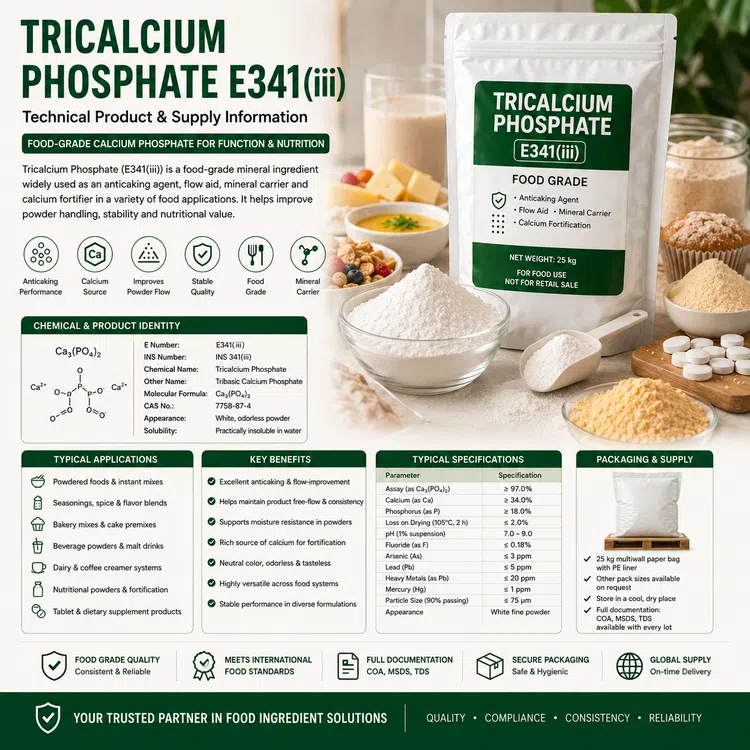
Product identity
| Product name | Tricalcium Phosphate |
|---|---|
| Specific additive identity | E 341(iii) / INS 341(iii) |
| Common synonyms | Calcium phosphate tribasic, tribasic calcium phosphate, calcium orthophosphate, tricalcium monophosphate |
| Related phase name | Pentacalcium hydroxy monophosphate or calcium hydroxyapatite |
| Chemical family | Inorganic calcium orthophosphates |
| Representative formula | Ca3(PO4)2 |
| Alternative representative formula | Ca5(PO4)3OH |
| Approximate EU composition | Variable calcium phosphate mixture approximating 10CaO·3P2O5·H2O |
| CAS number — calcium orthophosphate | 7758-87-4 |
| EC number — calcium orthophosphate | 231-840-8 |
| EC number — calcium hydroxyapatite | 235-330-6 |
| Molecular weight — Ca3(PO4)2 | Approximately 310.18 g/mol |
| Molecular weight — Ca5(PO4)3OH | Approximately 502.31 g/mol |
| Typical appearance | White, odourless powder stable in air |
| Water solubility | Practically insoluble |
| Ethanol solubility | Insoluble |
| Acid behavior | Soluble or increasingly soluble in dilute mineral acids; dissolution in food depends on pH, acid type, particle size, temperature and residence time |
| Typical physical forms | Fine powder, controlled-particle-size powder, granulated material or application-specific carrier grade |
Primary technical functions
- Calcium fortification: supplies calcium where an insoluble mineral source is compatible with the finished food, process and sensory target.
- Phosphorus contribution: supplies phosphorus as calcium phosphate and must be included in total phosphorus and phosphate calculations.
- Anticaking: helps reduce moisture-driven agglomeration and hard-lump formation in suitable dry powders.
- Powder-flow improvement: may improve discharge through bins, hoppers, augers, fillers, sachets and consumer packages.
- Mineral carrying: can support distribution of vitamins, minerals, flavours, colours or other low-dose ingredients in a dry premix.
- Dry-blend processing: can improve consistency during conveying, blending, dosing, filling and package discharge.
- Tableting support: selected physical grades may contribute flow, mineral content or compression behavior in food and nutrition tablets.
EU E 341(iii) specification benchmark
The following table provides a regulatory and purchasing benchmark for E 341(iii). The contracted supplier specification may include narrower chemical limits and additional physical parameters according to the intended application.
| Parameter | EU E 341(iii) benchmark | Industrial interpretation |
|---|---|---|
| Definition | Variable mixture of calcium phosphates obtained by neutralizing phosphoric acid with calcium hydroxide or calcium carbonate | The manufacturing route can influence mineral phase, morphology, density, impurity profile and physical performance. |
| Representative formulas | Ca5(PO4)3OH or Ca3(PO4)2 | Do not assume every compliant grade is phase-pure Ca3(PO4)2. |
| Assay | Not less than 90%, calculated on the ignited basis | Confirm the supplier’s calculation, reporting basis and analytical procedure. |
| P2O5 content | 38.5%–48.0% on the anhydrous basis | Useful for confirming phosphate composition and comparing mineral phases or manufacturing sources. |
| Appearance | White, odourless powder stable in air | Customers may add tighter limits for whiteness, foreign matter, agglomerates or visible contamination. |
| Calcium identity | Passes test | Confirms the calcium component but does not establish total calcium concentration or bioavailability. |
| Phosphate identity | Passes test | Confirms phosphate identity but does not establish phase, particle morphology or functional performance. |
| Solubility | Practically insoluble in water; insoluble in ethanol; soluble in dilute hydrochloric and nitric acid | Liquid applications require dispersion, sediment, suspension and acid-dissolution testing. |
| Loss on ignition | Not more than 8% after ignition at 800 °C ± 25 °C for 30 minutes | Supports control of moisture, hydroxyl content, carbonates and other volatile or decomposable components. |
| Fluoride | Not more than 50 mg/kg, expressed as fluorine | Important for mineral-source qualification and regulatory compliance. |
| Arsenic | Not more than 1 mg/kg | Confirm the analytical method, reporting limit, laboratory competence and applicable destination-market requirements. |
| Cadmium | Not more than 1 mg/kg | |
| Lead | Not more than 1 mg/kg | |
| Mercury | Not more than 1 mg/kg | |
| Aluminium — foods for infants and young children | Not more than 150 mg/kg | The intended food category must be disclosed to the supplier before approval. |
| Aluminium — other uses | Not more than 200 mg/kg | Customer limits may be lower according to risk assessment, market requirements or internal policy. |
Calcium, phosphorus and mineral-phase calculations
Mineral content depends on the calcium phosphate phases present in the commercial grade. The values below are theoretical reference values for the two representative formulas and should not replace supplier-declared composition.
| Representative mineral phase | Formula | Theoretical calcium | Theoretical phosphorus | Theoretical P2O5 equivalent |
|---|---|---|---|---|
| Stoichiometric Tricalcium Phosphate | Ca3(PO4)2 | Approximately 38.76% | Approximately 19.97% | Approximately 45.76% |
| Calcium Hydroxyapatite | Ca5(PO4)3OH | Approximately 39.89% | Approximately 18.50% | Approximately 42.39% |
Calcium-to-phosphorus ratio
Stoichiometric Tricalcium Phosphate has a molar calcium-to-phosphorus ratio of 1.50. Hydroxyapatite has a molar ratio of approximately 1.67. A commercial value between or around these ratios may reflect mineral-phase composition, minor calcium phosphates or analytical variation.
Where phase identity is contractually important, the buyer may request X-ray diffraction, calcium-to-phosphorus ratio data or another validated mineral-characterization method.
Nutrition mass balance
A preliminary calcium calculation is:
Calcium contributed = ingredient mass × supplier-declared calcium fraction
Where an assay correction is required:
Corrected calcium = ingredient mass × calcium fraction × assay correction
Finished-product declarations should include production variation, analytical tolerance, serving size and applicable nutrition rules.
Difference from other calcium phosphates
| Calcium phosphate | Specific identity | Representative formula | General functional character |
|---|---|---|---|
| Monocalcium Phosphate | E 341(i) | Ca(H2PO4)2 | Acidic calcium phosphate used in leavening and selected mineral systems |
| Dicalcium Phosphate | E 341(ii) | CaHPO4 | Sparingly soluble mineral source used in fortification, tableting and dry formulations |
| Tricalcium Phosphate | E 341(iii) | Ca3(PO4)2 or Ca5(PO4)3OH | Practically insoluble mineral used for fortification, anticaking, flow improvement and carrying |
The three calcium phosphates are not equal-weight or equal-function substitutes. Their calcium content, phosphorus content, acid-base behavior, solubility, particle characteristics and processing performance differ.
Anticaking and powder-flow performance
Interparticle separation
Fine Tricalcium Phosphate particles can distribute between larger host-powder particles and reduce direct particle contact. This may lower frictional locking and reduce the number of contact points where moisture-driven liquid or solid bridges can form.
Effective surface distribution depends on dosage, mixing method, particle-size ratio, electrostatic behavior and the tendency of the flow aid to form its own agglomerates.
Moisture-bridge control
Hygroscopic ingredients can absorb atmospheric moisture and develop liquid bridges between particles. During storage, these bridges may strengthen through dissolution, recrystallization or solidification.
A suitable Tricalcium Phosphate grade may reduce bridge formation, but it cannot compensate for excessive product moisture, inadequate packaging or uncontrolled warehouse humidity.
Particle-size relationship
Anticaking particles are commonly selected to be substantially smaller than the host-powder particles. Material that is too coarse may segregate and provide poor surface coverage.
Extremely fine material can become cohesive, dusty or difficult to distribute. The optimum particle range must be established in the actual host powder.
Surface morphology
Particle shape, roughness, porosity and specific surface area may affect coating, moisture interaction, oil absorption and flow performance. Two grades with similar chemical assays may therefore behave differently in the same formulation.
Critical applications may require morphology, surface-area or application-performance specifications in addition to chemical purity.
Powder-flow and anticaking test program
Chemical compliance alone does not prove that a grade will improve production flow. A qualification protocol should use the actual host powder and simulate realistic manufacturing, transport and storage conditions.
| Test | Information generated | Industrial value |
|---|---|---|
| Particle-size distribution | D10, D50, D90 or sieve profile | Supports assessment of coating, segregation, dusting and feeder behavior. |
| Loose bulk density | Untapped mass per unit volume | Relevant to package filling, silo capacity and volumetric dosing. |
| Tapped density | Density after controlled consolidation | Supports transport-settling and compressibility evaluation. |
| Carr index | Compressibility derived from bulk and tapped density | Comparative indicator of powder cohesion and flow tendency. |
| Hausner ratio | Tapped density divided by bulk density | Useful for comparative screening under standardized conditions. |
| Angle of repose | Natural pile angle under a defined method | Simple flow indicator that should be combined with other tests. |
| Orifice-flow test | Discharge time, mass flow and bridging tendency | Directly relevant to hoppers, augers and filling equipment. |
| Shear-cell analysis | Flow function, yield locus and wall friction | Valuable for industrial silo and hopper design. |
| Humidity conditioning | Flow and caking after controlled relative humidity and temperature | Simulates warehouse, shipping and consumer-storage exposure. |
| Caking-strength test | Lump strength after defined compression and storage | Relevant to stacked bags, drums and bulk containers. |
| Package-discharge test | Flow, residue and lumping after storage in the intended package | Provides commercially representative performance data. |
Selecting the correct commercial grade
| Grade type | Primary specification priorities | Typical use focus |
|---|---|---|
| Mineral-fortification grade | Calcium, phosphorus, contaminant limits, mineral phase, sensory quality and nutritional consistency | Cereals, nutrition powders, snacks, meal replacements and fortified foods |
| Anticaking grade | Fine particle profile, morphology, moisture, density, dispersion and caking performance | Salt, seasoning, beverage powder, bakery mixes and hygroscopic blends |
| Carrier grade | Particle-size compatibility, density, adsorption performance and segregation resistance | Vitamin, mineral, flavour, colour and microingredient premixes |
| Granulated grade | Low dust, granule strength, controlled density and reduced segregation | Automated handling, sachet filling, coarse blends and tableting |
| Sensitive-application grade | Tighter aluminium, heavy-metal, traceability and purity limits | Infant, young-child, medical or customer-controlled nutrition products |
Potential food-manufacturing applications
Application suitability depends on food-category permission, grade, particle properties, dosage, mineral target, processing conditions and sensory requirements. The following are evaluation areas rather than universal use or dosage recommendations.
| Application | Potential technical purpose | Critical validation points |
|---|---|---|
| Powdered beverages | Calcium fortification, anticaking and mineral carrying | Reconstitution, sediment, mouthfeel, suspension, flavour, package barrier and declared calcium |
| Nutrition and protein powders | Calcium addition, flow support and dry-blend standardization | Chalkiness, sediment, protein interaction, scoop accuracy, segregation and nutrition claims |
| Vitamin and mineral premixes | Mineral source, dilution carrier and low-dose ingredient distribution | Blend uniformity, density matching, assay recovery, electrostatics and segregation |
| Seasonings and spice blends | Flow improvement, caking control and minor-ingredient distribution | Oil content, colour dilution, flavour, dusting, humidity and package discharge |
| Salt and mineral-salt blends | Anticaking and improved discharge under humid conditions | Moisture exposure, particle matching, whiteness, taste and shaker flow |
| Bakery mixes | Calcium fortification, flow support and premix distribution | Dough behavior, leavening balance, flour color, mineral uniformity and finished-product texture |
| Breakfast cereals | Calcium and phosphorus fortification | Mineral retention, extrusion or cooking behavior, flavor, texture and serving-level claims |
| Extruded snacks | Mineral fortification and dry-premix processing support | Expansion, density, texture, die wear, color and mineral recovery |
| Soup, sauce and gravy powders | Flow improvement and dry mineral distribution | Reconstitution, sediment, starch hydration, mouthfeel and flavor |
| Confectionery and dessert powders | Flow support, mineral carrying and calcium fortification | Dissolution, chalkiness, chocolate or fat interaction, color and package stability |
| Food and nutrition tablets | Mineral contribution and selected powder-flow or compression support | Tablet hardness, friability, disintegration, tooling wear, dust and dose uniformity |
| Dry flavors and colors | Carrier, dilution aid and distribution support | Active retention, segregation, color strength, flavor release and declaration requirements |
Dispersion, suspension and acidic dissolution
Tricalcium Phosphate is practically insoluble in water and should not be expected to form a clear neutral solution. Liquid-food use requires control of suspension, sediment, particle perception, acid demand and mineral interactions.
Neutral and near-neutral products
- Visible settling may occur during storage.
- Fine particles may create haze or opacity.
- Insufficient stabilization may form compact sediment.
- Coarse particles may create chalkiness or grittiness.
- Homogenization can reduce particle size but does not make the mineral chemically soluble.
- Shelf-life testing should include sediment volume, redispersibility and mouthfeel.
Acidic products
- Lower pH generally increases dissolution.
- Dissolution rate depends on acid type and concentration.
- The mineral consumes acid and may increase the final pH.
- Released calcium may interact with citrate, pectin, alginate or protein.
- Concentrated local addition can create temporary precipitation or lumps.
- Final pH and titratable acidity should be measured after equilibration.
Dry-blending and dosing guidance
Recommended development sequence
- Define the objective. Identify whether the primary requirement is fortification, anticaking, flow improvement, carrying or tableting.
- Characterize the host powder. Record moisture, water activity, hygroscopicity, fat content, particle size, density, baseline flow and electrostatic behavior.
- Select candidate grades. Compare composition, particle distribution, morphology, density, moisture and application data.
- Establish a dose series. Test several controlled levels rather than relying on one generic supplier recommendation.
- Standardize mixing. Fix blender type, load level, sequence, time and speed.
- Condition samples. Apply realistic humidity, temperature, vibration, compression and storage conditions.
- Measure performance. Evaluate flow, caking, segregation, package discharge, sensory quality and mineral recovery.
- Validate production scale. Confirm performance in the actual hopper, conveyor, feeder, filler, package and warehouse.
Low-dose premixing
- Screen the ingredient where the validated process requires removal of agglomerates.
- Preblend low-dose material with a controlled portion of the host powder.
- Use staged dilution to reduce concentration gradients.
- Add the premix across an active mixing zone rather than one static location.
- Verify blend uniformity at multiple blender and package locations.
- Confirm that conveying and filling do not create resegregation.
Mixing controls
- Use a defined blender working volume.
- Control sequence, mixing time and rotational speed.
- Avoid unnecessary overmixing.
- Monitor dust loss and filter recovery.
- Control electrostatic accumulation where relevant.
- Validate line clearance and cross-contact prevention.
- Sample the start, middle and end of the packaging run.
Ingredient, calcium and phosphorus mass balance
Ingredient addition
Ingredient mass, kg = batch mass, kg × addition level, % ÷ 100
The addition level should be confirmed against the food category, legal conditions, formulation target and technical trial results.
Calcium contribution
Calcium mass = ingredient mass × supplier-declared calcium fraction
Use the contracted calcium specification rather than a generic theoretical value for finished-product labeling.
Phosphorus contribution
Phosphorus mass = ingredient mass × supplier-declared phosphorus fraction
Elemental phosphorus, phosphate and P2O5 equivalent are different reporting bases. The specification and calculation record should clearly identify which basis is used.
Cost-in-use analysis
Ingredient cost per tonne = ingredient price per kg × required kg per tonne
A complete commercial comparison should also include reduced caking, rejected material, package residue, cleaning time, dust loss, production stoppages and customer complaints.
Ingredient and process interactions
| System component | Potential interaction | Recommended validation |
|---|---|---|
| Food acids | Acid dissolves calcium phosphate, consumes acidity and releases calcium and phosphate ions. | Measure equilibrium pH, titratable acidity, dissolution, sediment and flavor. |
| Calcium-sensitive hydrocolloids | Released calcium may alter pectin, alginate or other calcium-responsive gel systems. | Validate gel time, viscosity, gel strength and addition order. |
| Soluble phosphates | Total phosphate and calcium-phosphate equilibrium may change. | Review precipitation, total mineral content, legal limits and labeling. |
| Dairy and plant proteins | Insoluble mineral particles may affect suspension, mouthfeel, viscosity and sediment. | Test dispersibility, chalkiness, heat stability and storage behavior. |
| Oil-rich flavors | Surface coating by oil may alter flow-aid distribution and efficiency. | Test the complete flavor and fat system under storage humidity. |
| Hygroscopic salts and sugars | Moisture uptake may exceed the capacity of the anticaking system. | Combine formulation control with moisture-barrier packaging. |
| Iron and trace minerals | Mineral interactions may influence color, oxidation or assay recovery. | Conduct accelerated stability and finished-product analysis. |
| Low-dose vitamins | Density and particle-size differences may create segregation. | Validate premix sequence, blend uniformity and package sampling. |
| Metal-detection systems | High mineral content may increase product effect or require detector-setting review. | Validate detector performance using the finished formulation. |
| Packaging films | Inadequate water-vapor protection can permit caking despite flow-aid addition. | Evaluate film barrier, seal integrity, headspace and package size. |
Typical manufacturing and finishing stages
Supplier processes vary, but food-grade Tricalcium Phosphate is generally produced by controlled reaction of phosphoric acid with an approved calcium source, followed by solid separation, washing, drying, thermal treatment, milling, classification and packaging.
- Raw-material qualification: phosphoric acid and calcium hydroxide, calcium carbonate or another approved calcium source are tested against purity requirements.
- Controlled neutralization: temperature, pH, concentration and addition rate influence the resulting calcium phosphate phases.
- Precipitation: process conditions affect crystal growth, agglomeration, morphology and filterability.
- Solid-liquid separation: filtration or centrifugation removes the reaction liquor.
- Washing: residual soluble salts and process impurities may be reduced.
- Drying and thermal treatment: moisture, phase structure and physical characteristics are adjusted.
- Milling and classification: particle size is tailored to fortification, flow-aid, carrier or granulation requirements.
- Foreign-material control: screens, magnets and other controls are applied according to the food-safety plan.
- Quality release: chemical, contaminant and physical results are reviewed before shipment.
Incoming quality control and COA review
Chemical identity and purity
- Exact product and food-additive name
- E 341(iii) or destination-market identity
- Calcium identity
- Phosphate identity
- Assay with reporting basis
- P2O5 content
- Calcium content where nutritionally relevant
- Phosphorus content where required
- Loss on ignition
- Fluoride
- Aluminium and elemental impurities
Physical and functional properties
- Appearance, color and odor
- Particle-size distribution
- Maximum sieve residue
- Loose bulk density
- Tapped bulk density
- Flowability or angle of repose where specified
- Specific surface area where critical
- Whiteness where visually important
- Dispersibility or sediment behavior where relevant
- Application-specific anticaking performance
Advanced characterization
- X-ray diffraction for mineral-phase identification
- Laser diffraction for D10, D50 and D90
- Scanning electron microscopy for morphology studies
- BET specific surface area where functionally relevant
- Calcium-to-phosphorus molar ratio
- Shear-cell flow function for hopper design
- Humidity-caking testing in the customer’s host powder
Lot traceability
- Manufacturer and approved production site
- Country of origin and manufacture
- Batch or lot number
- Manufacturing date
- Expiry, best-before or retest date
- COA issue date and authorization
- Specification revision
- Purchase-order reference
- Packaging code and net-weight verification
Food-safety and manufacturing controls to review
Quality-system controls
- Recognized food-safety certification
- HACCP or preventive-control program
- Raw-material approval
- Supplier monitoring
- Traceability and mass balance
- Recall and incident procedures
- Laboratory and calibration controls
- Foreign-material prevention
- Change-control notification
Declarations and certifications
- Food-grade compliance statement
- Allergen and cross-contact declaration
- GMO status
- Irradiation status
- Nanomaterial status where required
- Animal-origin, vegan and vegetarian status
- BSE/TSE statement where requested
- Halal certificate where required
- Kosher certificate where required
- Food-contact packaging compliance
Packaging, storage and logistics
Commercial packaging
Packaging depends on particle fineness, grade, shipment quantity and destination. Common formats may include lined multiwall paper bags, woven polypropylene bags with food-contact liners, drums, bulk bags or other contamination-resistant industrial packaging.
- Net weight per package
- Inner-liner material and thickness
- Food-contact compliance
- Bag-closing and tamper-evidence method
- Dust tightness and puncture resistance
- Bags per pallet
- Net pallet weight
- Pallet dimensions and construction
- Stretch wrapping and top-sheet protection
- Container-loading quantity
Storage controls
- Store in a cool, dry and well-ventilated warehouse.
- Keep packaging tightly sealed until use.
- Protect from humidity, rain and condensation.
- Store on clean pallets away from wet floors and walls.
- Prevent contamination by dust, pests and odors.
- Protect fine grades from unnecessary compression.
- Reseal partially used bags immediately.
- Use clean and dry dispensing equipment.
- Apply FEFO or the supplier-recommended rotation system.
- Follow the supplier’s declared shelf life.
Quotation logistics data
| Requested quantity | Sample, trial quantity, pallet, full-container load or annual forecast |
|---|---|
| Required grade | Fortification, anticaking, carrier, granulated or customer-specific physical grade |
| Packaging | Bag size, liner, palletization and labeling requirement |
| Destination | City, port, country and final regulatory market |
| Delivery basis | Requested Incoterm, delivery point and shipment window |
| Loading method | Palletized, slip-sheeted or floor-loaded container |
| Required documents | COA, specification, SDS, origin, certifications and import documents |
Dust, workplace and equipment controls
Food-grade status does not remove the need for industrial dust management. Fine mineral powders can create nuisance dust, eye or respiratory exposure and housekeeping challenges. Handling should follow the current supplier Safety Data Sheet and site risk assessment.
Powder-handling controls
- Minimize airborne dust during bag opening and charging.
- Use enclosed transfer or local extraction where practical.
- Use suitable eye and respiratory protection according to the SDS.
- Prevent powder accumulation on equipment and structures.
- Use approved industrial vacuum or controlled cleanup methods.
- Avoid contamination from damaged packaging.
- Train operators in product, grade and lot verification.
- Provide suitable eyewash facilities where required.
Equipment considerations
- Confirm feeder suitability for the specified density and particle size.
- Evaluate hopper angle, outlet size and wall friction.
- Use agitation or vibration only where validated.
- Avoid dead zones that retain previous production lots.
- Inspect screens, filters and transfer lines for buildup.
- Calibrate gravimetric and volumetric feeding systems.
- Validate cleaning and line-clearance procedures.
Regulatory and labeling considerations
European Union
Tricalcium Phosphate is specifically identified as E 341(iii). Compliance with the chemical specification does not automatically authorize use in every food. The finished-food category, maximum level, conditions of use and labeling requirement must be checked separately.
United States
U.S. regulation lists calcium phosphate in mono-, di- and tribasic forms as generally recognized as safe when used in accordance with good manufacturing practice. Product-specific standards of identity, fortification policy and labeling rules may also apply.
Reference: 21 CFR 182.1217 — Calcium phosphate
Other destination markets
Codex references, national additive lists, fortification policies, GCC requirements, customs classification, importer registration and local-language labeling should be checked independently.
- Confirm the permitted food category.
- Confirm the maximum level or GMP condition.
- Determine whether the material is used as an additive, nutrient source, carrier or processing aid.
- Review total phosphorus and phosphate calculations.
- Confirm the required ingredient or additive name.
- Review calcium and phosphorus nutrition labeling.
- Check conditions for calcium-related nutrition claims.
- Review infant-food and medical-food requirements.
- Confirm import and certification documents.
Process efficiency and environmental control
Manufacturing efficiency
- Optimize to the minimum technically effective dose.
- Use calibrated gravimetric or validated volumetric dosing.
- Track actual usage against standard consumption.
- Reduce dust loss during transfer and mixing.
- Choose package sizes that minimize partial bags.
- Include reduced caking and rejected product in cost analysis.
- Assess freight efficiency by active calcium and functional dose.
Waste controls
- Prevent dry powder from entering drains.
- Recover spills according to the site procedure.
- Include calcium and phosphorus inputs in wastewater and sludge review.
- Avoid unnecessary wet cleaning of dry processing lines.
- Coordinate formulation changes with wastewater-treatment personnel.
- Dispose of damaged or off-specification material through approved channels.
Documents to request before approval
Core technical documents
- Current Product Specification or Technical Data Sheet
- Representative and lot-specific Certificate of Analysis
- Current Safety Data Sheet
- Calcium and phosphorus composition statement
- Particle-size distribution
- Bulk-density information
- Product label or approved label draft
- Packaging and pallet specification
- Shelf-life and storage statement
- Country of origin and manufacturing-site statement
Compliance documents
- Food-grade compliance declaration
- Applicable EU, FCC, JECFA or national statement
- Allergen and cross-contact declaration
- GMO statement
- Irradiation statement
- Animal-origin and BSE/TSE statement
- Vegan and vegetarian status
- Halal certificate where required
- Kosher certificate where required
- Food-safety system certification
Application-specific data
- Anticaking study in a representative host powder
- Humidity and caking-test conditions
- Particle-size D10, D50 and D90 where available
- Loose and tapped bulk density
- Angle of repose or shear-cell data
- Mineral-phase or XRD data where required
- Specific surface area where relevant
- Dispersion and sediment data for liquid applications
- Calcium-bioavailability support where required for a claim
International trade documents
- Commercial invoice
- Packing list
- Certificate of origin
- Health or free-sale certificate where required
- Legalized or chamber-certified COA where required
- Transport-classification statement
- Container-loading plan
- ISPM 15 declaration where applicable
- Importer-specific registration documents
Information required for an accurate quotation
| Inquiry field | Information to provide |
|---|---|
| Product identity | Tricalcium Phosphate, E 341(iii) |
| Required function | Calcium fortification, phosphate contribution, anticaking, powder flow, carrier or tableting |
| Application | Finished-food category, host-powder composition and process |
| Applicable standard | EU 231/2012, FCC, JECFA, national or customer specification |
| Chemical requirements | Assay, calcium, phosphorus, P2O5, loss on ignition, fluoride, aluminium and heavy metals |
| Physical requirements | Particle size, sieve residue, bulk density, tapped density, flowability, whiteness or surface area |
| Performance target | Calcium per serving, desired flow rate, humidity condition, caking reduction or package-discharge target |
| Quantity | Sample, trial, pallet, container quantity and annual forecast |
| Packaging | Bag size, liner, palletization, private label and label language |
| Destination | Delivery city, port, country and final regulatory market |
| Commercial term | Requested Incoterm, currency, payment preference and shipment window |
| Documentation | Required COA parameters, certifications, origin and import documents |
| Reference material | Existing specification, COA, label, approved sample or competitor grade |
Frequently asked questions
What is the correct E number for Tricalcium Phosphate?
The specific designation is E 341(iii). E 341 describes the wider calcium phosphate group, which also includes Monocalcium Phosphate E 341(i) and Dicalcium Phosphate E 341(ii).
Is E 341(iii) always pure Ca3(PO4)2?
Not necessarily. Food-grade E 341(iii) may be a variable mixture of calcium phosphate phases represented by calcium orthophosphate and calcium hydroxyapatite.
What is Tricalcium Phosphate used for in food manufacturing?
It may be used for calcium and phosphate fortification, anticaking, powder-flow improvement, mineral carrying, dry premixes and selected tableting applications.
Is Tricalcium Phosphate a soluble phosphate buffer?
No. It is practically insoluble in water and is fundamentally different from soluble sodium or potassium phosphate buffers.
How much calcium does it contain?
Pure stoichiometric Ca3(PO4)2 theoretically contains approximately 38.76% calcium. Commercial composition varies, so supplier-declared calcium should be used for labeling.
Does Tricalcium Phosphate dissolve in water?
It is practically insoluble in water. It becomes more soluble in acidic conditions, but liquid applications may still require sediment, suspension and sensory control.
Can it be used in a clear beverage?
Clear-beverage use is challenging because the material is insoluble. Acidic conditions may dissolve part of it, but clarity, pH, sediment and shelf stability must be validated.
How does it improve powder flow?
A suitable fine grade can separate larger host particles, reduce direct contact and limit moisture-driven bridges. Performance depends on grade, dosage, humidity, mixing and packaging.
Does a finer grade always perform better?
No. Very fine particles may offer greater surface coverage but may also become cohesive, dusty or difficult to distribute. The optimum grade depends on the host powder.
Can it replace calcium carbonate?
It may be evaluated as an alternative calcium source, but it is not an equal-weight substitute. Calcium concentration, phosphate contribution, solubility, acid demand, density and cost differ.
Which powder tests should buyers request?
Useful tests include particle-size distribution, bulk and tapped density, Carr index, Hausner ratio, angle of repose, orifice flow, shear-cell analysis, humidity conditioning and caking strength.
Can one grade serve both fortification and anticaking?
Sometimes, but the specification priorities differ. Fortification requires reliable mineral and contaminant data, while anticaking depends strongly on physical properties and host-powder performance.
How should it be added to a dry blend?
Low-dose material is commonly distributed through a controlled premix before addition to the main batch. Mixing time, sequence, density differences and segregation must be validated.
What is the difference between food grade and technical grade?
Food-grade material should comply with a recognized food-additive specification and be manufactured, documented, packed and traceable for food use. Technical grade may have different purity controls.
Which COA values should be compared?
Compare assay, calcium, phosphorus or P2O5, loss on ignition, fluoride, aluminium, elemental impurities, particle size, density and relevant flow data.
Is it permitted in every country and food?
No. Permitted food categories, maximum levels, fortification policies and labeling requirements vary by jurisdiction.
What storage conditions are recommended?
Store in sealed packaging in a cool, dry and well-ventilated warehouse. Protect the product from water, condensation, contamination and excessive compression.
Can Global Food Additives compare an existing grade?
Yes. Buyers can provide an existing specification, COA, particle-size target, label, performance data or approved sample for supplier comparison.
Tell us the Tricalcium Phosphate grade and performance you require.
Include the intended function, finished-food application, calcium or phosphorus target, particle-size requirements, powder-flow target, destination market, quantity, packaging, delivery term and required documents.
Existing specifications, COAs, flow-test results, product labels or approved samples can be described in your message. Our team will review the inquiry and respond from orders@foodgradeadditives.com .
Your technical inquiry has been received. You will be redirected to the home page.