
Trisodium Citrate — E 331(iii)
Trisodium Citrate is the fully neutralised trisodium salt of citric acid. Food manufacturers use it as a mild alkaline citrate buffer, acidity regulator, flavour-balancing salt, calcium- and magnesium-ion complexing agent and formulation component in products requiring controlled pH, mineral management or protein stability.
Commercial food-grade material is commonly supplied as Trisodium Citrate Dihydrate, although anhydrous grades are also available. Hydration state affects molecular weight, active citrate content, sodium contribution, loss on drying, bulk density and equivalent dosage. An industrial inquiry should therefore identify the exact required grade rather than requesting only “sodium citrate.”
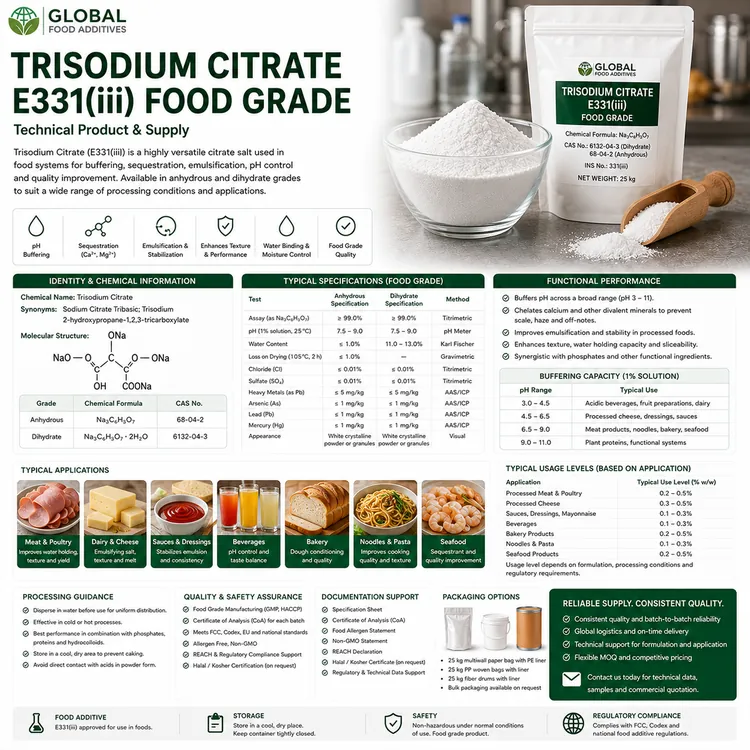
Product identity
| Product name | Trisodium Citrate |
|---|---|
| Specific additive identity | E 331(iii) / INS 331(iii) |
| Chemical family | Trisodium salt of citric acid |
| Systematic description | Trisodium 2-hydroxypropane-1,2,3-tricarboxylate |
| Anhydrous formula | Na3C6H5O7 |
| Dihydrate formula | Na3C6H5O7·2H2O |
| CAS number — anhydrous | 68-04-2 |
| CAS number — dihydrate | 6132-04-3 |
| Molecular weight — anhydrous | 258.07 g/mol |
| Molecular weight — dihydrate | 294.10 g/mol |
| Typical appearance | White or colourless crystals, granules or crystalline powder |
| Odour | Typically odourless |
| Sensory character | Mild saline, cooling and slightly tart or alkaline taste, depending on concentration and food matrix |
| Water solubility | Freely soluble in water |
| Ethanol solubility | Practically insoluble or insoluble |
| Typical commercial forms | Dihydrate and anhydrous powder or granules; aqueous solutions may be available from selected suppliers |
Primary technical functions
- Acidity regulation: moderates excessive acidity and helps move a formulation toward a controlled target pH.
- Citrate buffering: works with citric acid and other citrate salts to resist rapid pH change during processing and storage.
- Flavour balancing: can soften sharp citric-acid perception and provide a rounder, less aggressively sour flavour profile.
- Mineral-ion complexing: interacts with calcium, magnesium and selected trace metals, influencing hardness, precipitation and product stability.
- Emulsifying-salt functionality: supports calcium management and protein dispersion in selected processed-cheese and dairy systems.
- Process standardisation: helps compensate for controlled variation in ingredient acidity, mineral composition and process-water hardness.
- Antioxidant-system support: metal-ion binding may reduce selected metal-catalysed reactions, but performance must be confirmed in the actual food matrix.
Technical specification framework
The contracted specification should state the grade, analytical basis, required standard and test methods. The following parameters are commonly reviewed when qualifying food-grade Trisodium Citrate. Indicative values are provided for purchasing orientation only and must not replace the supplier’s approved specification or lot-specific Certificate of Analysis.
| Parameter | Typical purchasing target | Industrial relevance |
|---|---|---|
| Grade identity | Anhydrous or dihydrate, explicitly declared | Determines molecular weight, moisture profile, active fraction, bulk density and equivalent dosage. |
| Assay | Commonly not less than 99.0% on the specified anhydrous or dry-substance basis | Must be interpreted together with moisture or loss-on-drying data. |
| pH | Commonly controlled within an approximately neutral-to-mildly alkaline range using a defined aqueous concentration | The solution concentration, water quality, temperature and test method must be identical when comparing suppliers. |
| Loss on drying — anhydrous | Normally controlled at a low level appropriate to an anhydrous grade | Indicates moisture pickup and protects active-content consistency. |
| Loss on drying — dihydrate | Normally centred around the expected crystallisation-water range for the dihydrate | Supports hydrate identification and equivalent-active calculations. |
| Acidity or alkalinity | Complies with the applicable compendial or customer method | Detects abnormal free citric acid, excess alkali or composition drift. |
| Oxalate | Controlled according to the applicable food-additive standard | Relevant as a process- and raw-material-related citrate impurity. |
| Water-insoluble matter | Low and within the contracted limit | Influences solution clarity, filtration, sediment and nozzle performance. |
| Chloride and sulfate | Controlled where required by the selected standard | Useful for raw-material purity and process-consistency evaluation. |
| Lead and other elemental impurities | Within current destination-market and customer limits | Confirm analytical method, reporting limit and laboratory capability. |
| Solution clarity and colour | Clear and appropriately colourless at the defined concentration | Important in beverages, clear gels, syrups and visible liquid systems. |
| Particle-size distribution | Supplier standard or customer-specific sieve profile | Influences dusting, dissolution, segregation and dry-dosing repeatability. |
| Bulk density | Supplier-declared typical or controlled range | Important for silo design, volumetric dosing, pallet yield and filling. |
| Microbiological quality | Risk-based supplier specification where required by the application | Inorganic salts normally present low microbial-growth potential, but packaging and handling hygiene remain relevant. |
Anhydrous versus dihydrate selection
Trisodium Citrate Anhydrous
- Chemical formula: Na3C6H5O7.
- Molecular weight: approximately 258.07 g/mol.
- Provides a higher citrate-salt concentration per kilogram than the dihydrate.
- Contains approximately 26.7% sodium by theoretical molecular mass.
- May reduce freight and storage mass when products are compared on an anhydrous-equivalent basis.
- Requires effective moisture protection to maintain flow and active-content consistency.
- May have different dusting, dissolution and compaction behaviour from the dihydrate.
Trisodium Citrate Dihydrate
- Chemical formula: Na3C6H5O7·2H2O.
- Molecular weight: approximately 294.10 g/mol.
- Contains two molecules of crystallisation water per citrate molecule.
- Contains approximately 23.5% sodium by theoretical molecular mass.
- Represents approximately 87.7% anhydrous Trisodium Citrate by theoretical molecular-mass equivalence.
- Is a widely used commercial food-grade form with established handling and dissolution characteristics.
- Requires a higher material mass than anhydrous grade to deliver the same anhydrous-equivalent quantity.
Equivalent-active conversion
A theoretical hydrate correction can be used for preliminary formulation work:
Anhydrous-equivalent mass = dihydrate mass × 258.07 ÷ 294.10
The theoretical conversion factor is approximately 0.8775. Therefore, 1.000 kg of pure Trisodium Citrate Dihydrate corresponds to approximately 0.878 kg of pure anhydrous Trisodium Citrate.
Conversely:
Theoretical dihydrate mass = required anhydrous-equivalent mass × 294.10 ÷ 258.07
Approximately 1.140 kg of pure dihydrate is theoretically required to deliver 1.000 kg of anhydrous-equivalent salt. Production calculations should also include the actual lot assay, moisture basis and the supplier’s analytical method.
Citric acid–citrate buffering performance
Trisodium Citrate is often used together with citric acid to control both pH and titratable acidity. This acid-to-salt relationship allows formulators to modify sourness, buffer capacity and process stability more precisely than by adjusting citric acid alone.
Why the buffer ratio matters
Citric acid is triprotic, with three dissociation regions. Its approximate pKa values at ambient conditions are around 3.1, 4.8 and 6.4. Citric acid and citrate salts can therefore contribute useful buffering across a broad acidic-to-near-neutral range.
In simplified development work, a Henderson–Hasselbalch relationship may provide an initial estimate:
pH ≈ pKa + log (conjugate-base activity ÷ acid activity)
Because citric acid has multiple dissociation steps, real foods require formulation software, laboratory titration or practical trials rather than a single ideal-solution calculation.
Factors that shift actual pH
- Citric acid-to-citrate ratio
- Total buffer concentration
- Product temperature
- Ionic strength and salt content
- Protein, hydrocolloid and mineral composition
- Calcium and magnesium concentration
- Natural acidity of fruit, dairy or fermented ingredients
- Carbon dioxide and carbonation level
- Heat treatment and storage time
- pH-electrode calibration and sample preparation
How Trisodium Citrate affects food systems
Mineral-ion complexing
Citrate ions can form soluble complexes with calcium, magnesium, iron and other multivalent ions. This can reduce free-ion activity, alter water hardness, influence precipitation and modify the behaviour of proteins, pectins and phosphate systems.
The result depends on pH, citrate concentration, mineral concentration, temperature and competing ligands. Excessive sequestration can weaken calcium-dependent gels or destabilise processes that require available calcium.
Protein and emulsion behaviour
In dairy and processed-cheese systems, citrate can redistribute calcium associated with casein structures and support protein hydration and dispersion. This can influence melting, viscosity, emulsification, oil separation and final texture.
Trisodium Citrate is not universally interchangeable with phosphate emulsifying salts. Citrate and phosphate systems can produce different melt, firmness, flavour, calcium balance and storage behaviour.
Flavour modification
Trisodium Citrate can moderate sharp citric-acid perception and introduce a mild saline or cooling note. At excessive concentration, it may produce noticeable saltiness, alkalinity, bitterness or an unbalanced mineral taste.
Metal-catalysed reaction control
Binding selected transition-metal ions may help reduce their availability to catalyse oxidation or colour deterioration. This effect depends strongly on the oil phase, antioxidant system, oxygen exposure, packaging and trace-metal concentration.
Trisodium Citrate should be treated as one component of an overall oxidation-control strategy rather than as a complete antioxidant solution.
Potential food-manufacturing applications
Application suitability depends on the finished-food category, composition, legal permission, process conditions, sensory target, sodium requirements and total citrate level. The following areas are technical evaluation pathways rather than universal use or dosage claims.
| Application area | Potential technical purpose | Critical validation points |
|---|---|---|
| Carbonated and still beverages | Acid-profile adjustment, buffering, flavour rounding and mineral-ion management. | Final pH, titratable acidity, carbonation, flavour, haze, precipitation, colour and preservative-system performance. |
| Powdered beverage mixes | Dry buffer component, sourness control and mineral balance. | Particle segregation, dissolution rate, hygroscopicity, effervescence, dose uniformity and final beverage pH. |
| Processed cheese | Calcium management, protein dispersion and emulsifying-salt functionality. | Melt, viscosity, firmness, oil separation, flavour, final pH, cooling profile and storage stability. |
| Cheese sauces and dairy preparations | Protein stability, mineral control, emulsion support and pH standardisation. | Heat stability, viscosity, sediment, flavour, calcium balance and compatibility with starches or hydrocolloids. |
| Evaporated, recombined or processed dairy systems | Buffering and management of calcium-related heat instability. | Heat coagulation time, fouling, sediment, protein age, milk-salt balance and sterilisation conditions. |
| Plant-based beverages and analogues | pH adjustment, mineral management and protein-dispersion support. | Calcium-fortification compatibility, sediment, protein solubility, viscosity, flavour and heat stability. |
| Confectionery and gummies | Acid buffering, sourness moderation and process-pH control. | Gel strength, setting time, sugar inversion, flavour release, surface stability and acid-addition sequence. |
| Jams, fruit preparations and fillings | Adjustment of acid profile and controlled pH modification. | Pectin type, calcium requirement, gel strength, soluble solids, colour, microbial stability and fruit flavour. |
| Sauces, dressings and mayonnaise-type emulsions | Buffering, flavour balancing and metal-ion management. | Emulsion stability, preservative effectiveness, viscosity, oxidation, sensory profile and final pH. |
| Frozen desserts | Acidity control, mineral balance and dairy-protein compatibility. | Mix ageing, overrun, freezing behaviour, flavour, meltdown and stabiliser interaction. |
| Meat and poultry preparations | Selected pH, ionic and mineral-management functions where legally and technically appropriate. | Sodium contribution, colour, flavour, protein extraction, yield, purge, texture and market-specific additive rules. |
| Seafood preparations | Buffering and citrate-based mineral management in selected processes. | Texture, moisture uptake, drip loss, flavour, labelling and jurisdiction-specific restrictions. |
| Effervescent food or nutrition preparations | Citrate buffer formation and flavour control after reaction with an acid and carbonate source. | Moisture protection, reaction stoichiometry, sodium load, dissolution time, gas release and final pH. |
Process integration and dosing guidance
Recommended development sequence
- Define the primary function. Determine whether the objective is buffering, pH adjustment, sourness reduction, calcium control, protein stabilisation or emulsifying-salt performance.
- Confirm legal suitability. Verify the food category, maximum level or GMP condition, label declaration and cumulative sodium or additive requirements.
- Characterise the base product. Record pH, titratable acidity, mineral profile, protein, soluble solids, salt, temperature and water hardness.
- Select the required grade. Define anhydrous or dihydrate material, assay basis, particle size and applicable specification.
- Conduct controlled bench trials. Evaluate dose increments while measuring pH, acidity, flavour, clarity, viscosity, texture and mineral stability.
- Optimise the addition sequence. Compare dry addition, aqueous premixing and staged addition relative to acids, proteins, calcium salts and hydrocolloids.
- Complete pilot validation. Confirm mixing time, dissolution, heat response, filling behaviour, packaging compatibility and storage stability.
- Establish production controls. Set limits for ingredient dose, final pH, titratable acidity, sodium, viscosity and other critical quality attributes.
Aqueous premix preparation
- Use potable or specification-compliant process water.
- Charge water to the mixing vessel before gradually adding the Trisodium Citrate.
- Maintain sufficient agitation to prevent settling or local high-concentration zones.
- Control dust during bag opening and powder addition.
- Allow adequate mixing time for complete visual dissolution.
- Check solution clarity when the final application is sensitive to haze or sediment.
- Use a defined premix concentration and preparation record for repeatable dosing.
Addition-order controls
- Avoid uncontrolled local contact between concentrated citrate solution and concentrated calcium salts.
- Add acids gradually where rapid local pH change could affect protein, colour or hydrocolloid performance.
- Evaluate whether citrate should be added before or after protein hydration in dairy and plant-protein systems.
- Meter the solution into a well-agitated process zone.
- Allow equilibration before taking the final pH reading.
- Confirm whether heating changes dissolution, mineral balance or finished-product viscosity.
Dosage and mass-balance considerations
No universal dosage is appropriate for every food. The minimum effective amount should be established from the target pH, buffer capacity, titratable acidity, mineral content, sensory target and legal limit.
Useful production calculations
Ingredient dose, kg = batch mass, kg × target addition, % ÷ 100
As-is active mass = ingredient mass × lot assay fraction
Sodium contributed = ingredient mass × grade sodium fraction
Approximate theoretical sodium fractions are 0.267 for pure anhydrous Trisodium Citrate and 0.235 for pure dihydrate. Actual nutrition calculations should use the approved supplier composition and applicable labelling method.
Variables to monitor during optimisation
- Final equilibrium pH
- Titratable acidity
- Buffer capacity
- Free and total calcium
- Sodium contribution
- Solution clarity or sediment
- Protein stability and viscosity
- Emulsion stability
- Flavour and aftertaste
- Microbiological shelf-life performance
Ingredient and process interactions
| System component | Potential interaction | Recommended evaluation |
|---|---|---|
| Citric acid | Creates a citrate buffer and modifies sourness and pH. | Titrate the acid-to-citrate ratio against both pH and sensory targets. |
| Calcium salts | Citrate complexation can reduce free calcium and influence solubility or gel formation. | Evaluate addition sequence, concentration, precipitation and mineral bioavailability requirements. |
| Milk proteins | Calcium redistribution and pH change can modify casein hydration, dispersion and heat stability. | Measure viscosity, sediment, heat coagulation, melt and storage stability. |
| Plant proteins | pH and mineral complexation can change solubility, aggregation and mouthfeel. | Test across the intended heat process and calcium-fortification level. |
| Pectin and alginate | Citrate may reduce available calcium required for selected gel systems. | Validate gel time, gel strength, syneresis and mineral-addition order. |
| Phosphate salts | Combined mineral-binding and buffering effects may change calcium balance and protein functionality. | Optimise the citrate-to-phosphate ratio instead of assuming direct interchangeability. |
| Preservatives | Raising pH can reduce the proportion of active undissociated organic-acid preservative. | Revalidate preservative effectiveness and microbial shelf life after any citrate adjustment. |
| Iron and trace minerals | Citrate can alter solubility, colour and sensory behaviour by forming mineral complexes. | Test fortified products for haze, colour drift, oxidation and taste. |
| Carbonation | Buffering can alter the pH response and flavour perception of carbonic and added food acids. | Evaluate the fully carbonated product at intended serving temperature. |
Incoming quality control and COA review
Identity and composition
- Exact chemical and commercial grade name
- E 331(iii) or applicable destination-market identity
- Anhydrous or dihydrate declaration
- Correct CAS number for the supplied grade
- Assay with clearly stated reporting basis
- Loss on drying or moisture
- pH with test-solution concentration
- Citrate and sodium identity tests where specified
Purity and physical performance
- Oxalate
- Acidity or alkalinity
- Water-insoluble matter
- Chloride and sulfate where specified
- Lead and other regulated elemental impurities
- Solution clarity and colour
- Particle-size distribution
- Bulk density and flowability where operationally relevant
Lot traceability
- Manufacturer name and approved production site
- Country of origin and country of manufacture
- Batch or lot number
- Manufacturing date
- Expiry, best-before or retest date
- COA issue date and authorised approval
- Purchase-order and specification revision reference
- Packaging code and net-weight verification
Food-safety and market declarations
- Food-grade or food-additive compliance statement
- Allergen and cross-contact declaration
- GMO status
- Irradiation status
- Nanomaterial status where required
- Animal-origin, vegan and vegetarian status
- BSE/TSE statement where requested
- Halal and Kosher certificates where required
- Contaminant and food-contact packaging declarations
Packaging, storage and logistics
Commercial packaging
Packaging options depend on manufacturer, grade, order volume and destination. Common formats may include lined multiwall paper bags, woven polypropylene bags with an inner food-contact liner, fibre drums, bulk bags or other moisture-resistant industrial packaging.
Confirm the following before purchase:
- Net weight per package
- Inner-liner material and thickness
- Food-contact status of primary packaging
- Bag-closing and tamper-evidence method
- Bags per pallet and total net pallet weight
- Pallet dimensions and construction
- Stretch wrapping, top sheet and moisture protection
- Maximum stacking height
- Private, neutral or manufacturer labelling
- Container-loading quantity and floor-load option
Recommended storage controls
- Store in a cool, dry and well-ventilated warehouse.
- Keep original packaging tightly sealed until use.
- Protect from rain, condensation and direct water contact.
- Store on clean pallets away from damp floors and walls.
- Prevent contamination by dust, pests and strong odours.
- Reseal partially used packaging immediately.
- Use clean, dry and dedicated dispensing equipment.
- Apply FEFO or the supplier-recommended rotation method.
- Follow the supplier’s declared temperature and shelf-life conditions.
Logistics information required for quotation
| Quantity | Sample, laboratory trial, pallet, full-container load or annual forecast |
|---|---|
| Packaging preference | Required bag size, liner, palletisation and labelling format |
| Destination | City, seaport, country and final food market |
| Delivery basis | Requested Incoterm, delivery point and shipment window |
| Loading method | Palletised, slip-sheeted or floor-loaded container |
| Required documents | COA, specification, SDS, origin, certifications, health certificate or other import documentation |
Workplace and process controls
Food-grade status does not remove the need for controlled industrial handling. Operators should follow the current supplier Safety Data Sheet, local occupational requirements and the site’s powder-handling risk assessment.
Powder-handling controls
- Minimise airborne dust during bag opening and charging.
- Use enclosed transfer or local extraction where practical.
- Use suitable eye and respiratory protection as defined by the SDS.
- Prevent powder accumulation on floors and equipment.
- Use dry cleanup methods appropriate to the site risk assessment.
- Avoid contamination from damaged bags or dirty dispensing tools.
- Train operators in grade identification and lot traceability.
Equipment considerations
- Confirm compatibility of tanks, pumps, seals, hoses and dosing equipment with the intended solution concentration.
- Avoid stagnant solution zones where microbial contamination or crystallisation could occur.
- Size filters and strainers according to solution clarity requirements.
- Validate flushing and cleaning procedures after solution use.
- Calibrate load cells, loss-in-weight feeders or volumetric systems.
- Protect opened bags and transfer systems from humid air.
Regulatory and labelling considerations
European Union
Trisodium Citrate is specifically identified as E 331(iii), within the E 331 sodium-citrate group. Chemical compliance with a purity specification and permission to use the additive in a particular food are separate regulatory questions.
Buyers should review the current consolidated versions of the applicable EU legislation, including:
United States
U.S. buyers should review the current federal regulation for sodium citrate and any product-specific standard of identity, meat, poultry, beverage, dairy or labelling rule that applies to the finished food. General food-use status does not override more specific requirements.
Reference: 21 CFR 184.1751 — Sodium citrate
International destination markets
Codex references, national additive lists, GCC rules, customs classifications, importer registrations and local label requirements should be reviewed independently. An EU E number or supplier food-grade statement does not automatically authorise use in every country or product category.
- Confirm the permitted finished-food category.
- Confirm the maximum level, quantum satis or GMP condition.
- Determine the required additive or ingredient name on the label.
- Review sodium and nutrition-declaration consequences.
- Check whether citrate must be calculated as citric acid or another basis.
- Review infant-food, organic, natural-claim or clean-label restrictions.
- Confirm import, certificate and local-language requirements.
Preservation and shelf-life limitations
Trisodium Citrate is sometimes described broadly as supporting preservation because it can influence pH and bind selected metal ions. However, its addition can also raise pH and reduce the proportion of undissociated organic-acid preservatives. Its net effect must therefore be determined in the complete formulation.
Controls that still require validation
- Finished-product equilibrium pH
- Titratable acidity and buffer capacity
- Water activity
- Heat treatment or other lethality step
- Preservative concentration and active fraction
- Packaging oxygen and moisture barrier
- Cold-chain or ambient-storage conditions
- Challenge testing and shelf-life studies
Claims to avoid without evidence
- “Preservative-free” without market-specific review
- “Extends shelf life” without validated comparison data
- “Prevents microbial growth” as a universal product claim
- “Natural” or “clean label” without customer and legal assessment
- “Antioxidant” without application-specific performance evidence
Process efficiency and waste reduction
Ingredient-efficiency measures
- Use calibrated gravimetric or validated volumetric dosing.
- Correct formulations when changing hydrate form or assay basis.
- Optimise to the minimum technically effective addition.
- Track actual consumption against standard batch requirements.
- Reduce bag residue with appropriate emptying equipment.
- Choose package sizes that minimise partial-bag storage.
- Assess freight on an equivalent-active basis.
Water and cleaning considerations
- Prepare only the volume of citrate solution required for production.
- Avoid unnecessary dilution that increases water and energy demand.
- Recover or reuse compatible rinse water only under validated procedures.
- Prevent concentrated product from entering drains.
- Include sodium and chemical-oxygen-demand effects in wastewater review.
- Coordinate formulation changes with wastewater-treatment personnel.
Documents to request before approval
Core technical documents
- Current Product Specification or Technical Data Sheet
- Representative and lot-specific Certificate of Analysis
- Current Safety Data Sheet
- Product label or approved label draft
- Packaging and pallet specification
- Shelf-life and storage statement
- Country of origin and manufacturing-site statement
- Manufacturing-flow summary where qualification requires it
Compliance and certification documents
- Food-grade or food-additive compliance declaration
- EU, FCC, JECFA or national-standard statement as applicable
- Allergen and cross-contact declaration
- GMO and irradiation statements
- Animal-origin, vegan, vegetarian and BSE/TSE statements
- Halal and Kosher certificates where requested
- Quality-system or food-safety certification
- Traceability and recall-system declaration
International trade documents
- Commercial invoice and packing list
- Certificate of origin
- Health, sanitary or free-sale certificate where required
- Legalised or chamber-certified COA where required
- Transport-classification or non-dangerous-goods statement
- Container-loading plan
- ISPM 15 or wood-packaging declaration where applicable
- Importer-specific product registration documents
Information required for an accurate quotation
| Inquiry field | Information to provide |
|---|---|
| Product identity | Trisodium Citrate, E 331(iii) |
| Required form | Anhydrous, dihydrate or supplier recommendation |
| Applicable standard | EU 231/2012, FCC, JECFA, pharmacopoeial, national or customer-specific specification |
| Application | Finished-food category and required technical function |
| Critical parameters | Assay, pH, moisture, oxalate, clarity, particle size, bulk density and elemental impurity limits |
| Quantity | Sample, trial, pallet, container quantity and annual forecast |
| Packaging | Bag size, liner, palletisation, private label and label language |
| Destination | Delivery city, port, country and final regulatory market |
| Commercial term | Requested Incoterm, currency, payment preference and shipment window |
| Documentation | Required COA parameters, origin, certificates and import documents |
| Reference material | Existing specification, COA, label, approved sample or competitor grade |
Frequently asked questions
What is the correct E number for Trisodium Citrate?
The specific designation is E 331(iii). E 331 describes the wider sodium-citrate group, including monosodium citrate E 331(i), disodium citrate E 331(ii) and Trisodium Citrate E 331(iii).
Is Trisodium Citrate the same as citric acid?
No. Citric acid is the acidic parent compound, while Trisodium Citrate is its fully neutralised trisodium salt. Citric acid lowers pH and creates pronounced sourness; Trisodium Citrate normally moderates acidity and supplies buffering and mineral-complexing functionality.
What is the difference between anhydrous and dihydrate grades?
The dihydrate contains two molecules of crystallisation water and has a molecular weight of approximately 294.10 g/mol. The anhydrous grade has a molecular weight of approximately 258.07 g/mol. Their moisture, sodium fraction, bulk density and equivalent dosage are different.
Which grade is most common in food manufacturing?
Trisodium Citrate Dihydrate is a widely used commercial food grade, but anhydrous material is also available. Selection depends on the customer specification, dosage basis, processing needs, freight, storage and supplier availability.
Can Trisodium Citrate reduce sourness?
Yes. It can partially neutralise acid and increase citrate-buffer capacity, producing a rounder or less sharp acid profile. The final result depends on the acid-to-citrate ratio, total acidity and flavour system.
Why is Trisodium Citrate used in processed cheese?
Citrate ions can bind calcium associated with casein and support protein dispersion and hydration. This can influence melting, viscosity, emulsification and oil separation. The optimum result depends on cheese composition, pH, moisture and the complete emulsifying-salt system.
Can Trisodium Citrate interfere with calcium-set gels?
Yes. Citrate can reduce free calcium-ion activity and may weaken or delay calcium-dependent pectin, alginate or protein gelation. Addition sequence and total citrate-to-calcium ratio should be validated.
Does Trisodium Citrate improve beverage clarity?
It may help manage selected mineral interactions, but it can also change pH or form complexes that affect haze. Beverage trials should include actual water, minerals, flavours, sweeteners and processing conditions.
Is Trisodium Citrate a preservative?
It may support a preservation system through pH and mineral control, but it is not a universal stand-alone preservative. Raising pH can reduce the effectiveness of organic-acid preservatives, so microbial safety and shelf life must be revalidated.
How should Trisodium Citrate be added?
It can be added as a dry ingredient or as a prepared aqueous solution. A premix often improves dispersion and dosage control. Addition order should be evaluated carefully in products containing acids, calcium, dairy proteins, plant proteins or calcium-set hydrocolloids.
How should supplier COAs be compared?
Compare grade identity, assay basis, moisture or loss on drying, pH, oxalate, insoluble matter, elemental impurities, clarity, particle size and test methods. Results reported on different analytical bases should be normalised before comparison.
Is Trisodium Citrate permitted in every country?
No. Authorised food categories, use levels, GMP provisions and label declarations vary by jurisdiction. Current requirements must be confirmed for the intended food and destination market.
What storage conditions are recommended?
Store in sealed, moisture-resistant packaging in a cool, dry and well-ventilated area. Protect the product from water, condensation, contamination and strong odours and follow the supplier’s stated shelf-life conditions.
Can Global Food Additives review an existing specification?
Yes. Buyers can provide an existing specification, COA, label, approved sample reference or required compendial standard. Supplier options can then be compared by grade, assay, purity, packaging, documentation, origin, quantity and destination.
Tell us the Trisodium Citrate grade and specification you require.
For an accurate review, include the required anhydrous or dihydrate form, applicable standard, target assay, application, quantity, packaging, destination, Incoterm, shipment timing and documentation. Existing specifications, COAs or labels can be described in the message.
Our team will review your inquiry and respond from orders@foodgradeadditives.com .
Your technical inquiry has been received. You will be redirected to the home page.