
Vitamin A Palmitate
Vitamin A Palmitate, also known as retinyl palmitate, is a fat-soluble preformed vitamin A source used for controlled food fortification and enrichment. Industrial grades are supplied as stabilized powders, spray-dried beadlets, granules, oil concentrates, emulsifiable dispersions or custom nutrient premixes. Grade selection should consider potency, carrier composition, dosing accuracy, process exposure, oxidation risk, food matrix, packaging system, target shelf life and destination-market compliance.
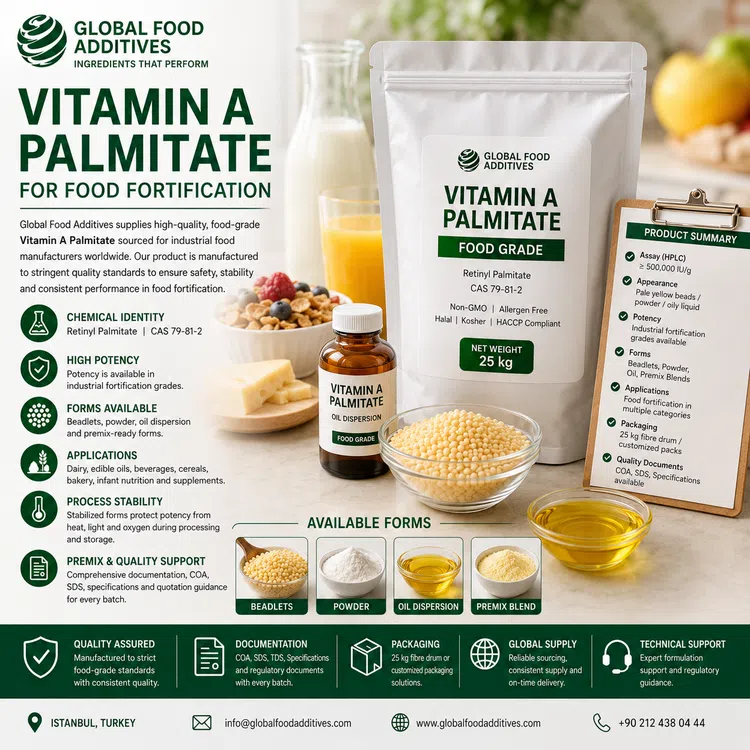
Product identity
| Product name | Vitamin A Palmitate |
|---|---|
| Chemical name | Retinyl palmitate |
| Alternative name | Retinol palmitate |
| CAS number | 79-81-2 |
| Molecular formula | C36H60O2 |
| Molar mass | 524.86 g/mol |
| Chemical class | Palmitic-acid ester of retinol |
| Nutrient class | Preformed, fat-soluble vitamin A source |
| Primary function | Nutrient fortification, enrichment and vitamin premix standardization |
| Water solubility | Practically insoluble as the pure active; commercial water dispersibility depends on the encapsulation and emulsifier system |
| Potency units | IU/g, IU/kg, µg RAE/g or µg RAE/kg |
| Activity conversion | For preformed vitamin A activity, 1 IU retinol = 0.3 µg RAE; confirm the supplier's assay and calculation basis |
| E / INS status | Normally managed as a vitamin nutrient source rather than a conventional numbered additive; confirm market-specific nomenclature and authorization |
| Commercial forms | Stabilized powder, beadlet, granule, oil concentrate, dispersion or custom premix |
| Source considerations | Active manufacture, palmitic-acid source, carrier ingredients and processing aids are supplier-specific |
Industrial application fit
Potential use areas, subject to grade validation and destination-market authorization, include:
- Fluid milk, dairy beverages and milk powders
- Plant-based drinks and dairy-alternative powders
- Margarine, fat spreads and edible oils
- Flour, bakery premixes and fortified staple foods
- Breakfast cereals, cereal blends and nutrition bars
- Dry beverage powders and instant nutrition products
- Meal replacements and protein-based formulations
- Sugar and other large-scale fortification vehicles where authorized
- Infant, clinical and special-purpose foods where specifically permitted
Selecting the correct industrial grade
Vitamin A Palmitate is generally purchased as a formulated concentrate rather than as unprotected active material. The commercial delivery system can protect the vitamin from oxidation and light, provide a manageable potency, improve flow or dispersibility, and support controlled micro-dosing. Purchasing specifications should therefore describe both the vitamin active and the complete carrier, encapsulant, antioxidant and processing-aid system.
Stabilized powder or beadlet
- Designed for dry blending, flour, cereal, nutrition powder and premix applications.
- May contain starches, carbohydrates, proteins, gums, antioxidants, emulsifiers or anti-caking agents.
- Can be formulated for cold-water dispersion, warm-water dispersion or dry incorporation only.
- Requires evaluation of particle size, bulk density, flowability, dusting and segregation behavior.
- Encapsulation integrity can influence heat, oxygen, humidity and mineral compatibility.
Oil concentrate or oil dispersion
- Normally selected for edible oils, fat spreads, lipid phases and metered liquid dosing.
- Requires confirmation of carrier-oil identity, antioxidant system, viscosity and low-temperature behavior.
- Should remain homogeneous during transport, storage, recirculation and production dosing.
- Transfer equipment should limit unnecessary light exposure, aeration and warm holding.
- Carrier-oil oxidation limits may be included in the purchasing specification.
Water-dispersible liquid or emulsion
- May be appropriate for selected beverages, dairy systems and liquid premixes.
- Performance depends on droplet size, emulsifier system, pH tolerance and ionic compatibility.
- Clouding, creaming, sedimentation and ring formation should be assessed during shelf-life trials.
- The grade should be tested under the actual homogenization, pasteurization and filling conditions.
Custom nutrient premix
- Reduces the handling of very small quantities of high-potency material.
- Can combine Vitamin A Palmitate with other compatible vitamins, minerals or carriers.
- Requires evaluation of interactions with iron, copper, moisture and reactive premix components.
- Should have validated uniformity, segregation control and defined rework procedures.
Potency, units and purchasing basis
Vitamin A Palmitate products are commonly sold according to vitamin A biological activity rather than only the mass of retinyl palmitate present. Potency may be expressed as International Units per gram, International Units per kilogram, micrograms of retinol activity equivalents, or another market-specific basis. The quotation, specification, certificate of analysis and formulation calculation must all use the same unit convention.
- Confirm whether potency is declared on an as-is or dry-matter basis.
- Confirm whether the assay represents all-trans Vitamin A Palmitate or total vitamin A activity.
- Record the unit conversion and rounding convention in the master formulation.
- Prevent confusion between micrograms of retinyl palmitate, micrograms of retinol and micrograms RAE.
- Verify whether the finished-product label requires RAE, RE, IU or another local declaration unit.
Formulation, dosing and batch homogeneity
Vitamin A Palmitate is normally added at a low concentration, making weighing accuracy and distribution critical. Direct addition of a small amount of high-potency concentrate to a large production batch can cause unacceptable variability. Industrial control options include a standardized nutrient premix, geometric dilution, loss-in-weight micro-feeding, preparation of a validated liquid concentrate or controlled addition into a recirculating phase.
Required ingredient (g per batch) = [target vitamin A activity (IU/kg) × batch mass (kg)] ÷ [ingredient potency (IU/g) × expected recovery fraction].
Use the lot-specific certified potency and validated process recovery. Any overage should be technically justified, legally acceptable and verified through shelf-life testing.
Premix design considerations
- Compatibility of the carrier with the finished food and ingredient declaration
- Particle-size and density matching to limit segregation
- Minimum feeder output, scale resolution and weighing uncertainty
- Mixing order, dilution ratio, mixing time and blender fill level
- Moisture and mineral interactions within multinutrient premixes
- Storage time between premix manufacture and final use
Uniformity verification
- Define representative sampling points across the blender or production run.
- Test both the premix and the finished product during process validation.
- Set acceptance criteria for mean potency and sample-to-sample variation.
- Investigate feeder drift, electrostatic loss, dust extraction and equipment hold-up.
- Revalidate after changes in batch size, equipment, carrier, potency or process sequence.
- Control rework so cumulative vitamin addition remains known and compliant.
Process stability and potency recovery
Although esterification improves the handling and stability of vitamin A relative to unesterified retinol, Vitamin A Palmitate remains sensitive to oxidation, light and prolonged thermal exposure. Stability also depends on the carrier, antioxidant system, encapsulation quality, food matrix, water activity, catalytic metals, processing conditions and final packaging.
| Process factor | Potential industrial concern | Recommended evaluation |
|---|---|---|
| Oxygen exposure | Oxidative potency loss during mixing, recirculation, storage or package life | Review aeration, headspace oxygen, antioxidant system and package oxygen barrier |
| Light exposure | Photodegradation in transparent equipment, containers or retail packaging | Use protected handling and compare opaque, UV-barrier or secondary packaging options |
| Thermal treatment | Loss during pasteurization, sterilization, baking, extrusion, drying or hot holding | Measure potency before and after the critical thermal operation |
| Humidity and moisture | Powder agglomeration, reduced flow or damage to encapsulated beadlets | Control storage humidity and evaluate moisture-sensitive handling points |
| Iron and copper contact | Reactive minerals can accelerate oxidative degradation in some premixes | Assess encapsulation, carrier separation and premix architecture |
| Mechanical shear | Excessive handling can damage some encapsulated delivery systems | Review conveying, milling, high-shear mixing and repeated recirculation |
| Acidic or ionic environment | Destabilization of some dispersible or emulsified commercial forms | Test the complete grade in the actual pH, mineral and emulsifier system |
| Distribution storage | Potency decline during warm transport or extended warehouse storage | Conduct stability work in the final package under realistic supply-chain conditions |
Overage and shelf-life strategy
An overage is an additional quantity introduced to compensate for demonstrated manufacturing and storage losses. It should not be used as a substitute for process control. Excessive overage can create regulatory, nutritional and safety concerns, particularly for preformed fat-soluble vitamins.
- Establish initial potency, post-process potency and end-of-shelf-life potency.
- Separate analytical variation from actual process or storage loss.
- Base overage on product-specific data rather than a generic industry percentage.
- Include variation from ingredient potency, weighing, mixing and analytical uncertainty.
- Review the highest expected concentration against applicable maximum levels and tolerances.
- Reassess the overage when the package, process, carrier or shelf life changes.
Specification and quality-control parameters
The approved purchasing specification should distinguish mandatory release criteria from informational characteristics. Exact limits must be agreed with the supplier and aligned with the food application, certification program, analytical capability and destination-market requirements.
Identity and potency
- Identity of retinyl palmitate by a suitable chromatographic or spectroscopic method
- Vitamin A potency with a clearly defined unit and calculation basis
- All-trans retinyl palmitate content where required
- Related isomers or degradation products where included in the standard
- Lot-specific certificate of analysis and expiry or retest date
- Compendial, Food Chemicals Codex or supplier-validated method reference
Physical properties
- Appearance, colour and odour
- Particle-size distribution for powder and beadlet grades
- Bulk and tapped density
- Flowability, dusting and caking tendency
- Dispersibility or emulsion performance where applicable
- Viscosity and low-temperature behavior for oil grades
Stability-related controls
- Moisture, loss on drying or water activity where relevant
- Antioxidant identity and concentration where declared
- Peroxide value or other oxidation controls for oil-based grades
- Light, oxygen and temperature storage requirements
- Accelerated and real-time stability information
- Minimum remaining shelf life required at delivery
Purity and contaminants
- Heavy metals and elemental impurities
- Residual solvents or process-related residues where applicable
- Microbiological limits appropriate to the commercial form
- Pesticide, dioxin or other source-relevant declarations where required
- Foreign-material and packaging-integrity controls
- Compliance with customer-specific restricted-substance limits
Carrier, encapsulant and source review
The active ingredient is only one part of a commercial Vitamin A Palmitate grade. A full compositional review is important because carriers and processing aids can affect allergen status, vegan suitability, labelling, dispersibility, process behavior and regulatory acceptance.
- Request the complete qualitative composition of carriers, encapsulants and emulsifiers.
- Confirm the identities of antioxidants, anti-caking agents and processing aids.
- Determine whether starches, sugars, proteins, gelatin or modified carbohydrates are present.
- Request the botanical, animal, microbial or synthetic origin of relevant components.
- Do not infer vegan suitability solely from the source of the vitamin active.
- Confirm allergen, gluten, lactose, GMO and irradiation status.
- Review halal, kosher, vegan and customer-specific certification requirements.
Analytical control and release strategy
Vitamin A Palmitate is commonly quantified using chromatographic methods such as HPLC with suitable detection. Finished-food testing can be technically demanding because the vitamin concentration is low and extraction may be affected by fats, proteins, starches, colours, flavours, minerals and encapsulation materials.
Method suitability
- Confirm the measured analyte and whether results represent retinyl palmitate or total vitamin A activity.
- Define sample preparation, extraction, saponification and conversion steps where applicable.
- Establish recovery, precision, linearity and reporting limits in the actual food matrix.
- Use appropriate reference standards and protect samples from light and oxidation.
- Document unit conversions and significant-figure rules.
Production release controls
- Verify the ingredient lot and certified potency before dispensing.
- Use controlled weighing and independent verification for micro-ingredients.
- Record actual addition, batch size and premix lot traceability.
- Test finished-product potency at a justified frequency.
- Trend results by supplier, lot, line, product, package and product age.
Packaging, storage and handling
Packaging should protect Vitamin A Palmitate from light, oxygen, moisture, contamination and uncontrolled temperature cycling. Exact storage conditions and shelf life must follow the approved supplier specification and package label.
Powder and beadlet grades
- Commonly supplied in sealed barrier bags, lined cartons or fibre drums
- May use opaque, foil-laminate or nitrogen-flushed primary packaging
- Partial containers should be resealed promptly after dispensing
- Use clean, dry and dedicated utensils suitable for micro-ingredients
- Protect from moisture pick-up, direct sunlight and warm storage areas
- Apply first-expired, first-out inventory control
Oil and liquid grades
- Commonly supplied in opaque, tightly sealed, food-contact-compliant containers
- Minimize air entry during pumping, recirculation and partial-container use
- Confirm hose, pump, seal and gasket compatibility with the carrier oil
- Avoid unnecessary heating and extended residence in day tanks
- Mix only according to the supplier's instructions
- Inspect for separation, precipitation or oxidation before use
Food-safety and operational controls
Vitamin A Palmitate is a high-potency micronutrient and should be included in the site's ingredient risk assessment, dispensing controls and traceability program. The main operational risk is often incorrect addition rather than conventional microbiological spoilage.
- Restrict access to approved and trained dispensing personnel.
- Use barcode, batch-record or electronic verification where available.
- Separate similarly named vitamins and different potency grades.
- Clearly identify opened, sampled, quarantined and released containers.
- Verify scales before dispensing and maintain suitable calibration intervals.
- Control line clearance between fortified and non-fortified production.
- Define action limits for incorrect addition, spillage and reconciliation failure.
- Include the ingredient in mock recall and traceability exercises.
Traceability and supplier qualification
Traceability should cover the vitamin manufacturer, formulation or encapsulation site, carrier ingredients, production lot, packaging lot, repacking operations and distribution chain. Supplier approval should also address change control and continuity of supply.
Traceability information
- Legal manufacturer and manufacturing-site address
- Country of origin of the vitamin active and commercial preparation
- Lot-code interpretation and production date
- Carrier and encapsulant source information
- Repacking, relabelling or subcontracted-processing disclosure
- Forward and backward traceability capability
Supplier-assurance review
- Recognized food-safety certification and audit status
- Deviation, complaint and out-of-specification procedures
- Change-notification agreement for source, site, formulation and method
- Recall and crisis-management capability
- Business-continuity and alternate-supply planning
- Historical potency, stability and delivery performance
Regulatory and labelling review
Vitamin A Palmitate may be regulated as a nutrient source, fortificant, supplement ingredient or component of a food for special groups, depending on the jurisdiction and product category. Authorization of the ingredient does not automatically permit every food use, concentration, claim or target population.
- Confirm that all carriers, emulsifiers and encapsulation materials are permitted in the finished food.
- Calculate vitamin A contribution from all ingredients, premixes, rework and natural sources.
- Evaluate the highest expected potency as well as the minimum end-of-shelf-life potency.
- Separate the legal fortification target from the manufacturing control target and overage.
- Confirm whether declaration must use µg RAE, µg RE, IU or another local unit.
- Verify conditions for claims such as “source of vitamin A” or “high in vitamin A.”
- Obtain specialist review for infant formula, medical foods and foods for special groups.
Documents to request before approval
Technical package
- Current product specification
- Technical data sheet
- Recent representative certificate of analysis
- Analytical method or method reference
- Full qualitative composition statement
- Stability, storage and shelf-life statement
- Application and process-recovery guidance
- Packaging specification and pallet configuration
Food-safety package
- Safety data sheet where applicable
- Food-safety certification
- Microbiological and contaminant statements
- Allergen and cross-contact declaration
- GMO and irradiation statements
- Foreign-material and traceability information
- Recall and change-control commitments
Origin and certification package
- Country-of-origin statement
- Manufacturing-site declaration
- Vitamin-active production-route statement
- Palmitic-acid, carrier and encapsulant source declarations
- Animal-origin or non-animal-origin statement
- Halal, kosher or vegan certificates where required
- Customer-specific restricted-ingredient declarations
Regulatory package
- Food-grade and intended-use statement
- Destination-market regulatory declaration
- Compendial or Food Chemicals Codex compliance statement where applicable
- Carrier and processing-aid compliance declarations
- Labelling-name recommendation
- Nutrition-unit and conversion statement
- Market-specific certificates or registrations where required
Information required for an accurate quotation
A technically complete enquiry reduces unsuitable offers and allows suppliers to compare equivalent products. Provide the following information whenever available:
- Required form: powder, beadlet, granule, oil, liquid dispersion or custom premix
- Required potency and acceptable assay range
- Required potency unit and calculation basis
- Finished-food application and product matrix
- Target vitamin A level in the finished product
- Batch size and proposed ingredient addition rate
- Mixing, heating, drying, extrusion or homogenization conditions
- Expected shelf life and final packaging format
- Carrier, allergen, source and certification restrictions
- Annual demand, trial quantity and order quantity
- Preferred pack size and minimum remaining shelf life on arrival
- Destination country, delivery location and requested Incoterm
- Required technical, regulatory and quality documents
- Existing specification, label or certificate of analysis for equivalency review
Frequently asked questions
What is Vitamin A Palmitate used for in food manufacturing?
Vitamin A Palmitate is a preformed vitamin A source used for controlled fortification and enrichment of foods, beverages, edible oils and nutritional premixes. Suitability depends on the selected grade, carrier system, process, target potency, shelf life and destination-market authorization.
What is the difference between powder, beadlet and oil grades?
Stabilized powder and beadlet grades are generally intended for dry blending or dispersible applications. Oil concentrates are normally selected for lipid-containing foods or controlled liquid dosing. Each grade has a different carrier, antioxidant system, potency, dispersibility and stability profile.
How is Vitamin A Palmitate potency expressed?
Commercial potency is commonly declared in IU/g or IU/kg. Nutrition calculations and labels may use µg RAE. For preformed vitamin A activity, 1 IU retinol equals 0.3 µg RAE. Always confirm the supplier's assay basis before performing a conversion.
Can the ingredient mass be converted directly into vitamin A activity?
Not safely without additional information. Commercial products contain carriers and may have different standardized potencies. Use the lot-specific potency stated on the certificate of analysis rather than calculating activity from the total mass of the formulated product.
Why is Vitamin A Palmitate normally stabilized?
Vitamin A compounds are sensitive to oxidation, light and prolonged heat exposure. Commercial grades may use encapsulation, antioxidants and protective carriers to improve handling, dispersion and potency retention.
Why is a premix often recommended?
Vitamin A Palmitate is normally used at a low addition rate. A compatible premix and validated mixing sequence can improve weighing accuracy and batch uniformity while reducing localized over-fortification or under-fortification.
Is Vitamin A Palmitate stable during pasteurization, baking or extrusion?
Retention depends on the commercial grade, encapsulation, temperature, residence time, oxygen, light, moisture, minerals and food matrix. Measure process recovery under actual manufacturing conditions and verify potency through the intended shelf life.
Which quality parameters should be reviewed?
Review identity, vitamin A potency, assay basis, isomer profile where specified, physical form, carrier composition, particle size, density, dispersibility, moisture, oxidation indicators, microbiological criteria, contaminants, packaging and stability.
Can a Vitamin A Palmitate product automatically be described as vegan?
No. Vegan status depends on the active-production route and the origins of the palmitic acid, carrier, encapsulant, emulsifier, antioxidant and processing aids. Request a declaration covering the complete commercial formulation.
Can Global Food Additives source Vitamin A Palmitate?
Global Food Additives can review supplier options according to required potency, form, carrier system, source restrictions, quantity, destination, packaging, certification and documentation requirements.
Which documents should be requested?
Buyers commonly request a current specification, certificate of analysis, technical data sheet, composition statement, analytical method, safety data sheet where applicable, origin declaration, allergen and GMO statements, stability information, packaging details, certifications and market-specific compliance documents.
Is Vitamin A Palmitate permitted in every food and every country?
No. Permitted vitamin sources, food categories, use levels, claims, tolerances and labelling requirements vary by jurisdiction. The manufacturer must confirm legal use and final-product compliance for every destination market.
Send your Vitamin A Palmitate specification and application requirements.
Include the required form, potency, unit basis, target application, process, quantity, destination country, packaging, source restrictions, certifications and documentation requirements. Our team will review compatible sourcing options and respond from orders@foodgradeadditives.com.
Your message has been received. You will be redirected to the home page.